Single sink vanities are having a moment, and for good reason. They aren't a compromise for smaller spaces. They work across bathroom sizes and design styles, often delivering more usable counter space and a cleaner visual footprint than a double sink configuration in the same footprint.
This guide covers everything you need to make a confident decision: style ideas across five aesthetics, how to size your vanity correctly, what materials and finishes are trending right now, and how to pull the full look together with mirrors, lighting, and hardware.
Key Takeaways
- Single sink vanities work well in powder rooms, guest baths, kids' bathrooms, and primary suites used by one person
- Transitional and wood-tone vanities dominate 2025–2026 design data — safe, stylish, and lasting
- Standard single sink widths run 24 to 48 inches; always measure for door swing and toilet clearance before buying
- Engineered quartz is the top vanity countertop material at 45% of renovated bathrooms
- LED-lit mirrors and coordinated hardware finishes are what separate a polished renovation from a builder-grade result
Why a Single Sink Vanity Could Be the Right Choice for Your Bathroom
A single sink vanity is often the smarter layout choice — not a compromise.
According to the 2025 Houzz Bathroom Trends Study, 47% of renovating homeowners chose vanities 48 inches or less in width — a range that aligns almost entirely with single-sink configurations. The same study showed double sinks in 47% of renovated bathrooms, down from 65% in 2023. That's a meaningful shift toward more intentional, right-sized layouts.
Where Single Sink Vanities Make the Most Sense
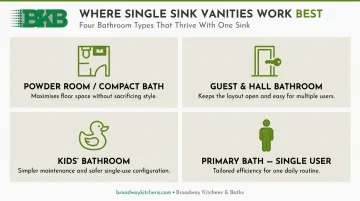
- Powder rooms and compact bathrooms — where a double sink simply won't fit without sacrificing clearance
- Guest and hall bathrooms — shared occasionally, not daily, so one sink is plenty
- Kids' bathrooms — single sink with smart drawer storage beats a crowded double every time
- Primary bathrooms used by one person — no need to dedicate wall space to a second sink that rarely gets used
The practical upside is real: a single sink vanity in a 36- or 48-inch width gives you more continuous counter space than a double sink in the same cabinet footprint, because you're not splitting the surface around two basins. That uninterrupted surface is easier to organize, easier to clean, and looks more considered in the finished space.
Single Sink Vanity Style Ideas to Transform Your Bathroom
The vanity cabinet — its door profile, finish, and hardware — sets the design language for the entire room. Here's how five major styles translate to a single sink configuration.
Modern and Minimalist
Modern vanities are defined by what they don't have: no raised panels, no ornate hardware, no visual clutter. Look for:
- Flat-panel (slab) or frameless cabinet doors
- Handleless pulls or thin linear bar hardware
- Matte or gloss finishes in white, gray, or charcoal
- Undermount or integrated sinks with clean-edge countertops
Floating wall-mounted vanities are the signature choice here. They open up the visual floor plane, make the room feel larger, and pair naturally with large-format tile and frameless mirrors. Broadway Kitchens & Baths carries the UltraCraft Slab door in a flat-panel MDF profile — one of the cleaner options for a true modern aesthetic — along with the Wolf Classic Somerset recessed panel door for a slightly softer take on the same look.
Transitional Style
Transitional is the most popular renovated-bathroom style in the country — 22% of renovated bathrooms according to Houzz 2025, with NKBA projecting that 70% of design experts identify transitional or timeless design as a top 2026 trend.
It earns that position by sitting comfortably between contemporary and traditional: clean lines without the severity of full modern, classic detailing without the formality of traditional. For a single sink vanity, that means:
- Shaker-style cabinet doors (Houzz reports 49% of renovated bathrooms chose shaker in 2025)
- Brushed nickel or matte black hardware
- Warm white, greige, or light oak finishes
Wolf Classic's Dartmouth shaker door and the York line — available in both paint and stain finishes — are solid starting points for a transitional single sink vanity that won't look dated in five years.
Farmhouse and Rustic
Farmhouse-style vanities build warmth and character through material and texture rather than ornamentation. Key elements include:
- Visible wood grain, painted or stained
- Apron-front or vessel sinks
- Open lower shelving
- Vintage-inspired hardware in oil-rubbed bronze or antique brass
The styling trick with farmhouse is contrast. Pair a wood or painted vanity with a white quartz or marble countertop, or bring in textured subway tile on the wall behind it. Without that contrast element, the look can tip toward heavy. With it, the result feels curated.
Mid-Century Modern
Mid-century vanities earn their appeal through warmth and proportion — warm walnut or oak tones, minimal ornamentation, and brass or gold hardware that nods to the era without tipping into costume. Flat-panel walnut vanities with brass hardware remain a recurring mid-century reference in contemporary bathroom design.
The pairings that make it cohesive:
- Round or oval mirror (not rectangular)
- Globe pendant sconces or exposed bulb fixtures
- Geometric hex or penny tile on the floor
Traditional and Classic
Traditional single sink vanities lean into furniture-style detailing — raised-panel cabinet doors, carved molding, turned legs, marble or stone countertops, and chrome or polished nickel fixtures. The Wolf Classic Hudson (mitered pillow raised-panel) and Saginaw (raised-panel with bold clean lines) both suit a traditional aesthetic well.
Defining elements that keep the look cohesive:
- Raised-panel or mitered cabinet doors
- Marble or stone countertops
- Chrome or polished nickel fixtures
- Ornate or oversized framed mirror as a focal point
The mirror and wall treatment determine whether a traditional vanity reads as intentional or builder-standard. An ornate, gilded, or oversized framed mirror elevates the vanity into a proper focal point. Add wainscoting or classic subway tile, and the room reads as designed rather than assembled.
How to Choose the Right Vanity Size for Your Space
Single sink vanities typically run 24 to 48 inches wide, per Home Depot's sizing guidance. Here's how the common widths break down in practice:
| Width | Best Fit |
|---|---|
| 24 in. | Powder rooms, very compact bathrooms |
| 30 in. | Standard guest or hall bath |
| 36 in. | Primary bath, single user, more storage |
| 48 in. | Primary bath, generous counter and cabinet space |
Depth and Clearance: The Numbers That Matter
Standard vanity depth runs 14 to 26 inches, averaging around 21 inches. Shallower profiles (16–18 inches) are available for tight spaces where you need to preserve floor clearance.
Before purchasing, measure for:
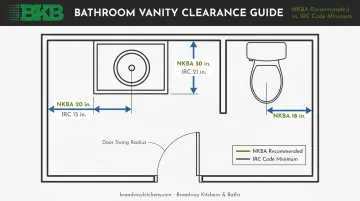
- Side clearance: NKBA recommends 20 inches from the lavatory centerline to a sidewall; IRC code minimum is 15 inches
- Front clearance: NKBA recommends 30 inches in front of the fixture; IRC minimum is 21 inches
- Door swings: A bathroom door that opens into the vanity is a costly oversight
- Toilet proximity: NKBA recommends 18 inches from toilet centerline to any wall or obstacle
In older homes — where wall angles aren't always square and plumbing rough-ins aren't always where you'd expect — a professional field measurement before ordering prevents costly returns and weeks-long reorder delays. Broadway Kitchens & Baths manages this process from initial site measurement through punch-list, keeping renovations on schedule when tolerances are tight.
Materials, Colors, and Finishes That Elevate the Look
Countertop Materials
Engineered quartz leads the market at 45% of renovated bathrooms in 2025, up from 39% in 2023. It's non-porous, comes in a wide color range (from pure white to dramatic veined patterns), and requires no sealing. Broadway Kitchens & Baths carries Caesarstone, Silestone by Cosentino, and Corian Quartz — all with options that span clean whites, warm neutrals, and concrete-look grays.
Other materials worth considering:
- Marble (13% share): Timeless and high-end, but requires sealing and is more susceptible to etching — best for low-traffic vanities
- Quartzite (20%): Natural stone with marble-like veining, harder and more durable than marble
- Concrete-look quartz: Caesarstone's Fresh Concrete, Sleek Concrete, and Cloudburst Concrete lines deliver the industrial aesthetic without the maintenance of poured concrete
Cabinet Colors and Wood Tones
Wood has overtaken white as the dominant vanity finish. Houzz 2025 reports wood tones at 28%, white at 20%, and off-white at 10%. NKBA's 2026 report confirms wood-faced vanities at 62% versus painted at 53% — a trend Architectural Digest summarized as "wood is the new white for vanities."
For accent color options, the data supports:
- Blue and gray (9% each per Houzz 2025) — navy and slate are the most referenced choices
- Green (5%) — sage and olive are NKBA's 2026 callouts; darker forest greens are resurging per Architectural Digest
- Black (3%) — a modern statement finish, works well in smaller doses
Hardware Finishes
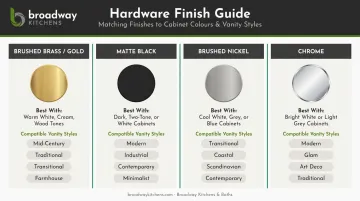
Hardware finish should reinforce your cabinet color — warm wood tones pair naturally with brass and gold, while painted finishes suit nickel or matte black. Houzz 2025 shows brushed nickel at 32%, matte black at 18%, and brushed gold at 14%. NKBA 2026 notes that polished finishes are giving way to matte, brushed, and satin options across the board.
A simple framework for hardware decisions:
- Brushed brass or gold — adds warmth; suits mid-century, transitional, and traditional styles
- Matte black — creates contrast; strongest in modern and contemporary applications
- Brushed nickel — the safe, timeless choice that works with almost every style
- Chrome — classic, clean, pairs well with traditional and minimalist aesthetics
Broadway Kitchens & Baths carries hardware from Top Knobs, Atlas Hardware, Emtek, and Jeffrey Alexander, covering the full finish spectrum. Coordinating your pulls, knobs, and faucet finish is the single easiest way to make a vanity look deliberate rather than pieced together.
Mirrors, Lighting, and Hardware: The Finishing Touches
Getting the Mirror Right
A mirror that spans close to the full width of the vanity reflects the most light and makes the bathroom feel larger. Kohler's buying guidance recommends keeping the mirror at or slightly narrower than the vanity width — not wider, which can look off-scale.
Frame style should follow the vanity's lead:
- Frameless or thin-profile mirrors for modern and minimalist vanities
- Arched or oval mirrors for mid-century and transitional styles
- Ornate or gilded frames for traditional vanities
- LED backlit or front-lit mirrors for contemporary spaces — Houzz 2025 reports 24% of renovated bathrooms included LED mirrors, and NKBA 2026 shows 47% of design experts favor integrated mirror lighting going forward
Vanity Lighting
Task lighting is non-negotiable in a well-designed bath — NKBA 2026 found 92% of respondents agree it should always be included in primary bath designs.
The options and their best applications:
- Side sconces flanking the mirror at approximately 60 inches from the floor: the best choice for shadow-free facial illumination, suited to almost every style
- Overhead bar light: clean and practical for modern and transitional spaces
- Pendant lights: add personality in farmhouse and mid-century bathrooms, particularly globe or cage-style pendants
Lighting finish should coordinate with your faucet and pull finish. A brushed gold sconce above a matte black faucet creates visual conflict — matching finishes across fixture types keeps the look cohesive. That same principle carries through to hardware selections.
Small Hardware Upgrades with Big Impact
Swapping pulls, knobs, or a faucet can transform an existing vanity without touching the cabinet box. Faucet configuration is the most impactful swap. Widespread (3-hole) faucets suit traditional and transitional vanities. Single-hole or wall-mount styles work best for modern configurations, while bridge-style faucets are a natural fit for farmhouse aesthetics.
Frequently Asked Questions
What are the trends in bathroom vanities in 2026?
Warm wood tones are outpacing painted finishes (wood-faced at 62% vs. painted at 53%, per NKBA 2026), floating wall-mounted vanities are gaining share, and bolder color choices — navy, sage, olive green — are growing. LED-integrated mirrors are a clear 2026 direction, with 47% of design experts favoring them. Natural stone and engineered quartz remain the dominant countertop choices.
What is the difference between a floating vanity and a freestanding vanity?
A floating (wall-mounted) vanity attaches directly to the wall with no floor contact, creating an open, airy look and making the floor easier to clean — though it does require proper wall blocking or reinforcement during installation. A freestanding vanity rests on the floor, is generally easier to install, and suits traditional or furniture-style aesthetics.
What size single sink vanity is right for a small bathroom?
A 24-inch vanity suits powder rooms and very compact bathrooms; a 30-inch vanity works well for most standard guest or hall baths. Always measure wall width, account for door swing clearance, and check toilet proximity before purchasing — NKBA recommends at least 20 inches from the lavatory centerline to the nearest sidewall.
What countertop material is best for a bathroom vanity?
Engineered quartz is the most popular choice at 45% of renovated bathrooms (Houzz 2025), offering durability and low maintenance. Marble delivers a timeless look but requires sealing. Quartzite offers natural stone beauty with better scratch and stain resistance than marble.
How can I maximize storage with a single sink bathroom vanity?
Choose a vanity with drawers for everyday items and cabinet doors for larger supplies, and add organizers inside to keep things accessible. Supplement with floating shelves or a medicine cabinet above, and keep the countertop clear to maintain an open, uncluttered feel.
Should I match my vanity hardware to my bathroom faucet finish?
Matching hardware and faucet finishes is the safest approach; using two complementary metals — brushed brass pulls with a matte black faucet, for instance — can also work when chosen deliberately. Mixing three or more finishes in the same space typically looks unplanned rather than curated.