Choose the wrong contractor and you're not just risking budget overruns. You're risking unpermitted work that surfaces during a home sale, substandard finishes that fail within a year, or worse — a project that stalls midway because the contractor disappeared.
This guide covers seven practical, NJ-specific tips to help you hire with confidence, from verifying credentials before the first meeting to recognizing red flags before you sign anything.
TLDR: 7 Tips at a Glance
- Confirm your contractor has a valid NJ Home Improvement Contractor (HIC) registration plus liability and workers' comp coverage
- Ask for references from past kitchen or bathroom projects specifically — not just general renovation work
- Get at least three detailed bids and compare scope of work, not just the final price
- Review every contract clause — timeline, payment schedule, material specs, and warranty terms
- Red flags to avoid: vague bids, large upfront deposits, pressure tactics, and no physical address
- Set communication protocols before work begins — agree on who you contact and how often
- A single full-service partner handling design through installation can cut coordination time and reduce costly miscommunication
Tip 1: Verify the Contractor's NJ HIC Registration and Insurance
What the Law Actually Requires
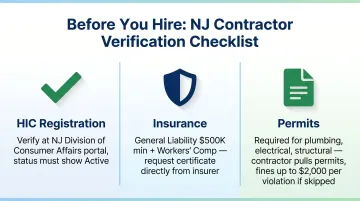
New Jersey law is explicit: under the NJ Contractors' Registration Act (N.J.S.A. 56:8-136), no contractor may perform home improvement work valued at $500 or more without being registered with the NJ Division of Consumer Affairs as a Home Improvement Contractor. Every qualifying project also requires a written, signed contract.
Hiring an unregistered contractor carries real consequences:
- Municipalities cannot issue construction permits to unregistered contractors, which can halt your project before it starts
- Violations constitute unlawful practices under the NJ Consumer Fraud Act
- Contractors who knowingly operate without registration face fourth-degree criminal charges
How to Verify Registration
Use the NJ Division of Consumer Affairs license verification portal. Select "Home Improvement Contractor" from the profession dropdown, then search by business name, registration number, or city. The portal shows real-time status — active, lapsed, or suspended. A lapsed registration means the contractor is currently operating illegally — treat it the same as no registration at all.
Insurance Requirements
NJ law mandates that registered contractors carry:
- General liability insurance — minimum $500,000 per occurrence, covering property damage
- Workers' compensation insurance — required for contractors with employees; protects you if a worker is injured on your property
Request the certificate of insurance directly from the contractor's insurer — not a copy handed to you by the contractor. For kitchen and bathroom remodels, which often run $30,000–$100,000+, verify that general liability limits are at least $500,000 per occurrence and that workers' comp is active if they employ a crew.
A Note on Permits
Insurance and registration protect you during the project. Permits protect you long after it's done.
Most kitchen and bathroom remodels involving plumbing, electrical, or structural changes require a permit from your local municipality under the NJ Uniform Construction Code. A reputable contractor pulls permits as a standard part of the process. If a contractor suggests skipping them to save time, walk away. Unpermitted work can result in fines up to $2,000 per violation and serious complications when you sell the home.
Tip 2: Ask for References and Review Their Past Projects
Online ratings give you a starting point, but a 4.5-star average tells you nothing about how a contractor handled a surprise plumbing issue at week three or whether they showed up on the days they promised.
Questions Worth Asking References
When you speak to past clients, go beyond "were you happy with the result?" Ask:
- Did the project finish on time and on budget?
- Were permits pulled, and did inspections go smoothly?
- How was the job site managed daily — was it cleaned up each evening?
- If something went wrong, how did the contractor handle it?
- Would you hire them again for a larger project?
Ask for references specifically from kitchen or bathroom projects, not general handyman or exterior work. The trades, coordination requirements, and finish standards are entirely different.
The Value of an In-Person Showroom
Photos on a website can hide a lot. Seeing actual cabinetry, countertop edges, tile work, and hardware in person tells you far more about quality and craftsmanship. Broadway Kitchens & Baths operates a showroom at 257 South Dean Street in Englewood, NJ. There, homeowners can evaluate cabinetry from brands like UltraCraft, Plain & Fancy, and Wolf Classic Cabinets alongside countertop samples from Caesarstone and Silestone — touching and comparing materials before committing to anything.
Where Else to Check
In-person visits tell you about quality; online research tells you about reliability. Cross-reference a contractor across a few sources before deciding:
- Google reviews — look for patterns across multiple reviews, not just the one-star outlier
- Houzz — check project photos with client comments, especially for design-focused remodelers
- Better Business Bureau — useful for spotting unresolved complaints or patterns of disputes
One negative review rarely tells the full story. Repeated complaints about the same issue — missed deadlines, unresponsive communication, incomplete work — tell you everything you need to know.
Tip 3: Get at Least Three Bids — and Know How to Compare Them
Getting three bids gives you a realistic sense of market-rate pricing — and helps you spot contractors whose numbers are suspiciously low or whose scope is vague enough to cause problems later.
What a Legitimate Bid Includes
A one-page bid with a single lump sum is a red flag. A detailed, professional bid should specify:
- Itemized labor and material costs (separate line items, not bundled)
- Brand names, model numbers, or quality grades for cabinetry, fixtures, and countertops
- A project timeline with defined milestones
- Permit costs (if the contractor is pulling them)
- A payment schedule tied to project phases
If a contractor can't or won't provide this level of detail before you sign, ask for it in writing before moving forward — or move on to the next bidder.
NJ Cost Benchmarks
Knowing the numbers helps you evaluate what you're looking at. According to Sweeten's NJ renovation cost data, based on the Remodeling Magazine Cost vs. Value Report for the Trenton metro area:
- Low-end NJ kitchen: $20,000–$25,000
- Mid-range NJ kitchen: starting at $30,000, averaging around $75,000 (~$375/sq ft)
- High-end NJ kitchen: starting at $60,000, averaging around $145,000 (~$725/sq ft)
- Low-end NJ bathroom (5'x8'): $15,000–$20,000
- Mid-range NJ bathroom: averaging $24,000 (~$685/sq ft)
- High-end NJ bathroom: $40,000–$75,000
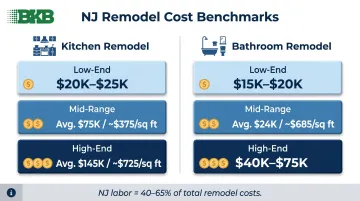
NJ labor rates trend higher than national averages — labor typically accounts for 40–65% of total remodel costs.
Comparing Bids Fairly
Those benchmarks only mean something if you're comparing equivalent scopes. If one bid uses semi-custom cabinetry and another uses stock boxes, the price gap is expected and appropriate. Align the specs across all three bids before making any comparison — ask each contractor to match material grades if needed, and most will accommodate.
The lowest bid is rarely the best choice. Contractors who underbid often recover their margin through change orders that inflate the final cost well beyond the original quote. The bid worth choosing is the one where every line item is accounted for — materials, labor, permits, and timeline — with nothing left to interpretation.
Tip 4: Review the Contract Before You Sign Anything
NJ law requires a written contract for any home improvement project over $500. Before you sign, confirm it includes:
- Contractor's legal name, business address, and HIC registration number
- Start date and projected completion date
- Detailed scope of work (not just "kitchen remodel")
- Material and product list with brand names or quality grades
- All warranties and guarantees in writing
- The NJ Division of Consumer Affairs toll-free number
Your Three-Day Right to Cancel
Many NJ homeowners aren't aware of this protection: under N.J.A.C. 13:45A-16.2, you can cancel a home improvement contract for any reason before midnight of the third business day after signing. Cancellation must be in writing, sent by certified or registered mail.
If cancelled, all money paid must be refunded within 30 days. The contractor is also legally required to provide a "Notice of Cancellation" form at the time of signing.
Watch the Payment Schedule
The NJ Division of Consumer Affairs advises homeowners not to pay more than one-third of the total cost upfront. Proper payment structures tie installments to project milestones:
- Design approval
- Material delivery
- Installation completion
- Punch-list sign-off
If a contractor asks for 50% or more before a single cabinet is ordered, walk away.
Regardless of the schedule, never pay in cash — always use a check or credit card and keep records of every transaction.
Tip 5: Watch Out for Common Red Flags
The NJ Division of Consumer Affairs receives thousands of complaints annually against home improvement contractors. The most common issues: shoddy workmanship, missed deadlines, and failure to complete work after taking a deposit.
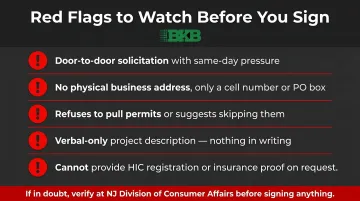
Red Flags Before You Sign
- Door-to-door solicitation with pressure to sign the same day
- No physical business address — only a cell number and a PO box
- Refusal to pull permits or suggestions to skip them to save time
- Verbal-only project descriptions — nothing in writing
- Inability to provide proof of HIC registration or insurance on request
The "Too Good to Be True" Bid
Contractors who come in far below every competitor's bid are almost never doing so through efficiency. They're cutting corners on materials, skipping licensed subcontractors, or pricing low to win the job and then recovering margin through change orders.
Watch for these warning signs during the estimate visit:
- Dismisses your questions or can't explain their process
- Shows up late or seems disorganized from the start
- Pressures you to decide before you've had time to compare bids
A contractor who's difficult before you've signed will be harder to manage once work is underway and you have less leverage. If you encounter fraud or deceptive practices, file a complaint with the NJ Division of Consumer Affairs online, by phone at (800) 242-5846, or in person at 124 Halsey Street, Newark, NJ 07102.
Tips 6 & 7: Set Clear Expectations and Choose the Right Partner
Tip 6: Establish Communication Protocols Before Work Begins
Poor communication is one of the most cited causes of NJ remodeling disputes — not bad craftsmanship, not cost overruns, but a breakdown in who's responsible for what information and when.
Before signing the contract, get clear answers to:
- Who is your primary point of contact during the project?
- How will you be notified if the timeline or budget changes?
- What's the preferred communication method — phone, email, a project app?
- How often will you receive formal progress updates?
A contractor who answers these questions directly and confidently has a process. One who deflects or gives vague answers probably doesn't. Once demolition starts and decisions need to be made fast, that difference becomes very real.
Tip 7: Consider a Full-Service Kitchen and Bath Partner
A general contractor coordinates trades and manages the timeline. A dedicated kitchen and bath design-build partner goes further: handling design, field measurements, product procurement, installation, and final punch-list with a single point of accountability throughout.
Broadway Kitchens & Baths works with NJ homeowners across Bergen, Hudson, Passaic, and Essex counties, offering that full-service model from their Englewood showroom. Their carpentry crews have over 20 years of installation experience, and their designers serve as a single point of contact from the first design consultation through the final walkthrough. Homeowners can also bring their own contractors and use Broadway strictly for design and product supply — the flexibility is built into how they work.
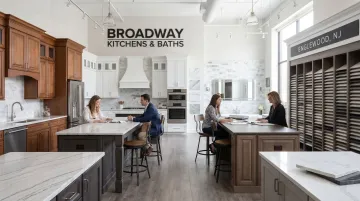
If you're starting a kitchen or bathroom renovation in northern NJ, schedule a conversation with their team. Call (201) 567-9585 or visit the showroom at 257 South Dean Street, Englewood, NJ (Monday–Friday, 9AM–5PM; Saturday, 10AM–4PM) to schedule a free consultation.
Frequently Asked Questions
How much would a contractor charge to renovate a small bathroom in NJ?
Small bathroom renovations in NJ typically range from $15,000 to $25,000 for a standard 5'x8' space, depending on material choices and whether plumbing is being relocated. Get itemized bids from at least three contractors to understand what's driving the cost for your specific layout.
How far will $100K go in remodeling a kitchen or bathroom?
In NJ, $100,000 covers a mid-to-high-range kitchen remodel (custom cabinetry, stone countertops, and quality appliances) or multiple bathroom renovations at once. It falls short of a full high-end kitchen, which averages around $145,000 in the NJ metro area.
What should I avoid when renovating a bathroom?
The most costly mistakes: skipping permits, choosing the lowest bid without comparing specs, making design changes mid-project (which trigger expensive change orders), and underestimating tile and plumbing costs.
Do I need a permit to remodel a kitchen or bathroom in NJ?
Yes. Any work involving plumbing, electrical, or structural changes requires a permit under the NJ Uniform Construction Code. Skipping permits can result in fines up to $2,000 per violation and complications when selling your home. A reputable contractor handles this process without being asked.
What is an NJ Home Improvement Contractor (HIC) registration?
It's a legal requirement under N.J.S.A. 56:8-136 for any contractor performing home improvement work valued at $500 or more in New Jersey. You can verify a contractor's current registration status through the NJ Division of Consumer Affairs verification portal.
How long does a kitchen or bathroom remodel typically take in NJ?
Bathroom remodels generally run 4–8 weeks from demolition to punch-list, depending on scope and permit approval timelines. Kitchen remodels range from 6 weeks for minor cosmetic work to 5+ months for full custom renovations. Get a written timeline with milestones in your contract before work begins.