The good news: a well-planned small bathroom remodel consistently delivers strong returns. According to Zillow's analysis of the 2025 Cost vs. Value Report, a midrange bathroom remodel returns roughly 80% of its cost nationally, with the adjacent New England region reaching closer to 90%. In a competitive market like NJ or NYC, that return can be even more meaningful at resale.
This guide covers 15 practical, design-forward ideas organized around layout optimization, smart storage, visual expansion, and 2026 style upgrades — all tailored to the real constraints of homes in the tri-state area.
Key Takeaways
- Floating vanities and wall-mounted toilets reclaim floor space without moving your plumbing stack — pocket doors free up wall area too
- Large-format tiles, full-width mirrors, and light neutrals are the fastest ways to make a small bathroom feel bigger
- Go curbless with frameless glass: it unifies the space visually and adds long-term accessibility value
- NJ/NYC full gut remodels typically start at $16,500–$18,000 and run well above national averages — factor in a 15–20% contingency from the start
- Building permits, co-op board approvals, and licensed contractor requirements add 2–6 weeks to most projects in this market
Why Small Bathroom Remodeling Is a Unique Challenge in NJ & NYC
NJ and NYC homes come with structural realities that most remodeling guides overlook entirely.
Pre-war construction — which defines much of Manhattan and older Bergen County buildings — uses plaster-and-lath walls instead of modern drywall. That plaster is significantly harder to work with, requires debris removal by hand in bucket loads, and makes tasks like cutting recessed niches or relocating fixtures far more involved.
Ceiling heights in these buildings typically run 9 to 11 feet. That's a genuine asset for vertical storage, but it complicates framing or mechanical work above the ceiling plane.
The Regulatory Layer
On top of the physical constraints, both NYC and NJ add meaningful administrative requirements:
- NYC: Most substantive bathroom work requires an Alteration Type 2 (ALT2) permit, which must be filed by a licensed PE or RA. Illegal construction can trigger Class 1 violations with fines reaching $25,000.
- NYC co-ops: Shareholders must execute an Alteration Agreement before work begins. Board review typically takes 2–4 weeks, and alteration agreement deposits commonly run $5,000–$50,000. Work is generally restricted to weekdays between 8 or 9 AM and 5 PM.
- NJ municipalities: Permit requirements vary by town but apply whenever plumbing, electrical, or mechanical systems are altered. Permit fees can reach 10% of total project cost in some municipalities.
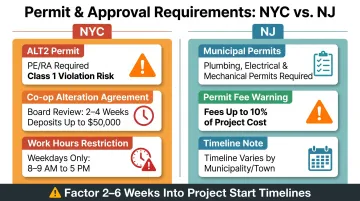
Factor these administrative steps into your timeline from day one — they routinely add 2–6 weeks to project starts.
15 Best Small Bathroom Remodeling Ideas for NJ & NYC Homes
These ideas fall into four focus areas: layout optimization, smart storage, visual expansion, and 2026 style upgrades. Most work independently, but combining them across categories produces the most noticeable transformation.
Layout & Space Optimization (Ideas 1–5)
Idea 1 — Install a Floating Vanity
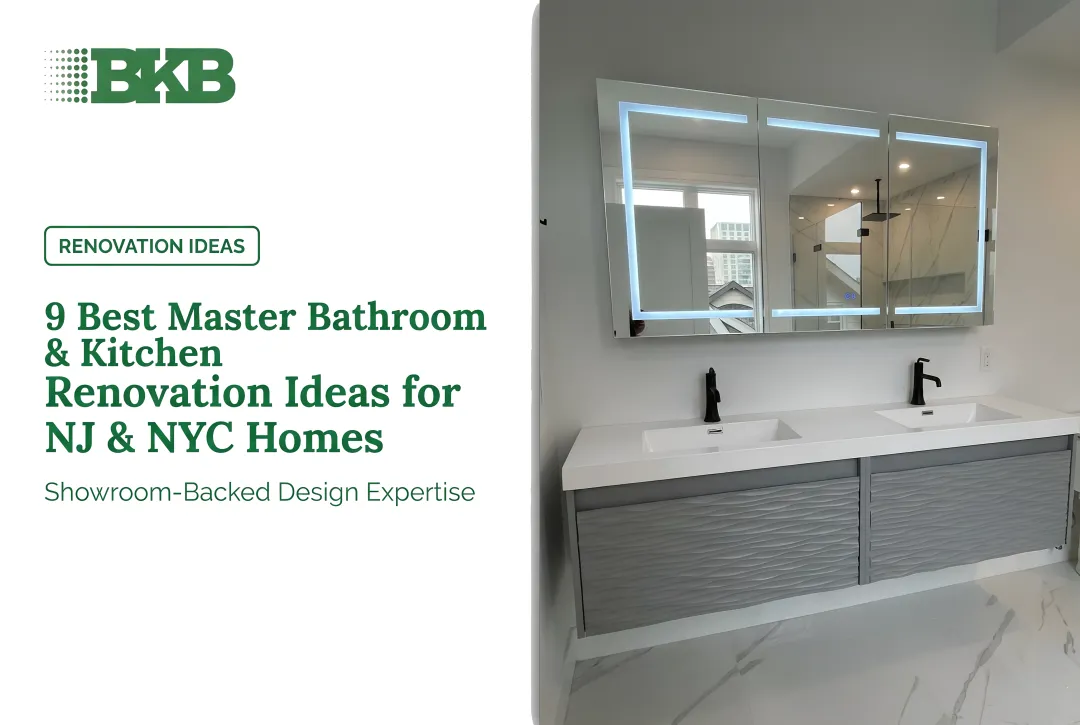
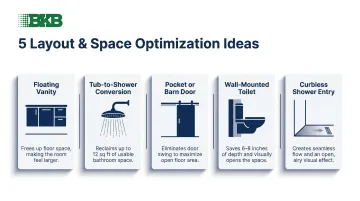
A wall-mounted vanity exposes the floor beneath it, which does two things: it makes the room feel larger by keeping the tile plane continuous and unbroken, and it makes cleaning dramatically easier. Floating vanities are available starting at 24 inches wide — workable in bathrooms where a standard 36-inch floor cabinet would feel cramped. Broadway Kitchens & Baths carries wall-mounted vanity options across multiple cabinetry lines, with their design team available to match width, depth, and finish to your specific layout.
Idea 2 — Convert the Bathtub to a Walk-In Shower
A standard 5-foot alcove tub occupies roughly 25–30% of floor area in a typical 40–50 sq ft bathroom. Removing it and installing a properly sized walk-in shower immediately returns that space to the room. This is consistently one of the most requested remodel moves for NJ/NYC apartments.
Before construction starts, plan for:
- Permits in most NJ municipalities (typically 2–4 weeks)
- Building board approval in NYC co-ops (add to your permit timeline)
Idea 3 — Replace Hinged Doors with Pocket or Sliding Barn Doors
A standard hinged bathroom door sweeps a significant arc that often conflicts directly with the vanity or toilet in small NJ/NYC bathrooms. Pocket doors eliminate that entirely by sliding into a wall cavity. Barn-style doors slide along the exterior wall surface and are structurally simpler to install since they don't require wall framing modifications. If your walls are plaster-and-lath or contain utilities, barn doors are typically the faster path.
Idea 4 — Install a Wall-Mounted Toilet
Wall-hung toilets conceal the cistern inside the wall cavity, saving up to 10–12 inches of floor depth compared to floor-mounted models. In a narrow NJ/NYC bathroom, that recovered depth can mean the difference between a cramped entry and a layout that actually functions. Plan this during a full remodel when walls are already open — retrofitting is significantly more disruptive.
Idea 5 — Design a Curbless (Zero-Threshold) Shower Entry
Eliminating the shower curb removes the visual break between the shower floor and the bathroom floor, letting the eye read the entire space as one continuous area. The room feels noticeably larger without changing a single wall or fixture. Curbless showers also add accessibility value — an increasingly relevant consideration for homeowners planning to age in place.
Smart Storage That Doesn't Consume Square Footage (Ideas 6–10)
Idea 6 — Build Recessed Wall Niches for Shower Storage
A corner caddy protrudes into the shower and visually crowds it. A recessed niche sits flush between wall studs — typically offering 3.5 inches of depth — and keeps the shower visually clean. In pre-war buildings with plaster-and-lath construction, verify cavity depth and plaster integrity before cutting. Done right, a recessed niche adds storage without claiming an inch of shower space.
Idea 7 — Use Floor-to-Ceiling Cabinetry to Go Vertical
Pre-war NJ and NYC apartments routinely have 9–10+ foot ceilings. Most homeowners stop cabinetry at standard height and leave two feet of dead space above. Taking cabinetry all the way to the ceiling adds meaningful storage for linens, cleaning supplies, and overflow without consuming any floor area.
Off-the-shelf cabinetry won't reach non-standard ceiling heights cleanly. Broadway Kitchens & Baths offers custom and semi-custom lines — including Plain & Fancy and UltraCraft — built to exact ceiling heights and unusual room dimensions. UltraCraft allows height, depth, and width modifications in 1/16-inch increments at no extra charge, which matters when you're working around irregular angles common in older NJ and NYC buildings.
Idea 8 — Install a Recessed Medicine Cabinet
A recessed medicine cabinet combines mirror and storage in a single wall-depth fixture, adding practical daily-use capacity without protruding into the room. For NJ/NYC bathrooms without adjacent linen closets, an 18–24-inch recessed cabinet handles a surprising volume while keeping countertops clear.
Broadway Kitchens & Baths carries medicine cabinets from Afina, Robern, and Kohler — all available in recessed and surface-mounted configurations. For tight spaces, always specify recessed.
Idea 9 — Maximize Corner Space
Corners are chronically underused. A corner vanity tucks into space that would otherwise sit empty and frees the main wall for fixtures. Corner shelves above the toilet or beside the shower add two to three tiers of accessible storage with minimal visual weight. Older NJ and NYC buildings often have irregular angles that make standard rectangular units fit awkwardly — corner units sidestep that problem entirely.
Idea 10 — Choose a Slim-Depth Vanity or Pedestal Sink
If wall construction makes a floating vanity impractical, a shallow-depth vanity (15–18 inches deep versus the standard 21 inches) or a pedestal sink achieves a similar visual effect by showing more floor. The trade-off is reduced cabinet storage — offset this with a medicine cabinet or vertical shelving elsewhere. Slim-depth cabinetry is a specialty product worth sourcing through a supplier experienced with NJ/NYC renovation constraints rather than a big-box retailer.
Light, Color & Visual Expansion Tricks (Ideas 11–13)
Idea 11 — Use Light, Neutral Paint Colors
Soft whites, warm off-whites, and pale greiges reflect both natural and artificial light around the room, pushing the perceived walls further away. This matters especially in windowless NJ/NYC bathrooms — which are far more common than in suburban homes.
Benjamin Moore's most recommended small-bathroom neutrals include Edgecomb Gray HC-173, White Dove OC-17, and Collingwood OC-28. Avoid dark accent walls in already tight spaces. Introduce personality through hardware finishes — matte black, brushed brass — and textured tile instead.
Idea 12 — Install Large-Format Floor and Wall Tiles
Large-format tile — defined as any tile with at least one side longer than 23 inches — requires fewer grout lines, creating a more continuous surface that reads as larger and less busy. The 12×24-inch and 24×24-inch formats work well in NJ/NYC bathrooms; running wall tiles vertically draws the eye upward and adds perceived height — especially useful in bathrooms where you can't raise the ceiling.
The NKBA's 2026 trend report confirms "grout is out," with homeowners opting for expanses of large-format tile for both visual and maintenance reasons. Broadway Kitchens & Baths carries MSI Stone tile across their showrooms, with their design team available to advise on orientation and format for your specific layout.
Idea 13 — Hang a Full-Width Mirror Above the Vanity
A mirror that spans the full width of the vanity wall visually doubles the space by reflecting both light and the room itself. In NJ/NYC apartments with limited natural light, a large mirror also amplifies artificial lighting, reducing the need for additional fixtures. Frameless or thin-framed mirrors maximize the reflective surface area — avoid heavy decorative frames that eat into the mirror's functional size.
2026 Style Upgrades Worth the Investment (Ideas 14–15)
Idea 14 — Upgrade to a Frameless Glass Shower Enclosure
A shower curtain or framed glass door cuts a small bathroom in half visually. A frameless glass panel or full enclosure extends the sightline to the shower's back wall, making the entire space feel more open and cohesive. Frameless glass has become the standard in higher-end NJ/NYC renovations — it holds up well over time, wipes clean easily, and adds measurable resale value in a competitive market. Broadway Kitchens & Baths carries shower doors from Dreamline and Glasscrafters, both of which offer frameless configurations.
Idea 15 — Layer Strategic Lighting: Vanity Sconces + Recessed LEDs
A single overhead fixture leaves faces shadowed and corners dark — both of which make a room feel smaller and less finished. Layering vanity-height sconces flanking the mirror with recessed ceiling LEDs eliminates shadows, adds depth, and modernizes the look without structural work.
The 2026 standard for residential bathrooms is LED fixtures at 2,700–3,000K color temperature — warm enough to be flattering, cool enough to render colors accurately at the mirror. This warm range pairs naturally with the material finishes trending across NJ/NYC projects right now: matte black, unlacquered brass, and warm stone surfaces.
How to Budget and Plan Your Small Bathroom Remodel in NJ & NYC
Realistic Cost Ranges
NJ and NYC labor costs run well above national averages due to higher base wages, union requirements, permitting overhead, and the logistics of building access in dense urban environments.
| Scope | NJ Range | NYC Range |
|---|---|---|
| Cosmetic refresh (no plumbing relocation) | ~$6,500–$16,500 | ~$3,000–$18,000 |
| Full gut remodel (mid-grade) | Starting ~$26,000 | $28,000–$45,000 |
| High-end gut remodel | Starting ~$37,500 | $45,000–$100,000+ |
Sources: Sweeten NJ (2025); Sweeten NYC (2025)
Labor alone accounts for 25–35% of most NJ project budgets. A gut renovation — stripping to studs and rerouting utilities — adds 15–25% to costs over a standard rip-and-replace.
The Correct Order of Operations
Skipping steps is where costly mistakes happen. Follow this sequence:
- Design, permits, and material ordering
- Demolition
- Structural repairs (water damage, rot)
- Rough-in plumbing
- Rough-in electrical
- Inspections (plumbing and electrical must pass before closing walls)
- Waterproofing, insulation, and backer board
- Tile installation
- Fixture and cabinetry installation
- Paint, trim, and final accessories
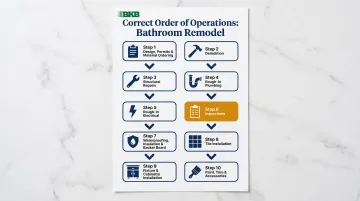
Waterproofing before tile must happen — inspectors will catch it if skipped. Inspections between rough-in phases are required in NJ/NYC. Schedule them in advance; missed inspection windows can push timelines by 2–4 weeks.
Administrative Steps to Build Into Your Timeline
- NYC co-op board review: 2–4 weeks minimum; full approval can extend to several months
- NYC pre-war buildings may require an ACP-5 asbestos clearance certificate before permits can be filed
- NJ permits: timeline varies by municipality; confirm requirements before setting a start date
- Contractor licensing: NYC requires licensed plumbers and electricians; verify credentials before signing
Broadway Kitchens & Baths handles design, supply, and installation for complete bathroom renovations — typically 4–6 weeks including inspections — serving Bergen, Hudson, Passaic, and Essex counties as well as Manhattan and Brooklyn.
Conclusion
A 45-square-foot NJ or NYC bathroom doesn't have to feel like one. The right combination of layout moves, storage solutions, and visual tricks — floating vanity, curbless shower, large-format tile, full-width mirror — can make a compact space genuinely comfortable and significantly more valuable at resale.
Start with layout priorities first, then layer in storage, then address aesthetics. And partner with a remodeler who understands the physical and regulatory realities of this market from day one.
Broadway Kitchens & Baths works with homeowners, architects, and contractors across NJ and NYC on residential and multi-unit bathroom renovations. Their showrooms in Englewood, NJ and Manhattan stock cabinetry, stone, tile, plumbing fixtures, and accessories — everything needed to bring a project together. Reach the team at +1 201-567-9585 to discuss your project.
Frequently Asked Questions
What is a reasonable budget for a small bathroom remodel?
Costs vary widely by scope. In NJ, a cosmetic refresh starts around $6,500–$16,500; a full gut remodel starts at $26,000 and rises from there. NYC budgets run slightly higher. Labor alone typically accounts for 25–35% of total project cost in this market.
Can you renovate a small bathroom for $10,000?
In NJ/NYC, $10,000 covers a strictly cosmetic update: new vanity, hardware, lighting, and paint, but only if the plumbing layout stays unchanged. Any tile replacement, tub-to-shower conversion, or fixture relocation will push costs beyond this threshold due to local labor rates.
What is the correct order to remodel a bathroom?
Demolition → rough plumbing and electrical → inspections → waterproofing and backer board → tile → fixtures and cabinetry → paint and accessories. In NJ/NYC, inspections between phases are required; scheduling them in advance prevents delays.
What looks good in a small bathroom?
Clean lines, light neutrals, large-format tile, and a statement vanity tend to perform best. Mixing one warm material (a wood-tone vanity or stone surface) against crisp white or off-white walls creates balance without overwhelming a compact space.
How do I modernize a small bathroom without moving plumbing?
Swap dated hardware for matte black or brushed brass, replace a shower curtain with frameless glass, update lighting with layered sconces and recessed LEDs, and install large-format tile. These changes modernize the look without touching the plumbing stack.
What color makes a small bathroom look larger?
Soft whites, warm off-whites, and pale greiges consistently perform best by reflecting light and reducing the visual weight of walls. Keeping floors, walls, and ceiling within the same light tonal family amplifies the effect further.