Yet most retailers treat display cabinet selection as an afterthought, picking what looks good in a catalog rather than what actually works for their store format, product mix, and customer flow. The result is cluttered, underperforming merchandising that leaves revenue on the table.
This guide covers 8 commercial display cabinet styles suited to the specific store formats found across NJ and NYC — from Midtown boutiques to Hoboken specialty shops — with a practical breakdown of what each style does best and where it fits.
Key Takeaways
- 82% of purchase decisions happen in-store, making display quality a direct revenue driver
- Each of the 8 styles covered here serves a distinct purpose — from securing high-value merchandise to maximizing a cramped storefront
- Style choice should follow product type, security needs, store footprint, and brand aesthetic
- Wall-mounted and countertop units solve tight NYC square footage; floor-standing and modular units suit larger NJ formats
- Broadway Kitchens & Baths designs and installs custom commercial cabinetry for retail spaces across NJ and NYC — built to your floor plan and brand
Why Display Cabinet Style Matters in NJ & NYC Retail
NJ and NYC retail environments don't give you the luxury of average merchandising. When you're paying premium rents in Manhattan or competing against e-commerce in a Bergen County strip center, your display setup needs to work harder than it would in lower-stakes markets.
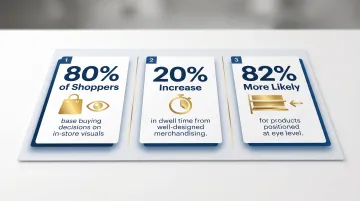
The numbers back this up. According to research compiled by ContraVision, display quality has a measurable impact on sales:
- 80% of shoppers base buying decisions on in-store visuals
- Well-designed merchandising increases dwell time by 20%
- Products at eye level are 82% more likely to be selected
Each of those figures points to the same conclusion: cabinet selection is a revenue decision, not just a design one.
NYC shoppers are design-savvy. They walk past luxury storefronts daily and have calibrated expectations for how products should be presented. NJ's independent retail scene — particularly in towns like Montclair, Hoboken, and Princeton — draws customers who respond to craft, warmth, and considered store design.
The 8 styles below are evaluated specifically for commercial retail contexts across both markets.
8 Best Commercial Display Cabinet Styles for NJ & NYC Retail Spaces
Each style is assessed on visual impact, space efficiency, security, and fit with the retail formats common across NJ and NYC.
1. Glass Display Cabinet
Glass display cabinets are the baseline for high-visibility retail. Jewelry stores, watch boutiques, cosmetic counters — any category where customers need to see the product clearly before they'll consider buying it.
The key spec to verify is glazing type. Tempered and laminated safety glass both meet IBC Section 2406 commercial building requirements, but they behave differently on impact. Tempered glass shatters into small fragments; laminated holds together. For high-traffic NYC environments, laminated is worth the conversation.
| Spec | Detail |
|---|---|
| Best For | Jewelry, cosmetics, watches, luxury accessories |
| Key Feature | 360° product visibility; lockable doors for theft prevention |
| Space Fit | Countertop and floor-standing configurations |
This style works well along NYC's luxury corridors — Fifth Ave, SoHo, the West Village — and in NJ's upscale shopping centers where transparent, clean presentation signals premium positioning.
2. Lighted / LED Display Cabinet
LED-integrated display cabinets do one thing better than any other style: they make products look more valuable. Research cited by the Lighting Science Group found shoppers perceive products in well-lit displays to be 20% more valuable, and strategic lighting can lift sales by 10%.
Color temperature matters more than most retailers realize:
- Warm white (2700–3000K) — jewelry, wine, lifestyle products
- Neutral white (3500–4000K) — cosmetics, food retail
- Cool white (5000K+) — electronics, skincare, tech accessories
For NYC retailers specifically, the energy argument is real. New York State commercial electricity rates hit 22.3 cents per kWh as of early 2025 — among the highest in the country. LEDs consume up to 75% less energy than traditional lighting, which adds up quickly across a full display installation.
| Spec | Detail |
|---|---|
| Best For | Electronics, skincare, wine, specialty food |
| Key Feature | Adjustable color temperature; dimmable options |
| Space Fit | Floor-standing and wall-mounted formats |
3. Wall-Mounted Display Cabinet
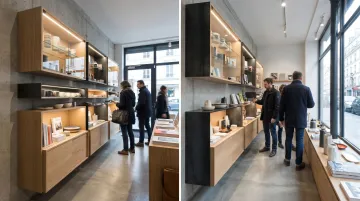
For NYC storefronts where floor space is the constraint, wall-mounted cabinets are the practical answer. They convert dead wall surface into active merchandising real estate while keeping aisles clear and traffic-friendly.
These units work well for fragrance, accessories, and curated product collections — categories where vertical presentation adds visual interest rather than detracting from it.
One installation consideration specific to NJ and NYC: older buildings frequently have plaster walls, uneven stud spacing, or structural quirks that make anchoring more complex than a standard commercial buildout. Proper load-bearing assessment matters, especially in pre-war Manhattan buildings or older NJ commercial strips. Broadway Kitchens & Baths, which handles commercial cabinetry installations across Bergen County and the greater NYC metro, coordinates directly with other trades to manage exactly these kinds of structural details.
| Spec | Detail |
|---|---|
| Best For | Accessories, fragrance, curated retail in tight spaces |
| Key Feature | Vertical space utilization; adjustable internal shelving |
| Space Fit | Compact storefronts in dense NYC neighborhoods |
4. Floor-Standing Display Cabinet
Floor-standing cabinets anchor a store's product zones. They're the most versatile commercial option — freestanding units that define sections, accommodate heavier merchandise, and can be repositioned when seasonal resets or store refreshes happen.
For NJ retailers with larger footprints — think Route 4 corridor stores, mall-adjacent boutiques, or open-plan specialty shops — floor-standing units provide the scale to fill space purposefully without feeling sparse.
Two specs worth confirming before purchase:
- Load capacity — particularly for collectibles, ceramics, or bottled products
- Base stability — especially in stores with high foot traffic or children as part of the customer mix
| Spec | Detail |
|---|---|
| Best For | Boutique apparel, collectibles, multi-category retail |
| Key Feature | Freestanding; repositionable; modular configurations available |
| Space Fit | Stores over 600 sq ft with defined merchandising zones |
5. Locked / Secure Display Cabinet
Locked display cabinets serve two functions at once: protecting high-value merchandise and preserving the open, browsable feel customers expect. The National Retail Federation's 2024 report found retailers reported a 93% increase in shoplifting incidents and a 90% increase in dollar loss from shoplifting between 2019 and 2023.
For jewelry, watches, pharmacy products, and tobacco/vape retail, a lockable cabinet is effectively a compliance requirement and a profit protection measure in one unit.
Full-glass fronts with keyed or electronic lock systems protect high-value SKUs without closing off the browsing experience. Options to compare:
- Keyed cylinder locks — simple, low-maintenance, familiar to staff
- Electronic keypad locks — faster access, no lost-key risk, audit trail capable
- Sliding glass doors with locks — common in jewelry showcases, easy customer-facing interaction
| Spec | Detail |
|---|---|
| Best For | Jewelry, watches, pharmacy, smoke/vape shops |
| Key Feature | Keyed or electronic lock systems; shatter-resistant glass |
| Space Fit | Countertop and floor-standing formats with lockable compartments |
6. Modular Display Cabinet
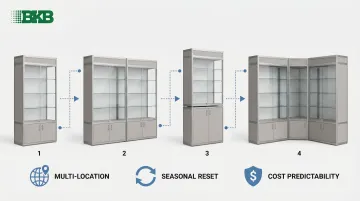
Modular systems are built for retailers who expect to grow or change. Individual units combine, stack, and reconfigure without a full redesign — which matters when you're opening a second location in Hoboken six months after launching in Astoria, or when your product mix shifts seasonally.
Broadway Kitchens & Baths' builders division has over 12 years of experience working with developers, construction management firms, and property management companies across multi-unit projects in the tri-state area. That same capability translates directly to multi-location retail operators who need consistent, repeatable cabinet layouts across different store footprints.
Modular systems also deliver cost predictability. Standardizing your display system means standardizing procurement, installation timelines, and your staff's familiarity with the setup.
| Spec | Detail |
|---|---|
| Best For | Multi-location retail, expanding boutiques, franchise operators |
| Key Feature | Mix-and-match unit configurations; standardized sizing |
| Space Fit | Scales from small NJ boutiques to larger NYC retail floors |
7. Wood / Antique-Style Display Cabinet
Solid wood display cabinets — oak, walnut, mahogany — communicate warmth, craft, and history in a way that glass and metal simply can't. For wine shops, gift stores, antique boutiques, and lifestyle brands, that emotional signal is part of the product experience.
This style is gaining ground in NJ's independent retail scene, where customers are specifically seeking out the opposite of the generic chain store experience. A well-finished wood cabinet in a specialty cheese shop or an independent bookstore does double duty — it displays the product and communicates the brand.
Custom finishes make the difference. Broadway Kitchens & Baths works with Plain & Fancy (fully customizable, handcrafted) and UltraCraft (hundreds of door styles and finishes), matching wood tones and stain profiles to a client's existing interior scheme.
| Spec | Detail |
|---|---|
| Best For | Wine shops, gift stores, antique boutiques, lifestyle retail |
| Key Feature | Custom wood stains and finishes; glass door inserts optional |
| Space Fit | Floor-standing and wall-mounted; fits classic and mixed-design interiors |
8. Countertop / Compact Display Cabinet
Countertop cabinets are positioned exactly where buying decisions get made — at the register. They spotlight impulse-purchase items, high-margin accessories, or promotional products at the moment a customer is already in transaction mode.
POPAI's Mass Merchant Shopper Engagement Study found 62% of mass merchant purchases are unplanned. A well-stocked countertop display is one of the most direct ways to capture that behavior.
These units work well in:
- Food retail and specialty grocery
- Cosmetic counters and beauty supply
- Convenience-oriented NYC formats
- Any checkout desk under 36" wide
Materials vary — glass, acrylic, and metal all work — and the lower price point makes seasonal swaps more practical.
| Spec | Detail |
|---|---|
| Best For | Impulse items, cosmetics, food retail, point-of-sale zones |
| Key Feature | Small footprint; portable; glass or acrylic construction |
| Space Fit | Checkout counters and service desks under 36" wide |
How to Choose the Right Display Cabinet Style for Your Store
Before committing to a style, run through these five evaluation factors:
- Product type — Does your merchandise need 360° visibility? Security? Temperature stability?
- Store footprint — Floor-standing units need room to breathe; wall-mounted units work in tight layouts
- Security requirements — High-value SKUs need locked cases, regardless of aesthetic preference
- Customer interaction model — Self-browse formats need accessible displays; assisted selling works with locked cases
- Brand identity — A minimalist LED glass case sends a different signal than a warm walnut cabinet
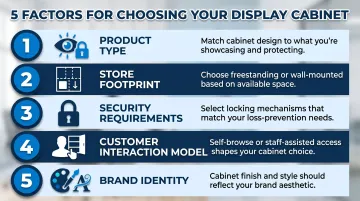
Each of these factors can override aesthetic preference — and that's where most NJ and NYC retailers go wrong. A cabinet that photographs well but creates bottlenecks in traffic flow, obscures products, or fails to meet building codes isn't an asset. It's a liability.
That's where a local commercial cabinetry partner adds real value. Broadway Kitchens & Baths handles commercial fitout projects across Bergen County, Hudson County, and the NYC metro — from field measurements and design through installation and final punch-list. Their team works in both union and non-union environments, which is a practical requirement for most NYC commercial projects.
Conclusion
Display cabinet selection is a merchandising decision, not a furniture decision. In NJ and NYC's retail markets — where rents are high, competition is fierce, and customers have calibrated expectations — the wrong cabinet costs you in ways that don't show up until you're looking at your quarterly numbers.
Assess your store format, product mix, and security requirements before locking in a style. Cabinets that can be reconfigured — through modular builds or adjustable shelving — hold their value far longer than fixed, single-purpose units as your inventory or floor plan shifts.
Broadway Kitchens & Baths works with commercial property owners, architects, and builders across NJ and NYC on custom cabinetry built to fit specific retail environments — not off-the-shelf formats. To discuss your project, call +1 201-567-9585 or visit the showrooms in Englewood, NJ, and Manhattan, NY.
Frequently Asked Questions
What is the difference between a display cabinet and a curio cabinet?
A display cabinet is a broad commercial term covering any unit used to showcase merchandise in a retail or commercial setting. A curio cabinet is a specific residential style, typically ornate with glass panels, designed for collectibles and decorative items rather than product display.
What is another name for a display cabinet?
Display cabinets are also called showcases, display cases, or vitrines, with the preferred term varying by industry — jewelry retail favors "showcase," museums use "vitrine," and general retail defaults to "display case."
Can you buy old store displays?
Yes, used commercial display cabinets can be sourced from store liquidators, auction houses, and fixture resellers. Before purchasing, verify the condition carefully and confirm the unit meets current safety glazing standards (IBC Section 2406) for use in a commercial NJ or NYC space.
Where can I buy glass display cases?
Glass display cases are available through commercial furniture suppliers, specialty retail fixture manufacturers, and local cabinetry companies. For NJ and NYC retailers needing custom-built cabinetry integrated into a broader fitout, Broadway Kitchens & Baths handles commercial cabinet design and installation across both markets.
What type of display cabinet works best for small NYC retail spaces?
Wall-mounted cabinets and countertop units are the top choices for space-constrained storefronts. Both styles maximize vertical space or point-of-sale placement without consuming the floor area that's at a premium in most NYC neighborhood retail locations.
Are custom display cabinets worth the investment for commercial retail?
For stores with non-standard dimensions, strong brand identities, or premium product lines, custom cabinets generally outperform off-the-shelf alternatives on fit, finish, and merchandising performance. In the competitive NJ and NYC retail market, customers notice the difference.