According to Bradley Corporation's annual survey, nearly 60% of Americans will actively seek out and spend more at businesses with clean, well-maintained restrooms — while 52% say a bad restroom experience makes them unlikely to return. In NYC and NJ's hypercompetitive commercial market, that's not a minor detail. It's a retention problem.
Remodeling a commercial bathroom here is more complex than in most markets. Older building stock, strict permit requirements, union labor environments, and extremely high foot traffic all raise the stakes. Done right, a remodel improves customer perception, employee satisfaction, code compliance, and long-term operating costs — simultaneously.
This article covers 10 actionable commercial bathroom remodeling ideas tailored specifically for NYC and NJ businesses, from quick functional wins to full system overhauls.
Key Takeaways
- 60% of customers spend more at businesses with quality restrooms — upgrading yours protects revenue directly
- NYC/NJ remodels must navigate local permits, union labor, older building conditions, and ADA requirements
- The 10 ideas span touchless fixtures, bold tilework, ADA compliance, system upgrades, and brand-aligned design
- Budget $70–$300+ per square foot depending on scope; NYC/NJ projects typically land toward the higher end
- A tri-state contractor familiar with NYC/NJ codes helps avoid permit delays, failed inspections, and unexpected budget overruns
Why Commercial Bathroom Remodeling Matters for NYC & NJ Businesses
A commercial bathroom remodel isn't just new tile and a fresh coat of paint. It typically includes fixture replacement, plumbing upgrades, ADA compliance retrofits, ventilation improvements, and electrical work — all coordinated around a business that stays open throughout construction.
In NYC and NJ, that complexity compounds quickly:
- Building age: Much of NYC's commercial stock predates 1980. Older buildings bring outdated plumbing, inadequate ventilation, and potential asbestos (the NYC Department of Buildings requires asbestos investigation before permits on buildings constructed before April 1, 1987)
- Permit requirements: NYC DOB filings (typically Alt-2 for interior renovations) and NJ Uniform Construction Code submissions (N.J.A.C. 5:23) add time and cost to every project
- Union labor: Many commercial projects in NYC operate under union labor agreements, which affects scheduling, cost structure and contractor qualifications
- Foot traffic: High daily use accelerates wear on fixtures, grout, finishes, and partitions — making material selection far more consequential than in a residential context
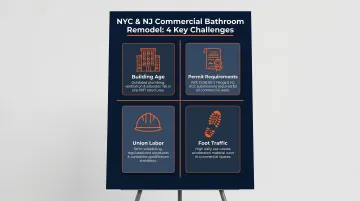
The 10 ideas below address each of these factors directly, covering materials, fixtures, and layouts built for high-traffic commercial use in this market.
10 Best Commercial Bathroom Remodeling Ideas for NYC & NJ Businesses
These ideas span functional upgrades, aesthetic improvements, and compliance requirements. The strongest remodels combine several of these into a cohesive scope.
1. Install Touchless and Water-Efficient Fixtures
Four fixture upgrades deliver the most impact in high-traffic commercial restrooms:
- Automatic faucets and sensor-flush toilets
- Touchless soap dispensers
- Motion-activated lighting
Together, these reduce water consumption, lower utility costs, and signal cleanliness to every person who walks in.
EPA WaterSense-certified bathroom faucets use a maximum of 1.5 gallons per minute — at least 20–30% less than a standard 2.2 gpm faucet — without any noticeable performance difference. For a high-traffic commercial restroom, that adds up fast across hundreds of daily uses.
In NYC, the DEP's Water Conservation & Reuse Grant Program offers competitive grants for commercial water-saving projects — worth confirming for the current funding cycle. WaterSense fixtures also count toward LEED indoor water use reduction credits under USGBC's rating systems, which matters for businesses pursuing green building certifications.
Broadway Kitchens & Baths carries plumbing fixtures from Toto, Kohler, Hansgrohe, and Brizo — brands with strong commercial-grade product lines that can be specified for touchless applications.
2. Upgrade Lighting for Ambiance and Efficiency
Harsh fluorescent overhead lighting makes every restroom look institutional — regardless of how good the tile or fixtures are. Replacing it with layered lighting (ambient overhead, vanity-level task lighting, and accent fixtures) dramatically changes how clean and well-appointed a space feels.
LED fixtures are the right call for operating cost reasons: the DOE reports LEDs use at least 75% less energy than incandescent lighting and last up to 25 times longer. In a space running lights all day, that matters.
For NYC commercial buildings over 25,000 gross square feet, there's an additional reason to address lighting: NYC Local Law 97 caps annual greenhouse gas emissions for covered buildings, with penalties of $268 per metric ton of CO2e over the limit. The first compliance period runs 2024–2029, with stricter limits taking effect in 2030.
Lighting and mechanical upgrades contribute meaningfully to whole-building emissions reductions. A contractor with NYC experience will know how these calculations factor into your project scope.
3. Invest in Durable, Easy-to-Clean Surfaces and Flooring
Material selection is where high-traffic commercial bathrooms diverge sharply from residential projects. What looks good at installation matters far less than what still looks good after 18 months of heavy use and daily cleaning.
Recommended materials for NYC/NJ commercial restrooms:
- Porcelain tile — dense, moisture-resistant, low maintenance, available in large formats that minimize grout lines
- Solid surface or quartz countertops — non-porous, resists staining and bacterial growth, easy to wipe clean
- Grout-free wall panels — eliminate the grout maintenance problem entirely in high-humidity wall areas
- Commercial-grade LVT or porcelain floor tile — specify wet DCOF of at least 0.42 per ANSI A137.1 for slip resistance in wet areas
Cheaper materials — residential-grade vinyl, standard ceramic, or porous stone — deteriorate faster under commercial cleaning chemicals and foot traffic, leading to repeat remodel costs well ahead of schedule.
4. Maximize Privacy with Full-Height Partitions
Standard partition stalls with large floor gaps and partial-height doors are among the most common restroom complaints from users. Upgrading to full-height or floor-to-ceiling partitions is one of the highest-impact improvements relative to cost.
Partition material options for NYC/NJ commercial environments:
| Material | Best For | Key Properties |
|---|---|---|
| Phenolic | High-traffic, schools, transit | Impact-resistant, graffiti-resistant, moisture-proof |
| HDPE (Solid Plastic) | Healthcare, food service | 1″ thick, won't delaminate, corrosion-resistant |
| Stainless Steel | Corporate, hospitality | Upscale finish, durable, premium appearance |
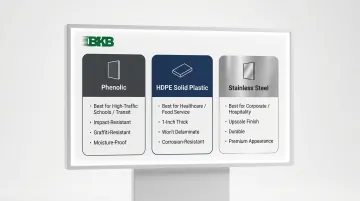
Match partition material to your business type and traffic volume. A law firm and a restaurant have very different durability and aesthetic requirements — and their partition specs should reflect that.
5. Ensure Full ADA Compliance
ADA compliance is a legal requirement, not an optional upgrade. Non-compliant facilities expose businesses to liability — and retrofitting after the fact costs significantly more than building it right the first time.
Key ADA restroom specifications per U.S. Access Board standards:
- Accessible stall: 60 inches minimum width, 56–59 inches depth (wall-hung vs. floor-mounted fixture)
- Grab bars: mounted 33–36 inches AFF; side bar minimum 42 inches, rear bar minimum 36 inches
- Lavatory rim: 34 inches maximum AFF
- Mirror bottom edge: 40 inches maximum AFF
- Turning radius: 60-inch diameter clear floor space
ADA retrofits in older NYC/NJ commercial buildings can be complicated by original construction constraints — narrow doorways, existing plumbing locations, load-bearing walls. Budget time for a thorough existing-conditions survey before finalizing the design.
Two federal tax incentives are worth knowing:
- IRS Section 44 (Disabled Access Credit): Small businesses (under $1M in prior-year gross receipts or fewer than 30 FTEs) can claim 50% of eligible access expenditures between $250 and $10,250 — a maximum annual credit of $5,000
- IRS Section 190 (Barrier Removal Deduction): All businesses can deduct up to $15,000 per year for qualified barrier removal work
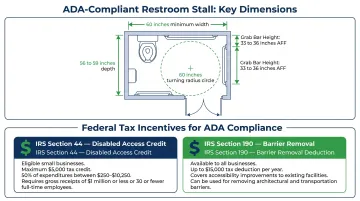
Verify current IRS guidelines with your tax advisor before claiming either.
6. Design Custom Vanities and Countertops That Reflect Your Brand
The vanity area is where a commercial restroom shifts from functional to impressive. Material choices here communicate brand quality more directly than almost anything else in the space.
For commercial applications, quartz and engineered stone surfaces from brands like Caesarstone, Silestone, and Corian Quartz are practical choices — non-porous, durable, and available in a wide range of finishes. Paired with thoughtfully designed cabinetry, the result reads as intentional rather than institutional.
Broadway Kitchens & Baths supplies countertops from Caesarstone, Silestone, Corian Quartz, and MSI Stone, along with custom cabinetry from UltraCraft, Plain & Fancy, and Wolf Classic. Cabinet dimensions can be customized for compact NYC restroom layouts or ADA-compliant vanity configurations.
Their showrooms in Englewood, NJ and Manhattan are available for commercial clients to view materials before specifying them — useful when coordinating with architects or management companies on multi-unit projects.
7. Use Bold Tilework and Statement Walls
A distinctive tile choice — geometric patterns, large-format slabs, textured subway tiles, or a mosaic accent wall — turns an ordinary commercial bathroom into a space worth mentioning. In competitive NYC and NJ markets, that kind of word-of-mouth carries real weight.
The practical approach: focus the high-design tile on one statement wall or the floor, and keep surrounding surfaces neutral. This balances visual impact with long-term maintainability. A bold floor with clean white wall tile is far easier to sustain over years of heavy use than an all-over decorative scheme.
Broadway Kitchens & Baths handles tile selection and professional installation for commercial bathroom projects across Bergen County, Hudson County, and the greater NYC metro area, including retail bathrooms and public restrooms.
8. Incorporate Natural Materials for a Premium Feel
Nature-inspired elements — wood-look porcelain, stone-textured panels, live plants, or bamboo accents — create warmth that cold, hard commercial restrooms typically lack. This works especially well for hospitality, wellness, and upscale retail businesses where the bathroom needs to feel like an extension of the brand experience.
One firm rule: avoid real wood in commercial restroom environments. Moisture and cleaning chemicals will deteriorate it quickly. Instead:
- Wood-look porcelain tile — captures the aesthetic with commercial moisture resistance
- High-pressure laminate (HPL) panels — realistic wood grain textures, designed for humid environments
- Stone-look porcelain — large-format slabs that read as natural stone at a fraction of the maintenance burden
9. Add Inclusive and Family-Friendly Features
Baby changing stations, gender-neutral signage, and family restroom options are increasingly expected rather than exceptional. They also carry specific legal weight in NYC: Local Law 79 of 2016 requires that single-occupant, publicly accessible restrooms in NYC buildings be designated gender-neutral. NYC's Human Rights Law additionally protects restroom access by gender identity.
These additions are relatively low-cost:
- Baby changing stations in accessible locations (the federal BABIES Act sets the national precedent for accessible federal buildings; check local requirements for your jurisdiction)
- Gender-neutral signage updates during any remodel
- Family restroom designation where square footage allows
Most of these updates cost little during an active remodel — the signage and station installations add minimal scope when trades are already on site.
10. Update Plumbing, Ventilation, and Electrical Systems
The least glamorous remodeling idea typically has the greatest long-term impact. In NYC and NJ's older commercial building stock, aging plumbing, inadequate ventilation, and outdated electrical are root causes of odors, moisture damage, mold, and premature fixture failures.
A bathroom remodel is the most cost-effective window to address these systems — the walls are already open, trades are already on site, and disruption costs are already being absorbed.
System upgrades to prioritize during any remodel:
- Ventilation: Exhaust systems should meet ASHRAE 62.1 requirements for toilet rooms; inadequate CFM is the primary driver of persistent odors and moisture buildup
- Electrical: NEC 2023 Article 210.8(B) requires GFCI protection for receptacles in commercial bathroom wet areas — older buildings rarely comply
- Plumbing: Replace aging supply and drain lines while walls are open; proactive replacement costs far less than emergency repairs after fixture failures
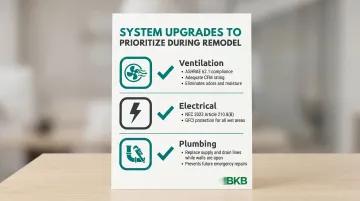
These system investments also extend the useful life of every other improvement made during the remodel.
What to Consider Before Starting Your Commercial Bathroom Remodel in NYC & NJ
Permits and Approvals
Every commercial bathroom remodel in NYC requires DOB filings — typically an Alt-2 for interior renovations not affecting use, egress, or the certificate of occupancy. NJ projects fall under the Uniform Construction Code (N.J.A.C. 5:23), which requires permits for building, plumbing, electrical, and mechanical work. Pulling the correct permits upfront avoids stop-work orders and certificate of occupancy complications.
For NYC buildings constructed before April 1, 1987, asbestos investigation is required before demolition can begin — budget time for surveys and any required abatement.
Budget Planning
Commercial bathroom remodels in NYC and NJ typically run $70–$300+ per square foot, depending on:
- Scope of systems work (plumbing, electrical, ventilation)
- Material selections (standard vs. premium)
- Union vs. non-union labor environment
- Building-specific surprises (asbestos, outdated plumbing, structural constraints)
Projects in this market consistently trend toward the higher end of national ranges. Build contingency into the budget — 15–20% is reasonable for older buildings where hidden conditions are common.
Operational Continuity
Plan for how staff and customers access facilities during construction. Phased remodels, temporary restroom provisions, or scheduling work during off-hours are all viable strategies depending on the business type and remodel scope. The contractor you choose should help you map this out before work begins.
Choosing the Right Contractor
A contractor with demonstrated commercial bathroom experience in the NYC/NJ market specifically understands local code requirements, works effectively in union environments, maintains relationships with local suppliers, and manages the full process — from field measurements through punch-list completion. That expertise directly affects whether a project comes in on time and within budget.
Broadway Kitchens & Baths works as a single point of contact for commercial bathroom projects across the tri-state area — covering design, materials, supply, and installation. The team handles all required insurance documentation and collaborates directly with architects, GCs, and property managers. Schedule a consultation at their Englewood, NJ showroom (257 South Dean Street) or through their NYC office.
Conclusion
A well-executed commercial bathroom remodel in NYC or NJ delivers returns across multiple fronts — customer retention, employee satisfaction, regulatory compliance, and lower long-term maintenance costs. The businesses that see the best outcomes come in with a clear scope, a realistic budget, and a contractor who knows this market.
Broadway Kitchens & Baths has been handling commercial renovation projects across NYC and NJ for over 30 years — managing everything from field measurements and material selection to installation and punch-list, in both union and non-union environments.
To schedule a free consultation, call (201) 567-9585 (Englewood, NJ) or (212) 260-7768 (NYC).
Frequently Asked Questions
What is a realistic budget for a commercial bathroom remodel?
Most commercial bathroom remodels run $70–$300+ per square foot, depending on size, material selections, and the extent of systems work involved. NYC and NJ projects typically land toward the higher end due to local labor rates, permit costs, and the frequency of unexpected conditions in older building stock.
How much does it cost to build a commercial bathroom?
New commercial bathroom construction typically runs $400–$800+ per square foot in the NYC/NJ market, well above the national average. Costs vary based on square footage, fixture selections, and mechanical requirements — get a detailed estimate from a local contractor who can assess site-specific conditions.
What is the most expensive part of a commercial bathroom remodel?
Plumbing and electrical system updates, tile installation labor, and custom vanity or countertop work are consistently the largest cost drivers. In older NYC/NJ buildings, unforeseen conditions — outdated pipes, asbestos, inadequate ventilation — can add substantially to these line items.
What should you avoid when renovating a commercial bathroom?
The most common mistakes are skipping proper permits, specifying residential-grade materials in high-traffic commercial spaces, ignoring ADA compliance until it becomes a liability issue, and underestimating lead times for specialty fixtures or custom materials.
How can I make a commercial bathroom look nice?
Cohesive design — consistent fixture finishes, layered LED lighting, one statement tile element, and quality vanity selections — makes the biggest visual impact. Touchless fixtures and durable, easy-clean surfaces keep it looking good long after opening day without constant maintenance effort.
What are the latest trends in commercial bathroom remodels?
Current trends include touchless technology across all fixture types, floor-to-ceiling privacy partitions, natural material aesthetics (stone-look and wood-look porcelain), warm layered lighting replacing fluorescent, gender-inclusive design, and sustainability-driven fixture selections targeting WaterSense certification and LEED credits.