Introduction
Planning a kitchen remodel in the tri-state area means making decisions that will outlast trends by a decade — and choosing the wrong countertop material, color, or finish is one of the most expensive mistakes to undo.
Quartz now dominates kitchen remodels because it's non-porous, never needs sealing, and holds up across cabinet styles and kitchen configurations without demanding maintenance. The challenge is that "quartz" describes hundreds of distinct products — colors, finishes, and formats that vary widely in how they'll actually look installed in your space.
This guide breaks down 10 specific quartz countertop ideas, covering color, finish, and format, so you can make a confident, informed choice before committing to your remodel.
Key Takeaways
- Quartz is engineered stone (~90% quartz crystals + resin): non-porous, virtually maintenance-free, and available in dozens of 2026-ready styles
- Warm tones (ivory, cream, greige), leathered finishes, and formats like waterfall islands and jumbo slabs lead 2026 trends
- The right choice depends on your cabinet color, kitchen size, lighting, and lifestyle — not just your Pinterest board
- Showroom lighting is misleading; always view samples under your home's natural light before deciding
- Broadway Kitchens & Baths carries Caesarstone, Silestone, Corian Quartz, and MSI Stone across their NJ and Manhattan showrooms
Why Quartz Countertops Dominate Kitchen Remodels in 2026
Engineered quartz is composed of roughly 90% ground quartz crystals bound with resin and pigments — producing a non-porous, factory-consistent surface that granite or marble can't replicate without regular maintenance. Granite and marble require periodic sealing, show unpredictable variation, and can absorb stains if left unprotected — ongoing costs and effort quartz eliminates entirely.
That practical advantage shows up in the numbers. According to Grand View Research, engineered quartz countertops are projected to grow at a CAGR of 8.2% from 2026 to 2033 — outpacing the broader countertop market. The residential segment alone accounts for 72.3% of total countertop market revenue.
That growth is reshaping design choices at the professional level. The NKBA's 2026 Kitchen Trends Report — based on surveys of designers, manufacturers, remodelers, and architects — confirms that professionals are actively moving away from granite and marble in favor of engineered quartz.
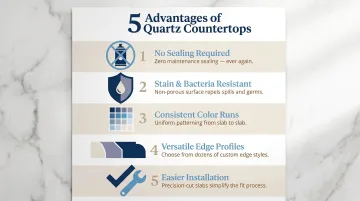
Why quartz wins on every practical front:
- Requires no sealing, ever
- Resists stains and bacterial growth due to its non-porous surface
- Available in consistent color runs, making large islands and matched perimeter countertops achievable
- Works with a wide range of edge profiles — waterfall, mitered, and eased — for a custom finished look
- Easier and faster to install than poured concrete alternatives
10 Best Quartz Countertop Ideas for Your 2026 Kitchen Remodel
These ideas span color, finish, and format — each chosen for durability, versatility, and relevance to where kitchen design is heading in 2026.
Calacatta White Quartz
A bright white background with soft grey or gold veining that mimics Italian Calacatta marble. The light-reflective surface opens up smaller kitchens visually — walls feel farther apart, and the space reads larger without structural changes.
Best pairings: White or light grey shaker cabinets, polished chrome or brushed gold hardware, large-format white floor tile. Broadway Kitchens & Baths carries Caesarstone's #5131 Calacatta and Corian Quartz's Calacatta Natura for homeowners seeking this aesthetic.
Warm Ivory and Gold-Veined Quartz
A creamy ivory base with subtle gold or beige movement — the engineered stone answer to Taj Mahal quartzite. FloForm Countertops identifies this as one of the most-requested aesthetics in 2026, with homeowners wanting the look but preferring quartz's predictability.
Best pairings: Light oak or white oak flat-panel cabinets, matte brass fixtures, wood-look flooring. Broadway Kitchens & Baths carries Caesarstone's #5212 Taj Royale and #5220 Dreamy Marfil in this category.
Concrete-Look Matte Quartz
Flat grey or greige tones with a matte or concrete finish — all the industrial aesthetic of poured concrete without the cracking or maintenance overhead. Caesarstone's concrete line includes multiple options like 4001 Fresh Concrete and 4011 Cloudburst Concrete.
Best pairings: Flat-panel charcoal or navy cabinets, black or gunmetal fixtures, large-format porcelain floors in grey or stone tones. Ideal for modern, minimalist, or industrial kitchen styles.
Soft Greige and Warm Grey Quartz
A neutral blend of grey and beige — minimal veining, maximum versatility. This is the safest countertop choice for resale value and the most forgiving of changing design tastes.
Best pairings: Two-tone cabinetry (white uppers, greige or sage lowers), brushed nickel fixtures, wood or stone-look flooring. If the remodel has one eye on eventual resale, this is the most reliably appealing option.
Earth-Tone Terrazzo Quartz
Quartz incorporating recycled glass chips or contrasting aggregate to create a modern terrazzo effect in warm earth tones. This is a rising 2026 trend driven by interest in textured, sustainable-looking surfaces.
Best pairings: White or cream painted cabinets, natural wood open shelving, rattan or ceramic hardware. Adds visual personality to a neutral kitchen without overwhelming it.
Bold Charcoal or Black Quartz
Deep charcoal, graphite, or near-black quartz — either with subtle veining or as a solid tone — used as a dramatic anchor in high-contrast kitchens. The contrast works because the dark surface absorbs light while white cabinetry reflects it, creating a ratio that reads as intentional rather than heavy.
Best pairings: Crisp white cabinetry, polished chrome or brass fixtures, light wood or white marble-look flooring.
One practical note: dark quartz surfaces show water spots and fingerprints more readily than lighter options. A honed or leathered finish in this color range significantly reduces that issue.
Waterfall Edge Quartz Island
A format idea rather than a color: the countertop surface continues vertically down one or both sides of the island all the way to the floor, creating a seamless, sculptural effect. Getting the veining to align at the corners requires through-body veining quartz and precision fabrication.
This is one of the strongest 2026 statement formats for open-concept kitchens with large islands. It adds perceived value and appears in nearly every high-end kitchen design portfolio. Broadway Kitchens & Baths coordinates full project management from measurements through installation, which matters here — a misaligned waterfall edge is immediately obvious.
Leathered or Honed Finish Quartz
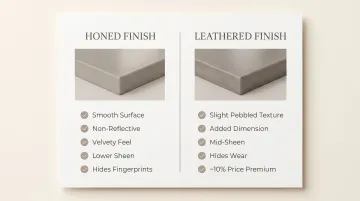
The finish changes everything. Instead of the standard high-gloss polished surface, a honed finish delivers a soft matte sheen, while a leathered finish adds slight tactile texture. Both hide fingerprints, smudges, and minor surface wear far better than polished.
- Honed: Smooth, non-reflective, velvety feel — lower sheen
- Leathered: Slight pebbled texture, a bit more dimension — mid-sheen
Expect roughly a 10% price premium over polished options due to additional processing steps. Worth it for busy family kitchens or any open layout where the countertop sees constant use.
Jumbo-Slab Seamless Quartz
Oversized slabs — Caesarstone's jumbo format measures approximately 128" x 64.5", while Cambria's reaches 132" x 65.5" — used on large islands or long perimeter runs (the continuous countertop stretching along walls) to eliminate visible seams. Fewer seams means a cleaner look and fewer places for bacteria to accumulate.
For islands over 8 feet, this format is worth the higher material cost. It's particularly impactful in open-concept kitchens where the island is the room's visual centerpiece. Caesarstone currently offers jumbo slabs in 17 colors.
Sage Green or Soft-Colored Quartz
One of the boldest shifts in 2026 kitchen design: adding color at the countertop rather than the cabinetry. Sage green, dusty blue, and blush-toned quartz let homeowners inject personality without committing to painted or stained cabinets that are harder to change later.
Best pairings: White or cream Shaker cabinets, brushed brass or matte black fixtures, natural wood accents. This works especially well for homeowners who want a distinctive kitchen but aren't ready to go full-color on their cabinetry.
How to Choose the Right Quartz Idea for Your Kitchen
Most countertop selection mistakes come down to two things: choosing under the wrong lighting, and picking a style without considering what it's sitting next to.
The Lighting Problem
Showroom lighting — typically bright LED spotlights — makes every slab look its best. Natural daylight in your actual kitchen is a different story. White quartz can read cool or slightly blue under north-facing windows. Warm ivory tones look richer in afternoon sun. Before committing, take samples home and observe them at different times of day.
Matching to Your Full Kitchen
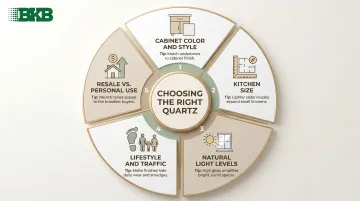
Your countertop doesn't exist in isolation. The right choice depends on:
- Cabinet color and style — Dark cabinets need contrast; light cabinets can handle both light and dark countertops
- Kitchen size — Lighter quartz opens up smaller kitchens; large open-concept spaces can handle bolder color or pattern
- Natural light levels — Low-light kitchens benefit from brighter, warmer tones
- Lifestyle — High-traffic households should lean toward leathered or honed finishes and mid-tone colors that hide wear
- Resale vs. personal use — Trendy colors (sage green, dusty blue) are personal choices; greige and warm white are safer for resale
Working with a Full-Service Remodeler
The countertop decision is only one piece of a kitchen remodel. Broadway Kitchens & Baths carries Caesarstone, Silestone, Corian Quartz, and MSI Stone across their Englewood, NJ and Manhattan showrooms. Their design team handles cabinetry, countertops, and tile selection together — which matters more than it sounds. A countertop that looks perfect in isolation can clash with cabinet undertones once both are installed; coordinating the selections upfront catches those mismatches before they become costly surprises.
Conclusion
The best quartz countertop for your 2026 kitchen remodel isn't the one getting the most attention on social media — it's the one that fits your kitchen's light, pairs naturally with your cabinetry, holds up to how you actually live, and still looks right in ten years.
Quartz is a long-term investment. It adds durability, hygiene, and genuine resale value, but only when it's chosen as part of a cohesive design — not in isolation.
That's where working with an experienced design team makes a real difference. Broadway Kitchens & Baths offers free, no-obligation design consultations at their showrooms in Englewood, NJ and Manhattan, NY — where you can see quartz slabs, cabinetry pairings, and full kitchen configurations in person before committing to anything. Call (201) 567-9585 or stop by to start the conversation.
Frequently Asked Questions
How much does it cost to replace countertops with quartz?
According to Angi's 2026 data, quartz countertops typically run $50–$200 per square foot for materials, plus $10–$30 per square foot for labor, with total projects ranging from $1,000 to $12,000 depending on kitchen size, edge profile complexity, and slab grade. Get a project-specific quote for an accurate number.
How much does it cost to get quartz countertops refinished?
Quartz is an engineered surface bonded with resin and cannot be refinished or re-polished the way natural stone can. Minor chips may be addressable by a fabricator, but heat damage or severe surface issues typically require slab replacement. There's no equivalent of a marble polishing service for engineered quartz.
Can quartz countertops be redone?
Not in the way painted surfaces can. Quartz cannot be recoated or resurfaced. If a slab is structurally intact but aesthetically outdated, full replacement is the only option.
Can you use Clorox wipes on quartz?
Occasional use is generally fine, but routine use of bleach-based products can dull the resin binders over time. Both Caesarstone and Cambria recommend mild soap and warm water for daily cleaning — that's all an engineered quartz surface actually needs.
Should a countertop be lighter or darker than the floor?
There's no firm rule, but contrast typically creates a more dynamic, visually defined kitchen. Lighter countertops over darker floors (or vice versa) prevent the space from reading as flat or monochromatic. Matching both to the same tone tends to flatten the room.
What color countertops are in for 2026?
Warm whites, ivory, warm greige, and earthy soft tones — including sage green and dusty blue — are leading 2026 trends. The shift is away from the cool grey and stark white palettes that dominated the past decade, toward surfaces that feel warmer and more organic.