Introduction
In New Jersey, kitchens carry more weight than in most markets. Buyers scrutinize them. Appraisers price them. Owners live in them daily.
The challenge is real: aging housing stock (the Philadelphia-Camden-Wilmington metro's median housing unit age is 55 years), tight suburban footprints, and direct proximity to one of the country's most design-forward markets across the Hudson all shape what a kitchen renovation has to accomplish here.
The result? A renovation landscape where aesthetics and practicality have to coexist — and where the right choices can meaningfully affect resale value. According to the 2025 Cost vs. Value Report, a minor midrange kitchen remodel in the Mid-Atlantic region recoups 107.2% of its cost at resale. In practical terms, the right kitchen upgrades don't just improve daily life — they pay back at resale.
This guide covers the 15 trends actually showing up in NJ renovation projects right now — organized across four categories: design and style, cabinetry and storage, countertops and surfaces, and technology and sustainability.
Key Takeaways
- Design is moving away from all-white minimalism toward warm, earthy, layered spaces
- Cabinetry is getting bolder: two-tone finishes, handleless profiles, and pantry walls are leading requests
- Natural stone is reclaiming ground from engineered quartz, with waterfall edges becoming a signature move
- Smart tech and sustainability are now baseline expectations in NJ kitchen renovations
- Kitchen islands have become full social and functional hubs, combining seating, storage, and prep in one
Design and Style Trends Reshaping NJ Kitchens in 2026
NJ homeowners are moving away from the sterile, all-white kitchen aesthetic that dominated the 2010s. The new direction draws from NYC design culture: richer tones, tactile materials, and layouts built around how people actually use their kitchens.
Trend 1: Warm Earthy Tones Replacing All-White Kitchens
White cabinets now appear in just 33% of renovated kitchens, according to the 2025 Houzz Kitchen Trends Study — a notable drop from prior years. The NKBA's 2026 Colors of the Year roundup identifies greens, blues, and browns as the dominant kitchen tones replacing them.
What's replacing white? Rich terracottas, sage greens, creamy off-whites, and deep forest tones. Benjamin Moore named Silhouette (a rich espresso brown) its 2026 Color of the Year. Sherwin-Williams went with Chrysanthemum, a warm amber. Both choices lean into the same underlying shift: kitchens that feel warm and lived-in rather than sterile and staged.
For NJ homeowners, this shift is practical: warmer tones complement the natural light typical of Bergen and Essex County homes better than stark white.
Trend 2: Open-Concept Layouts with Defined Kitchen Zones
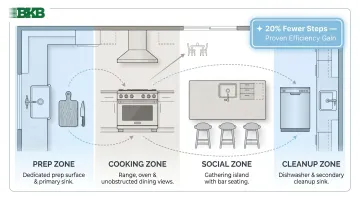
Open-concept layouts remain the standard in NJ suburban homes, but the 2026 approach adds structure. Designers are now carving defined zones — prep, cooking, cleanup, social — using islands, lighting changes, and material shifts rather than walls.
This matters in NJ's suburban homes where the kitchen-dining area is often one connected space. The "everything visible" problem of fully open layouts gets resolved through intentional zone definition:
- Prep zone: Positioned near the sink with dedicated counter space
- Cooking zone: Anchored by the range with a clear sightline to the dining area
- Social zone: Island seating oriented toward the family room
- Cleanup zone: Dishwasher and secondary sink tucked away from the main flow
The NKBA reports that kitchens organized into task zones see 20% fewer steps during meal prep compared to traditional triangle layouts — a real-world efficiency gain.
Trend 3: Mixed Metals and Statement Hardware
Single-finish kitchens are giving way to intentional metal mixing. NJ homeowners are pairing brushed brass with matte black, or unlacquered brass alongside stainless, to build a layered look rather than a showroom-catalog feel.
The anchor metal principle keeps this from looking unfinished: choose one dominant metal (say, matte black for cabinet pulls and the faucet), then introduce a secondary accent metal (brushed brass for lighting and open shelving brackets) in smaller doses. The ratio should sit around 70/30. Without that structure, the mix reads as accidental rather than intentional.
Hardware and fixture selection has become a deliberate design conversation that needs to happen early in the project — not as an afterthought once cabinets are installed.
Trend 4: Statement Backsplashes — Zellige Tile, Fluted Surfaces, Textured Materials
The backsplash has become the kitchen's primary design statement. Standard subway tile is giving way to three dominant options:
- Zellige tile: Handmade Moroccan clay tile with natural color variation and uneven edges — the handcrafted imperfection is the point
- Fluted/ribbed ceramic: Adds dimensional texture without the visual complexity of pattern tile
- Large-format textured slabs: Runs countertop-to-ceiling for a dramatic, seamless effect
The 2025 Houzz study found that 85% of homeowners upgrade their backsplash during a kitchen remodel — second only to countertops. And unlike a full cabinet replacement, backsplash installation is one of the most cost-effective ways to completely shift a kitchen's character, making it accessible across budget levels.
Cabinetry and Storage Trends NJ Homeowners Are Requesting
Cabinetry typically accounts for 26–29% of a kitchen renovation budget — the single largest line item. The 2026 cabinetry trends reflect both aesthetic sophistication and a growing demand for smarter organization. Working with a supplier that offers genuine variety across price points and finish options — like Broadway Kitchens & Baths, which carries UltraCraft, Plain & Fancy, Wolf Classic, and others — is especially important when navigating these decisions.
Trend 5: Two-Tone Cabinetry — Dark Lowers, Light Uppers
Two-tone layouts have replaced the all-one-color cabinet approach in mid-to-large NJ kitchens. The formula: darker, richer tones on base cabinets (navy, forest green, deep charcoal) with lighter or white uppers to keep the space from feeling heavy.
This combination creates visual balance and grounded elegance. In NJ's mid-size suburban kitchens, where ceiling heights can make all-dark cabinetry feel oppressive, two-tone is often the smarter structural call.
Broadway Kitchens & Baths' Shaker kitchen documentation notes that "contrasting islands or two-toned kitchens are very popular," reflecting what their design team hears from clients regularly.
Trend 6: Handleless and Slab-Front Cabinet Profiles
Handleless cabinetry — using integrated grip channels, push-to-open mechanisms, or recessed finger pulls — delivers the clean, European-influenced look NJ homeowners are increasingly requesting. The result is a kitchen where the cabinetry becomes a smooth architectural surface rather than a collection of hardware.
Two details to resolve early in the design process:
- Installation precision matters more — handleless doors require tighter tolerances and more careful alignment than traditional hardware-pulled cabinets
- Finish selection is critical — matte finishes hide fingerprints significantly better than high-gloss; for an active family kitchen, matte or satin is the smarter choice
Trend 7: Built-In Pantry Walls and Concealed Storage Systems
Floor-to-ceiling pantry walls and concealed appliance garages are now baseline expectations in NJ kitchen projects. For NJ homeowners dealing with smaller kitchens, this trend offers a way to substantially increase storage capacity without touching the footprint.
Broadway Kitchens & Baths integrates storage accessories from suppliers like Rev-A-Shelf, Richelieu, and Häfele as part of their cabinetry planning process. The most requested internal configurations:
- Pull-out roll systems that bring items to the front of deep cabinets
- Dedicated spice pull-outs flanking the range (typically 6-inch base cabinets on tracks)
- Double-bin trash pull-outs in 18-inch base cabinets
- Corner solutions including pull-out chrome systems and wooden lazy Susans
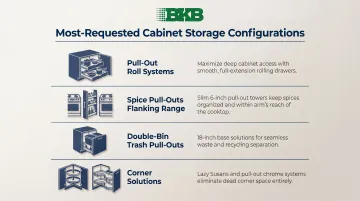
On most projects Broadway handles, these configurations are specified at the planning stage, not added later.
Trend 8: Glass-Front Upper Cabinets for Curated Display
Glass-front uppers are back , and not simply as a nostalgic callback. They're functioning as a deliberate visual contrast to the otherwise streamlined, handleless cabinetry trend, providing rhythm and breathing room in kitchens that could otherwise feel too austere.
Fluted or reeded glass inserts are the 2026 variant of choice, tying directly into the broader textured surfaces trend. Rather than clear glass (which requires meticulously styled shelves to look intentional), fluted glass obscures the contents enough to forgive imperfection while still letting light through.
Countertop and Surface Trends Gaining Ground in NJ
The quartz countertop boom of the early 2020s is giving way to more nuanced material choices. NJ homeowners want surfaces that feel less catalog and more considered.
Trend 9: Waterfall Edge Countertops
A waterfall countertop — where the stone continues vertically down the sides of an island to the floor — has become the signature luxury-look element in mid-range NJ renovations. What was once reserved for high-end projects is now showing up across a wider budget range.
The cost reality: a waterfall island typically adds $3,000 to $10,000+ over a standard island configuration, driven by the additional slab material and the specialized fabrication required to match veining precisely at the corner. Materials that translate best:
- Natural quartzite: Preferred for the organic vein movement
- Engineered quartz: More forgiving for matching; widely available
- Sintered stone/porcelain slab: Excellent for contemporary, minimal aesthetics
Broadway Kitchens & Baths' Tenafly, NJ project portfolio includes a modern kitchen with glass and black marble countertops featuring waterfall sides on the island — a real-world example of this trend in a Bergen County suburban home.
Trend 10: Quartzite and Natural Stone Reclaiming Ground from Engineered Quartz
Engineered quartz remains the dominant countertop material in NJ kitchens — but quartzite is closing the gap. The appeal is straightforward: quartzite offers marble-like aesthetics (the veining, the movement) with better durability and wear resistance. It's harder than granite, heat-resistant, and scratch-resistant, though it requires periodic sealing given its porous nature.
MSI Surfaces identified both natural quartzite and quartzite-look quartz as leading 2025 countertop trends, noting that homeowners increasingly want "visual appeal and resilience against daily use." Popular varieties showing up in NJ projects:
- Taj Mahal: Warm gold veining on a creamy white ground
- White Macaubas: Charcoal veining on a bright white ground
Engineered quartz still holds an edge for large installations — it's non-porous, never needs sealing, and delivers consistent batch-to-batch color matching.
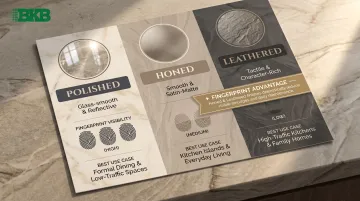
Trend 11: Leathered, Honed, and Fluted Finishes Over High-Polish
The ultra-polished countertop look is losing ground to tactile alternatives:
- Leathered granite: Slightly textured surface that enhances the natural pattern
- Honed marble: Matte, velvety finish instead of the mirror-like polish
- Fluted stone accents: Dimensional ribbing applied to island sides or feature surfaces
These finishes earn their place on functional grounds too. Honed and leathered surfaces show fewer fingerprints and watermarks than high-gloss polished stone — a real advantage in an active NJ family kitchen where countertops take daily abuse.
Technology and Sustainability Trends in 2026 NJ Kitchen Renovations
NJ homeowners — particularly in Bergen, Essex, and Middlesex County markets — are treating smart technology and sustainable materials as baseline expectations, driven by rising utility costs and a competitive real estate market that rewards move-in-ready, future-proof kitchens.
Trend 12: Smart Kitchen Appliances and Integrated Technology
The smart kitchen features gaining real traction in NJ renovations:
- Wi-Fi-enabled refrigerators with inventory tracking
- Voice-controlled faucets and touchless fixtures
- Smart ranges with remote preheating
- Under-cabinet charging stations with USB-C and wireless pads
- Integrated LED lighting systems with scene control
On the resale side, the NAR's 2025 Profile of Home Buyers and Sellers found that 5% of buyers cited smart home features as a factor in their purchase decision — a modest but growing segment that will only expand as these features become standard.
Trend 13: Induction Cooktops and Energy-Efficient Cooking
Induction adoption in NJ kitchens is accelerating, and the economics explain why. As of May 2026, NJ's residential electricity rate sits at 22.65 cents/kWh, roughly 25% above the national average. Induction cooking is 85–90% energy-efficient versus roughly 40% for gas, making it cost-effective despite NJ's above-average electricity rates.
NJ's electrification goal — 400,000 dwelling units electrified by 2030 — is supported by a rebate infrastructure rather than mandate. The NJ Board of Public Utilities received $91.3 million through the IRA-funded Home Electrification and Appliance Rebates (HEAR) program, with funds available for appliance upgrades.
Induction cooktops also create a flat, seamless surface that complements the streamlined handleless cabinetry seen throughout 2026 NJ renovations — a practical upgrade that doubles as a design choice.
Trend 14: Sustainable and Reclaimed Materials
Specific sustainable choices appearing in NJ renovation projects:
- FSC-certified cabinet wood: Brands like Conestoga Wood Specialties offer chain-of-custody certified options
- Recycled glass countertop inserts: Particularly in island designs
- Reclaimed wood open shelving: As a counterpoint to the polished cabinetry
- Low-VOC cabinet finishes: Both an environmental and indoor air quality consideration
NJ homeowners can access rebate programs through JCP&L for ENERGY STAR certified appliances and through PSE&G's appliance recycling incentives, in addition to the BPU's broader HEAR program. These programs offset a portion of the upfront cost of eco-conscious choices.
Trend 15: The Multifunctional Kitchen Island as the Room's Social Hub
The 2026 NJ kitchen island functions as a fully designed station, combining prep, cooking, storage, and social seating into one purpose-built centerpiece:
- Prep and cooking: Integrated prep sink, cooktop option
- Social seating: 3–4 seats with 15-inch overhang for knee clearance
- Appliance integration: Beverage drawers, warming drawers, dishwasher drawers
- Connectivity: Under-counter charging, pendant lighting above
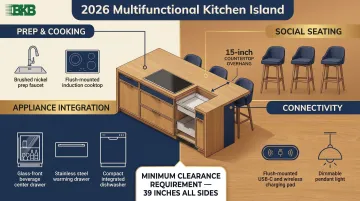
The 58% of homeowners who add or upgrade an island during renovation (per the 2025 Houzz study) are increasingly spec-ing islands over 7 feet long. NJ's suburban kitchens often can't accommodate that scale, so sizing to the room matters as much as the feature list.
Broadway Kitchens & Baths recommends a minimum 39-inch clearance between the island and base units (roughly 3 feet) for full door opening and comfortable traffic flow. The kitchen should be at least 11.5 x 11.5 feet to accommodate an island without compromising circulation.
NKBA guidelines set the minimum work aisle at 42 inches for a single cook, 48 inches for multiple cooks. In NJ kitchens where the island is also a social hub during parties, the 48-inch standard is worth building to.
What's Driving These Kitchen Renovation Trends in New Jersey
Three NJ-specific forces are converging to shape the 2026 renovation landscape:
NYC proximity accelerates trend adoption. The tri-state area shares a design marketplace: the same showrooms, architects, and design media shaping Manhattan renovations reach Bergen and Essex County homes within a year or two. NJ homeowners see finished NYC kitchens in person, through real estate listings, and on social media — then bring those references to their renovation consultations.
NJ labor costs are substantially above national averages. BLS data shows NJ construction laborers earn a mean hourly wage of $32.35 versus the national mean of $23.69 — a premium that puts real pressure on renovation budgets. This is pushing homeowners toward durable, timeless material choices (quartzite over trendy laminates, quality cabinetry over builder-grade) that won't need replacement in a decade.
ROI math favors kitchen investment. In a high-competition NJ housing market, a renovated kitchen is one of the clearest differentiators. Minor midrange kitchen remodels in the Mid-Atlantic region recoup 107.2% of their cost at resale — one of the few renovation categories where you legitimately come out ahead. That return is why so many NJ homeowners are pursuing design-led renovations, not just basic upgrades — and why the 15 trends below are gaining serious traction.
Conclusion
Across all 15 trends, NJ kitchens in 2026 are moving toward spaces that are warmer, smarter, and built to last. The common thread isn't any single finish or fixture — it's intentionality. Homeowners are making choices that hold up aesthetically and functionally for years, not just through the next design cycle.
For NJ homeowners ready to act on these ideas, Broadway Kitchens & Baths offers a free, no-obligation design consultation at their Englewood showroom (257 South Dean St.). They carry a wide range of cabinetry finishes, countertop materials, and fixtures — and can work with your existing contractor on design and supply alone.
Prefer full project management? Their team handles everything from demolition through final walkthrough. Reach them at +1 201-567-9585.
Frequently Asked Questions
What is the new look for kitchens in 2026?
The 2026 kitchen is defined by warm earthy tones, textured surfaces, two-tone cabinetry, and integrated smart technology. It's a clear move away from all-white minimalism toward layered, personalized spaces with materials that have visual depth and tactile character.
What is the newest trend in countertops?
Quartzite and natural stone are reclaiming ground from engineered quartz — a strong choice for homeowners who want the marble look with better durability. Waterfall edge installations and leathered or honed finishes are among the most requested countertop upgrades in 2026.
How much does it cost to redo a kitchen in NJ?
NJ kitchen renovations typically range from $28,000 for budget remodels up to $75,000+ for high-end projects, with some full gut renovations exceeding $110,000. Local labor costs run well above national averages, so treat national cost guides as a floor, not a benchmark.
How much should a 20x20 kitchen remodel cost?
A 400 sq ft kitchen in NJ at a mid-range finish level typically runs $50,000–$100,000+, with structural changes, layout shifts, or significant plumbing and electrical work pushing costs toward the higher end.
Should I paint kitchen cabinets or replace countertops first?
Finalize your cabinet color and finish before selecting countertops — countertop material and color should complement the cabinetry, not the other way around. If keeping your existing countertops, painting cabinets first makes sense so you can confirm the combination works before committing.
What program is used to design kitchen layouts?
Professional kitchen designers typically use CAD-based software such as 20-20 Design or Chief Architect for precise, to-scale layouts. Consumer-friendly tools like RoomSketcher or IKEA's kitchen planner work well for early concept exploration; for full installation planning, working with a professional designer ensures accuracy.