Introduction
Commercial bathroom remodeling in New York and New Jersey isn't what it used to be. Aging infrastructure in pre-war buildings, tenants expecting hotel-grade hygiene standards, and increasingly enforced ADA requirements have pushed property owners from reactive repairs to strategic overhauls.
The stakes are real. A poorly maintained or non-compliant restroom can:
- Trigger occupancy permit issues or failed inspections
- Expose ownership to ADA liability in high-traffic commercial spaces
- erode tenant retention in one of the most competitive real estate markets in the country
A well-executed remodel tells a different story — it increases property value, supports LEED certification goals, and signals to tenants that building management takes quality seriously.
This article covers the six most effective commercial bathroom remodeling solutions for NJ and NYC properties — from ADA-compliant redesigns and touchless fixture upgrades to space optimization in tight urban footprints — along with guidance on how to evaluate and choose the right approach for your property.
Key Takeaways
- ADA compliance, high foot traffic, and tenant expectations drive most commercial bathroom remodels in NJ and NYC
- The six solutions: ADA redesigns, touchless fixtures, high-traffic flooring, custom cabinetry/vanities, plumbing overhauls, and space optimization
- Solution selection should follow property type, local codes, and building age — not aesthetics or lowest bid
- Most commercial bathroom work in NJ and NYC requires permits — build that into your project timeline
- Hire contractors fluent in local codes and both union and non-union environments to stay on time and on budget
Commercial Bathroom Remodeling in NJ & NYC: What Makes It Different
Commercial bathroom remodeling goes well beyond swapping fixtures. In this market, a remodel typically involves structural modifications, mechanical upgrades, and mandatory compliance work — all governed by commercial building codes that differ substantially from residential standards.
New York City alone holds nearly 730 million square feet of office space across the five boroughs — and that's before accounting for hospitality, mixed-use, and multi-tenant retail. Every one of those buildings has restrooms that age, fall out of compliance, and eventually require intervention.
Regulatory requirements add complexity on both sides of the Hudson:
- New Jersey (NJ UCC, NJAC 5:23): The Bureau of Construction Project Review completes first reviews within 20 business days of a complete submittal.
- New York City (NYC DOB): A NYS Registered Design Professional — a licensed PE or RA — must file plans for most construction work.
Understanding these requirements upfront determines which solution fits your property — and how to scope the project without delays.
6 Best Commercial Bathroom Remodeling Solutions
These solutions are selected based on compliance relevance, impact, and adaptability across commercial property types in the NJ/NYC built environment.
ADA-Compliant Restroom Redesigns
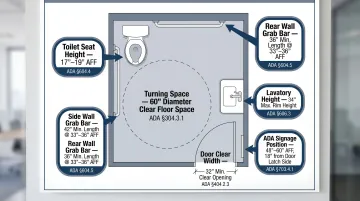
For most commercial properties, ADA compliance isn't optional — it's the law, and non-compliance creates real exposure. The 2010 ADA Standards for Accessible Design establish clear dimensional requirements for commercial restrooms:
- Turning space: 60-inch diameter circular clearance (Section 304.3)
- Toilet seat height: 17–19 inches from finished floor (Section 604.4)
- Grab bars: Mounted 33–36 inches above floor; side wall minimum 42 inches long, rear wall minimum 36 inches long
- Door clear width: 32 inches minimum at 90 degrees (Section 404.2.3)
- Lavatory height: 34 inches maximum to rim or counter (Section 606.3)
- Signage: Tactile characters with Braille, mounted 48–60 inches AFF at the latch side
NYC and NJ layer additional requirements on top of federal standards. NYC applies Chapter 11 of the 2022 NYC Building Code for accessibility scoping on new and altered work. New Jersey's Barrier Free Subcode (N.J.A.C. 5:23-7) governs accessibility under the NJ UCC, with enforcement by local construction officials.
Older buildings — and much of the NJ/NYC commercial stock predates modern accessibility mandates — often require reinforced walls for grab bar blocking, doorway widening, and full fixture repositioning. Non-compliant alterations can jeopardize Certificate of Occupancy approvals through NYC DOB.
| Category | Details |
|---|---|
| Best For | Office buildings, retail spaces, restaurants, hotels, and any property open to the public |
| Key Features | Barrier-free layouts, reinforced walls for grab bars, compliant fixture heights, accessible door widths and turning radius, ADA-compliant signage |
| Estimated Timeline | Varies by scope; typically 2–6 weeks for retrofit projects |
Touchless & Smart Fixture Upgrades
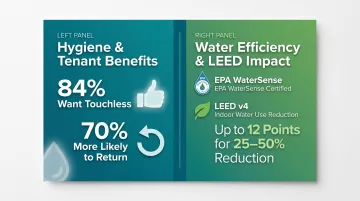
High-traffic commercial restrooms in office buildings, hotels, and restaurants have a strong business case for touchless upgrades — and the data backs it up. According to a 2021 Plumbing & Mechanical survey, 84% of Americans want touchless fixtures in public restrooms, and 70% are more likely to return to a business that offers them.
Key components of a touchless upgrade include:
- Sensor-activated faucets and auto-flush toilets
- Touchless soap dispensers and paper towel systems
- Motion-activated lighting
- Water flow controls and low-consumption valves
Beyond hygiene, these systems reduce long-term maintenance costs and support water efficiency goals. The EPA's WaterSense program provides frameworks for commercial buildings to reduce water and energy use through high-efficiency fixture selection. For properties pursuing LEED certification, the Indoor Water Use Reduction credit under LEED v4 awards up to 12 points for demonstrating 25–50% reductions versus baseline — touchless faucets and auto-flush systems directly support that target.
Broadway Kitchens & Baths carries plumbing fixture lines from brands including Kohler, Toto, Hansgrohe, and Brizo for commercial bathroom applications — all brands with sensor and low-flow commercial product lines.
| Category | Details |
|---|---|
| Best For | High-traffic office buildings, hotels, restaurants, and healthcare-adjacent commercial spaces |
| Key Features | Sensor faucets, auto-flush toilets, touchless dispensers, motion-activated lighting, water-saving controls |
| Estimated Timeline | Typically 1–3 weeks depending on fixture count and existing plumbing compatibility |
High-Traffic Flooring & Wall Surface Solutions
Commercial bathroom floors in NJ and NYC face conditions that residential materials simply can't handle: constant foot traffic, moisture exposure, aggressive cleaning chemicals, and strict safety requirements. The wrong surface choice leads to premature failure, slip liability, or both.
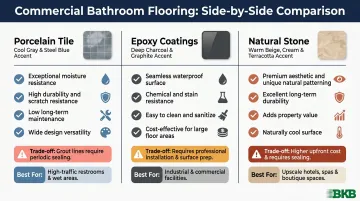
Flooring options and trade-offs:
- Porcelain tile — Industry standard for commercial wet areas. Dense, low-absorption, and available in large-format options that reduce grout lines and maintenance. Must meet slip resistance standards.
- Epoxy coatings — Cost-effective for warehouse-style or back-of-house commercial restrooms. Seamless surface resists moisture and chemicals; requires proper surface prep and may need recoating over time.
- Natural stone — Premium aesthetic for hospitality and upscale office environments, but requires sealing and more intensive maintenance in wet areas.
On slip resistance: The Tile Council of North America (TCNA) recognizes ANSI A326.3 as the current dynamic coefficient of friction (DCOF) test standard for hard surface flooring. Interior level wet areas are generally referenced against a 0.42 wet DCOF minimum under prior ANSI A137.1 use classification — verify current requirements against A326.3 product classifications for your specific project.
On the wall side, grout-free waterproof panel systems eliminate a major maintenance point in high-moisture environments. Evaluate panels against relevant health and hygiene certifications (NSF, GREENGUARD) based on the specific occupancy type.
Broadway Kitchens & Baths provides wall and floor tile installation as part of its commercial bathroom scope, serving retail bathrooms and public restrooms across Bergen County, Hudson County, and the greater NYC metro area.
| Category | Details |
|---|---|
| Best For | Any high-traffic commercial restroom — gyms, restaurants, hotels, and transit-adjacent retail |
| Key Features | Slip-resistant porcelain or stone tile, epoxy flooring, grout-free wall panels, antimicrobial surface options |
| Estimated Timeline | Typically 1–4 weeks depending on square footage and surface prep requirements |
Custom Cabinetry, Vanity & Storage Installations
In hospitality properties, upscale office suites, and mixed-use developments, the bathroom vanity is a first impression. Custom cabinetry solves functional problems — storage, workflow, ADA-compliant counter heights — while delivering the finish quality that distinguishes a premium property from a standard one.
Broadway Kitchens & Baths offers commercial-grade cabinetry through lines including UltraCraft, Plain & Fancy, Hanssem/Massachusetts Design, Wolf Classic Cabinets, and Great Northern. Material options span woods, high-pressure laminate, melamine, Italian veneer, metal, and thermofoils — allowing specification based on budget, aesthetic, and moisture resistance requirements.
For countertops, the company supplies and installs engineered quartz from Caesarstone, Silestone, and Corian Quartz, as well as natural stone options through MSI Stone.
The process is designed to fit commercial project timelines. After field measurements and design sign-off, Broadway Kitchens & Baths coordinates material ordering, fabrication, and installation through their own carpentry crews — managing every phase from design concept through punch-list completion. They're also proficient in both union and non-union environments, which matters considerably in NYC commercial construction.
| Category | Details |
|---|---|
| Best For | Hotels, high-end office suites, upscale retail, and multi-unit residential buildings with shared commercial bathrooms |
| Key Features | Custom cabinet sizing, engineered quartz and stone countertops, moisture-resistant material options, integrated sink vanities, varied finish and door style options |
| Estimated Timeline | Typically 3–6 weeks including design, fabrication, and installation |
Commercial-Grade Plumbing & Fixture Overhauls
Many NJ and NYC commercial properties — particularly those in pre-war or mid-century buildings — run on plumbing infrastructure that was never designed to handle modern fixture counts or water efficiency expectations. Chronic low pressure, corroded supply lines, and undersized drain systems are symptoms of a root-cause infrastructure problem that cosmetic work can't fix.
A full plumbing overhaul typically addresses:
- Replacement of aging galvanized or cast-iron supply and drain lines
- Installation of pressure-balancing valves to stabilize water temperature and pressure
- Low-flow toilet and urinal upgrades (WaterSense-labeled fixtures support indoor water reduction goals)
- Updated fixture connections to support touchless and sensor-activated systems
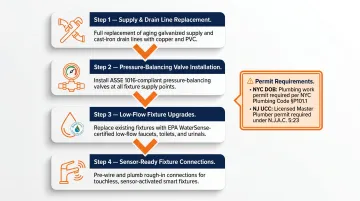
Permitting is non-negotiable here. In NYC, plumbing is a primary permit type under the DOB system, and a NYS Registered Design Professional must file plans. In NJ, the UCC governs with the Bureau of Construction Project Review handling plan review — expect at least 20 business days for first review of a complete submittal.
Work with a contractor who coordinates permit acquisition as part of project scope. Attempting to manage the NYC DOB or NJ DCA permitting process separately from construction almost always adds delays.
| Category | Details |
|---|---|
| Best For | Older commercial buildings, multi-tenant office properties, and buildings upgrading to water-efficient systems |
| Key Features | Low-flow toilets and urinals, updated supply/drain lines, pressure-balancing valves, water-efficient fixture packages |
| Estimated Timeline | Typically 2–5 weeks depending on building age, floor count, and scope |
Space Optimization & Layout Reconfiguration
Square footage is currency in NYC and dense NJ markets. Single-occupancy restrooms that can't serve morning peak demand, back-of-house bathrooms eating into revenue-generating space, and undersized layouts that fail minimum fixture counts — these are solvable design problems, often without touching load-bearing walls.
Common reconfiguration strategies include:
- Converting single-occupancy restrooms to multi-stall configurations
- Incorporating underused adjacent storage or utility space into bathroom square footage
- Installing wall-hung toilets and compact vanities to recover floor area
- Using pocket doors to eliminate swing clearance conflicts
- Repositioning fixtures to maximize circulation and ADA turning radius
NYC's Administrative Code Section 403.1 specifies minimum fixture counts by occupancy — for business use, one water closet per 1–20 occupants at the base tier, scaling upward. A reconfiguration that doesn't account for these minimums may satisfy the aesthetic goal but fail plan examination.
In NYC, layout reconfigurations that involve structural or mechanical changes require a NYS PE or RA to file construction plans with the DOB.
Broadway Kitchens & Baths works collaboratively with architects, general contractors, and builders on commercial bathroom reconfiguration projects — providing design, material sourcing, and installation while trade professionals maintain broader project oversight. Their builders division has over 12 years of experience working with developers and construction managers across Bergen County, Manhattan, Brooklyn, and surrounding areas.
| Category | Details |
|---|---|
| Best For | Small NYC office suites, restaurants with limited back-of-house, and retail spaces with single-occupancy restrooms |
| Key Features | Fixture repositioning, pocket doors, wall-hung toilets, corner vanities, compact layout planning, architect coordination |
| Estimated Timeline | Typically 3–8 weeks depending on whether structural or mechanical changes are required |
How to Choose the Right Solution
The most common mistake property owners make is selecting a remodeling solution based on aesthetics or the lowest bid. That approach almost always surfaces problems mid-project — an ADA non-conformance caught at plan examination, a plumbing upgrade scope that balloons once walls open, or a permit process that wasn't budgeted into the schedule.
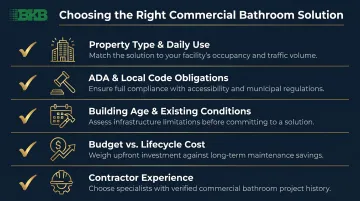
Evaluate solutions against these criteria before committing:
- Property type and daily use — A restaurant restroom with 300 covers per day has different durability and hygiene requirements than a 10-person office suite
- ADA and local code obligations — Determine what compliance gaps exist before scoping the work; retroactive corrections are expensive
- Building age and existing conditions — Older buildings often reveal surprises (asbestos, undersized supply lines, inadequate blocking) that affect both scope and budget
- Budget vs. long-term maintenance cost — Lower-cost surface finishes often carry higher maintenance costs over time; model the lifecycle, not just the installation cost
- Contractor experience — Verify familiarity with NYC DOB and NJ UCC permitting, capability in union and non-union environments, and a track record with your property type
A 2025 AGC survey found that 92% of construction firms reported difficulty hiring, making workforce availability the leading cause of project delays nationally. In NJ and NYC labor markets, that pressure is acute. Choose partners who have established crews and trade relationships, not those assembling a team project by project.
The best commercial remodeling partners handle the full scope: field measurements, design, permitting coordination, installation, and punch-list sign-off. That single point of accountability means fewer gaps, fewer surprises, and less time managing handoffs between trades.
Conclusion
Commercial bathroom remodeling in NJ and NYC is a strategic capital decision — one that affects compliance standing, tenant satisfaction, and long-term asset value. Whether the driver is ADA compliance, aging infrastructure, sustainability goals, or competitive repositioning, the solution has to match the property's operational reality and local code environment — not just the budget.
Evaluate potential partners on local code knowledge, project management depth, and direct experience with commercial builds in the tri-state area. A contractor who can navigate NYC DOB plan examination and NJ UCC review — while coordinating trades on a live commercial schedule — delivers far more value than the one who simply comes in lowest.
Broadway Kitchens & Baths works with commercial property owners, architects, and management companies across Bergen County, Hudson County, Manhattan, Brooklyn, and the greater NYC metro area on bathroom remodeling projects ranging from single-suite upgrades to multi-unit gut renovations. To discuss your project, reach out at +1 201-567-9585 or visit the showrooms in Englewood, NJ or Manhattan, NY.
Frequently Asked Questions
How much does a commercial bathroom remodel cost in NJ or NYC?
Minor fixture upgrades typically run $10,000–$30,000. Full gut renovations with ADA retrofits and plumbing overhauls in NYC buildings can exceed $100,000. Permit fees, union labor rates, and building age all push costs higher.
How long does a commercial bathroom renovation typically take?
Fixture-only upgrades typically complete in 1–3 weeks. Full renovations involving structural, mechanical, and compliance work generally run 4–10 weeks. Permit processing adds time — NJ DCA first reviews take up to 20 business days; NYC DOB timelines vary by project type and plan examination scheduling.
What ADA requirements apply to commercial bathrooms in New Jersey and New York?
The 2010 ADA Standards for Accessible Design set federal minimums; NYC adds requirements through Chapter 11 of the 2022 NYC Building Code, while New Jersey's Barrier Free Subcode (N.J.A.C. 5:23-7) governs locally. Confirm which adopted edition of ICC/A117.1 applies with your local construction official.
Do commercial bathroom remodels require permits in NJ and NYC?
Yes. Any commercial bathroom work involving plumbing, structural changes, or electrical modifications requires permits. NYC DOB is the permitting authority in the five boroughs; local NJ municipal construction offices handle permits under the NJ UCC. A NYS Registered Design Professional must file plans for most NYC construction.
What is the most durable flooring option for a high-traffic commercial bathroom?
Porcelain tile is the most widely specified option — dense, low-maintenance, and available in verified slip-resistant formats. Epoxy coatings are a cost-effective alternative for utility-grade spaces. For either option, confirm the tile or coating meets the 0.42 wet DCOF minimum per ANSI A326.3 test methodology for interior wet areas.
How do I find the right contractor for a commercial bathroom remodel in NJ or NYC?
Look for contractors with commercial licensure, demonstrated knowledge of NYC DOB and NJ UCC requirements, and a track record with your property type. Verify their experience in both union and non-union environments — then ask specifically about prior commercial projects in the tri-state area and how they handle permitting.