Yet property managers and business owners consistently treat commercial bathrooms as afterthoughts. The result: dated fixtures, non-compliant layouts, and spaces that actively undermine the brand experience they've worked hard to build elsewhere in the building.
The stakes are higher than most realize. According to Bradley Corporation's 2025 Healthy Handwashing Survey, 75% of Americans will think twice before returning to a business after a bad restroom experience, and more than 90% associate restroom quality directly with overall business quality.
This article covers 8 commercial bathroom design ideas and trends that are gaining traction in NYC and NJ — practical, durable, and built for the demands of high-traffic commercial environments.
Key Takeaways
- Restroom quality directly affects customer retention — businesses that invest in better facilities see measurable gains in repeat visits and guest satisfaction
- Top 2026 trends include touchless tech, spa-inspired minimalism, biophilic elements, and bold branded finishes
- ADA compliance is non-negotiable in NYC and NJ — violations carry fines up to $75,000 for a first offense
- Compact NYC spaces benefit most from floating vanities, large-format tile, and recessed storage
- Choose a remodeler fluent in local codes and union/non-union environments to avoid costly delays
Why Commercial Bathroom Design Matters in NYC & NJ
Commercial bathrooms in the tri-state area carry an unusual burden. They absorb hundreds — sometimes thousands — of daily users, must meet strict NYC DOB and ADA requirements, and serve a client base that expects elevated interiors as a baseline, not a bonus.
The numbers back this up consistently across sectors:
- 71% of Americans are more likely to return and spend more at businesses with clean, well-maintained restrooms
- 70% have chosen one business over a competitor based on restroom reputation alone
- These patterns hold across office, retail, and food service environments — not just hospitality
In NYC and NJ specifically, the pressure intensifies. Dense foot traffic accelerates wear faster than most markets, while local law compliance — including NYC's Local Law 97 for larger commercial buildings — adds a layer of regulatory complexity most renovation projects can't ignore. In competitive commercial real estate, shared bathroom conditions also factor directly into tenant retention and lease renewal decisions.
The designs and trends below are selected for their relevance to these conditions — balancing visual impact with the durability and code compliance that NYC and NJ commercial projects demand.
8 Best Commercial Bathroom Design Ideas & Trends
These ideas are selected based on their growing adoption in commercial renovations across NYC and NJ, their performance in high-traffic settings, and their ability to reflect a business's identity without sacrificing function.
1. Touchless Fixtures & Smart Technology
Sensor-based faucets, automatic soap dispensers, touchless hand dryers, and motion-activated lighting are now standard specification in most commercial bathroom projects.
The hygiene argument is clear : nearly 80% of respondents in Bradley Corporation's 2025 survey consider touchless fixtures important for a better restroom experience. But the financial case is equally compelling.
Water and energy savings from touchless upgrades:
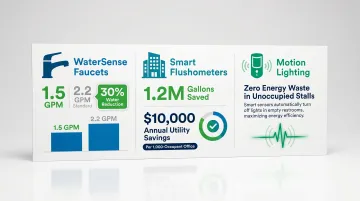
- WaterSense-labeled faucets use a maximum of 1.5 GPM (a 30% reduction) from the standard 2.2 GPM (EPA WaterSense)
- Upgrading older commercial flushometer toilets in a 10-story office building with 1,000 occupants can save approximately 1.2 million gallons of water and $10,000 in annual utility costs
- Motion-activated lighting eliminates waste in frequently unoccupied stalls
For NYC office buildings and restaurants managing tight overhead, these savings compound quickly. The global smart faucets market is projected to grow from $2.44 billion in 2025 to $4.18 billion by 2034 — confirming that commercial adoption is accelerating, not plateauing.
2. Spa-Inspired Minimalism
The minimalist approach works particularly well in dense urban commercial environments where square footage is limited and visual clutter compounds the feeling of constraint.
Core elements of the minimalist commercial bathroom:
- Neutral palettes: soft grays, warm whites, matte blacks
- Frameless mirrors and recessed lighting instead of decorative fixtures
- Concealed plumbing and wall-hung toilets that simplify the visual field
- Floating vanity cabinets that open up floor space and simplify mopping
Minimalism also has a practical maintenance advantage: fewer surfaces, fewer grout lines, and fewer decorative elements mean less cleaning time per service cycle. For facilities managers in high-traffic NYC buildings, that's a meaningful operational benefit.
3. Sustainable & Eco-Friendly Design
Sustainability in commercial bathrooms is now an expectation, not a differentiator, particularly in NYC, where Local Law 97 establishes carbon emissions limits for buildings 25,000 sq ft and larger, with stricter thresholds taking effect in 2030.
Water-efficient plumbing fixtures directly affect a building's energy profile by reducing hot water demand. Beyond compliance, the business case is strong: JLL research shows LEED-certified buildings command approximately 6% rental premiums and enjoy 16% higher occupancy rates compared to non-certified counterparts.
High-impact sustainable upgrades for commercial bathrooms:
- Dual-flush toilets and low-flow faucets (WaterSense certified)
- LED lighting with occupancy sensors
- Recycled-content or regionally sourced tile
- Low-VOC paints and adhesives
- Hands-free soap dispensers (reduces product waste, not just water)
For NJ commercial properties, sustainability features have also become a tenant attraction differentiator — especially in Bergen and Hudson County office markets where ESG-conscious tenants actively evaluate building performance during site selection.
4. Bold, Brand-Driven Statements
Forward-thinking businesses , particularly hospitality, co-working, and retail operators in NYC , are treating the bathroom as a brand touchpoint rather than a utility space.
This plays out through:
- Signature tile color or pattern on a single accent wall
- Custom signage with brand typography
- Curated artwork that continues the lobby or dining room aesthetic
- Branded amenities (soaps, paper goods, hardware finishes) that match the overall interior palette
Balance is critical here. Bold design elements land best against neutral backgrounds and durable substrates. Matte black hardware against white quartz, or a single wall of patterned tile behind a row of floating vanities, reads as intentional. When everything competes for attention, the result feels chaotic and ages quickly.
Broadway Kitchens & Baths has completed commercial bathroom projects with custom tile work and branded design elements for retail and restaurant clients across the NYC and NJ metro area, drawing on countertop and tile lines including Caesarstone, Silestone, and MSI Stone.
5. ADA-Compliant & Inclusive Layouts
ADA compliance in commercial bathrooms isn't optional . In NYC and NJ, enforcement is serious. Under Title III of the ADA, businesses face fines of up to $75,000 for a first violation and $150,000 for subsequent violations. ADA lawsuits have increased by 320% since 2013.
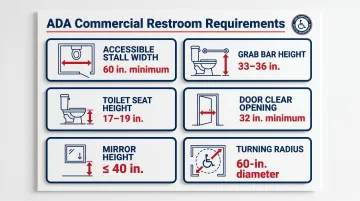
Key ADA specifications for commercial restrooms:
| Requirement | Standard |
|---|---|
| Accessible stall width | 60 inches minimum |
| Grab bar height | 33–36 inches above finished floor |
| Toilet seat height | 17–19 inches |
| Door clear opening | 32 inches minimum |
| Mirror height | Bottom edge no higher than 40 inches |
| Turning radius | 60-inch diameter circle |
The good news: modern ADA-compliant design no longer looks institutional. Contemporary grab bars in matte black or brushed nickel, barrier-free shower entries, and clean geometric layouts can meet every code requirement while delivering a finish quality that matches the rest of the space.
NYC's Building Code Chapter 11 incorporates federal ADA standards with local amendments enforced by the NYC DOB. NJ follows the IBC with state-specific modifications administered by the NJ Department of Community Affairs.
6. Natural Elements & Biophilic Design
Biophilic design now extends well beyond living plant walls in corporate lobbies. In commercial bathrooms, it takes the form of wood-look porcelain tile, stone countertops with natural veining, bamboo accessories, and warm lighting that mimics natural light.
The rationale is grounded in research. Gensler's analysis of the Interface Human Spaces Report found that biophilic design in workplaces can improve productivity by 6% and creativity by up to 15%. Even brief exposure — as little as five to twenty minutes — to natural elements produces measurable stress reduction benefits.
In high-density urban environments like Manhattan offices or NJ medical facilities, these effects matter. A restroom that feels calm and connected to natural materials provides a genuine break from the sensory intensity of the surrounding environment.
Practical biophilic elements for commercial bathrooms:
- Stone or stone-look countertops (quartz offers durability without the maintenance of natural stone)
- Wood-look porcelain tile (the durability of ceramic, the warmth of wood)
- Warm-toned LED lighting in the 2700–3000K range
- Plant accents in durable planters (real or high-quality faux)
- Natural fiber or textured accessories
7. Space-Maximizing Solutions for Compact Commercial Bathrooms
NYC commercial spaces , particularly in Manhattan and dense NJ urban corridors , frequently come with square footage constraints that make standard bathroom layouts impractical. The solution isn't always renovation; often it's strategic product selection.
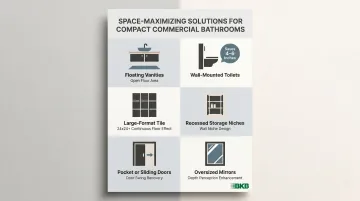
Proven space-maximizing approaches:
- Floating vanities open floor area and make cleaning easier
- Wall-mounted toilets push the tank into the wall cavity, gaining 4–6 inches of floor depth
- Large-format tile (24x24 or larger) reduces grout lines and makes floors read as continuous
- Recessed storage niches eliminate the need for freestanding shelving
- Pocket or sliding doors recover the swing clearance of a standard door
- Oversized mirrors visually double the perceived depth of a narrow space
Broadway Kitchens & Baths offers custom and semi-custom floating vanity configurations suited to non-standard commercial footprints, with a design approach built around the idea that storage and a clean aesthetic aren't mutually exclusive, even in tight spaces.
Light-toned materials throughout (countertops, tile, walls) reinforce the sense of space without requiring structural changes.
8. Luxury Finishes & Premium Materials
In NYC hotels, upscale restaurants, and corporate offices, a consistent material language has emerged across premium commercial renovations: quartz or marble countertops, brushed brass or matte black hardware, vessel or undermount sinks, backlit mirrors, and floor-to-ceiling tile cladding.
These choices communicate quality at every touchpoint , which matters when the restroom is part of a $500-per-night hotel stay or a client-facing corporate floor.
Premium materials and finishes for commercial bathrooms:
- Countertops: Quartz (Caesarstone, Silestone, Corian Quartz, MSI Stone) for durability and low maintenance
- Cabinetry: UltraCraft, Plain & Fancy, and Wolf Classic lines across multiple price tiers
- Hardware & fixtures: Hansgrohe, Kohler, and Brizo in brushed brass, matte black, or polished chrome
Broadway Kitchens & Baths fabricates and installs these surfaces with in-house crews, giving commercial clients a single point of accountability from material selection through final installation.
Key Considerations When Planning a Commercial Bathroom Remodel in NYC & NJ
Permitting and Labor
Most commercial bathroom renovations in NYC require an ALT2 permit filed by a licensed PE or RA. Working without permits carries Class 1 violations and fines up to $25,000 plus accrued penalties. Basic office renovation permits run $3,000–$10,000; restaurant buildouts can exceed $50,000.
Union vs. non-union labor is a practical reality in this market. Broadway Kitchens & Baths works in both environments, handling the required insurance documentation and compliance — so property managers and general contractors don't have to manage those requirements separately.
Material Selection for Commercial Use
Not all materials that look good in a showroom perform in high-traffic commercial settings.
- Choose non-porous surfaces (quartz, porcelain) over natural stone that requires regular sealing
- Specify commercial-grade fixtures rated for heavy daily use — residential-grade products fail faster and cost more in replacement cycles
- Factor lifecycle cost, not just upfront price — a $200-per-square-foot finish that lasts 15 years beats an $80 finish that needs replacing in five
Common Planning Mistakes
These are the mistakes that drive cost overruns and project delays:
- Older NYC buildings routinely surface hidden conditions — outdated plumbing, asbestos tile, deteriorated subfloors — so under-budgeting for scope changes is the most common budget killer
- Commercial bathrooms in enclosed spaces must meet mechanical ventilation code; retrofitting this mid-project is expensive and disruptive
- ADA compliance must be designed in from the start — expanding stall dimensions or repositioning grab bars after framing begins drives significant rework costs
Broadway Kitchens & Baths manages commercial projects from field measurements through punch-list, including coordination with other trades on-site. Most complete commercial bathroom installations wrap in 4–6 weeks, including building inspections.
Conclusion
A well-designed commercial bathroom in NYC or NJ isn't just a code-compliant utility space. It reinforces brand identity, reduces long-term maintenance costs, and shapes how every visitor perceives the business — often more directly than any other interior space.
If your current commercial restrooms don't reflect the quality of your business, the 8 trends above offer a clear roadmap for modernizing them.
That's where Broadway Kitchens & Baths comes in. The team works with construction professionals, architects, property managers, and management companies across the tri-state area to plan and execute commercial bathroom renovations that perform as well as they look. Broadway Kitchens & Baths' Englewood, NJ showroom at 257 South Dean St. is open for project consultations — reach the team at (201) 567-9585 or at operations@broadwaykitchens.com to discuss your next commercial project.
Frequently Asked Questions
How much does it cost to hire a commercial bathroom interior designer?
Commercial interior designers in NYC typically charge $150–$500 per hour depending on experience level, or 15–35% of total project cost for full-scope work. Basic design plans run $15–$25 per square foot; luxury or bespoke projects can reach $350+ per square foot.
How much does it cost to build or remodel a commercial bathroom?
NYC commercial remodels generally run $100–$400+ per square foot — well above the national average of $50–$250 — due to higher labor costs, permitting fees, and material costs. ADA-compliant plumbing for two commercial bathrooms alone can run $30,000–$50,000.
How do you design a commercial bathroom?
Start by assessing traffic volume, user needs, and ADA requirements. Select durable, low-maintenance materials suited to commercial use. Then layer in aesthetic elements — finishes, fixtures, lighting — that align with the brand. Permitting and code review should happen before design is finalized, not after.
Do interior designers design commercial bathrooms?
Yes — both commercial interior designers and kitchen-and-bath remodelers with commercial experience handle these projects. The key distinction: a designer focuses on aesthetics and space planning, while a full-service remodeler like Broadway Kitchens & Baths manages design, material procurement, permitting coordination, and installation under one roof.
What design mistakes make a commercial bathroom look cheap?
The most common offenders: mismatched hardware finishes, overly trendy colors that date quickly, residential-grade fixtures that show wear, poor lighting, and cluttered accessories. Deferred maintenance compounds all of these — even a well-designed space reads as neglected if upkeep slips.
What are the top commercial bathroom design trends for 2026?
Leading trends for NYC and NJ commercial projects include touchless technology, spa-inspired minimalism, biophilic elements, bold brand-driven color accents, sustainable low-flow fixtures, and luxury finishes. ADA-inclusive design is also shifting from a compliance checkbox to a genuine aesthetic differentiator.