Introduction
Picture this: a homeowner in Hoboken signs with a remodeler offering the lowest quote on the block. Six weeks later, work has stopped — the contractor skipped the required plumbing permit, and the co-op board has flagged the project. Now the homeowner faces fines, a stalled renovation, and a contractor who won't return calls.
It's a preventable situation — and it happens regularly in this market.
The NJ and NYC remodeling market carries layers of complexity most other regions don't: Home Improvement Contractor registration requirements, NYC Department of Buildings permits, co-op alteration agreements, and union labor rules that vary building by building.
A contractor who performs fine on a suburban Pennsylvania job may be completely unprepared for a Manhattan condo — and you won't find that out until work is already underway.
The 10 questions below are organized by category. Work through them before you sign anything.
Key Takeaways
- Licensed and insured contractors protect you from legal and financial liability if something goes wrong on-site
- Itemized written estimates prevent budget surprises and make contractor comparisons fair
- Ask whether the work is done by an in-house crew or subcontractors — it directly affects quality and accountability
- Portfolio and references validate real-world experience, not just sales pitches
- Clear communication processes are the single strongest predictor of a smooth remodel
Why These Questions Matter More in NJ & NYC
The NJ Licensing Reality
In New Jersey, anyone performing home improvement work on a residential property must register annually with the NJ Division of Consumer Affairs under the Contractors' Registration Act (N.J.S.A. 56:8-136). Registration is mandatory — hiring an unregistered contractor strips you of key protections under the NJ Consumer Fraud Act, including access to state-mediated dispute resolution. Unregistered contractors face civil penalties up to $10,000 for a first offense.
Ask to see a contractor's HIC registration number and verify it directly on the NJ Division of Consumer Affairs website before any contract is signed.
The NYC Complexity Layer
In New York City, bathroom remodel work in co-ops and condos involves more than just contractor licensing. Contractors must comply with NYC Department of Buildings permit requirements, meet building-specific insurance minimums, and often sign a formal alteration agreement with the board before work begins.
A contractor unfamiliar with this process can get your project rejected before a single tool is unpacked.
What Remodels Actually Cost Here
These compliance layers are also why the financial stakes are higher here. According to Sweeten's 2025 data, NYC bathroom remodel costs far exceed the national median of ~$13,000:
- Full bathroom remodel: $9,177–$45,000+
- Master bathroom remodel: $30,000–$60,000+
This isn't an average market. Careful vetting protects an investment most homeowners make once.
Questions About Credentials, Licensing & Permits (Questions 1–3)
Question 1: Are You Licensed, Registered, and Insured in New Jersey and/or New York?
This is the first question, and the answer should be immediate and verifiable.
In NJ, contractors must hold active HIC registration with the Division of Consumer Affairs. In NYC, home improvement contractors working in 1–4 family homes and condos/co-ops need a license from the NYC Department of Consumer and Worker Protection (DCWP). Plumbing work must be performed by a Licensed Master Plumber; electrical work by a Licensed Master or Special Electrician.
Verify both before signing anything:
- General liability — NJ registered contractors must carry at least $500,000 per occurrence; NYC DOB registration requires $1 million in coverage
- Workers' compensation — if a worker is injured on your property and the contractor has no workers' comp, you can be sued directly for medical expenses, lost wages, and damages in both NJ and NY
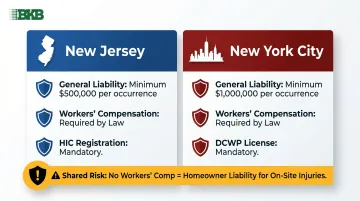
Request certificates of insurance, not just verbal assurances. Ask to be listed as an additional insured on the policy.
Question 2: Will You Pull All Required Permits for This Project?
Any bathroom work involving plumbing relocation, electrical changes, or structural modifications requires permits in both NJ (under the Uniform Construction Code, N.J.A.C. 5:23) and NYC (Administrative Code Section 28-105). A contractor who suggests skipping permits to "save time" is a serious red flag.
Unpermitted work can affect home resale, void insurance claims, and create safety inspection failures — consequences that fall on you as the homeowner, not the contractor.
The contractor should pull permits in their own name, not yours. When a contractor holds the permit, they bear legal accountability for inspection compliance. If a homeowner pulls it instead, that accountability shifts entirely to you.
Question 3: Have You Worked in Co-ops, Condos, or Managed Residential Buildings Before?
This question separates NYC-experienced contractors from those who aren't. Co-op and condo boards require contractors to submit documentation before work begins, including:
- HIC licenses and insurance certificates
- A signed alteration agreement
- Board approval of contractor qualifications
- Compliance with building-specific work hour restrictions
Ask specifically for references from similar building types. A contractor with a strong track record in New Jersey single-family homes isn't automatically qualified for a Manhattan co-op renovation.
Broadway Kitchens & Baths has over 12 years of experience working on co-ops, condos, and multi-family buildings across Bergen County, Manhattan, and Brooklyn. The team is proficient in both union and non-union environments — a practical requirement in most Manhattan co-op and condo buildings.
Questions About Budget, Timeline & Contracts (Questions 4–6)
Question 4: Can You Provide a Fully Itemized Written Estimate?
A lump-sum quote gives you no basis for comparison. A line-item estimate breaks down costs by category — labor, demolition, materials, fixtures, tile work, permits — so you can compare contractors on equal footing and see exactly where money is going.
When you receive the estimate, ask one follow-up question: "What is explicitly NOT included?" Scope gaps are where budget surprises hide. If waterproofing, disposal fees, or permit costs aren't listed, assume they'll be added later.
Question 5: What Is the Payment Schedule, and Do You Require a Large Upfront Deposit?
The NJ Division of Consumer Affairs advises homeowners not to pay more than no more than one-third of the total project cost upfront, and NJ law prohibits contractors from demanding final payment before work is complete.
Be cautious of any contractor requesting 50% or more before work begins. That's a pattern associated with contractors who lack the cash flow to order materials themselves.
A reasonable milestone structure looks like this:
- Deposit at contract signing (~25–33%)
- Payment after rough-in completion (plumbing, electrical, demo)
- Payment at tile and fixture installation
- Final payment after walkthrough, punch-list sign-off, and inspection approval
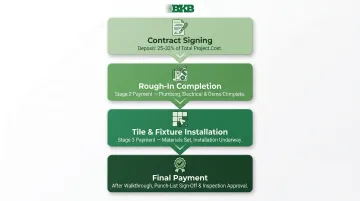
In NYC, under NY Lien Law, contractors must deposit pre-completion payments into escrow within five business days , which is another reason clear, written payment terms are non-negotiable.
Question 6: What Is the Estimated Timeline, and How Do You Handle Delays?
Realistic timelines in NJ and NYC account for factors that contractors from other regions often underestimate:
- NYC DOB permit approval: typically 2–8 weeks; can extend to several months for complex filings
- NJ municipal permits: faster, but still require multiple inspection stages
- Material lead times: supply chain delays can add 4 weeks to 4 months depending on product availability
- Co-op/condo board approval: can add weeks before construction even starts
Ask directly: Is there a penalty clause if the project runs significantly over schedule? Who covers extended carrying costs if a delay pushes your move-in date? Get the answers in writing.
Questions About Crew, Materials & Past Work (Questions 7–9)
Question 7: Will the Work Be Done by Your In-House Crew or Subcontractors?
Subcontractors aren't automatically a problem — many excellent remodelers use them for specialized trade work. But you should know who is on your property, who is responsible for quality control, and whether all subs are independently licensed and insured. In NYC, both contractors and subcontractors must be licensed by the DCWP. An unlicensed subcontractor working under an unlicensed GC loses the legal right to recover payment — and you could be caught in the dispute.
Also ask specifically about union vs. non-union labor if you're in a NYC co-op or condo. Many larger full-service buildings require union labor as a condition of the alteration agreement.
Broadway Kitchens & Baths uses in-house carpentry crews with 20+ years of installation experience and works in both union and non-union environments — a distinction that matters in buildings with strict alteration requirements.
Question 8: What Product Lines and Materials Do You Work With?
Material access directly affects both the quality and the timeline of your remodel. Contractors with established manufacturer relationships can secure materials faster and at more consistent pricing than those sourcing on the fly — a real advantage given that material shortages can delay projects by 4 weeks to 4 months.
Broadway Kitchens & Baths carries cabinetry from UltraCraft, Plain & Fancy, Wolf Classic Cabinets, Hanssem, and Great Northern, with countertop options from Caesarstone, Silestone, Corian Quartz, and MSI Stone. That integrated sourcing — available through their Englewood, NJ and Manhattan showrooms — gives homeowners more flexibility and fewer surprises mid-project.
Question 9: Can You Share a Portfolio and Provide References?
A portfolio tells you what a contractor has built. References tell you what it was like to work with them.
Look for portfolio projects similar in scope to yours — a small NYC bathroom is a very different job from a large NJ master bath renovation. When you call references, ask:
- Did the project finish close to the original timeline?
- Was the final cost near the estimate?
- How responsive was the team when problems came up?
- Would you hire them again?
A homeowner who navigated a punch-list with the contractor and came out satisfied is worth more than a stack of anonymous five-star ratings.
The Final Question That Separates Good Remodelers From Great Ones (Question 10)
Question 10: What Does Your Project Management and Communication Process Look Like?
This question reveals operational maturity faster than any other. A contractor who can walk you through their process — design consultation, field measurements, permit filing, material ordering, demo, construction phases, inspections, punch-list, final sign-off — with clarity and confidence is far less likely to go silent once your deposit clears.
What you're listening for: a named process, not a vague promise. "We'll keep you updated" is not a communication process. "You'll have a single point of contact, we meet at key milestones, and you receive written updates before each phase transition" — that's a process.
Broadway Kitchens & Baths is built around this kind of structured approach — seamless coordination from field measurements through punch-list, with designers actively present on job sites throughout construction. That level of operational structure is worth asking about with every contractor you consider.
Once you've evaluated communication and process, use these dealbreakers as a final filter.
Red Flags to Watch For
No matter how good a contractor's pitch sounds, these four signals should stop the conversation:
- Missing license or insurance — no verifiable HIC registration or certificates means no protection if something goes wrong
- Resistance to pulling permits or suggesting the homeowner pull them instead
- Large upfront cash-only deposit demand — particularly 50%+ before work begins
- No written contract — vague scope and absent payment schedule leave you with no recourse
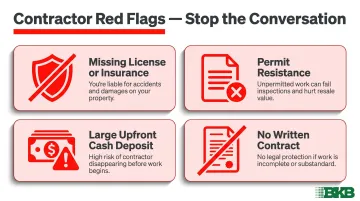
Trust your read during the consultation. A contractor who gets defensive about licensing questions or waves off permit concerns is showing you their communication style. That's exactly how they'll respond when a real problem surfaces mid-project.
Frequently Asked Questions
What is a realistic budget for a bathroom remodel in NJ or NYC?
Expect to spend $10,000–$30,000 for a mid-range full bathroom renovation in the NJ/NYC area, with master bath projects running $30,000–$60,000 or more. Costs vary significantly based on scope, materials, and building type. Always get itemized quotes from at least three contractors.
What is the most expensive part of a bathroom remodel?
Labor typically accounts for 40–65% of total project cost, with plumbing relocation and skilled tile work among the highest per-trade expenses. In NJ and NYC, permit fees, expediter costs, and union labor premiums can add $1,000–$5,000 or more to the total.
What should I avoid when renovating a bathroom?
The biggest mistakes: hiring an unregistered or unlicensed contractor, skipping permits to save time, under-budgeting for hidden issues like water damage or outdated plumbing, and making frequent mid-project design changes. Each of these adds cost and time.
How much do interior designers charge for bathroom design?
Standalone interior designers in the NJ/NYC area typically charge $75–$200/hr or a flat fee of $500–$2,500 for bathroom design. Many full-service remodelers bundle design consultation into the project cost, so confirm whether it's included before comparing estimates.
What are the most critical questions to ask a contractor before a bathroom remodel?
Prioritize licensing, insurance, and permit responsibility first — these protect you legally. Then press for an itemized estimate with explicit exclusions and a payment schedule tied to milestones, not arbitrary dates. How a contractor answers these questions tells you as much as their references do.