Introduction
The bathroom is statistically one of the most dangerous rooms in a home for older adults. According to peer-reviewed research published in the American Journal of Lifestyle Medicine, the bathroom accounts for 22.7% of fall-related emergency department visits among community-dwelling older adults — rising to 26.1% for adults 85 and older.
In NJ and NYC, that risk compounds quickly. Pre-war tile floors, narrow Victorian-era doorways, cramped shower stalls, and aging plumbing systems create hazards that newer construction in other regions rarely shares.
Co-op and condo board approvals add another layer on top — turning what should be a straightforward accessibility upgrade into a project that genuinely demands local expertise.
What follows breaks down the 10 most impactful upgrades, with realistic cost ranges for the tri-state market and practical notes on fitting each feature into the tight footprints these homes typically offer.
Key Takeaways
- Bathrooms are a leading location for fall injuries among seniors — accessibility upgrades directly reduce this risk
- Features covered include structural changes, fixture upgrades, and surface treatments — from curbless showers to grab bars
- NJ & NYC homes often need custom solutions due to tight square footage and older layouts
- Full accessible bathroom remodels in this region often start at $15,000–$30,000+, depending on scope
- Several features qualify for financial assistance programs — see the FAQ section
Why Senior-Friendly Bathrooms Matter in NJ & NYC Homes
New Jersey's 65+ population now represents 17.4% of the state's total population, and NYC's senior population grew 36% between 2010 and 2020, reaching 1.1 million residents. That demographic pressure is accelerating demand for aging-in-place renovations across the tri-state area.
That demand runs headlong into the region's housing stock. NJ and NYC are dense with pre-war apartments, brownstones, and colonial-era homes built long before aging occupants were a design consideration:
- Original ceramic or marble floors with polished finishes that become dangerously slick when wet
- Narrow doorways (often 28–30 inches) that can't accommodate walkers or wheelchairs
- Cramped shower stalls with high thresholds requiring a significant step to enter
- Older plumbing systems without pressure-balancing or thermostatic controls
The Harvard Joint Center for Housing Studies projects the supply of new accessible homes in the Northeast will fall short of demand by 800,000 units — meaning most homeowners retrofit rather than replace. The 10 features below address safety impact, installation feasibility in compact older bathrooms, and long-term ROI.
10 Best Senior-Friendly Bathroom Remodel Features
These features are ranked by a combination of safety impact, feasibility in NJ/NYC homes, and incremental value — not every one requires a gut renovation.
Feature 1: Curbless (Zero-Threshold) Walk-In Shower
A standard tub or shower threshold requires a senior to lift their leg 4 to 6 inches — a small movement that causes thousands of falls annually. A curbless shower eliminates that ledge entirely, and also accommodates walkers and wheelchairs while delivering a clean, contemporary aesthetic.
Key specs for NJ/NYC bathrooms:
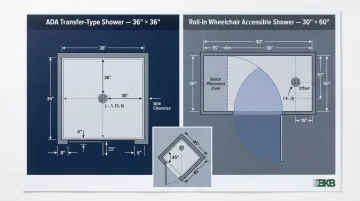
- ADA minimum: 36" × 36" for a transfer-type shower compartment
- Roll-in wheelchair access: 30" × 60" minimum clear inside dimensions
- In tight NYC or NJ bathrooms, a corner curbless shower or wet-room design can achieve compliance without significantly expanding the footprint
- Proper linear drain installation is essential to prevent water from migrating onto the main floor
Feature 2: Strategically Placed Grab Bars
Grab bars are consistently the single most requested aging-in-place modification, according to NAHB's 2023 remodeler survey. Installed correctly, they provide critical support for sitting, standing, and maintaining balance near the toilet, inside the shower, and beside the tub.
Placement standards (ADA-compliant):
- Height: 33–36 inches from the floor to the top of the gripping surface
- Shower: bars on the control wall and back wall for transfer showers
- Toilet side wall: at least 42 inches long, positioned no more than 12 inches from the rear wall
- Diameter: 1.25–2 inches; 1.5-inch clearance from wall to bar
- Must withstand 250 pounds of force in any direction
One critical note for NJ/NYC homes: older plaster and tile walls cannot support grab bars without proper blocking installed inside the wall cavity first. This must be done by a contractor familiar with older construction — surface-mounted anchors in plaster are not sufficient.
Feature 3: Built-In Shower Seat or Fold-Down Bench
Fatigue during showering is an underappreciated fall risk. A built-in or fold-down shower seat lets seniors bathe seated, eliminating the instability that comes from standing on a wet surface while reaching or rinsing.
- ADA-compliant height: 17–19 inches from the floor
- Fold-down versions preserve floor space when not in use — particularly valuable in compact NJ/NYC bathrooms
- Always pair with a handheld showerhead (see Feature 4) for full seated usability
- Teak and tiled bench options both work; tiled benches integrated into the shower walls are more durable long-term
Feature 4: Handheld and Adjustable Showerhead
A handheld showerhead on a sliding bar lets seniors direct water while seated or standing without repositioning their body — cutting the risk of slipping while turning or reaching overhead.
Installed cost nationally runs approximately $150–$500 depending on fixture quality and labor. In most cases, no plumbing reconfiguration is needed — only a replacement of the existing shower arm connection, making this one of the easiest upgrades to complete without a full bathroom renovation.
Broadway Kitchens & Baths carries shower systems from Hansgrohe, Rohl, Kohler, Danze, and Brizo, all of which offer sliding-bar handheld configurations that pair well with accessible shower designs.
Feature 5: Non-Slip Flooring
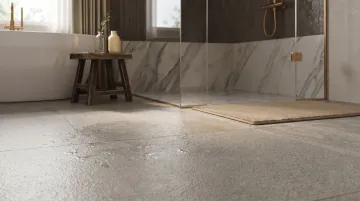
Polished marble and glazed ceramic tile — both common in NJ/NYC pre-war bathrooms — are among the most hazardous flooring choices when wet. Safe alternatives include:
- Textured porcelain tile: Look for a wet Dynamic Coefficient of Friction (DCOF) of 0.42 or higher for wet interior floors (per current ANSI A137.1 standard); shower floors specifically should target 0.60 DCOF or higher
- Matte-finish stone: Provides natural texture without the slip risk of polished surfaces
- Slip-resistant luxury vinyl plank (LVP): Warmer underfoot, easier on joints, and highly durable
If full floor replacement isn't feasible — common in landmarked buildings or co-ops with restrictions — a professionally applied surface anti-slip treatment is a less invasive alternative. Both approaches should be installed by a professional to ensure durability and proper adhesion.
Feature 6: Comfort-Height ADA-Compliant Toilet
Standard toilets sit at 14–15 inches from floor to seat. Comfort-height models measure 17–19 inches, closer to the height of a standard chair. That difference noticeably reduces the joint strain involved in sitting down and standing up — one of the most frequent bathroom movements for seniors.
Two configurations to consider:
- Floor-mounted: A straightforward swap requiring minimal plumbing changes
- Wall-mounted: Fully height-adjustable and frees floor space for wheelchair clearance — requires wall reinforcement and a carrier frame behind the wall
Broadway Kitchens & Baths carries Toto and Kohler toilet lines, both of which offer extensive comfort-height and ADA-compliant model selections.
Feature 7: Thermostatic Shower Valve (Anti-Scald Control)
Older adults have thinner skin, slower reaction times, and often reduced temperature sensitivity — making scalding a genuine danger during bathing. The CDC reports an estimated 8,620 annual emergency department visits for nonfatal scald burns among adults 65+ during the study period, with tap water scalds accounting for a significant share.
Regulatory requirements in NJ and NYC:
- NYC (Plumbing Code Section 424): Balanced-pressure, thermostatic, or combination valves are required for all shower and tub-shower fixtures, with a maximum temperature of 120°F — this is code, not optional
- NJ: The same requirement is codified through the adopted International Plumbing Code under the NJ Uniform Construction Code
For homes that predate these requirements, a thermostatic valve retrofit is one of the most cost-effective safety upgrades available. The valve itself adds minimal cost to a shower renovation; installation requires a licensed plumber.
Feature 8: Widened Doorways and Lever-Style Hardware
A standard interior bathroom door in an older NJ or NYC home typically runs 24–28 inches wide. ADA guidelines require 32 inches minimum clear width to accommodate a walker, and 36 inches for comfortable wheelchair access.
Widening a doorway in a brownstone or colonial often requires a structural assessment — bathroom walls in these homes are frequently load-bearing. Budget for an engineering consult before finalizing plans.
Lever hardware is the lower-cost win here. Swapping round knobs and small faucet handles for ADA-compliant lever-style hardware costs a fraction of a structural modification. Levers can be operated with a closed fist, making a real difference for seniors with arthritis or reduced grip strength.
Per ADA Section 309.4, operable parts must not require tight grasping, pinching, or wrist twisting.
Feature 9: Accessible Vanity and Cabinetry
A fully wheelchair-accessible vanity requires:
- Counter height: no higher than 34 inches
- Knee clearance: 27 inches minimum height underneath, at least 8 inches deep
- Toe clearance: 9 inches high extending 6 inches under the cabinet
Wall-mounted vanities achieve all of this while making the bathroom feel larger — a meaningful benefit in compact NJ/NYC spaces. Pipes below open lavatories must be insulated to prevent contact burns.
Storage positioning matters too. ADA reach range guidelines specify 15–48 inches from the floor for unobstructed forward reach. Pull-out drawers, D-ring handles, and soft-close mechanisms make cabinets far more usable for seniors with limited dexterity.
Broadway Kitchens & Baths offers customizable cabinetry across brands including UltraCraft, Plain & Fancy, and Wolf Classic, with hundreds of door styles and finishes — including configurations suited to the irregular layouts and compact footprints common in tri-state area bathrooms.
Feature 10: Enhanced and Motion-Activated Lighting
A 60-year-old typically requires approximately three times as much light as a 20-year-old to perform the same visual tasks. Inadequate bathroom lighting is a primary environmental risk factor for falls — particularly nighttime falls, which account for a higher share of serious injuries than daytime incidents.
Recommended lighting layers:
- Overhead ambient light: 300–500 lux minimum for senior environments
- Vanity/mirror lighting: Task lighting may need to exceed 1,000 lux for grooming tasks
- Low-level night lights: Motion-activated LED strip lighting along the floor or toe kick provides guidance without requiring a full light switch operation at 2 a.m.
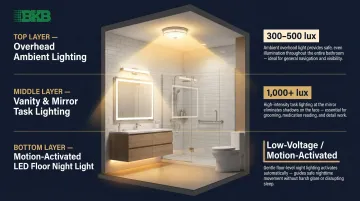
Motion-activated options are low-voltage and easy to retrofit — they don't require significant electrical work, making them one of the most accessible upgrades on this list for NJ/NYC apartment dwellers.
How Much Does a Senior-Friendly Bathroom Remodel Cost in NJ & NYC?
National benchmarks give useful context. HomeAdvisor's 2025 data puts the national average bathroom remodel at $12,135, with a typical range of $6,641–$17,629. Angi reports the average in New York City specifically at $11,724, ranging from $3,150 to $27,600.
Those national figures are a starting point — NJ and NYC projects consistently run higher. Regional cost drivers push budgets up: union labor rates, urban material delivery logistics, permit and inspection fees, and co-op or condo board alteration requirements all add to the baseline.
Approximate installed cost ranges (national estimates; NJ/NYC will run higher):
| Feature | Estimated Installed Cost |
|---|---|
| Grab bar (per bar) | $100 – $500 |
| Comfort-height toilet | $400 – $800 |
| Handheld showerhead | $150 – $500 |
| Non-slip flooring (per sq ft) | $2 – $15 |
| Walk-in shower conversion (from tub) | $1,200 – $8,000 |
| Widened doorway | $700 – $2,500+ (structural assessment additional) |
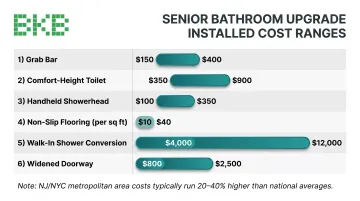
These numbers reflect materials plus installation — and labor alone accounts for 40–65% of total project cost. That makes sequencing important. Start with the highest-impact, lower-cost upgrades — grab bars, lever hardware, handheld showerhead, non-slip flooring — then budget curbless shower conversion and door widening for a full remodel phase.
Financial assistance options to explore:
- USDA Section 504 Home Repair Program: Grants up to $10,000 for homeowners 62+ in eligible rural NJ areas; loans up to $40,000 at 1% fixed interest
- Rebuilding Together: National nonprofit providing free accessibility modifications to income-qualifying seniors; local affiliates serve NJ and NYC
- NYC Access to Home Program: Administered through NYFSC for substantially disabled, low/moderate-income NYC residents
- NJ Helping Hands for Seniors Program: Assists adults 65+ with home maintenance and modification through NJ Division of Aging Services
These programs operate on limited, first-come funding — contact NJ DCA or the NYC Department for the Aging directly to confirm current eligibility and availability before starting your project.
Conclusion
A senior-friendly bathroom remodel in a NJ or NYC home is one of the most practical investments a family can make — combining immediate safety gains, long-term independence, and real property value. The right combination of features can meaningfully reduce fall risk and help a loved one stay in their home on their own terms.
Broadway Kitchens & Baths handles bathroom renovations across the tri-state area, managing every step from initial field measurements through final punch-list at showrooms in Englewood, NJ and Manhattan, NY.
To discuss which of these 10 features fits your specific bathroom layout and budget, call +1 201-567-9585 or stop by the Englewood, NJ showroom for a free, no-obligation design consultation.
Frequently Asked Questions
Frequently Asked Questions
How much does a bathroom remodel for seniors cost?
Nationally, full bathroom remodels average $12,135 with a typical range of $6,641–$17,629. A focused accessibility upgrade generally runs $3,000–$15,000. NJ and NYC homeowners should budget toward the higher end due to regional labor rates, permit fees, and urban logistics costs.
Does Medicare cover bathroom remodeling for seniors?
Standard Medicare (Parts A and B) does not cover home modifications like grab bars or shower conversions. Some Medicare Advantage (Part C) plans cover specific safety modifications as supplemental benefits, but coverage varies — contact your plan directly and get pre-authorization before work begins.
Can seniors get a free bathroom remodel?
Programs like the USDA Section 504 Home Repair Program (for eligible rural NJ areas), Rebuilding Together, and local Area Agency on Aging referrals can provide free or subsidized modifications for income-qualifying seniors. Funding is limited; most programs are first-come, first-served.
What is the best bathroom design for seniors?
The most effective senior bathroom combines a curbless walk-in shower, comfort-height toilet, grab bars, non-slip flooring, and an accessible vanity — sized and arranged around the user's mobility level and home layout. No single template fits every space.
Do I need a permit for a senior bathroom remodel in NJ or NYC?
Yes. Both NJ and NYC require permits for plumbing, electrical, and structural changes. NYC co-op and condo owners also need board approval before work begins. Working with a licensed local contractor ensures compliance and avoids costly violations or stop-work orders.