Hire the wrong contractor and you're looking at permit violations, cost overruns, failed inspections, and resale headaches. In a region with co-op board requirements, strict NJ permit processes, and hundreds of contractors competing for your business, the vetting process matters more than most homeowners realize.
This guide walks you through 8 actionable tips to vet, compare, and hire the right bathroom remodel contractor — whether you're in Bergen County, Manhattan, or anywhere in between.
Key Takeaways
- Verify licensing, HIC registration, and permit knowledge before anything else
- Get itemized written estimates from at least three contractors; the lowest bid rarely delivers the best outcome
- Prioritize local NJ/NYC experience — regional codes, co-op rules, and union labor requirements add real complexity
- Call references directly; don't rely on star ratings alone
- Choose a design-build contractor who manages the full process to avoid costly coordination gaps
Why Choosing the Right Bathroom Remodel Contractor Matters in NJ & NYC
The stakes here are higher than in most markets. The NJ Division of Consumer Affairs receives thousands of home contractor complaints annually — covering shoddy workmanship, missed deadlines, and contractors who vanish after taking a deposit.
Those complaints aren't just aggravating — they carry real legal and financial consequences. In NJ and NY, sellers must disclose known material defects, including unpermitted renovations, and lenders may refuse to finance properties with unresolved permit issues. That bathroom gut job done without proper permits could become your buyer's problem and your liability.
Understanding Contractor Types
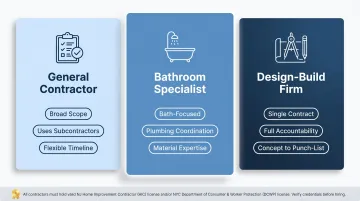
Not all contractors are the same, and the distinction affects your outcome:
- General contractor — handles broad home improvement work; may subcontract most trades
- Bathroom specialist — focused on bath-specific design, plumbing coordination, and material selection
- Design-build firm — manages everything from concept through punch-list under one contract
NJ requires all home improvement contractors to hold Home Improvement Contractor (HIC) registration through the Division of Consumer Affairs. NYC has its own licensing requirement through the Department of Consumer and Worker Protection (DCWP). Hiring someone without the right credentials can result in failed inspections, rejected permits, and resale complications.
8 Tips for Choosing a Bathroom Remodel Contractor in NJ & NYC
Tip 1: Verify Licensing, Registration, and Permit Know-How
In NJ, any contractor performing home improvement work — regardless of where they're based — must be registered under the Contractors' Registration Act (N.J.S.A. 56:8-136 et seq.). This registration must be renewed annually, and the registration number must appear on all contracts, vehicles, and advertisements.
Unregistered contractors cannot legally be issued municipal construction permits.
You can verify a contractor's NJ HIC status at newjersey.mylicense.com.
In NYC, the licensing body is the DCWP — not the DOB. Any project exceeding $200 requires an HIC license. Separately, the NYC Department of Buildings handles permits for work involving plumbing line changes, structural modifications, or electrical rerouting. Replacing a fixture doesn't require a permit; moving a drain line does.
Ask any prospective contractor directly: Do you pull permits for this type of work, and have you done so in this building type before? A contractor who hesitates on that question is a red flag.
Tip 2: Confirm They Carry Adequate Insurance
Two types of coverage are non-negotiable:
- General liability insurance — NJ requires a minimum of $500,000 per occurrence for registered HICs. NYC co-ops typically require at least $1,000,000, with the co-op corporation named as an additional insured.
- Workers' compensation — mandatory for any contractor with employees. Without it, you could be financially liable if a worker is injured on your property.
Don't accept a copy of an insurance certificate from the contractor — request it directly from their insurer. When reviewing the Certificate of Insurance (COI), confirm:
- Policy dates cover your full project duration
- Coverage types include both general liability and workers' comp
- Your property or building is listed as an additional insured
NJ also now requires HICs to carry compliance bonds ranging from $10,000 to $50,000, tiered by contract volume, under legislation passed in 2023.
Tip 3: Request Detailed Written Estimates from Multiple Contractors
A legitimate contractor provides an itemized estimate — labor, materials, permits, and contingencies broken out separately. A vague lump sum tells you nothing useful and gives you no protection if the scope shifts.
Get at least three estimates. Here's what current pricing looks like in this market:
| Project Tier | NYC (2025) | NJ (2025) |
|---|---|---|
| Basic/cosmetic refresh | $3,000–$10,000 | Included in mid-range |
| Mid-range remodel | $10,000–$35,000 | $15,000–$35,000 |
| Full gut/high-end | $25,000–$75,000+ | $16,500–$69,500+ |
| Luxury/master bath | $200,000+ | $40,000–$100,000+ |
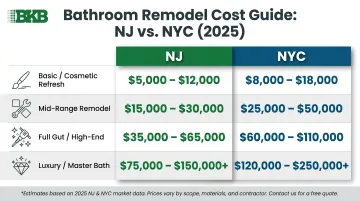
Source: Sweeten, 2025
The lowest bid isn't always the best value — it's often a sign that someone is cutting corners on materials, skipping permits, or underestimating scope to win the job.
Under NJ law, any home improvement contract exceeding $500 must be in writing and include the contractor's HIC registration number, project description, start/completion dates, and total price.
Tip 4: Review Their Portfolio of Completed Bathroom Projects
Marketing images show what a contractor wants you to see. Before-and-after photos of actual completed projects show what they can actually deliver.
When reviewing a portfolio, look for:
- Consistency in finish quality across multiple projects
- Projects at a similar scale and complexity to yours
- Range of design styles (not just one aesthetic)
- Photos in building types similar to yours
That last point matters more in this region than anywhere else. Pre-war NYC apartments often have aging galvanized or lead branch lines that must be replaced back to the main stack — adding scope and cost. Many co-op boards enforce "wet-over-dry" restrictions that prohibit moving plumbing above dry living spaces. NJ townhomes and older colonial-era homes present their own structural constraints.
Ask specifically: Have you completed bathroom remodels in buildings like mine? A contractor who's never worked in a pre-war co-op has a learning curve — at your expense.
Tip 5: Check References and Read Verified Reviews
There's a meaningful difference between a reference a contractor hand-picks and an independent review posted publicly. Use both.
For independent reviews, check:
- Google Business Profile — publicly visible and tied to verified accounts
- Houzz — renovation-specific platform with project photos alongside reviews
- BBB (bbb.org) — verified complaint history and formal resolution process
For references the contractor provides, call them — don't email. Three questions worth asking every reference:
- Was the project completed on time and within the original budget?
- How did the contractor handle problems or unexpected issues mid-project?
- Would you hire them again without hesitation?
The answer to question two is the most revealing. Every project hits a snag somewhere. What matters is how a contractor responds when things don't go according to plan.
Tip 6: Look for Full-Service, Design-Build Capability
A design-build contractor holds a single contract covering both design and construction — meaning one entity is accountable for the entire outcome. According to the Design-Build Institute of America, design-build projects average 3.8% less cost growth and are completed significantly faster than projects using separate design and construction contracts.
For bathroom remodels, the practical benefit is coordination. When the same team handles design, material selection, and installation, there's no finger-pointing between a designer and a contractor when something doesn't fit or arrives late.
Broadway Kitchens & Baths operates on this model, managing bathroom renovations across NJ and NYC from initial design consultation through final punch-list.
Their showrooms in Englewood, NJ and Manhattan carry vanities, countertops (Caesarstone, Silestone, Corian Quartz), tile, and plumbing fixtures from brands like Hansgrohe, Kohler, Toto, and Dreamline. Having product selection and installation under one roof reduces sourcing delays and eliminates the "that's not what I ordered" conversations that derail timelines.
Tip 7: Prioritize Local NJ/NYC Market Experience
Local experience carries real weight here. Contractors unfamiliar with this region regularly underestimate what's involved.
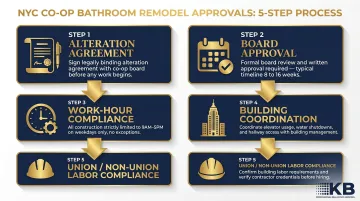
In NYC co-ops and condos, a bathroom remodel often requires:
- An alteration agreement with the co-op board before any work begins
- Board approval — a process that typically takes 8 to 16 weeks on its own
- Compliance with building work-hour restrictions (often 9 AM–5 PM weekdays only, more restrictive than the DOB's standard window)
- Coordination with building superintendents for elevator access and plumbing shutdowns
- Awareness of union vs. non-union labor requirements, which some buildings mandate for specific trades
Broadway Kitchens & Baths works in both union and non-union environments and handles the required insurance documentation for each project type. That familiarity with building-specific rules across Manhattan, Brooklyn, and Bergen County translates directly into fewer delays and fewer surprises.
Tip 8: Evaluate Communication Style and Project Management Process
How a contractor communicates during the estimate phase is a direct preview of how they'll behave mid-project. Slow responses, vague answers, or difficulty explaining their process are warning signs worth taking seriously.
A well-run bathroom remodel project includes:
- A single point of contact who knows your project inside and out
- A written timeline with a defined start date, completion date, and key milestones
- A clear change order process — any scope additions documented and priced before work proceeds
- A defined closeout procedure at project end, so nothing gets left unfinished
Broadway Kitchens & Baths assigns designers as the single point of contact for residential projects, managing communication from design through final walkthrough. Client reviews specifically note that the team "responds immediately and keeps right on schedule" — the kind of consistency that prevents a 6-week project from becoming a 4-month ordeal.
Red Flags to Watch Out For When Hiring a Bathroom Contractor
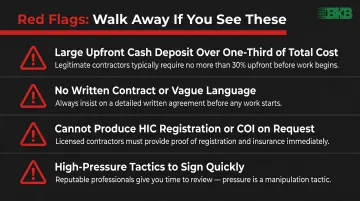
Walk away if you see any of these:
- Large upfront cash deposit — the NJ Division of Consumer Affairs warns against paying more than one-third of the total project cost before work begins
- No written contract or vague contract language — NJ law requires written contracts for projects over $500; NYC law requires the same plus a 3-business-day cancellation notice
- Can't produce a HIC registration number or COI on request — a legitimate contractor has both and shares them without hesitation
- Pressure to sign quickly — a sign they know you'll think twice if given time
There's one more risk to flag: contractors who subcontract most or all work without disclosing it. When the company you hired isn't the company doing the work, accountability and warranty claims get complicated. Ask upfront who specifically will be on-site and what their relationship to the company is.
Before signing anything, check complaint history through the NJ Division of Consumer Affairs' public database at njconsumeraffairs.gov/hic, or call them directly at 1-800-242-5846.
Conclusion
In NJ and NYC, hiring a bathroom remodel contractor requires more than a Google search and a gut feeling. The regional complexity — licensing requirements, co-op board rules, permit workflows, union labor considerations — means that a contractor who does great work in another market can still cause permit delays, board rejections, or costly rework.
The right contractor brings local expertise, proper credentials, transparent pricing, and a clear process that keeps your project on track.
If you're ready to start planning your bathroom remodel in NJ or NYC, Broadway Kitchens & Baths offers free design consultations at their Englewood, NJ and Manhattan showrooms. Their team handles everything from design and material selection through installation and punch-list — reach them at (201) 567-9585 or stop by to see the full range of cabinetry, stone, and fixture options in person.
Frequently Asked Questions
Do I need a contractor for a bathroom remodel?
Any work involving plumbing, electrical, or structural changes legally requires licensed contractors in both NJ and NYC — and those projects need permits. Cosmetic updates like painting or swapping hardware can be DIY, but unpermitted work creates disclosure obligations and resale complications down the line.
What is a reasonable budget for a bathroom remodel in NJ or NYC?
Mid-range remodels typically run $15,000–$35,000 in NJ and $10,000–$35,000 in NYC. Full gut renovations in older buildings can reach $70,000–$100,000+, driven by regional labor rates, building-specific requirements, and material costs. These figures reflect actual 2025 market conditions in this region.
What licenses should a bathroom contractor have in New Jersey?
The general contractor must hold active HIC registration through the NJ Division of Consumer Affairs. Plumbing work requires a licensed Master Plumber, and electrical work requires a contractor licensed through the NJ Board of Examiners of Electrical Contractors.
How long does a bathroom remodel typically take?
In NYC, construction runs 4–6 weeks, but the full process — design, permits, approvals, and build — typically takes 3–4 months. NJ single-family projects move faster without co-op board requirements. Build in a buffer of at least 25–30% over your estimated timeline; hidden conditions in older housing stock are common.
What should be included in a bathroom remodel contract?
Every contract should include: project scope, itemized cost breakdown, payment schedule, start and completion dates, a defined change order process, warranty terms, and proof of insurance. In NJ and NYC, the contractor's license or registration number must appear on the contract.
What is the difference between a general contractor and a bathroom remodeling specialist?
General contractors handle broad home improvement work and may subcontract most trades, while bathroom specialists focus specifically on bath design, plumbing coordination, and material selection. For complex or high-end bathroom projects — especially in older NJ or NYC buildings — a specialist or design-build firm typically delivers better outcomes and tighter accountability.