The challenge here isn't just taste. NJ Colonials often hide deteriorated plumbing behind walls that haven't been opened in 40 years. Manhattan co-ops have board rules and restricted work hours. Tight square footage in both markets rules out ideas that look great in design magazines but require a bathroom the size of a small bedroom.
The 12 ideas below are chosen with those real-world constraints in mind — organized by budget so you can immediately find what applies to your situation.
Key Takeaways
- Shower remodels range from a quick $500 hardware refresh to a $15,000+ steam shower conversion, with solid options across every budget point
- The three upgrades that most consistently boost resale value in NJ/NYC: curbless walk-in showers, large-format tile, and frameless glass enclosures
- Budget a 15–20% contingency in pre-1980 homes; hidden plumbing and water damage are common discoveries
- Match the remodel scope to your square footage, your plumbing layout, and how long you plan to stay
- A local remodeling partner familiar with NJ and NYC building types prevents costly permit surprises
Why Your NJ or NYC Shower Deserves a Remodel
Bathrooms rank among the first rooms buyers evaluate in NJ and NYC real estate — and the numbers back that up. The 2025 Cost vs. Value Report shows a mid-range bathroom remodel costs $26,138 and recoups roughly 80% at resale — one of the strongest returns in home improvement.
The urgency is structural, too. More than 80% of NYC's housing stock was built over 50 years ago, and NJ counties like Hudson and Essex show similar aging patterns. That translates directly into outdated waterproofing, galvanized supply lines, and tile degrading behind your walls for years without showing it.
That aging infrastructure shows up the same way in kitchens as it does in showers. In this market, the problems tend to cluster around a familiar set of issues:
- Aging grout and tile in pre-war buildings that traps mold and looks perpetually dirty
- Inefficient tub-shower combos that waste space in bathrooms under 50 square feet
- Fixtures from the 1990s — polished chrome, builder-grade showerheads — that contradict otherwise updated interiors
The 12 ideas below are organized by budget, so you can jump straight to what's realistic for your project.
Ideas 1–4: Quick Wins — Budget-Friendly Shower Updates Under $3,000
Budget-friendly doesn't mean low-impact. These four upgrades deliver the highest visual return per dollar and, in most cases, don't require touching plumbing or structural walls.
Idea 1: Frameless Glass Shower Enclosure
Replacing a framed door or shower curtain with a frameless glass panel is one of the most effective visual tricks available in small bathrooms. Removing the metal frame eliminates visual weight — the shower reads as part of the room rather than a separate compartment. In NYC apartments where every square foot is negotiating space, this matters.
Installed cost in the NJ/NYC market: $600–$1,700 for standard configurations, rising to $3,300 for thicker glass or custom shapes. Common upgrade options include:
- ½-inch glass: adds roughly $650, improves rigidity and perceived quality
- Low-iron "extra-clear" glass: another $650, eliminates the greenish tint standard glass carries
- No metal channels: daily cleaning improves with nothing to trap soap scum
Broadway Kitchens & Baths works with shower door brands including Dreamline and Glasscrafters, both sized and configured for the varied enclosure dimensions typical in NJ and NYC bathrooms.
Idea 2: Large-Format Tile (Floor-to-Ceiling)
A 24×48-inch porcelain slab run floor to ceiling does two things: it drastically reduces the number of grout lines (which means less maintenance and a cleaner visual), and it makes the shower appear taller. Both matter in NJ bathrooms that average under 50 square feet.
The NKBA's 2026 Bath Trends Report confirms this direction — 80% of industry experts identify large-format tile as the most popular flooring choice through 2026, and 89% of homeowners specifically want smaller or no grout lines.
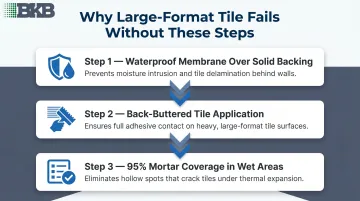
One critical note: large-format tile requires a waterproof membrane over solid backing throughout the shower — a TCNA-specified requirement that directly affects longevity.
Proper mortar coverage in wet areas must reach 95%, achieved by back-buttering the tile in addition to troweling the substrate. Skipping either step is the most common cause of costly early failures.
Idea 3: Matte Black or Brushed Gold Hardware Refresh
Swapping chrome showerheads, faucets, and towel bars for a unified matte black or brushed gold finish is the fastest cosmetic upgrade on this list. No plumbing relocation, no tile work — just fixture replacement.
The trend data supports it. The NKBA's 2026 Bath Trends Report surveyed nearly 700 industry experts and found:
| Finish | Expert Preference |
|---|---|
| Matte | 54% |
| Brushed | 51% |
| Satin | 46% |
| Polished | 39% |
Matte black and brushed brass are both safe for resale — they're trending without being so specific that they'll date quickly. Broadway Kitchens & Baths supplies fixtures from Hansgrohe, Kohler, Brizo, and Rohl, all of which offer comprehensive finish options across their shower lines.
Idea 4: Built-In Shower Niche
A recessed niche eliminates plastic caddies, gives the shower a custom built-in look, and adds minimal cost when planned during a tile job. The niche is framed between studs (or into a non-structural wall) and tiled as part of the surrounding installation.
Two design approaches work well here:
- Tile-matched niche: blends seamlessly with the surrounding wall for a minimal, monolithic look
- Contrasting accent tile: a different color, texture, or mosaic insert that turns the niche into a focal point
Either approach costs little when timed with the tile work — and the absence of a wire caddy alone justifies the planning.
Ideas 5–8: Mid-Range Upgrades That Transform the Shower Experience ($3,000–$10,000)
These upgrades involve some plumbing or structural work. The result is a shower that functions differently, not just one that looks better.
Idea 5: Walk-In Curbless Shower Conversion
Removing the step-over curb and converting to a barrier-free, curbless shower is the single most-requested upgrade in NJ master bathrooms. Three benefits drive that demand:
- Modernizes the aesthetic immediately — curbless showers read as intentional, designed spaces
- Opens up visual floor space in tight bathrooms
- Improves accessibility, which matters for NJ's suburban homeowner demographic aging in place
AARP's 2024 survey found 75% of adults 50+ want to remain in their homes as they age, and 51% say they need a home that supports independent aging. Curbless showers serve both goals.
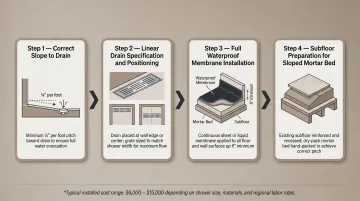
The technical requirements are non-negotiable. A curbless conversion requires:
- Correct slope to drain (typically ¼ inch per foot toward the drain)
- Linear drain specification and proper positioning
- Full waterproof membrane installation beneath the tile
- Proper subfloor preparation to accommodate the sloped mortar bed
Installed cost in NJ/NYC: $6,000–$15,000, depending on shower size and materials. This is a project that requires an experienced contractor — the waterproofing and slope execution are where most failures originate.
Idea 6: Rain Shower + Multi-Head Fixture System
A ceiling-mounted rain head combined with a handheld wand — and optionally body sprays — controlled through a thermostatic mixing valve gives you preset temperature and independent volume control at each outlet. It's a substantively different shower experience, not just a fixture upgrade.
Key specifications to sort out before committing:
- Water pressure: Multi-head systems may require 40–80 PSI and a ¾-inch supply line rather than the standard ½-inch. Older NJ homes and NYC high-rises can fall short — verify with a licensed plumber before specifying
- Thermostatic valve: Required for a proper multi-head system; Hansgrohe and Kohler both offer well-supported options
- Hot water capacity: A rain head combined with body sprays draws significantly more hot water — your water heater needs to keep up
Broadway Kitchens & Baths supplies shower systems from Hansgrohe, Rohl, Kohler, Danze, and Brizo — all brands with thermostatic valve options across price tiers.
Idea 7: Custom Tile Patterns — Herringbone, Chevron, or Statement Accent Wall
The same subway tile laid in a herringbone or stacked vertical pattern instead of a standard horizontal run changes the visual character of a shower without changing the tile budget. Note that herringbone does require more installation labor than a standard offset run — expect a modest labor premium — but the material cost stays flat.
A bold accent tile wall on one shower surface — contrasting color, fluted texture, or a different material — is a cost-effective way to create a designed feel without retiling the entire shower.
What's working in NJ/NYC right now:
- Warm neutrals and stone looks — greige, warm white, soft taupe — in large format or organic textures
- Fluted tile on a single accent wall
- Herringbone in classic subway for a timeless result
What to avoid if resale is a factor: highly saturated colors, highly specific patterns (chevron in a bold color, for example), or anything that strongly signals a particular decade. The NKBA 2026 report notes 70% of experts prioritize transitional/timeless over statement-driven styles.
Idea 8: Built-In Shower Bench
A tiled bench built into the shower footprint during construction is what most contractors and designers recommend — it's permanent, waterproof, and reads as a native part of the shower rather than an afterthought.
Practical value beyond aesthetics:
- Shaving and grooming without contortion
- Seated bathing for children or seniors
- A place to set products during longer showers
Minimum dimensions: NKBA guidelines recommend bench height of 17–19 inches above the shower floor and 15 inches deep. You need at least 36 inches of interior shower width to accommodate a bench without making the enclosure feel narrow; 48–60 inches is more comfortable.
For existing showers where structural work isn't possible, a fold-down teak bench is a functional alternative — though it doesn't deliver the same finished look.
Ideas 9–12: Premium Shower Transformations Worth the Investment ($10,000+)
These upgrades require a larger budget and more extensive work. The payoff is a shower that adds measurable resale value and changes the daily experience of the home.
Idea 9: Steam Shower Conversion
A steam shower requires more than a generator. The installation touches multiple systems and trades:
- Fully sealed enclosure — no gaps around doors or vents where steam can escape
- Sloped ceiling to prevent condensation dripping on bathers
- Vapor-rated lighting and electrical fixtures throughout
- Dedicated electrical circuit for the steam generator itself
What it costs: $4,000–$14,000 for a custom steam shower, with high-end designs reaching $25,000. The steam generator unit runs $600–$2,500 separately.
Why it's in demand: The Global Wellness Institute reports the wellness real estate market reached $584 billion in 2024, growing 18% year-over-year, and is projected to double to $1.1 trillion by 2029. NJ homeowners treating a steam shower as an in-home spa investment are aligned with a verified macro trend, not a design fad.
Idea 10: Natural Stone Slab Shower Walls
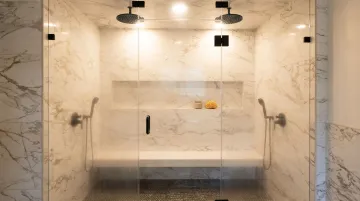
Large-format marble, quartzite, or porcelain stone-look slabs on shower walls eliminate grout lines almost entirely and deliver an unmistakably premium result. The continuity of veining across a wall surface is not replicable with standard tile.
The practical tradeoff worth knowing:
| Factor | Natural Stone | Porcelain Stone-Look |
|---|---|---|
| Maintenance | Annual sealing required | Regular cleaning only |
| Porosity | Porous; vulnerable to staining | Non-porous |
| Aesthetics | Unique natural variation | Consistent, replicable pattern |
| Cost/sq ft | $5–$50+ | $3–$10 |
For busy NJ and NYC households, porcelain slabs that convincingly replicate marble or quartzite offer similar aesthetics with significantly lower upkeep. Broadway Kitchens & Baths carries countertop and tile materials from Caesarstone, Silestone, Corian Quartz, and MSI Stone — several of which extend into large-format tile suitable for shower walls.
Idea 11: Heated Shower Floor (Radiant Heat)
Electric radiant heat under shower floor tile is straightforward: a heating mat is installed beneath the tile, connected to a thermostat, and protected by a dedicated GFCI circuit. Step onto the floor, and it's warm — particularly valued in NJ homes where tile floors in January make the point on their own.
Two numbers worth knowing before budgeting:
- Installation runs $600–$4,600 (average ~$1,800), at $8–$20 per sq ft; add $600–$2,600 if new electrical lines are required
- Timing is everything — radiant heat must go in before tile. Planned during a tile remodel, it costs almost nothing extra; added afterward, it means tearing up the floor
Idea 12: Smart / Digital Shower System
Digital shower controls let you pre-set water temperature, volume, and steam settings — activated from a wall panel or a smartphone before you step in. Water is at temperature when you are, with no cold-to-scalding guesswork.
Current options span a wide range:
| System | Price Range | Key Features |
|---|---|---|
| Kohler DTV Mode | $100–$400 | Digital on/off and temperature control |
| Kohler DTV+ | $750–$1,700 | Steam, water, light, music via app |
| Hansgrohe ShowerSelect | ~$912+ | Thermostatic shower control |
| ThermaSol Digital Package | ~$5,650 | Full digital control with 10-inch touch panel |
Installation requires a plumber and electrician working in coordination — this isn't a one-trade job. It fits naturally into NYC luxury apartments and NJ smart homes where whole-home automation is already in place — and increasingly, it's the upgrade homeowners return to request after seeing it in a neighbor's renovation.
How to Choose the Right Shower Remodel for Your NJ or NYC Home
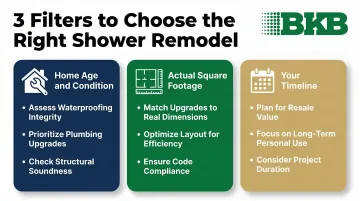
Three filters narrow it down quickly:
1. Match scope to age and condition. Pre-1980 homes often need waterproofing or plumbing updates before cosmetic upgrades make sense. Opening walls in older NJ Colonials or pre-war NYC buildings frequently reveals deteriorated supply lines, failed waterproofing, or outdated wiring. Cosmetics on top of a failing substrate will fail too.
2. Match the idea to your actual square footage. Curbless showers, built-in benches, and multi-head systems all have minimum size requirements. Some of the most appealing shower upgrades are impractical in a 35-square-foot bathroom — knowing your dimensions before specifying saves everyone time.
3. Match the investment to your timeline. Broad cosmetic upgrades (large-format tile, frameless glass, hardware refresh) suit homes approaching resale. Personalized luxury investments — steam showers, radiant heat, digital controls — make more sense for homeowners staying long-term.
Budget for what you can't see: In NJ and NYC, add 15–20% above your quoted project cost. Hidden conditions — aging plumbing, water damage behind tile, inadequate subflooring — are the norm in pre-1980 homes throughout the tri-state area.
That hidden-condition risk compounds when trades aren't coordinated. Shower remodels in this market typically involve tile contractors, plumbers, electricians, and glass installers — and when each is hired separately, scheduling gaps and unclear accountability are where projects stall or go over budget. Broadway Kitchens & Baths manages bathroom renovations as a complete project, from field measurements and material selection through installation and final punch-list, with a single point of contact across all trades.
Conclusion
There's a viable shower remodel at every budget and for every bathroom size in NJ and NYC. The key is matching the right idea to your specific space, your plumbing reality, and your goals — rather than simply copying what photographs well online.
Execution matters as much as inspiration. The best shower design fails without proper waterproofing, correct plumbing spec, and quality materials installed by people who've done this work before in homes like yours.
That's exactly where Broadway Kitchens & Baths comes in — with hands-on experience across NJ and NYC renovations and a showroom where you can see materials and fixtures in person before committing.
Schedule a consultation:
- 📞 +1 201-567-9585
- 📍 257 South Dean St., Englewood, NJ
Frequently Asked Questions
What is the average cost to remodel a bathroom shower?
A shower-only remodel ranges from $300 for a basic refresh (new fixtures and re-grouting) up to $15,000+ for a full custom tile shower with linear drain and frameless glass. In NJ and NYC, expect to pay 15–25% above national averages due to higher local labor rates.
Can I remodel a bathroom for $5,000?
In the NJ/NYC market, $5,000 is realistic for a partial remodel — new hardware, a frameless glass door, basic tile work, or a quality fixture upgrade. A full gut renovation at this budget isn't feasible, so focus your spend on one high-impact upgrade.
Is $10,000 enough for a bathroom remodel?
$10,000 can fund a meaningful mid-range shower remodel in NJ/NYC — a curbless conversion with new tile, for example. It likely won't stretch to structural changes or premium fixtures simultaneously without careful prioritization of where the money goes.
What is the 30% rule in remodeling?
The 30% rule is a general financial guideline: don't spend more than 30% of your home's current market value on a renovation. Over-improving relative to your home's value makes it harder to recoup the investment at resale, particularly in price-sensitive neighborhoods.
What should I avoid when remodeling a bathroom?
The most common and costly mistakes to avoid:
- Skipping waterproofing behind tile
- Choosing trendy finishes that hurt resale appeal
- Hiring contractors without verified bathroom-specific experience
- Setting a budget with no contingency for unexpected conditions
What shower style is trending now?
The leading directions for 2025–2026, per NKBA's 2026 Bath Trends Report and Houzz's 2025 Bathroom Trends Study:
- Curbless walk-in showers with frameless glass
- Large-format tile in warm neutrals and stone looks
- Matte black or brushed brass fixtures
- Minimalist built-in niches