Custom quartz has become the dominant countertop choice across the tri-state area, and for good reason. It handles the daily reality of bathroom use better than most natural stones while delivering a design range that spans minimalist modern to full luxury marble-look. The styles available today go far beyond generic white slabs.
This guide covers the 7 most relevant quartz styles for NJ and NYC homes, plus the customization details — edge profile, thickness, finish — that determine whether a selection looks truly custom or just competent.
Key Takeaways
- Quartz is engineered from ~93% natural quartz + resin: non-porous, no sealing needed, and resistant to moisture, mold, and stains
- NJ suburban baths and NYC apartment vanities have different spatial demands — style selection matters for both
- The 7 styles below range from Calacatta marble-look to biophilic sage tones, each matched to a distinct design context
- Edge profile, slab thickness, and finish (polished vs. honed) significantly shape the final result
- Broadway Kitchens & Baths carries Caesarstone, Silestone, Corian Quartz, and MSI Stone for NJ & NYC bathroom projects
Why Quartz Works for NJ & NYC Bathroom Countertops
Bathrooms are harder on countertop materials than kitchens. Humidity, toothpaste, cosmetics, cleaning agents, standing water — all of it accumulates daily in a space that often has limited ventilation, especially in NYC apartments.
Its manufacturing process creates a permanent non-porous surface that resists moisture, bacteria, and staining without ever requiring sealing. Unlike marble or granite, there's no annual maintenance cycle. It also rates 7 on the Mohs hardness scale (one of the harder countertop options available), which matters in a room that takes daily abuse.
The NJ vs. NYC Context
These two markets have genuinely different bathroom profiles:
- NYC apartments and co-ops: Compact vanities where a countertop must work hard aesthetically in a small footprint. Reflectivity, color lightness, and clean lines matter more here
- NJ suburban homes: Double-vanity master baths where visual weight, consistency across a larger surface, and coordination with custom cabinetry take priority
A solid bright white quartz opens up a tight Manhattan bathroom; a Calacatta-look slab with bold veining anchors a NJ master suite without the upkeep that real marble demands.
Pricing in the NJ/NYC Market
Typical installed costs in this region break down as follows:
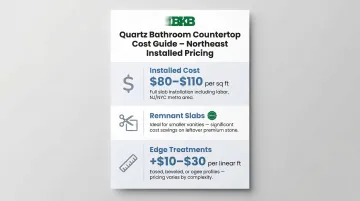
- $80–$110 per square foot installed in the Northeast, reflecting higher labor rates and delivery logistics
- Remnant slabs often used for smaller bathroom vanities, reducing overall project cost
- Edge treatments add $10–$30 per linear foot depending on complexity
Those ranges reflect the options available across the brands Broadway Kitchens & Baths works with — Caesarstone, Silestone, Corian Quartz, and MSI Stone — covering the full price and style spectrum for bathroom applications.
7 Best Custom Quartz Bathroom Countertop Styles
These styles were selected based on design versatility, current tri-state market demand, and compatibility with the bathroom types most common in NJ and NYC homes. Broadway Kitchens & Baths regularly sources and installs these styles for residential and multi-unit projects across Bergen County, Manhattan, Brooklyn, and beyond.
Style 1: Calacatta Marble-Look (White Base with Bold Veining)
A crisp white background with dramatic gray or gold veining that mimics high-end Italian marble — with none of the sealing, staining, or etching that marble requires. This is among the most-requested styles in NJ master bath renovations. The visual effect reads as luxury; the material reality is quartz.
Best fit: Larger bathrooms with white or light wood cabinetry. Pair with brushed gold or chrome fixtures and large-format floor tile.
Brand examples:
- Cambria Brittanicca — creamy white base with meandering gray veins; available in polished and matte finishes
- Caesarstone 5131 Calacatta Nuvo — features wide, cascading gray veins on a white base; carried by Broadway Kitchens & Baths
On double vanities, the veining pattern develops across the full slab span — which is where this style shows best.
Style 2: Pure Bright White (Solid or Minimal Veining)
A clean, uniform white surface with little to no veining. The primary functional advantage in a bathroom context: maximum light reflection, which makes small spaces feel larger. This is the go-to choice for NYC co-op and condo bathroom renovations where a timeless, move-in-ready look is the goal.
Best fit: White shaker or flat-panel cabinetry, matte black fixtures, subway tile. Works in any size bathroom but is especially valuable in compact city vanities.
Brand examples:
- Caesarstone 1141 Pure White — described as "the perfect white surface, creating a super-smooth, immaculate canvas"; Broadway Kitchens & Baths carries this color
- Silestone White Zeus — a hybrid mineral surface with a solid white appearance and subtle texture
For small NYC bathrooms, a polished finish on solid white quartz maximizes brightness more than any other combination.
Style 3: Soft Gray & White (Subtle Movement, Transitional Style)
A soft blend of white and gray tones with gentle, flowing veining. This style sits between modern and traditional — flexible enough to work across a wide range of NJ and NYC bathroom designs without committing to either direction. It's one of the most frequently specified styles for multi-unit residential bathroom packages in NJ precisely because it appeals broadly without polarizing anyone.
Best fit: Gray, navy, or greige cabinetry. Works well with both chrome and brushed nickel fixtures.
Brand examples:
- Caesarstone 6131 Bianco Drift — soft off-white with gray movement; priced around $50–$70/sqft at the slab level
- MSI Calacatta Fioressa — warm white base with wispy gray and gold veining; available in 2cm and 3cm thicknesses
Gray floor tile with white shaker cabinetry pairs naturally with this style — or with Style 2 if you prefer a cleaner, less-movement look. Style 4 is worth considering when the goal shifts from cool-neutral to warm.
Style 4: Warm Beige & Cream (Classic or Lightly Veined)
Creamy, warm-toned quartz in ivory or beige — either solid or with soft tan/brown veining. This style resonates strongly in NJ suburban homes where the homeowner wants warmth rather than the starkness of a bright white. It creates a welcoming, traditional atmosphere that coordinates naturally with raised-panel cabinetry.
Best fit: Antique white, cream, or warm wood cabinetry. Also pairs well with Alabaster cabinet finishes — a common NJ/NYC choice — where warm white or lightly veined cream quartz complements Alabaster's undertones without clashing.
Brand examples:
- Caesarstone #5220 Dreamy Marfil — warm beige tone suited to traditional bathroom designs; available through Broadway Kitchens & Baths
- Corian Quartz: Venetia Cream, Valente Pearl, Warm Taupe — multiple warm neutral options for traditional NJ suburban bathrooms
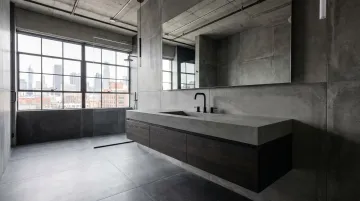
Style 5: Concrete & Industrial Gray (Urban Loft Aesthetic)
Medium-to-dark solid gray or lightly textured gray quartz that mimics poured concrete — but with none of concrete's maintenance liabilities. Real concrete countertops require sealing, are prone to cracking, and absorb stains; quartz in this colorway delivers the same aesthetic with a fraction of the upkeep. This style has a strong following in NYC loft conversions and modern NJ new-construction baths where the design intent is deliberately urban and minimal.
Best fit: Floating wall-mount vanities, matte black or brushed nickel hardware, large-format porcelain floor tile. Open, minimalist layouts.
In higher-end NYC renovations, this style is often chosen when the bathroom is designed as a destination rather than a utility room. Caesarstone's #2003 Concrete — available through Broadway Kitchens & Baths — is the most commonly specified option in this category.
Style 6: Bold Dramatic Veining (Dark Background or High-Contrast)
Quartz with dark charcoal or black backgrounds and white or gold veining (inspired by Nero Marquina marble) — or white backgrounds with exceptionally bold, brushstroke-scale veining. This style anchors the entire bathroom design — the countertop becomes the focal surface, not the background.
Best fit: Powder rooms or boutique-style master baths where one vanity surface functions as a focal point. Pairs with dark cabinetry or contrasting light walls.
According to 2025 quartz style trend data, high-contrast and bold veining styles are among the fastest-growing bathroom countertop requests — particularly among NYC brownstone owners and NJ homeowners doing full master suite renovations.
Brand examples:
- Silestone Eternal Noir — stark white veins against an inky black background
- Cambria Inverness Stonestreet — deep charcoal and black with creamy white veining
Style 7: Soft Green, Sage & Earthy Tones (Biophilic & Trending)
Quartz in muted green, sage, terracotta-blush, or warm taupe — part of a broader biophilic design direction that brings organic color into the bathroom. According to MSI, green tones are "redefining bathroom design in 2025", and these colorways are among the fastest-growing quartz requests across the tri-state market.
Best fit: Natural wood cabinetry, rattan or woven accessories, matte finishes. Particularly popular in NJ homes where the homeowner wants a nature-inspired retreat rather than a stark contemporary look.
Top picks:
- MSI Calacatta Viraldi — organic green and brown veining against a warm white background
- Corian Quartz in Mossy Green or Sage — available through Broadway Kitchens & Baths for NJ and NYC projects
Customization Details: Edge, Thickness & Finish
Selecting a quartz color is step one. The customization details below determine whether the finished countertop looks truly tailored to the space.
Edge Profiles
Edge choice has more design impact than most homeowners expect:
| Edge Type | Best For | Visual Effect |
|---|---|---|
| Eased/Straight | Modern, contemporary | Clean, minimal |
| Beveled | Transitional | Angled, slightly dressed-up |
| Bullnose | Traditional, soft | Rounded, approachable |
| Ogee | Traditional, formal | Decorative, adds depth |
| Waterfall | High-end modern | Slab continues to floor |
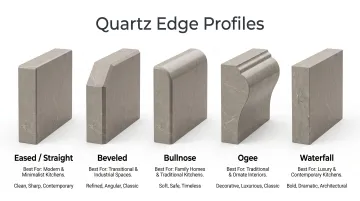
A clean eased edge reinforces a modern look. An ogee elevates a traditional design without being ornate. Broadway Kitchens & Baths handles custom edge profiles in-house, from field measurement through installation — so the profile you select in the showroom is what gets fabricated and fitted.
Thickness: 2cm vs. 3cm
- 2cm (¾") works well for smaller vanities or installations where weight is a consideration — standard and cost-effective
- 3cm (1¼") carries more visual weight and is the increasingly preferred choice for double vanities in NJ master baths — expect to pay roughly 15–20% more than 2cm
- Mitered edges: Used to create the appearance of even greater thickness on thinner slabs — a common technique for achieving a high-end look at lower material cost
Finish Options
- High-gloss polished finish is the most common choice — it maximizes color vibrancy and brightness, making it especially effective for solid white quartz in compact NYC bathrooms
- Honed (matte, velvety) hides water spots and fingerprints better than polished — on a Calacatta-look quartz, it produces a more organic, spa-like result
- Leathered finish is textured and tactile — it adds dimension and pairs naturally with concrete-look or earthy quartz in contemporary bathrooms
For 2025 bathroom projects, matte finishes are increasingly requested — they photograph well and hold up to daily use. Taken together, edge profile, thickness, and finish interact as a system: getting all three right is what separates a countertop that looks custom from one that simply looks installed.
How to Match Your Quartz Style to the Rest of Your Bathroom
Once you've narrowed down your favorite styles, one planning mistake can derail the whole decision: choosing quartz before accounting for the elements that are hardest to change.
Start With Fixed Elements
Floor tile, wall tile, and tub or shower surround are expensive to replace. Start there, then select quartz to complement those surfaces — not the other way around.
A practical example: gray floor tile + white shaker cabinets → Style 2 or Style 3 will produce a cohesive result. The same gray floor tile with navy cabinets → Style 1 (Calacatta) or Style 6 (bold veining) creates contrast without conflict.
Cabinet Color as a Driver
| Cabinet Color | Compatible Quartz Styles |
|---|---|
| White | Styles 1 through 5 (most flexible) |
| Dark navy/charcoal | Styles 1, 2, or 7 |
| Warm wood tones | Styles 4 or 7 |
| Alabaster (warm white) | Warm white, soft cream, or lightly veined — Style 4 or Calacatta-look with warm undertones |
Light Conditions Matter More Than Most Expect
Quartz colors shift between natural daylight, warm incandescent light, and cool LED. A soft gray that looks elegant in a showroom can read blue or green under bathroom lighting.
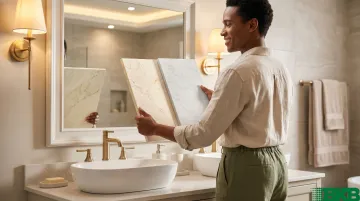
Request physical samples from Broadway Kitchens & Baths and place them in your actual bathroom at different times of day before finalizing. View each sample under your vanity lighting and any natural light the room gets — the same slab can look like two different colors depending on conditions.
Choosing Well Is the Whole Point
The right quartz style for a NJ master bath renovation is not the same as the right choice for a compact NYC co-op bathroom. Scale, light, cabinetry, and daily function all feed into the decision. The 7 styles above span from stripped-down minimalism to dramatic statement — and the customization options for edge, thickness, and finish mean no two installations need to look alike.
Broadway Kitchens & Baths works with homeowners, builders, architects, and property managers across the tri-state area — from single-vanity renovations to 200-unit residential developments. The team handles selection, field measurements, fabrication coordination, and installation end to end.
Call +1 201-567-9585 or visit the showrooms in Englewood, NJ or Manhattan, NY to explore quartz options, view samples, and discuss your project with the design team.
Frequently Asked Questions
How much do quartz countertops cost for a bathroom?
In the NJ/NYC metro area, expect to pay $80–$110 per square foot installed, with premium options reaching $120–$200+. Cost varies based on slab size, edge profile, sink cutouts, and brand. For smaller vanities, remnant slabs are often the most budget-friendly option.
Is quartz countertop good for a bathroom?
Yes — quartz is particularly well-suited for bathrooms. Its non-porous surface resists moisture, mold, and common bathroom stains (toothpaste, cosmetics, cleaning agents), and it never requires sealing. The wide style range means it works in virtually any design context.
How thick should a quartz bathroom countertop be?
The two standard options are 2cm (~¾") and 3cm (~1¼"). For double vanities and higher-end NJ master bath projects, 3cm is increasingly preferred for its visual weight and durability. Mitered edges can simulate greater thickness on 2cm slabs at lower material cost.
What quartz goes with Alabaster cabinets?
Alabaster's warm undertones pair best with warm white, soft cream, or lightly veined quartz — Calacatta-style designs with warm (not cool gray) veining work especially well. Stark, cool-white quartz tends to clash rather than complement.
What are the top 5 quartz countertops?
Five widely recognized options for bathroom applications:
- Cambria Brittanicca — Calacatta marble-look
- Caesarstone 1141 Pure White — solid bright white
- MSI Calacatta Fioressa — gray and gold veining
- Silestone Eternal Noir — bold, dramatic dark
- Caesarstone 5131 Calacatta Nuvo — classic marble-look
The right pick depends on your design context and bathroom style.
What is the least toxic countertop?
Installed quartz is low-toxicity for homeowners. The real risk is at fabrication: traditional engineered quartz contains over 90% crystalline silica, a serious inhalation hazard during cutting. Low-silica alternatives exist — Silestone XM is under 10% and Caesarstone ICON under 1% — and NJ/NYC contractors should confirm their fabricator follows OSHA silica exposure guidelines.