The problem most homeowners hit: they know they want marble, but they don't know which marble. Carrara and Calacatta aren't interchangeable. A honed finish and a polished finish on the same slab produce completely different bathrooms. The variety, veining scale, finish, and application all determine whether the result feels custom and considered — or generic.
This guide covers the 8 marble styles most requested in luxury NJ and NYC bathroom renovations, with pricing context, finish recommendations, and design pairing guidance for each.
Key Takeaways
- Marble is the No. 2 vanity countertop material in the US (Houzz, 2023) — a consistent choice for luxury bathroom renovations
- Eight distinct styles span entry-level to ultra-premium price points, covering traditional, transitional, and contemporary design languages
- Finish matters as much as variety — honed surfaces hide water marks and etching better than polished
- Installed costs range from roughly $80 to $250+ per square foot depending on variety and fabrication complexity
- Match the marble to your bathroom's design style, traffic level, and lighting conditions before selecting a slab
Why Marble Dominates Luxury Bathroom Design in NJ & NYC
Marble holds a category of its own in luxury bathroom design. Its appeal comes from qualities no engineered material reproduces:
- Veining patterns that are genuinely unrepeatable slab to slab
- A light-reflective surface that shifts in appearance throughout the day
- A material history spanning millennia, carrying association with permanence and craft
- Natural variation that makes each installation distinct
The Natural Stone Institute is direct about marble's best applications — listing it as ideal for "foyers, bathrooms, floors and hearths." The acid-etching risk that makes marble higher-maintenance in kitchens (acidic foods, citrus, wine) is essentially absent in bathrooms, where most products are pH-neutral. That's a practical advantage most homeowners don't consider when comparing materials.
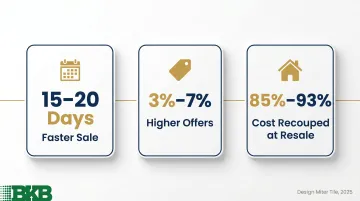
That lower maintenance burden also has a direct financial upside. According to 2025 data from Design Miter Tile, homes with updated countertops sell 15-20 days faster and receive offers 3%-7% higher than comparable homes, with minor bathroom remodels recouping approximately 85%-93% of cost at resale.
The 8 styles below represent the marble choices currently driving luxury bathroom renovations across NJ and NYC, from Bergen County estates to Manhattan condos.
8 Best Marble Bathroom Countertop Styles for Luxury NJ & NYC Homes
These styles were selected based on design versatility, tri-state market availability, luxury appeal, and suitability for bathroom environments.
1. Classic Carrara White
Carrara is the most widely used marble for bathroom vanities — and for good reason. Quarried in Tuscany's Carrara region, it features a soft white-to-gray background with delicate gray veining that works equally well in traditional and transitional bathrooms. It's the definition of understated luxury.
It pairs cleanly with white or light wood cabinetry, chrome or brushed nickel fixtures, and subway tile. A polished finish adds spa-like light reflection; honed suits high-traffic family bathrooms where minor etching would show on a gloss surface.
| Detail | Specification |
|---|---|
| Origin | Carrara region, Tuscany, Italy |
| Recommended Finish | Polished for master baths; honed for family bathrooms |
| Best Pairing | White or light wood vanities, chrome or brushed nickel fixtures |
| Material Cost | ~$40–$80/sqft |
2. Calacatta Gold
Calacatta Gold is a clear step above Carrara — bolder veining in warm gold and beige tones against a brighter white background. It's frequently used as the visual centerpiece in NYC condo master baths and NJ estate renovations where the vanity needs to make a statement on its own.
Its price premium reflects genuine rarity. While Carrara comes from high-volume quarries, Calacatta Gold is sourced from limited quarry sites in the Apuan Alps — a smaller, more exclusive supply chain. Material costs reflect that scarcity, typically running $180–$300+ per square foot for premium grades.
| Detail | Specification |
|---|---|
| Origin | Apuan Alps, Italy (rarer quarries than standard Carrara) |
| Recommended Finish | Polished — maximizes the warm gold veining |
| Best Pairing | Gold or brass fixtures, warm-toned wood cabinetry, vessel sinks |
| Material Cost | $180–$300+/sqft (premium grades) |
3. Statuario
Statuario occupies the top tier of white Italian marble. Its background is brighter and more luminous than Calacatta, with bold, flowing gray veining that reads almost architectural. Historically reserved for high-profile public buildings, it's now a consistent request in ultra-luxury NJ and NYC master bathrooms.
Because of its striking appearance and price point, Statuario works best in powder rooms or low-traffic vanities — spaces where visual impact matters more than daily durability. A polished finish is the standard choice; the bright white and bold veining demand high-gloss presentation.
| Detail | Specification |
|---|---|
| Origin | Apuan Alps, Tuscany, Italy |
| Recommended Finish | Polished |
| Best Pairing | Minimalist all-white bathrooms, matte black fixtures, floating vanities |
| Material Cost | $50–$100/sqft depending on grade |
4. Calacatta Viola
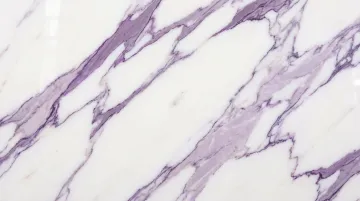
Calacatta Viola is the most design-forward option on this list. A white background threaded with purple, lilac, and violet veining — it reads as distinctly luxurious and fashion-forward. Demand has been climbing in high-end NJ and NYC renovations from clients who want something genuinely different.
Supply is limited. Dedalo Stone, an Italian supplier, classifies Calacatta Viola as "scarce," with "medium-high" pricing. It works best in powder rooms or as a statement master bath vanity where the unusual coloring becomes the focal point rather than just part of the backdrop.
| Detail | Specification |
|---|---|
| Origin | Italy (Calacatta family, Carrara/Apuan Alps, limited quarry production) |
| Recommended Finish | Polished — brings out the depth and richness of the violet veining |
| Best Pairing | Neutral gray or white cabinetry, matte gold fixtures, minimalist backdrops |
| Material Cost | Medium-high; varies by availability |
5. Nero Marquina
Black marble done right. Nero Marquina's deep black background with crisp white veining originates from the Basque region of northern Spain — one of the most distinctive natural stone pairings in the market. It creates high-contrast, contemporary elegance suited for modern NYC apartments and NJ homes with bold interior design schemes.
The key with Nero Marquina is balance. Pairing it with light cabinetry or white walls prevents the space from closing in. A honed finish softens the drama; polished amplifies the luxurious depth.
| Detail | Specification |
|---|---|
| Origin | Basque region, northern Spain |
| Recommended Finish | Polished for high drama; honed for contemporary restraint |
| Best Pairing | White or light gray cabinetry, brushed gold or matte black fixtures |
| Material Cost | ~$70–$100/sqft |
6. Crema Marfil
Crema Marfil is the warm, approachable marble — cream and beige tones with subtle veining, quarried in Spain's Alicante province since the 1950s. It suits traditional and transitional bathroom styles common in NJ suburban estates and older NYC townhouses or brownstones.
Its warm undertones complement natural wood vanities, oil-rubbed bronze fixtures, and warm lighting. The result isn't dramatic — it's refined without demanding attention, which suits spaces where warmth and continuity matter more than statement-making.
| Detail | Specification |
|---|---|
| Origin | Alicante province, Spain |
| Recommended Finish | Honed for soft warmth; polished for a more formal look |
| Best Pairing | Warm wood cabinetry, oil-rubbed bronze or brushed brass fixtures |
| Material Cost | ~$40–$60/sqft |
7. Honed White Marble (Matte Finish Style)
Honed white marble isn't just a material choice — it's a distinct design aesthetic. Taking a white marble (typically Carrara or Bianco Sivec) and applying a matte finish produces a completely different result: quieter, softer, more contemporary. The surface absorbs rather than reflects light.
This style is increasingly requested in NJ and NYC minimalist and Scandinavian-influenced bathrooms. There's also a practical argument: honed marble hides etch marks dramatically better than polished. On a polished surface, etching shows as a dull spot against gloss; on a honed surface, any new dull area blends into the existing matte finish. For high-traffic bathrooms, that's a real advantage.
Matte finishes have seen a notable rise in buyer preference over the past several years, reflecting both aesthetic shifts toward quieter interiors and practical recognition of honed marble's durability in daily use.
| Detail | Specification |
|---|---|
| Base Marble | Typically Carrara or Bianco Sivec white marble |
| Recommended Finish | Honed (matte) — the defining feature of this style |
| Best Pairing | Integrated undermount sinks, flat-front cabinetry, warm or cool neutral tones |
| Material Cost | Varies by base marble; finish adds minimal cost |
8. Book-Matched Marble
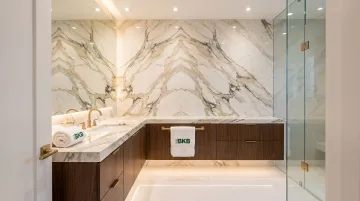
Book-matching is where marble moves from material into architecture. Two adjacent slabs are mirrored so their veining creates a symmetrical butterfly pattern — most often executed with Calacatta or Statuario for maximum visual effect. The result appears in high-end NJ and NYC master bath wall panels, shower surrounds, and oversized vanity tops.
The fabrication requirement is real. Book-matching demands a higher level of craftsmanship than standard stone layouts — precise seam placement, vein alignment, and access to matching slab pairs from the same lot. For projects in the tri-state area, working with a renovation partner who manages both stone sourcing and fabricator coordination — like Broadway Kitchens & Baths — reduces the risk of slab mismatches and alignment errors that can compromise the finished effect.
| Detail | Specification |
|---|---|
| Commonly Used Marble | Calacatta Gold, Statuario, or any dramatic large-vein variety |
| Recommended Finish | Polished — maximizes the mirrored veining effect |
| Best Pairing | Full-height shower surrounds, statement vanity walls, spa-style master baths |
| Fabrication Cost | Premium above base material — sourcing and alignment add significant cost |
How to Choose the Right Marble Style for Your Bathroom
Start with the bathroom's design language, then weigh in traffic patterns and budget. These three factors — style, use, and cost — will narrow your options quickly.
By design style:
- Minimalist NYC condo → Statuario or Honed White Marble
- Warm transitional NJ master bath → Crema Marfil or Carrara
- Bold contemporary → Nero Marquina or Calacatta Gold
- Statement/fashion-forward → Calacatta Viola or Book-Matched Calacatta
By traffic level:
- High-use family bathrooms → honed finish, Carrara or Crema Marfil (forgiving vein patterns)
- Powder rooms and low-traffic vanities → Calacatta Viola, Statuario (dramatic veining with less wear concern)
By budget:
| Tier | Varieties | Installed Cost Range |
|---|---|---|
| Entry-level | Carrara, Crema Marfil | $80–$120/sqft |
| Mid-range | Statuario, Nero Marquina | $100–$180/sqft |
| Premium | Calacatta Gold, Calacatta Viola | $200–$300+/sqft |
| Variable | Honed White, Book-Matched | Depends on base stone + fabrication |
Rarity, country of origin, and quarry availability drive cost more than material category alone.
Caring for Your Marble Bathroom Countertop
Marble bathroom countertops are more forgiving than their reputation suggests — as long as you follow a few consistent habits.
Sealing:
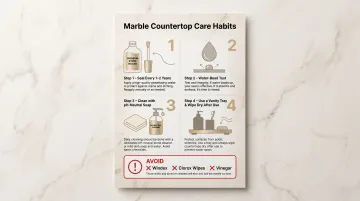
- Reseal with a penetrating stone sealer every 1–2 years for bathroom use (less frequent than kitchen marble, which needs sealing every 6–12 months due to acid exposure)
- Water-bead test: place a few drops of water on the surface. If it beads, the seal is intact. If it soaks in and darkens the stone, it's time to reseal
Cleaning:
Use pH-neutral stone cleaner or mild dish soap with warm water and a soft cloth. Avoid:
- Windex — contains ammonia, which etches marble
- Clorox wipes — bleach and acid-based formulas dull and etch the surface
- Vinegar or citrus cleaners — react with calcium carbonate, leaving permanent dull spots
Two habits that prevent most problems:
- Keep a tray on the vanity for skincare and hair products — never place bottles directly on marble
- Do a quick wipe-down with a dry cloth after heavy bathroom use to prevent hard water mineral deposits from building up
With the right care routine, a well-chosen marble countertop will hold its character and finish for decades.
Conclusion
No single marble variety is the right answer for every bathroom. Carrara suits some spaces perfectly; Calacatta Viola would overwhelm them. The right choice depends on your design vision, daily use patterns, and what the budget realistically supports.
For homeowners, architects, and designers across NJ and NYC, Broadway Kitchens & Baths manages the full bathroom renovation scope — countertop sourcing, cabinetry, tile, and installation — from initial field measurements through final punch-list. Their showrooms in Englewood, NJ and Manhattan let you view stone slabs in person before committing, and their team collaborates directly with trade professionals on custom projects throughout the tri-state area.
Call +1 201-567-9585 or stop by either showroom to review marble options and talk through your project.
Frequently Asked Questions
How much does a marble bathroom countertop cost?
Installed marble countertop costs typically range from $80 to $250+ per square foot, depending on marble variety and fabrication complexity. Most bathroom vanity projects land between $2,000 and $5,000 total.
Is marble good for bathroom countertops?
Bathrooms are actually one of the best environments for marble. Lower acid exposure compared to kitchens means significantly less etching risk. With proper sealing and basic care, marble performs well and ages beautifully in bathroom applications.
What is the best countertop for a bathroom vanity?
Marble is the top choice for luxury vanities — the aesthetics and natural veining are unmatched. For high-traffic or family bathrooms where maintenance is a priority, quartz offers a lower-maintenance alternative with similar visual appeal.
Is marble still in style for bathrooms?
Marble has been a design standard for centuries, not a passing trend. Specific varieties cycle in and out of fashion, but the material itself holds its position as a benchmark for luxury — and that hasn't changed.
Can I use Windex or Clorox wipes on marble bathroom countertops?
Neither is safe for marble. Windex contains ammonia; Clorox wipes are acidic — both etch the surface and cause permanent dulling over time. Use a pH-neutral stone cleaner or mild dish soap instead.
What kind of sink works best with marble bathroom countertops?
Undermount sinks are the most popular choice — they create a seamless look and make cleaning easier. Vessel sinks work well for statement designs, particularly with bold marble styles like Calacatta Gold or Nero Marquina.