Introduction
In Manhattan, the bathroom has become one of the most scrutinized rooms in any listing, renovation pitch, or co-op application. What was once purely functional is now a design statement — and the expectations have shifted dramatically heading into 2026.
Renovation activity is surging across Upper East Side co-ops, Tribeca condos, and pre-war buildings citywide. Homeowners aren't asking for "nice tile" anymore — they want steam showers, bookmatched marble, heated floors, and hardware that reads like jewelry.
Delivering that requires navigating real constraints: building board approvals, wet-over-dry restrictions, limited square footage, and material lead times that don't bend for anyone. Architects, contractors, and decorators working in this city know the challenge well.
This guide covers the 10 defining bathroom design trends shaping Manhattan renovations in 2026: what they look like, why they're gaining traction, and how to execute them within the real constraints of New York City living.
Key Takeaways
- Natural stone dominates: Bookmatched marble and grout-free plaster finishes are replacing standard tile in luxury Manhattan bathrooms
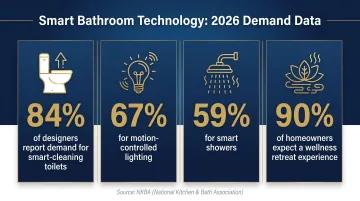
- 90% of homeowners now expect a primary bathroom to function as a personal wellness retreat
- Smart tech is baseline: Digital shower controls, heated floors, and smart mirrors are now expected in high-end renovations
- Powder rooms are the new design playground — bold color, dramatic fixtures, and statement wallcoverings are taking over
- Warm metals are in, chrome is out: Brushed brass, aged bronze, and champagne finishes define 2026 hardware choices
Trend 1: Luxury Natural Stone, Custom Stonework, and Textured Surfaces
Standard tile is out. Large-format stone slabs, hand-applied plasters, and custom stone fixtures have taken its place — chosen for permanence and individual expression. Manhattan's top bathroom renovations in 2026 are defined by materials that feel crafted, not assembled.
Large-Format Stone Slabs and Bookmatched Marble
Floor-to-ceiling stone slab installations — in marble, travertine, onyx, and quartzite — are replacing tile as the defining luxury finish. The visual appeal of bookmatched slabs, where two mirrored cuts of the same stone are opened like a book, creates a seamless, gallery-like surface that no tile layout can replicate.
The NKBA's 2025 Bath Trends Report — based on a survey of 500 industry experts — identifies floor-to-ceiling stone slabs as a leading trend for creating a "monochromatic, luxurious look." Houzz's 2026 KBIS report confirms quartzite and sintered stone with dramatic veining as dominant surface materials, with examples like Neolith's Taj Mahal sintered stone setting the reference point for texture and movement.
This trend is especially prominent in gut-renovated condos and townhouses where the renovation scope allows for full wet-area stone installation from substrate up.
Custom Stone Sinks and Bespoke Fixtures
Custom-carved stone sinks — vessel or undermount — fabricated from the same slab material used on walls and floors push bathrooms from "well-designed" into genuinely bespoke territory. The continuity of material across every surface communicates luxury without requiring additional embellishment.
Among Manhattan architects and interior designers, it's a growing request — particularly in primary bathrooms where material cohesion carries the entire design concept.
Tadelakt, Microcement, and Grout-Free Finishes
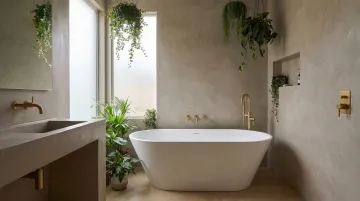
Tadelakt (traditional Moroccan waterproof lime plaster), microcement, and limewash finishes are increasingly common across Manhattan for one practical reason: they eliminate grout lines entirely.
Architectural Digest's 2025 interior design coverage names tadelakt — described as a "hand-troweled plaster praised for its organic appeal" — alongside specific luxury marbles as a leading surface treatment. In smaller Manhattan bathrooms, a continuous grout-free surface reduces visual clutter and adds tactile warmth that tile simply can't match.
Trend 2: Smart Technology, Spa Wellness Features, and Statement Showers
Manhattan homeowners — particularly in luxury high-rises and renovated pre-war buildings — are demanding bathrooms that perform like private wellness retreats. The global smart bathroom market was valued at $10.19 billion in 2025, projected to reach $11.25 billion by 2026 at a 10.4% CAGR (Polaris Market Research), with North America leading adoption.
Smart Bathroom Technology Integration
The 2026 Manhattan luxury renovation now routinely includes:
- Programmable digital shower systems (preset temperature, flow, and duration via app or touchscreen)
- Smart mirrors with integrated LED lighting, defogging, and optional health monitoring displays
- Heated floor systems with app-scheduled radiant heat, particularly valued in pre-war buildings with inconsistent radiator heat
- Automated toilet systems with bidet functions, self-cleaning cycles, and seat warming
NKBA data shows 84% of designers report high demand for smart-cleaning toilets, 67% for motion-controlled lighting, and 59% for smart showers. These are no longer amenities — they're baseline expectations in the upper tier of the Manhattan market.
Spa and Wellness-Driven Features
64% of homeowners cite a spa-like atmosphere as their primary bath design goal, and 72% use showers specifically for rehabilitation, including steam and aromatherapy functions. Features being specified in Manhattan primary bathrooms include:
- Steam showers with chromotherapy lighting
- Soaking tubs with overflow drain design
- Rainfall and multi-function shower heads
- Heated towel rails integrated into the wall plane
This shift accelerated post-pandemic, and client expectations have moved firmly toward boutique hotel standards. For architects and contractors specifying these projects, that means sourcing fixtures and systems — not just surfaces — that can deliver on the wellness brief.
Walk-In Frameless Showers Replacing Tub-Shower Combos
53% of homeowners are removing tubs to increase shower size, per the NKBA survey. In Manhattan, the rationale is both practical and aesthetic.
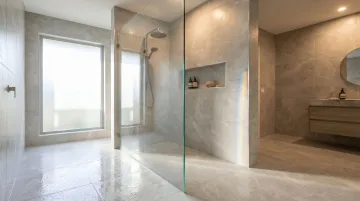
A curbless walk-in frameless glass shower does three things simultaneously:
- Reclaims floor area lost to bulky tub surrounds
- Creates visual openness by eliminating the shower pan curb
- Reads as a single continuous floor plane, making bathrooms feel significantly larger
Broadway Kitchens & Baths stocks frameless enclosure options from Dreamline and Glasscrafters, and their installation crews work regularly with the precision tolerances curbless entries demand — a detail that matters when you're coordinating tile layout, drain placement, and glass panel alignment across a single continuous floor plane.
Trend 3: Vanities, Bold Powder Rooms, Statement Lighting, and Warm Metal Finishes
These are the finishing-touch trends that define a 2026 Manhattan bathroom's personality — and where many homeowners make their most visible design statements.
Floating Vanities and Custom Cabinetry for Manhattan Living
In space-constrained Manhattan bathrooms, a floating vanity does more than look clean. Wall-mounting the vanity:
- Exposes more floor area, visually expanding the room
- Allows for integrated toe-kick lighting beneath
- Simplifies floor cleaning and maintenance
- Creates space for concealed plumbing runs within the wall cavity
Broadway Kitchens & Baths offers wall-mounted floating vanities alongside cabinetry lines including UltraCraft, Plain & Fancy, and Wolf Classic Cabinets — all adaptable for bathroom applications. Their designers note that in New York City and New Jersey projects, "storage is important — knowing what products keep the modern feel while maximizing storage is crucial."
Custom and semi-custom configurations support lacquer, wood veneer, and two-tone finishes tailored to the bathroom's overall material palette.
Dark, Moody, and Bold Powder Room Designs
The powder room has become Manhattan's preferred space for design risk-taking. Deep greens, charcoal, plum, and matte black are being paired with statement vessel sinks, dramatic wallcoverings, and sculptural faucets — combinations that would feel overwhelming across a full primary bathroom renovation.
The small scale is precisely what makes it work. A bold color choice costs far less to execute here than in a 100-square-foot primary bath, and the impact per dollar is far higher. Clients looking to test a design direction — a specific tile pattern, a dark paint color, a sculptural fixture — can validate it in the powder room before committing across a larger space.
Statement Lighting and Warm Mixed Metal Hardware
Lighting is being treated as a design element in its own right in 2026. 96% of NKBA respondents prioritize lighting quality — and the approach has shifted toward layered, intentional schemes:
- Sculptural wall sconces flanking mirrors at eye level
- Backlit anti-fog mirrors providing even, flattering light
- Recessed LED niches in shower shelves (eliminating clunky surface-mounted fixtures)
- Warm color temperature — 2,700K is the NKBA's recommended standard for appearance quality
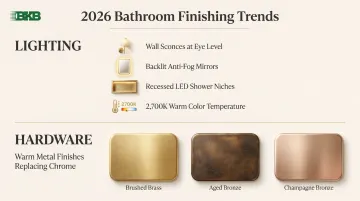
Hardware choices are moving in the same direction. Architectural Digest's 2025 bathroom trend coverage describes hardware evolving into "jewelry-like statements," with preference for handcrafted, antique, and hammered finishes. Brushed brass, aged bronze, and champagne bronze are replacing chrome and polished nickel — finishes that add warmth and tactile richness to minimalist tile and stone surfaces.
What's Driving Manhattan's 2026 Bathroom Design Trends
Several converging forces are making bathroom renovation one of the highest-priority home improvement investments in Manhattan right now.
Real estate value and listing pressure: Manhattan's luxury market places an outsized premium on bathroom quality. Nationally, midrange bathroom remodels recoup approximately 80% of cost on resale, per the 2025 Cost vs. Value Report. In Manhattan's high-cost market, where luxury finishes are baseline buyer expectations rather than differentiators, the calculus shifts further — a below-standard bathroom actively suppresses listing value rather than just failing to add to it.
Rising client sophistication: Manhattan homeowners arrive at renovation conversations having already absorbed content from Architectural Digest, 1stDibs, and international travel. They're referencing specific stone types, specific hardware finishes, and specific hotel bathrooms by name. Designers and contractors are being asked to match those references — which pushes the entire market toward more bespoke, considered solutions.
Manhattan's regulatory environment as a design catalyst: Several overlapping requirements force precision into every renovation decision before a single fixture is ordered:
- Co-op board approval processes, typically 60–90 days for complex projects
- DOB ALT2 permit requirements for any plumbing relocation
- Wet-over-dry rules governing stack placement
- Asbestos abatement requirements in pre-war buildings
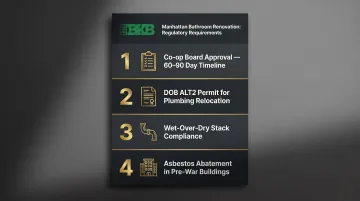
These constraints have, counterintuitively, raised the overall quality of finished bathrooms. When you can only move a drain once, you plan it correctly the first time.
Turning These 2026 Trends into Your Manhattan Bathroom Renovation
Getting the design right is the easier half of a Manhattan bathroom renovation. The harder half is navigating the city's layers of regulatory and building-specific requirements before a single tile goes up.
Work With a Team That Knows the City's Rules
A contractor unfamiliar with Manhattan's regulatory landscape can add weeks to a project timeline before a single tile is set. Key requirements include:
- Co-op alteration agreements and board approval processes
- DOB permit sequencing and wet-over-dry restrictions
- Union versus non-union labor documentation
- Freight elevator scheduling and building access coordination
Broadway Kitchens & Baths handles bathroom renovations from field measurements through punch-list completion, working across union and non-union environments with the insurance documentation each requires. The full scope covers design consultation, procurement, installation, and final inspection — with crews experienced enough to complete a full bathroom renovation in 4–6 weeks, including building inspections.
Prioritize Your Budget Strategically
NYC gut bathroom renovations range from $38,000–$65,000 for standard full renovations to $120,000–$240,000+ for luxury primary baths with custom stonework, steam showers, and heated floors, per NYC Renovation Guide's 2026 data. Building logistics add a 5–10% cost premium on top.
Anchor spend on permanent, high-impact elements first:
- Stone surfaces and slab installation
- Custom cabinetry and floating vanity infrastructure
- Smart technology rough-in (plumbing and electrical)
Decorative hardware, lighting fixtures, and accessories can be phased or upgraded later. Infrastructure cannot.
Frequently Asked Questions
How much should a high-end bathroom remodel cost in Manhattan?
Full gut renovations in Manhattan run $38,000–$65,000 for standard scope and $120,000–$240,000+ for luxury primary baths with custom stonework, steam showers, and bespoke cabinetry. Building logistics, NYC labor rates, and DOB fees add a significant premium above national averages.
How long does a bathroom renovation take in a Manhattan apartment?
Standard gut renovations typically take 6–10 weeks for construction, with co-op board approval adding 60–90 days before work begins. Custom stone fabrication or complex smart technology installation can extend timelines further.
Do I need board approval to renovate a bathroom in a Manhattan co-op or condo?
Most co-ops and many condos require board approval and a signed alteration agreement before work starts. For plumbing or structural changes, the NYC DOB also requires an ALT2 permit filed by a licensed P.E. or R.A.
What is the most popular bathroom surface trend for 2026?
Large-format stone slabs, bookmatched marble, and grout-free textured finishes — particularly tadelakt and microcement — are the dominant surface trends replacing traditional tile in Manhattan's luxury bathroom market.
How do I incorporate spa features into a small Manhattan bathroom?
A curbless walk-in shower with a rainfall head, radiant heated floors, and recessed LED niches delivers a spa-caliber experience in compact footprints. Removing the tub-shower combination typically frees up enough floor area to make these features feasible.
Are smart bathroom features worth the investment for a Manhattan renovation?
For the luxury segment, yes. Digital shower controls, heated floors, and smart mirrors add lifestyle value and resale appeal. Even if you phase the installation, rough in all wiring and plumbing during the full renovation — retrofitting later costs significantly more.