
Most co-op owners start planning around fixtures and finishes, then get blindsided — by approval delays, building architect fees, asbestos testing requirements, and contractor insurance thresholds that have nothing to do with whether the herringbone tile looks right.
Here are 7 things you need to understand before any work begins, so your project moves forward without costly surprises.
Key Takeaways
- Read your alteration agreement before hiring anyone — it governs work hours, insurance requirements, and construction duration limits
- Budget $25,000–$75,000+ in compliance soft costs on top of your materials and labor budget
- Wet-over-dry rules can kill your layout plans before design even starts
- Pre-war buildings require ACP-5 asbestos clearance before the DOB will issue a permit
- Board approval and DOB permitting are sequential — plan for 3–5 months total
Thing 1: Read the Alteration Agreement Before You Plan Anything
The alteration agreement is a legally binding contract between you (the shareholder) and the co-op board. It dictates every parameter of your renovation: allowed work hours, contractor insurance minimums, plumbing and electrical specifications, and what scope triggers the need for architectural drawings.
As Brick Underground describes it, it's "a contract between you and your co-op board stipulating that your renovation work will comply with code-related and building-specific requirements." The board enforces it under your proprietary lease — not a city agency, and not subject to appeal through city channels.
Every Building's Agreement Is Different
This is where many co-op owners go wrong: they assume their building's rules match a neighbor's, or a friend's building across town. They don't. Fontan Architecture confirms that "each building's alteration agreement reflects its own priorities," with variations in insurance minimums, permitted work hours, and the scope that triggers architectural drawings. The NYC Bar Association publishes a model form, but individual buildings adopt and modify it to suit their own governance needs.
What's permitted in one Upper West Side co-op may be prohibited in a building two blocks away. Read your specific agreement before you budget or hire — the cost of assumptions shows up later in penalties and delays.
Watch for Duration Caps and Daily Penalties
Many alteration agreements cap construction at 90–120 days, with financial penalties for overruns typically ranging from $100 to $500 per day. These penalties are deducted from the refundable renovation deposit you post before construction begins.
Understanding these terms before you engage a contractor shapes your entire project schedule. If a contractor underestimates the timeline, you absorb those penalties, not them.
Thing 2: Budget for Co-op Compliance Costs — Not Just Tiles and Fixtures
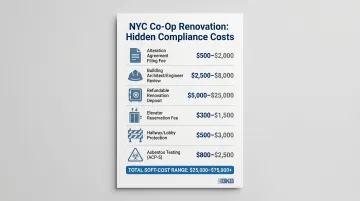
The compliance costs unique to NYC co-op renovations form a separate budget layer that most owners don't anticipate. According to Gallery KBNY, a realistic soft-cost allowance for a Manhattan co-op gut renovation runs $25,000–$75,000+, depending on the building.
| Compliance Cost Item | Typical Range |
|---|---|
| Alteration agreement filing fee | $250–$500 (non-refundable) |
| Building architect/engineer review | $1,500–$3,000+ |
| Refundable renovation deposit | $10,000–$50,000 |
| Elevator reservation fee | $500–$2,000/month |
| Hallway/lobby protection | $2,000–$5,000 |
| Asbestos testing (ACP-5) | $1,500–$4,000 |
Several of these line items catch owners off guard. Here's what to expect from the most impactful ones.
The Building Architect Fee
Most co-op boards retain their own architect or engineer to review your submitted construction drawings. You — the shareholder — pay that fee. It's entirely separate from any architect or designer you hire yourself, and it often involves multiple revision cycles, each adding time and cost.
Contractor Insurance Requirements
Co-op boards typically require contractors to carry $1M–$2M in general liability insurance, with luxury buildings demanding $5M–$10M in umbrella coverage. A contractor who can't meet the threshold cannot work in the building. Confirm insurance compliance before signing any contracts — discovering a gap mid-project means work halts until a compliant replacement is found.
Restricted Work Windows Drive Up Labor Costs
NYC co-op buildings typically restrict construction to weekdays between 9:00 AM and 4:00 PM — roughly 6 productive hours per day after setup and cleanup. This compressed schedule directly increases labor costs compared to unrestricted projects elsewhere.
Recommended contingency reserve: 15–20% of total project cost for pre-war buildings (built before 1940), where hidden infrastructure issues are most likely.
Thing 3: Understand the Wet-Over-Dry Rule Before Finalizing Your Layout
The wet-over-dry restriction prohibits placing a "wet" area — bathroom, kitchen, or laundry — directly above a "dry" area (bedroom or living room) in the unit below. Fontan Architecture notes this is "typically imposed by co-op boards or condominium management as a risk-management policy intended to reduce potential water damage" to neighboring units. It's a board governance policy, not a DOB regulation.
The practical impact: if your layout reconfiguration would position your bathroom above a neighbor's bedroom, the board will reject it. This can eliminate the entire premise of a redesign before a single drawing is produced.
Plumbing Riser Constraints
In NYC co-op buildings, supply and waste lines run vertically through the building's stack. Horizontal rerouting to distant risers is typically prohibited: running drain lines through the floor assembly of the unit below creates structural concerns and water-damage liability the board won't accept.
Before finalizing any layout, confirm your riser locations. Two constraints come up consistently in alteration agreements:
- Fixture placement: All fixtures must connect to existing stacks — relocating to a distant riser is rarely approved.
- Branch line replacement: Boards frequently require replacing existing branch lines and shut-off valves during renovation, even when your original scope was limited to cosmetic work.
Thing 4: Plan for Asbestos and Lead Testing in Pre-War Buildings
The NYC Department of Buildings requires an ACP-5 asbestos clearance certificate before issuing demolition or renovation permits. Per the NYC DOB, "full demolition applications require an ACP-5 form for DOB to proceed." The form must be filed by a DEP-certified asbestos investigator.
Pre-war co-ops built before 1940 are at the highest risk. Asbestos commonly turns up in:
- Pipe insulation and steam riser wrapping
- Floor tile adhesive and vinyl floor tiles
- Wall plaster and joint compound materials
The Cost of Waiting
| Asbestos Scenario | Cost | Timeline Impact |
|---|---|---|
| Proactive pre-construction ACP-5 testing | $1,500–$4,000 | Integrated into planning |
| Standard abatement (if found) | $3,000–$15,000 | 2–4 weeks |
| Mid-demolition discovery | $15,000–$40,000+ | 2–6 weeks of unplanned stoppage |
Discovering asbestos after demolition begins sets off a chain of mandatory steps:
- Immediate work stoppage on the entire project
- DEP notification (10-business-day notice required for projects over 160 sq ft)
- Emergency abatement contractor mobilization
- Post-abatement air monitoring before work can resume
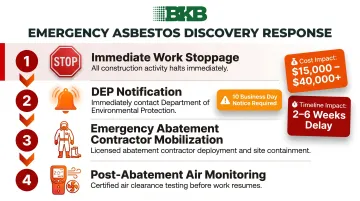
That sequence alone can consume your entire construction duration cap.
Test before demolition. Mid-project discovery never saves time or money — it only multiplies both costs.
Thing 5: Meet the Board's Soundproofing Requirements Before You Tile
Most NYC co-op boards require specific soundproofing measures under bathroom floors to prevent noise and impact transfer to neighbors below. NYC Administrative Code Section 27-769 sets a minimum STC rating of 45 for airborne noise, but many boards mandate materials that exceed that threshold.
Common board-approved options include:
- Cork underlayment for its impact absorption and ease of specification
- Sound-dampening membranes such as Schluter-DITRA for tile-ready installations
- Products with independent laboratory STC/IIC test results, which some boards require submitted alongside physical material samples
These requirements must be specified in your alteration agreement submission before tiling begins. Boards treat this as a condition of approval, not a formality.
Omitting soundproofing specifications from the initial submission is one of the most common reasons boards issue work stoppage notices mid-project. Retrofitting underlayment after tile is installed means tearing out finished floors and starting over — a costly disruption that's entirely avoidable with the right prep.
If your board requires independent laboratory STC/IIC test results or physical material samples with your submission, that documentation needs to be prepared before you submit, not after the board asks for it.
Thing 6: Plan for Two Separate Timelines — Approval and Construction
Most co-op owners build one timeline: how long will construction take? The real question is two-part, and the first half often takes longer than the second.
The Pre-Construction Approval Gauntlet
Board approval for a renovation typically takes 60–90 days, and that's for straightforward projects. The sequence:
- Submit the alteration agreement package to building management
- Building's architect or engineer reviews your plans
- Multiple revision cycles (each requiring resubmission and re-review)
- Final board vote
Each revision cycle adds weeks. Submitting a complete, compliant package the first time — with all required drawings, specs, insurance certificates, and soundproofing documentation — is the only way to compress this phase.
DOB Filing Comes After Board Approval
DOB permit applications can only be submitted after board approval is granted. ACP-5 clearance must also be obtained before DOB filing. These steps are sequential, not parallel. DOB residential permit processing adds another 4–8 weeks after that.
Build a Realistic Master Calendar
A typical full gut bathroom renovation in a NYC co-op, mapped out honestly:
- Board approval phase: 60–90 days
- DOB permitting: 4–8 weeks
- Construction (6-hour co-op workdays): 5–8 weeks
- Water shut-off coordination with the super and adjacent units: typically adds 1–2 days per shut-off event
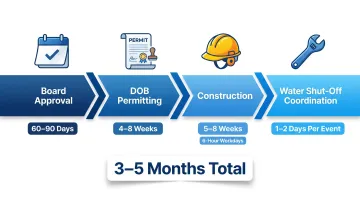
Total realistic range: 3–5 months from alteration agreement submission to punch-list completion. Most experienced NYC co-op renovators end up at roughly twice their original construction estimate. Budget your calendar accordingly.
Thing 7: Hire a Contractor Who Has Worked in NYC Co-op Buildings
Co-op experience separates projects that move from ones that stall for weeks in revision cycles and compliance failures. The distinction shows up fast.
What Building-Experienced Contractors Know
- The board's reviewing architect's expectations and how to prepare submissions that satisfy them
- How to protect common areas correctly (elevator pads, hallway runners, lobby shielding)
- The superintendent's scheduling requirements for water shut-offs and service elevator access
- How to structure the alteration agreement package so management clears it on the first submission
What Inexperienced Contractors Miss
Contractors without NYC co-op experience routinely underbid because they don't account for:
- DOB filing fees and compliance documentation
- Building architect review fees ($1,500–$3,000+)
- High-limit insurance requirements ($1M–$2M GL minimum, up to $10M umbrella)
- Logistics costs — elevator protection, lobby shielding, debris removal via service elevator only
- The shorter daily work window and its effect on labor pricing
When management rejects an incomplete submission, the project stalls. Every revision cycle adds weeks before a single wall comes down.
That's why the right contractor matters before the alteration agreement is even drafted. Broadway Kitchens & Baths works in both union and non-union co-op buildings across the tri-state area, managing projects from field measurements through punch-list — with the compliance knowledge to get submissions approved the first time.
Frequently Asked Questions
Can you renovate a co-op in NYC?
Yes, but co-op renovations require board approval through a formal alteration agreement, DOB permitting, licensed and insured contractors, and full compliance with the building's house rules. None of those steps are optional, and they must happen in sequence before construction begins.
Do I need board approval for a bathroom renovation in a NYC co-op?
Virtually all bathroom renovations require board approval via the alteration agreement. Even work that seems minor — updating fixtures, replacing tile — often involves plumbing connections that trigger the formal review process.
How long does a co-op bathroom renovation take in NYC?
Board approval and DOB permitting take 8–16 weeks combined; construction for a full gut renovation adds another 5–8 weeks under co-op work-hour restrictions. Most projects span 3–5 months total from alteration agreement submission to completion.
What is the wet-over-dry rule in NYC co-op renovations?
The wet-over-dry rule prohibits relocating a bathroom or kitchen directly above a bedroom or living room in the unit below. Boards enforce it to limit water-damage liability, and it effectively restricts layout changes in most co-op buildings.
Do I need asbestos testing before renovating my NYC co-op bathroom?
If the building was constructed before 1980, the NYC DOB requires an ACP-5 asbestos clearance certificate before issuing a renovation permit. Pre-construction testing is mandatory, not optional — and discovering asbestos mid-demolition adds 2–6 weeks of unplanned stoppage.
How much does a bathroom renovation cost in a NYC co-op?
A full gut renovation in a NYC co-op typically runs $30,000–$75,000, roughly 2.5–6x the national average of approximately $12,136. Compliance costs — insurance requirements, asbestos testing, architect review, and restricted work hours — account for the bulk of that premium over standard residential renovations.