That's exactly where a kitchen bump-out makes sense. It extends the existing footprint by a targeted number of feet — enough to change how the space actually works — without the disruption and cost of a full addition.
The catch: costs vary dramatically. According to HomeAdvisor, kitchen bump-outs run $100–$300 per square foot, with total projects ranging from $5,000 to $43,000+ depending on structural approach, utility requirements, and interior finish level. A homeowner who budgets only for framing and forgets cabinetry will be caught off guard.
This guide covers cost ranges by scope, the factors that move the number up or down, a line-by-line cost breakdown, and practical budgeting tips.
Key Takeaways
- Kitchen bump-outs typically cost $5,000–$43,000+, running higher than bedrooms due to plumbing and cabinetry complexity
- Cantilever extensions (2–4 feet, no foundation) cost significantly less than foundation-supported ones
- Interior finishing (cabinetry, countertops, flooring) often rivals or exceeds structural costs
- Moving the sink wall or adding appliance circuits can add $1,500–$3,000+ to the budget
- Always build in a 15–20% contingency for surprises once walls open up
How Much Does a Kitchen Bump-Out Addition Cost?
Two kitchen bump-outs of identical square footage can differ by $20,000 or more. The structural approach and interior finish level are what separate a $10,000 project from a $45,000 one — not just size.
The most common budgeting mistake: homeowners price the structural work accurately, then forget they need new cabinetry, countertops, and flooring to make the expanded space usable. A bump-out that stops at drywall isn't a finished kitchen. Even modest interior finishing adds meaningfully to shell costs.
Here's how costs break down across three realistic scopes:
Budget Kitchen Bump-Out: $5,000–$15,000
- Small cantilever extension, 2–4 feet deep
- No foundation excavation or new footings
- Existing utilities stay in place — no plumbing or electrical relocation
- Interior finishing limited to flooring patch, drywall, insulation, and basic trim
A good fit for homeowners who need a marginal space gain — room for a small island, better traffic flow, or a slightly wider galley — without a full kitchen overhaul.
Mid-Range Kitchen Bump-Out: $15,000–$35,000
- Foundation-supported extension, 6–10 feet deep
- May involve modest plumbing rerouting (sink relocation 3+ feet costs $500–$1,500)
- New windows for natural light (typically $500–$2,000 per window)
- New cabinetry in the extended area, countertops, and flooring match
Suits homeowners who want a functional upgrade — a breakfast nook, expanded counter space, or room for an island — and are willing to invest in interior quality to match.
High-End Kitchen Bump-Out: $35,000–$55,000+
- Extension of 10–15 feet with full foundation and engineered structural support
- Plumbing and electrical relocation throughout the expanded kitchen
- Semi-custom or custom cabinetry across both the new and existing kitchen area
- Premium countertops (quartz or stone), new windows, and exterior finish matching
- Complete kitchen reimagining, not just a space addition
At this investment level, the bump-out becomes a full kitchen transformation. Interior finish quality matters as much as the structural work itself.
Key Factors That Affect the Cost of a Kitchen Bump-Out
Pricing is shaped by structural decisions and kitchen-specific interior choices — and a few key variables can swing the total cost by tens of thousands of dollars.
Cantilever vs. Foundation-Supported
The structural approach is the single biggest cost variable:
- Cantilever bump-outs (typically up to 24 inches, sometimes up to 4 feet with engineering) require no excavation or new footings — keeping structural costs low
- Foundation-supported extensions are necessary for deeper projections and add $5–$37 per square foot in foundation costs alone, plus engineering review
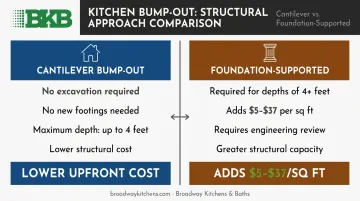
Most kitchen bump-outs beyond 4 feet require foundation support. That shift fundamentally changes the budget.
Size and Extension Depth
Even a few additional feet can flip a project from a simple cantilever to a foundation job. Cost per square foot often decreases slightly as projects get larger, but total project cost always rises. A 4-foot cantilever and an 8-foot foundation-supported extension are different projects financially, not just spatially.
Plumbing, Electrical, and HVAC
Kitchens are the most expensive room type for bump-outs specifically because utilities often need to move. Key cost triggers:
- Relocating a plumbing fixture 3+ feet: $500–$1,500 per line reroute
- Adding a dedicated electrical circuit (required for most new appliances): $250–$900 per circuit
- Extending HVAC ductwork: $10–$55 per linear foot depending on material and complexity
If the sink wall isn't moving and no new appliance circuits are needed, this line item stays near zero. If the layout changes substantially, it can add $3,000–$6,000 or more.
Interior Finishing: Cabinetry, Countertops, and Flooring
Once the structure is complete, interior finishing often becomes the largest single cost category. Key benchmarks:
| Finish Item | Typical Cost Range |
|---|---|
| Cabinetry — stock to semi-custom (installed) | $150–$500/linear ft |
| Custom cabinetry (installed) | $500–$1,500+/linear ft |
| Laminate countertops (installed) | $20–$80/sq ft |
| Quartz countertops (installed) | $50–$200/sq ft |
| LVP/LVT flooring (installed) | $4–$16/sq ft |
The cabinetry tier — stock, semi-custom, or custom — and countertop material choice are the two biggest budget variables in a finished kitchen bump-out.
Location, Permits, and Local Labor Rates
Labor costs vary significantly by region. In high-cost metro areas like the NY/NJ tri-state region, labor rates typically run 20–40% above national averages. Permits add another layer of cost to account for upfront:
- Building permits: required for virtually all kitchen bump-outs
- Typical permit range: $460–$2,900 depending on municipality and project scope
- Tri-state area: permit timelines and fees vary considerably by borough or county
Factoring in local labor and permit costs early prevents budget gaps later in the project.
Full Kitchen Bump-Out Cost Breakdown
Homeowners who budget only for framing and roofing consistently face overruns. Here's how a complete kitchen bump-out budget actually breaks down:
Structural Work
- Framing: $4–$16/sq ft
- Roof extension or tie-in: $4–$11/sq ft
- Foundation/footings (if required): $5–$37/sq ft
Exterior Finishing
- Siding to match existing: $4–$13/sq ft (vinyl to fiber cement)
- Windows: $500–$2,000 per unit
- Exterior paint touch-up: $1.50–$5.00/sq ft
Plumbing, Electrical, and HVAC (only when extending existing runs)
- Plumbing reroute: $650–$1,500 per line
- Dedicated circuit: $250–$900 per circuit
- HVAC duct extension: $10–$55/linear ft
Interior Finishing
- Cabinetry: $150–$1,500+/linear ft by cabinet tier
- Countertops: $20–$200/sq ft by material
- LVP flooring: $4–$16/sq ft installed
- Drywall, insulation, paint, and trim: project-dependent
Labor and Permits
- General contractor fee: 10–20% of total project cost
- Building permit: $460–$2,900 (varies by municipality)
Interior finishing is where the budget swings widest: cabinetry alone can account for 30–40% of total project cost depending on whether you go stock, semi-custom, or fully custom.
Low-Cost vs. High-End Kitchen Bump-Outs: What's the Difference?
The gap between a $10,000 and a $50,000 kitchen bump-out isn't just square footage. Here's what actually separates them:
| Dimension | Lower-Cost Project | Higher-End Project |
|---|---|---|
| Structural approach | Cantilever, no footings | Full foundation with excavation |
| Interior finishing | Stock cabinets, laminate counters | Semi-custom or custom cabinetry, stone countertops |
| Utility work | No plumbing or electrical changes | Sink wall relocation, new circuits |
| Scope | Shell expansion only | Complete kitchen reimagining |
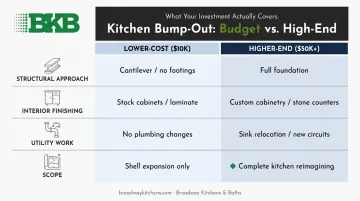
Those cost tiers also carry different resale implications. ROI benchmarks vary widely depending on scope:
- Bump-out additions return an estimated 30–50%, per Angi
- Major kitchen remodels recoup around 51%, per the JLC 2025 Cost vs. Value Report
- Minor kitchen remodels have historically recouped closer to 96%
Interior finish quality — particularly cabinetry and countertops — is what buyers actually notice and respond to at resale.
How to Estimate the Right Budget for Your Kitchen Bump-Out
Building an accurate budget means working through both structural scope and interior finishing scope. Skipping either leads to underestimating.
Pre-Budget Checklist
Answer these questions before you price anything:
- How far will the bump-out extend? (Under 4 feet, or deeper?)
- Will the sink wall or any plumbing move?
- Will cabinetry be extended into the new space, or fully replaced throughout?
- What finish level is the goal — stock, semi-custom, or custom?
- Are new windows part of the plan?
The Most Common Budgeting Mistakes
- Budgeting only for structure — the shell cost is just the beginning; interior finishing often costs as much or more
- Underestimating utility relocation — a sink move and two new circuits can add $3,000–$5,000 before any cabinetry
- Choosing the lowest bid without understanding scope — two bids can be $15,000 apart because one excludes cabinetry entirely
- Skipping the contingency — structural surprises when walls open are common; budget 15–20% above your base estimate
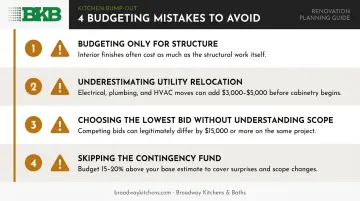
For projects that include new or extended cabinetry, involving a kitchen design specialist before demolition begins matters. Cabinetry spec'd after framing is complete often requires expensive retrofitting — the wrong cabinet run, a misaligned island, or a hood that can't vent properly. Broadway Kitchens & Baths offers a free design consultation from their showrooms in Englewood, NJ, and Manhattan, NY, and provides in-home design visits when accurate spatial assessment is needed.
A realistic budget accounts for structure, utilities, and finishes together — not as separate decisions made at separate times. Getting all three aligned early is what keeps projects on track.
Frequently Asked Questions
Frequently Asked Questions
How much does it cost to bump out a kitchen?
Most kitchen bump-outs fall between $5,000 and $43,000+ depending on size, structural approach, and finish level. Kitchens run higher than other room types because plumbing, electrical work, and cabinetry add cost that a bedroom or office bump-out doesn't carry.
Is a bump-out cheaper than a full addition?
Yes — bump-outs cost considerably less because they don't require a new HVAC system, separate foundation structure, or full interior build-out. Kitchen bump-outs close that gap more than other rooms, but they're still typically less expensive than a full room addition.
How far can a kitchen bump-out extend?
Cantilever bump-outs are generally limited to 2–4 feet before structural support is required. Foundation-supported extensions can reach 10–15 feet or more, subject to local zoning setback rules and lot conditions.
Do I need a permit for a kitchen bump-out?
Yes — virtually all kitchen bump-outs require a building permit since they involve structural changes and frequently plumbing or electrical work. Your general contractor typically handles permitting as part of the project.
How long does a kitchen bump-out take to complete?
Simple cantilever bump-outs can be completed in 1–3 weeks. Foundation-supported extensions with full interior finishing typically take 4–8 weeks or longer, depending on utility work complexity and material lead times for cabinetry and countertops.
Does a kitchen bump-out increase home value?
Generally, yes. Bump-out additions offer an estimated 30–50% ROI, and kitchens with quality cabinetry and countertops tend to perform well with buyers. Interior finish level matters most — a completed kitchen bump-out delivers stronger resale value than an unfinished structural shell.