The challenge? Cabinet costs don't follow a simple formula. A homeowner replacing stock cabinets in a galley kitchen faces a very different budget than one outfitting a large open-plan space with custom millwork. Get the type wrong and you're either over-specifying or setting yourself up for structural disappointment in five years.
This guide breaks down pricing by cabinet type and kitchen size, explains the factors that move costs up or down, and gives you a working framework for building an accurate budget before you commit to anything.
Key Takeaways
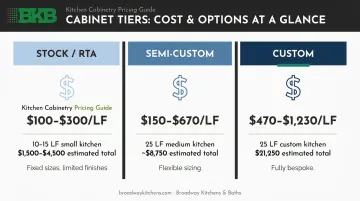
- Stock/RTA cabinets run $100–$300/LF installed; semi-custom $150–$670/LF; custom $470–$1,230/LF
- Kitchen size multiplies everything — small kitchens use 10–15 linear feet, large kitchens 35+
- Customization and labor are the two biggest cost drivers — together they can account for 50–70% of total project spend
- Refacing costs $4,234–$10,226 on average and only makes sense when existing boxes are structurally sound
- Total cost of ownership matters — budget cabinets often require replacement or repair within 10 years, erasing initial savings
How Much Do Kitchen Cabinets Cost?
Cabinet pricing covers a wider range than most homeowners expect — and the difference between entry-level stock and fully custom cabinetry isn't a few hundred dollars. It's often four or five times the cost.
According to Forbes Home, installed costs break down by cabinet type as follows:
| Cabinet Type | Installed Cost per Linear Foot | Notes |
|---|---|---|
| Stock / RTA | $100–$300/LF | Pre-built, limited sizes and finishes |
| Semi-Custom | $150–$670/LF | More sizing options, wider finish range |
| Custom | $470–$1,230/LF | Built to exact specs, unlimited options |
Kitchen size matters as much as cabinet type. Angi's cabinet installation data puts typical linear footage at:
- Small kitchen: 10–15 linear feet
- Medium kitchen: 20–30 linear feet
- Large kitchen: 35+ linear feet
A medium kitchen with 25 linear feet of stock cabinets at $200/LF runs about $5,000 installed. The same space in custom cabinets at $850/LF is $21,250. That gap shapes every other decision in a kitchen renovation budget. Here's how each tier breaks down.
Stock / RTA Cabinets
Stock and ready-to-assemble (RTA) cabinets come pre-built or as flat-pack units in fixed sizes — typically in 3-inch increments — with a limited selection of finishes and door styles. Installed cost generally runs $100–$300 per linear foot, with material cost per unit around $200–$350 according to Forbes Home.
What's included:
- Box construction in particleboard or MDF
- Pre-drilled hardware and door mounting
- A limited finish selection — typically white, gray, and natural oak
Best for: Budget-conscious homeowners, rental properties, and DIY-friendly projects where standard sizing fits the space without gaps or filler pieces.
Semi-Custom Cabinets
Semi-custom cabinets offer sizing flexibility beyond stock — often available in 1.5-inch increments rather than fixed widths — plus a broader range of door styles, finishes, and optional interior upgrades. Installed cost runs $150–$670 per linear foot, with units typically priced at $300–$600 each.
What's included:
- Sizing increments as narrow as 1.5 inches to reduce filler pieces
- Broader door style and finish selection than stock
- Optional interior upgrades like soft-close hinges and drawer organizers
- Lead times of 5–6 weeks per This Old House
Best for: Most mid-range residential renovations where standard stock doesn't quite fit the layout and full custom isn't warranted by the budget.
Custom Cabinets
Custom cabinets are designed and built to the exact dimensions of your kitchen — no standard sizing constraints, no compromises on material or finish. Installed cost runs $470–$1,230 per linear foot, with individual units starting at $500 and reaching $1,000+ for specialty pieces like corner units or integrated appliance panels.
What's included:
- Sizing and configuration built to your exact floor plan
- Premium materials — solid wood frames, plywood box construction
- Specialty finishes, glazing, and custom painted details
- Built-in organization features designed around your workflow
- Manufacturing lead times of 8 weeks to 6 months
Best for: High-end renovations, irregular or non-standard kitchen layouts, and homeowners who want cabinets built to last 20–30 years rather than 10–15.
Key Factors That Affect Kitchen Cabinet Costs
Cabinet quotes can look very different for the same kitchen depending on how these variables shake out. Understanding them prevents both underbudgeting and over-specifying.
Cabinet Construction and Door Style
Framed vs. frameless construction affects aesthetics and cost. Frameless (full overlay) cabinets typically cost more than framed due to tighter tolerances and different hardware requirements. Inset cabinets — where doors sit flush inside the frame — cost 15% to 30% more than overlay options, according to Angi, because precision fitting demands more labor.
Door style also moves the needle significantly:
- Shaker: The most common mid-range option; $100–$1,200/LF depending on material
- Slab/flat-panel: Most affordable when made from thermofoil or melamine
- Raised panel: More expensive due to added detailing, especially in solid wood
- Glass-front: Wall units start around $300 for a 15-inch unit
Door material is a separate variable: solid wood costs more than MDF veneer, which costs more than thermofoil. A semi-custom cherry veneer/plywood unit runs around $225; a comparable custom painted-maple unit can reach $975, per This Old House examples.
Once you've settled on materials and style, overall kitchen size and layout shape the budget more than any other single factor.
Kitchen Size and Layout Complexity
Total linear footage is the single most important input for any cabinet budget. Beyond simple footage, layout complexity adds cost in ways that don't show up in per-linear-foot pricing:
- Islands require additional cabinet runs, often with furniture-style detailing
- Angled walls or soffits need custom filler pieces and additional labor
- Irregular ceiling heights may require custom tall cabinets or stacked units
- Corner configurations require specialty solutions (lazy Susans, blind corner units) that add both product and labor cost
Hardware Choices
Hardware costs catch many homeowners off guard. Angi's hardware installation data puts the range at $5–$30 per piece for labor plus $2–$50 per piece for standard hardware, with premium metals — copper, zinc alloy, brass — running $5–$200 per piece. A kitchen with 20–40 hardware pieces can total $120–$2,400 including labor for that line item alone.
Labor and Installation
Labor typically accounts for a significant portion of total project cost, with wide variation by region and project complexity. Current ranges:
| Labor Type | Typical Range |
|---|---|
| Per hour | $40–$100 (Forbes) / $50–$250 (Angi) |
| Per linear foot | $50–$450 depending on scope |
| Old cabinet removal | $350–$800; up to $1,000 for large kitchens |
| Crown molding | $2–$3 per linear foot |
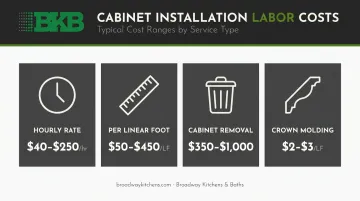
Ceiling-height cabinets, crown molding, old cabinet removal, and drywall patching after removal are all common labor adders that don't appear in the cabinet product price.
Full Cost Breakdown: What Goes Into the Total Price
The cabinet purchase price is rarely the final number. Here's the full picture:
One-time costs:
- Cabinet units — The largest single line item. Stock runs $200–$350 per unit; semi-custom $300–$600; custom $500 and up. Cost scales directly with linear footage.
- Installation and labor — Covers measurement, leveling, mounting, and finishing. Old cabinet removal adds $350–$800 separately. Some installers charge a measurement fee as a distinct line item — confirm this upfront.
- Permits and overhead — Kitchen remodel permits range from $460–$2,770 depending on scope and jurisdiction. Cabinet-only replacements with no plumbing, electrical, or structural changes may not require a permit, but any layout modification typically does.
Periodic costs:
- Maintenance and repairs — Cabinet repair averages $280, with typical ranges of $200–$490. Hinge repair runs $30–$80 per door; drawer repair $120–$350. Minor repairs are often worth doing if the box structure is still intact.
- Refacing vs. replacement — Costs vary widely depending on the scope of work:
| Option | Typical Cost Range |
|---|---|
| Cabinet refacing | $4,234–$10,226 (avg. $7,230) |
| Full replacement | $2,200–$24,600 for a 150 sq ft kitchen |
| Refinishing / repainting | $775 average for painting; $20–$60/LF for refinishing |
Refacing — replacing doors and applying veneer to existing box fronts — makes sense when the box structure is sound and the layout doesn't need to change. Full replacement is necessary when boxes are damaged, layouts are shifting, or structural modifications are involved.
Stock, Semi-Custom, or Custom: Which Fits Your Budget?
| Factor | Stock / RTA | Semi-Custom | Custom |
|---|---|---|---|
| Installed cost | $100–$300/LF | $150–$670/LF | $470–$1,230/LF |
| Customization | Fixed sizes, limited finishes | Flexible sizing, more finishes | Fully bespoke |
| Lead time | 1–5 weeks | 5–6 weeks | 8 weeks – 6 months |
| Durability | Lower (particleboard common) | Mid-range | Highest (plywood, solid wood) |
| Long-term value | Lowest | Mid | Highest |
The cheapest upfront option isn't always the lowest cost over 10–15 years. Stock cabinets in a rental property make complete sense. Stock cabinets in a high-use family kitchen with heavy daily wear may need replacement in 8–10 years, while custom plywood-box cabinets could last 25+.
Two sourcing paths worth comparing:
- Big box stores (Home Depot and similar): Installation runs roughly $69–$119 per linear foot — but cabinet product cost, removal, trim, hardware, and disposal are scoped separately. You get a single point of contact; the trade-off is limited design flexibility and no say in which contractor you're assigned.
- Kitchen design and supply specialists: Pricing is typically higher, but you control material grade, configuration, and who does the work — which matters most on non-standard layouts or high-specification projects.
How to Estimate the Right Kitchen Cabinet Budget
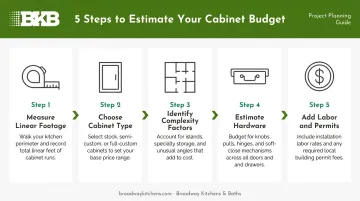
Use this framework to build an estimate before talking to any supplier:
- Measure total linear footage — count upper runs, lower runs, and tall/pantry cabinets separately
- Decide cabinet type — stock, semi-custom, or custom based on layout fit and budget ceiling
- Identify complexity factors — island, corner cabinets, ceiling height, angled walls
- Estimate hardware — count approximate pieces and price point (basic pulls vs. designer hardware)
- Add labor, removal, and permits — don't skip these; they often add $1,500–$5,000+ to a mid-range project
Common budgeting mistakes to avoid:
- Pricing only the cabinet units and ignoring installation
- Choosing the cheapest box construction without checking material quality
- Forgetting permit costs when layout or plumbing changes are involved
- Not accounting for filler pieces, molding, and finishing details in the quote
These mistakes compound quickly on complex projects. For architects, contractors, and management companies navigating multi-room or multi-unit scopes, an accurate field measurement and a firm material takeoff at the start are what keep budgets from drifting mid-project. Broadway Kitchens & Baths — with showrooms in Englewood, NJ and Manhattan, NY — manages the full process from initial measurement through final punch-list across stock, semi-custom, and custom cabinetry lines, giving project teams a single point of accountability from scope to installation.
Frequently Asked Questions
How much do Home Depot kitchen cabinets cost?
Home Depot publishes installation or replacement pricing at $69–$119 per linear foot. Cabinet product costs, hardware, removal, trim, and disposal are scoped separately, so total project cost depends heavily on the cabinet line selected and kitchen size. Confirm all included and excluded items before comparing this quote to others.
What is the cheapest type of kitchen cabinet to buy?
Stock and RTA cabinets are the most affordable option, starting around $100–$300 per linear foot installed. Ordering directly from a discount supplier and handling assembly yourself can bring costs down further, though delivery and hardware may be priced separately.
How long does it take to install kitchen cabinets?
Professional installation generally takes 1–3 days for standard kitchens, according to Angi. Custom cabinets carry an additional manufacturing lead time of 8 weeks to 6 months before installation can begin, so factor this into the overall project schedule.
Is it cheaper to reface or replace kitchen cabinets?
Refacing averages $4,234–$10,226 versus full replacement averaging $8,200–$24,600 for a 150 sq ft kitchen. Refacing makes sense when the existing box structure is sound and the layout isn't changing; replacement is necessary when boxes are damaged or a layout modification is required.
What factors affect kitchen cabinet costs the most?
Cabinet type (stock vs. custom), total linear footage, material and door style, layout complexity, and installation labor are the primary cost drivers.
How many linear feet of cabinets does a typical kitchen need?
Angi puts small kitchens at 10–15 linear feet, medium kitchens at 20–30 linear feet, and large kitchens at 35+ linear feet. Linear footage is the most critical early measurement because it multiplies directly against your per-foot cost. Establish this number before any other planning decision.