Introduction
Kitchen cabinets are consistently the largest single expense in any kitchen renovation. According to CliqStudios' kitchen remodel budget breakdown, cabinetry accounts for roughly 29% of the total kitchen remodeling budget — more than countertops, appliances, or labor individually.
That share translates to a wide dollar range. Stock cabinets for a small kitchen can run under $2,000, while a fully custom build in a large kitchen can push past $30,000. Most homeowners land somewhere between $5,000 and $15,000, depending on cabinet type and kitchen size.
This guide covers pricing by cabinet tier, the factors that push costs up or down, what most budgets overlook, and how to build an estimate grounded in your actual project.
Key Takeaways
- Cabinet costs range from $1,500 to $30,000+, with most projects falling between $5,000–$15,000
- 3 pricing tiers determine most budgets: stock/RTA, semi-custom, and fully custom
- Installation labor typically adds 50–75% on top of cabinet material costs
- Plywood cabinet boxes cost roughly 10–20% more than particleboard but last 2–3x longer
- Always reserve a 10–20% contingency buffer for surprises
How Much Do New Kitchen Cabinets Cost?
There's no single fixed price for kitchen cabinets. The final number depends on cabinet type, material quality, kitchen dimensions, and labor — and underestimating any one of these leads to mid-project budget overruns.
The Three Most Common Budgeting Mistakes
- Pricing cabinets without installation — the cabinet sticker price is only part of the cost; labor adds 50–75% on top
- Choosing the wrong cabinet type — stock cabinets in a non-standard layout often require workarounds that eliminate the savings
- Skipping a contingency buffer — the American Institute of Architects recommends 5–10% for construction contingency; for homeowner remodels, 10–20% is more realistic
Cabinet Cost by Tier
| Cabinet Tier | Cost per Linear Foot | Typical 10×10 Kitchen Total |
|---|---|---|
| Stock / RTA | $35–$300/LF | $2,000–$5,000 |
| Semi-Custom | $90–$650/LF | $5,000–$15,000 |
| Custom | $150–$1,200/LF | $12,000–$30,000+ |
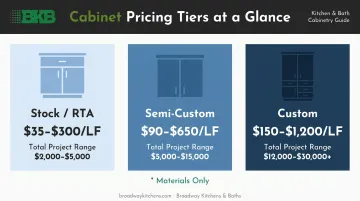
Note: These figures cover cabinet materials only. Installation labor is priced separately.
Here's what each tier actually means in practice.
Stock / RTA Cabinets
Stock and ready-to-assemble (RTA) cabinets are pre-made in standard sizes, sold through home improvement retailers and online suppliers. They come in limited finish and style options, and the purchase price excludes installation labor.
These work well for:
- Budget-conscious homeowners with straightforward kitchen layouts
- DIYers comfortable with assembly and basic installation
- Renovation professionals managing multi-unit projects where cost control and speed take priority
- High-volume builds where standard dimensions align with the floor plan
Semi-Custom Cabinets
Semi-custom cabinets are factory-built with more flexibility than stock — more size options, a wider range of door styles, finishes, and storage upgrades. Lead times typically run 4–8 weeks.
These work well for:
- Homeowners who need a better fit than stock allows without paying for full custom
- Mid-range renovations with some non-standard dimensions
- Projects where storage functionality matters but budget has a ceiling
Custom Cabinets
Custom cabinets are built to exact specifications: precise dimensions, unlimited material and finish choices, and specialty storage solutions. Lead times are typically 8–12 weeks.
These are the right choice when:
- The kitchen layout is irregular and standard sizes won't work
- Long-term durability and resale value are priorities
- Design precision is a non-negotiable requirement
Key Factors That Affect Kitchen Cabinet Costs
Six variables drive most of the cost variation in kitchen cabinet projects — from manufacturing category to regional labor rates. Knowing where each dollar comes from makes budgeting far more accurate.
Cabinet Type and Configuration
The manufacturing category — RTA, stock, semi-custom, or custom — is the single biggest price lever. A semi-custom cabinet in the same door style as a stock cabinet can cost 2–3 times more due to sizing flexibility and build quality.
Within each category, configuration choices also shift costs:
- Base cabinets vs. wall cabinets carry different price points
- Drawer banks cost more than door-only base cabinets
- Specialty units — corner solutions, pantry towers, pull-out trash drawers — add cost beyond standard linear footage
Kitchen Size and Layout Complexity
Cabinets are priced per linear foot, so a larger kitchen costs more. Layout complexity adds cost beyond footage alone. Common layout factors that increase cost:
- U-shaped and L-shaped kitchens require corner cabinet solutions at each turn
- Kitchen islands need finished side panels and an additional base cabinet run
- Corner mechanisms — blind corner pull-outs, lazy Susans — are priced as specialty units and can add several hundred dollars per corner
Material and Build Quality
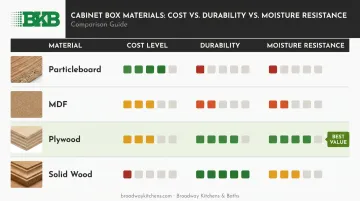
The cabinet box (carcass) material matters as much as the door material. Here's how the main options compare:
| Material | Cost Level | Durability | Moisture Resistance |
|---|---|---|---|
| Particleboard | Lowest | Poor | Low |
| MDF | Low–Mid | Moderate | Moderate |
| Plywood | Mid–High | Good | Good |
| Solid Wood | Highest | Excellent | Varies by species |
Plywood cabinet boxes typically cost 10–20% more than particleboard alternatives but resist moisture and hold screws far better — a real advantage in kitchens near sinks and dishwashers, where particleboard swells and fasteners loosen over time.
Level of Customization
Off-the-shelf cabinets come in fixed sizes and standard finishes. Customization charges apply for:
- Non-standard widths or heights
- Specialty storage inserts (pull-outs, organizers, dividers)
- Glass fronts and open shelving
- Painted vs. stained finishes
Add-ons like soft-close hinges, lazy Susans, and under-cabinet lighting are priced separately. Individually, each is a modest cost — collectively, they can add $1,000–$3,000+ to a project.
Installation and Labor Costs
According to Home Depot's cabinet installation cost guide, professional installation runs $69–$119 per linear foot. HomeAdvisor reports installer hourly rates of $30–$60 per hour, with per-cabinet pricing ranging from $50–$450 depending on cabinet type and complexity.
Labor rates vary by region. Metro markets like the New York tri-state area typically run at the higher end of national ranges.
Most installation quotes cover removal, leveling, shimming, and hardware attachment — but exclude electrical modifications, plumbing adjustments, and permit fees. Confirming what's in scope before signing prevents the most common budget surprises.
Typically included:
- Removal of existing cabinets
- Installation, leveling, and shimming
- Attaching hardware and trim
Typically excluded:
- Electrical modifications
- Plumbing adjustments
- Permit fees
Full Cost Breakdown: What You're Actually Paying For
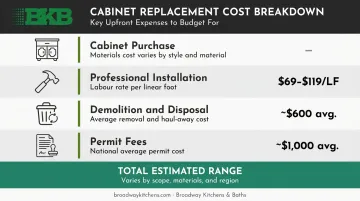
The cabinet purchase price is only one piece of the total cost. According to This Old House, installation labor typically runs 50–75% of the cabinet material cost alone — meaning a $10,000 cabinet order could carry $5,000–$7,500 in additional installation costs.
Upfront Costs
- Cabinet purchase — priced by type and linear footage (see tier table above)
- Professional installation — $69–$119/LF or roughly $2,000–$8,000+ for average kitchens
- Demolition and disposal — cabinet removal typically runs $15–$20 per linear foot, with project averages around $600 according to Angi
- Permit fees — average ~$1,000 nationally when electrical, structural, or plumbing changes are involved; ranges from $350 (Virginia Beach) to $4,000+ (high-cost metros like Mountain View, CA)
Beyond the upfront spend, cabinets carry long-term costs that are easy to overlook during planning.
Ongoing Ownership Costs
- Hardware replacement — hinges, drawer slides, and pulls wear over time, particularly in high-use kitchens
- Surface maintenance — painted finishes may need touch-ups every few years; cleaning requirements vary by finish type
- Refinishing or refacing — after 10–15 years, refacing can extend cabinet life as an alternative to full replacement
Budget vs. Premium Cabinets: What's the Real Difference?
Budget and premium cabinets can look similar in photos. The differences show up in construction, durability, and performance over time.
| Dimension | Budget / Stock | Premium / Custom |
|---|---|---|
| Box construction | Particleboard or MDF | Plywood or solid wood |
| Expected lifespan | 10–15 years | 25–50+ years |
| Finish durability | More susceptible to wear and moisture | Higher resistance with proper sealing |
| Hardware quality | Basic hinges, standard slides | Soft-close, full-extension, rated for weight |
| Storage functionality | Fixed shelves, limited configurations | Pull-outs, organizers, custom inserts |
| Resale impact | Minimal | Moderate to significant |
Those construction differences translate directly into financial return. The 2025 Cost vs. Value Report from JLC/Zonda puts a mid-range major kitchen remodel at approximately 51% cost recouped at resale. Mid-range semi-custom cabinets offer the best balance of upfront cost and long-term value — better durability than stock, lower price point than full custom.
How to Estimate the Right Cabinet Budget
The right budget isn't the cheapest or most expensive option — it's the one that fits the kitchen's actual use, size, and long-term goals.
Key Questions to Answer Before Setting a Number
- How many linear feet of cabinetry does the kitchen require?
- Which cabinet tier — stock, semi-custom, or custom — fits the layout and performance needs?
- What materials suit the household's usage habits and maintenance preferences?
- Is professional installation required, and what are local labor rates?
- What contingency buffer is realistic? (Plan for 10–20% on top of your estimate)
Building a Realistic Estimate
Start with linear footage. Measure the total run of base and wall cabinets, then multiply by the per-linear-foot range for your chosen tier. Add installation labor (use $69–$119/LF as a baseline, adjusted for your region). Factor in demolition, hardware, and any permit costs if layout changes are involved.
For architects, contractors, and multi-unit managers, that estimation complexity compounds fast — especially across multiple units or phased timelines. Broadway Kitchens & Baths handles projects across the tri-state area from initial field measurements through final installation, giving professionals a single point of contact for scoping, product selection, and on-budget delivery.
What Most People Get Wrong About Kitchen Cabinet Costs
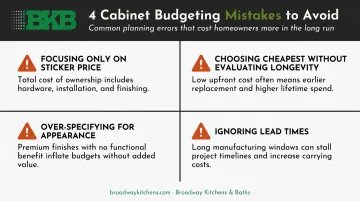
Most budget overruns come from the same handful of planning mistakes. Avoiding these keeps your project on track.
- Focusing only on the sticker price — installation, demolition, hardware, and finishing can easily match or exceed the material cost
- Choosing the cheapest option without evaluating longevity — stock cabinets that fail in 5–7 years often cost more in the long run than a mid-range option that lasts 25+
- Over-specifying for appearance — glass fronts, decorative inserts, or premium finishes add real cost; if they won't be used or noticed daily, they rarely justify the spend
- Ignoring lead times — semi-custom cabinets run 4–8 weeks; custom runs 8–12 weeks; missing these windows delays countertop installation, appliance delivery, and project completion
Frequently Asked Questions
How much should I budget for new kitchen cabinets?
Plan for $1,500–$30,000+ depending on cabinet type and kitchen size, with most homeowners landing between $5,000 and $15,000. As a rough guide, cabinets account for 29–40% of the total kitchen renovation budget, so use that ratio when setting your overall project number.
What is the average cost of kitchen cabinets per linear foot?
Stock cabinets run $35–$300/LF, semi-custom ranges from $90–$650/LF, and custom cabinets typically start around $150–$1,200/LF. These figures cover cabinet materials only — installation labor is priced separately.
How much does it cost to have kitchen cabinets professionally installed?
Professional installation runs $69–$119 per linear foot (Home Depot national service data) or $30–$60 per hour for independent installers. Total installation for an average kitchen typically falls between $2,000 and $8,000.
Are custom cabinets worth the higher price?
Custom is worth it for irregular layouts, long-term ownership, and builds where design precision is non-negotiable. For most standard kitchens, semi-custom hits a better cost-to-value balance — more flexibility than stock, without full custom pricing, and a lifespan of 20–30 years.
What is the difference between stock and semi-custom cabinets in terms of cost?
Stock cabinets ship in fixed dimensions with limited finish options — what you see is what you get. Semi-custom allows sizing adjustments and a wider style selection, which reduces filler pieces and produces a cleaner installed look. For mid-range renovations, that fit advantage typically justifies the price difference.
Can I lower my kitchen cabinet costs without sacrificing quality?
Yes. Choose semi-custom over fully custom, keep the existing kitchen layout to avoid plumbing and electrical changes, limit decorative add-ons to those you'll actually use, and get quotes from multiple suppliers before committing. Relocating a sink or range, by contrast, can add $1,000–$3,000 in trade costs before a single cabinet is hung.