The problem isn't a lack of pricing information online. It's that the numbers published rarely account for your specific kitchen dimensions, your chosen materials, or every cost component involved. A per-linear-foot figure seen on a retailer's website tells only part of the story.
This guide breaks down real pricing tiers, the variables that move costs up or down, a practical step-by-step approach to estimating your budget, and the mistakes that derail even well-intentioned renovation plans.
Key Takeaways
- Kitchen cabinets typically cost $3,000–$25,000+ for a standard installed project, depending on cabinet type and kitchen size.
- Stock, semi-custom, and custom cabinets span very different price ranges — know which tier fits your budget before visiting a showroom.
- Total cost includes more than the cabinet price: labor, hardware, removal, and hidden repairs all add up.
- ROI data favors modest kitchen investments — the highest-end spend rarely pays back proportionally at resale.
How Much Do Kitchen Cabinets Cost? A Pricing Overview
There is no single fixed price for kitchen cabinets. Costs vary based on cabinet type, material quality, kitchen size, and installation scope — which is why understanding the tiers matters before any showroom visit.
Two budgeting errors consistently derail early planning:
- Anchoring to a single number found online without accounting for specific kitchen dimensions
- Treating the cabinet price as the project price, ignoring installation, hardware, and accessory costs entirely
Pricing by Cabinet Type
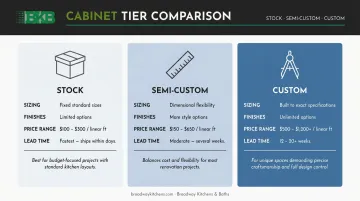
Cabinets fall into three manufacturing categories: stock, semi-custom, and custom. These categories define the core price difference.
According to 2026 data from Angi and HomeAdvisor, current per-linear-foot ranges are:
| Cabinet Type | Per Linear Foot | What You're Getting |
|---|---|---|
| Stock | $100–$300 | Pre-made in standard sizes; limited finishes; fastest lead time |
| Semi-Custom | $150–$650 | Size flexibility; more style options; moderate lead time |
| Custom | $500–$1,200+ | Built to exact specs; near-unlimited options; longest lead time |
Each tier trades off price, lead time, and personalization differently. Stock cabinets ship quickly but come in fixed dimensions, which can mean filler strips and wasted space in non-standard kitchens.
Semi-custom cabinets accommodate dimensional adjustments — some manufacturers, like Broadway Kitchens & Baths' UltraCraft line, modify height, depth, and width in 1/16" increments at no extra charge. Custom cabinets, such as Plain & Fancy's handcrafted line, are built to whatever specification the project requires but carry both a higher price and a longer production window.
Pricing by Kitchen Size
Angi's 2026 installed project data gives these size-based ranges:
- Small kitchen (10–15 linear feet): $3,000–$6,000 installed
- Medium kitchen (20–30 linear feet): $6,000–$12,000 installed
- Large/custom kitchen (35+ linear feet): $12,000–$25,000+
The industry-standard "10×10 kitchen" benchmark — roughly 20 linear feet — is useful for comparing cabinet brands on a a direct comparison basis. It is not a reliable budget anchor for real projects. Home Depot's 10×10 pricing explicitly excludes finish panels, molding, decorative hardware, countertops, sink, faucet, and appliances.
What These Ranges Include and Exclude
Before building a project budget, know what published per-linear-foot estimates actually cover. Most include cabinet boxes, doors, and basic hardware — and stop there. They typically exclude:
- Installation labor
- Removal and disposal of existing cabinets
- Permits
- Specialty finishes or two-tone color work
- Interior organizers (pull-outs, lazy Susans, drawer inserts)
- Countertops
Published ranges are a useful anchor, but your fully installed cost depends on which of these line items apply to your project — the next section breaks down each cost driver in detail.
Key Factors That Affect Kitchen Cabinet Cost
Once you understand the tiers, the next step is identifying which specific variables will move your project toward the lower or higher end of those ranges. Most of them are decisions you control.
Material and Construction Quality
Material selection affects both upfront cost and long-term durability. HomeAdvisor's 2026 custom cabinet data shows these material price ranges at the custom tier:
- MDF: $300–$400/linear foot
- Maple or birch: $300–$400/linear foot
- White oak: $400–$600/linear foot
- Cherry: $500–$700/linear foot
Cabinet box construction also matters. Plywood boxes outperform particleboard in moisture resistance and screw-holding strength, and KraftMaid's durability testing shows base cabinets must withstand 2,500 pounds of static load. Many stock-tier products use particleboard by default.
Stock cabinets from Wolf Classic Cabinets, for example, use 1/2" plywood side and back panels — placing them above the typical stock baseline on this measure.
Cabinet Style and Door Design
Door style has a real effect on price. Simpler profiles like flat-panel or basic shaker cost less than ornate raised-panel or inset designs. HomeAdvisor reports that frameless cabinet construction adds approximately 15%, and inset/flush cabinets can add around 20% to base costs.
Painted finishes (which require multiple coats of catalyzed enamel) typically cost more than stained finishes. Two-tone configurations add a further premium that varies by manufacturer and requires a direct quote.
Kitchen Layout and Configuration Complexity
Non-standard layouts increase costs in two ways: they require specialty cabinet units, and they take longer to install. Corner configurations, tall ceiling heights, angled walls, and large islands all add scope. Specific examples from HomeAdvisor's custom cabinet data:
- Lazy Susan: $200–$600+
- Pull-out spice rack: $200–$500+
- Corner base cabinet (IKEA SEKTION example): $461 vs. $209 for a standard base with door/drawer
A drawer-heavy design also adds cost. A six-drawer base can run more than five times the price of a standard door-only base at the same width.
Hardware and Interior Accessories
Hardware costs range widely:
- Basic pulls: $5–$20 per piece
- Premium pulls: up to $50+ per piece
- Soft-close hardware: $20–$50 per cabinet
Accessories such as pull-out shelves, lazy Susans, built-in dividers, and glass door inserts are priced separately from the cabinet itself. Add up each item by cabinet count to get an accurate accessories total.
Installation Labor and Location
Professional installation rates vary by experience, cabinet type, and region:
- National range: $50–$250/hour
- Tri-state metro (NY/NJ/CT): rates trend toward the higher end
- Custom cabinets: cost more to install than stock due to precise fitting and trim work
Broadway Kitchens & Baths serves the NYC and NJ markets with in-house carpentry crews, which keeps scheduling and labor coordination within a single point of contact.
Budget vs. Premium Cabinets: What's the Real Difference?
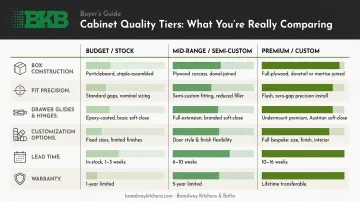
The gap between a $7,000 cabinet package and a $25,000 one isn't purely aesthetic. It reflects real differences in how cabinets are built, how precisely they fit your space, and how long they hold up under daily use.
| Dimension | Budget/Stock | Mid-Range/Semi-Custom | Premium/Custom |
|---|---|---|---|
| Box construction | Particleboard common | Plywood options available | Plywood standard |
| Fit precision | Standard sizing; fillers needed | Adjustable dimensions | Built to exact spec |
| Drawer glides/hinges | Basic; limited cycles | Soft-close standard | High-cycle, lifetime hardware |
| Customization | Limited door styles/finishes | Hundreds of options | Unlimited |
| Lead time | Days to weeks | 6–12 weeks typical | 12–20+ weeks |
| Warranty examples | Varies by brand | UltraCraft: 100-year limited | KraftMaid: lifetime limited |
The JLC 2025 Cost vs. Value Report puts the resale math in sharp relief: a minor midrange kitchen remodel recoups 113% of its cost, while a major midrange remodel recoups 51% and a major upscale remodel only 36%. Premium cabinetry is not a guaranteed resale investment.
For homeowners planning to sell, a well-executed mid-range project likely delivers better financial returns than a full custom installation. For those staying long-term, the calculus shifts — durability, precise fit, and hardware longevity justify the higher upfront cost in ways resale figures can't capture.
How to Estimate the Right Cabinet Budget for Your Kitchen
Getting to an accurate budget requires more than picking a tier. It's a step-by-step process that accounts for your kitchen's specific dimensions, priorities, and all cost components.
Step 1 — Measure Your Space
Measure every wall section where cabinets will be installed, in inches. Include island runs if applicable. Convert to linear feet by dividing total inches by 12. This number is your baseline for getting quotes — and for applying per-linear-foot estimates from any published source.
Step 2 — Choose Your Tier and Priority Features
Work through this decision framework:
- Renovation scope: Full remodel or cosmetic refresh?
- Time horizon: How long do you plan to stay in the home?
- Layout constraints: Does your kitchen have non-standard dimensions that make stock sizing impractical?
- Must-haves vs. nice-to-haves: Which features (storage solutions, door style, finish) are non-negotiable, and which can be scaled back?
If your kitchen has angled walls, a large island, or ceiling heights above standard, stock cabinets will likely require workarounds that add cost and compromise the result.
Step 3 — Account for Every Cost Component
Build your estimate to include:
- Cabinet materials (boxes, doors, hardware)
- Installation labor
- Removal and disposal of existing cabinets
- Interior accessories (pull-outs, lazy Susans, soft-close upgrades)
- Permits, if required
- Contingency buffer: 10–20% of total project cost
The contingency isn't optional. Houzz's 2026 renovation study found that 37% of homeowners exceeded their initial budgets in 2025, and Angi reports over 50% encountered surprise expenses — most commonly labor and materials. In older housing stock common across the tri-state area, hidden water damage, outdated wiring, and wall repairs uncovered during demo are frequent contributors. Use 20% for older homes or any project involving layout changes.
Step 4 — Get Multiple Quotes and Read Them Carefully
Get at least three quotes and compare line by line:
- What's included under "installation"?
- Is hardware priced separately?
- Does removal of old cabinets carry an additional charge?
- What does the warranty cover, and for how long?
A lower headline number can exceed a higher one quickly once missing line items are added back.
Step 5 — Work with a Professional Who Knows Your Space
Once you've compared quotes, the next step is confirming that at least one estimate comes from a professional who has physically measured the space — not one working from homeowner-provided dimensions. Field measurements catch layout complexities, ceiling height variations, and structural quirks that don't show up in ballpark figures.
Broadway Kitchens & Baths manages this process from initial field measurement through project completion, using in-house carpentry crews and a portfolio spanning stock (Wolf Classic Cabinets), semi-custom (UltraCraft), and fully custom (Plain & Fancy) lines. That range makes it possible to match the specification level to the actual scope — rather than defaulting to a tier that doesn't fit the project.
Common Budgeting Mistakes to Avoid
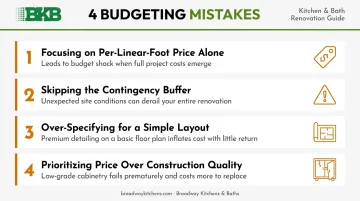
Four pitfalls derail otherwise well-planned projects:
- Focusing on per-linear-foot price alone. Total installed cost — including labor, hardware, and accessories — is what actually determines your spend. Per-linear-foot figures are a starting point, not a budget.
- Skipping the contingency buffer. Budget overruns are the rule, not the exception. Build the cushion in before committing to a spend ceiling, not after you've hit it.
- Over-specifying for a simple layout. High-end custom solutions in a straightforward galley kitchen often deliver no practical benefit over a well-chosen semi-custom line. Match the specification to the actual complexity.
- Prioritizing price over construction quality. Cabinets that fail within five years cost more in replacements and labor than a mid-range choice made once — the savings rarely hold.
Conclusion
Kitchen cabinet costs span a wide range — from around $3,000 for a small stock installation to well over $25,000 for a large semi-custom or custom project. The right number depends on your kitchen's dimensions, your functional priorities, and your long-term plans for the home.
Understanding all the cost components, not just the cabinet price, is what keeps a budget intact from planning through installation.
For homeowners and professionals in the tri-state area ready to turn an estimate into a finished kitchen, Broadway Kitchens & Baths offers cabinetry across stock, semi-custom, and custom tiers, professional field measurements, and full project management from design through installation. Contact them at (201) 567-9585 or visit their Englewood, NJ showroom to start planning your project with accurate, transparent pricing.
Frequently Asked Questions
How much should you budget for kitchen cabinets?
Most homeowners should budget between $3,000 and $25,000 for a standard installed project, with the final number depending on cabinet type, kitchen size, and finish level. Set aside an additional 10–20% as a contingency for installation variables, hidden repairs, and change orders.
What is the most affordable type of kitchen cabinet?
Stock cabinets are the most affordable option, typically ranging from $100–$300 per linear foot, and work well in standard kitchen layouts where size flexibility is not a priority. Wolf Classic Cabinets, available through Broadway Kitchens & Baths, is one example of a stock line with solid wood construction at a lower cost than semi-custom alternatives.
How much does kitchen cabinet installation cost?
Professional installation runs $50–$250 per hour depending on experience and region. In the New York–New Jersey metro area, expect rates toward the higher end of that range. Most kitchen projects total $2,000–$8,000 in labor, varying with kitchen size, layout complexity, and cabinet type.
Is it cheaper to reface or replace kitchen cabinets?
Refacing typically costs $150–$450 per linear foot and works well when existing cabinet boxes are structurally sound and the layout doesn't need to change. If the layout needs reconfiguration or the boxes show damage, full replacement delivers better long-term value.
How do I estimate kitchen cabinet costs by kitchen size?
Measure all cabinet wall runs in linear feet, multiply by the per-linear-foot cost of your chosen cabinet tier, then add installation labor, hardware, accessories, and a 10–20% contingency buffer. Use the result as a planning baseline, not a final number. Get local bids to confirm actual project costs.
Are custom kitchen cabinets worth the investment?
Custom cabinets make the most sense for non-standard layouts, long-term homeowners, or kitchens that stock and semi-custom sizing simply can't fit. For those planning to sell, a well-executed mid-range project typically delivers stronger return than a full custom investment.