Introduction
Walk into any upscale Manhattan apartment or New Jersey colonial these days and you'll notice something: wine storage has moved out of the basement and into the living space. Homeowners, restaurateurs, and hotel designers across the tri-state area are treating wine cabinets as interior features — not afterthoughts.
Off-the-shelf wine racks don't fit irregular spaces, can't maintain consistent temperatures, and rarely match surrounding cabinetry. In a market where premium real estate commands premium design, that gap matters.
According to Zillow data, wine rooms can boost a home's sale price by up to 31%, and roughly 45% of affluent homebuyers actively seek properties with dedicated wine storage.
This article covers 8 custom wine cabinet ideas built for NJ and NYC spaces: from under-stair built-ins in brownstones to display walls in restaurant dining rooms.
Key Takeaways
- Custom wine cabinets protect wine quality through climate control and add proven resale value to your home or business
- NJ and NYC spaces have unique spatial constraints that make custom-built far more effective than freestanding units
- Ideas covered: under-stair built-ins, kitchen integrations, floor-to-ceiling wine walls, and dual-zone collector cabinets
- Key decisions: cooling system type, wood species, bottle capacity, and display vs. aging function
- A local NJ/NYC cabinetry partner ensures the design fits your space, local codes, and aesthetic from the start
Why NJ & NYC Homes and Businesses Are Choosing Custom Wine Cabinets
The U.S. wine cabinets market is growing at a 5.8% CAGR and is projected to reach $1.59 billion by 2029, according to Data Bridge Market Research. The residential segment is driving that growth — and the NJ/NYC metro sits squarely in the premium tier of that demand. Two local conditions make custom-built the practical default in this market:
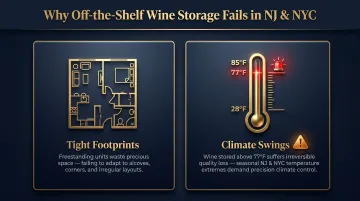
- Tight footprints: Manhattan condos, NYC co-ops, and NJ townhouses rarely have unused square footage. Freestanding units eat floor space and rarely fit neatly into alcoves or beside existing cabinetry — custom-built works with actual room dimensions.
- Climate swings: NYC temperatures range from 28°F in winter to 85°F in summer. That 57-degree annual spread makes passive storage risky outside a naturally stable basement. Wine stored above 77°F for extended periods suffers measurable, irreversible quality loss.
The settings driving demand across the region include:
- High-rise NYC apartments and co-ops with compact, design-forward interiors
- NJ colonial and contemporary suburban homes with basements and multi-room layouts
- Restaurant groups and wine bars seeking display cabinets that drive sales
- Hotel lobbies and upscale lounges using wine walls as focal-point features
Each setting demands a different answer. The eight ideas below cover the full range — from a climate-controlled under-stair build in a NJ townhouse to a full glass-display wall in a Manhattan restaurant.
8 Best Custom Wine Cabinet Ideas for NJ & NYC Homes & Businesses
The ideas below span residential and commercial applications, adapt to different budgets and square footages, and reflect the range of design sensibilities common in this region — from modern minimalist to classic traditional.
1. Under-Stair Built-In Wine Cabinet
The space beneath a staircase is one of the most underutilized areas in NJ townhouses and NYC brownstones. Most homeowners treat it as overflow storage. A custom built-in wine cabinet transforms that dead zone into a functional, visually striking feature.
Design elements that work well here:
- Horizontal bottle slots (more stable and space-efficient than vertical)
- Temperature-regulated insulation lining to buffer ambient heat from the living space
- Soft-close glass or wood doors — glass for display, wood for a cleaner, more formal look
- Integrated LED strip lighting to illuminate bottles and create visual depth
The configuration works particularly well in NJ colonial homes and NYC brownstones, where the stair geometry often creates a naturally enclosed alcove. Wine Spectator recommends maintaining storage at 55°F — achievable in under-stair builds when proper insulation and a compact cooling unit are included.
2. Kitchen-Integrated Wine Cabinet
Embedding wine storage directly into kitchen cabinetry appeals to homeowners who want wine accessible during meal prep and entertaining — without the visual disruption of a separate unit.
The key to making this work is finish matching. When the wine cabinet doors align with surrounding shaker, slab, or painted cabinetry, the storage disappears into the kitchen rather than competing with it. The NKBA 2024 Kitchen Trends Report confirms that integrated, customized storage is among the top priorities for premium kitchen projects.
Practical specifications:
- Dedicated wine cubby section with both horizontal and angled slots
- An undercounter cooling drawer for frequently accessed bottles
- Door styles and hardware matched to adjacent cabinetry — not close, exact
- Active cooling is essential here; kitchens fluctuate in temperature significantly, making passive storage a risk for anything you plan to age
For homeowners working with cabinetry specialists like Broadway Kitchens & Baths, the process includes selecting door profiles, wood species, and finish from a wide library — ensuring the wine section reads as part of the kitchen, not an addition to it.
3. Floor-to-Ceiling Wine Display Wall
This is the statement piece. A full-height wine rack or cabinet wall uses every inch of vertical space and works as both storage and architecture. It's the go-to design for open-plan NJ homes, restaurant feature walls, hotel wine bars, and NYC loft-style apartments.
A 200-bottle display wall creates an immediate focal point in any room and signals to restaurant guests that wine is central to the experience.
Construction details to get right:
- Structural wall anchoring at both floor and ceiling (200+ bottles weigh over 500 lbs — this is not standard shelving)
- Mixed-depth cubbies for magnums, standard 750ml bottles, and sparkling formats
- Integrated channel lighting or backlit panels behind bottles
- Hardwood selection: white oak, walnut, and mahogany all perform well and age elegantly
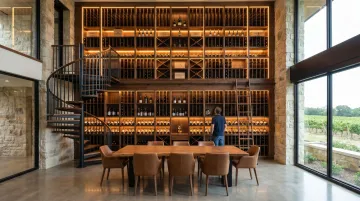
For commercial installations, glass-enclosed versions with interior lighting create a refrigerated display that doubles as a sales tool. Cornell's Center for Hospitality Research found that visible wine displays directly correlate with higher per-table beverage spend — guests order more when the selection is in front of them.
4. Climate-Controlled Wine Closet Cabinet
A spare bedroom closet, hallway closet, or pantry space can become a dedicated wine room. This is the preferred option for NJ suburban homeowners with growing collections — it holds hundreds of bottles in a small footprint and maintains optimal conditions year-round when built correctly.
Technical requirements for a proper build:
- Vapor barrier and insulation on all walls, floor, and ceiling
- A dedicated through-wall or split cooling unit sized to the cubic footage
- Digital thermostat set to 55°F with humidity maintained at 60%
- Interior racking built to all four walls to maximize bottle count
The closet format works because the structure is already enclosed. Adding insulation and a cooling unit creates a stable micro-environment — far less disruptive than building a standalone room, and typically less expensive.
That cost advantage is meaningful. According to HomeAdvisor, a modest closet conversion starts around $2,500, while a 500-bottle dedicated room runs $15,000–$22,000. Cooling units alone range from $1,000 (through-wall) to $15,000 (split system).
5. Floating Wall-Mounted Wine Cabinet
For NYC condos and apartments where floor space is finite, a wall-mounted wine cabinet is often the most practical solution. It stores bottles, creates a modern aesthetic, and leaves the floor clear.
The design works as a single display unit or a modular multi-section system stacked vertically or arranged horizontally across a wall.
Key considerations for NYC buildings:
- Weight-bearing wall anchoring — older NYC buildings require structural assessment before mounting anything heavy
- Open-front bottle display vs. closed-door storage: open displays look more dramatic, but closed doors offer better temperature stability
- Finish options: matte lacquer, natural wood veneer, or painted MDF all work well in contemporary interiors
- Pairing with a narrow wine fridge below creates a functional two-part system — display above, active cooling below
6. Basement Wine Cabinet
NJ homeowners have a natural advantage here. NAHB data shows that 48.8% of new Middle Atlantic homes feature basements — nearly three times the 17% national average. Basements are naturally cooler, darker, and more temperature-stable than above-grade rooms.
A custom basement wine cabinet takes that existing advantage and refines it:
- Full-perimeter racking in dark hardwood (walnut or mahogany work well)
- A cooling unit to hold a consistent 55°F regardless of seasonal basement fluctuations
- A glass-panel entry door for display and easy inventory access
- Ambient LED lighting on a dimmer — warm tone, low UV output
- Optional tasting counter along one wall for entertaining
The basement format also accommodates larger collections. A 1,000-bottle room typically runs $26,000–$32,000. For collectors buying futures or cellaring age-worthy bottles, that investment recovers quickly in avoided storage fees and wine preserved at peak condition.
7. Commercial Wine Display Cabinet
For restaurants, wine bars, and hotel lounges in NYC and NJ, a custom wine display cabinet serves two purposes: functional storage and a sales-driving visual feature.
Organized, well-lit wine storage signals expertise and encourages purchases. Commercial installations differ from residential builds in several important ways:
| Feature | Residential | Commercial |
|---|---|---|
| Refrigeration | Through-wall or split unit | Ducted self-contained, vents externally |
| Shelving | Wood racking | Commercial-grade, often steel or reinforced |
| Security | Standard locks | Lockable glass doors |
| Capacity | 100–1,000 bottles | 500–2,000+ bottles |
| Compliance | Standard electrical | NSF/ANSI 7 food equipment standards |
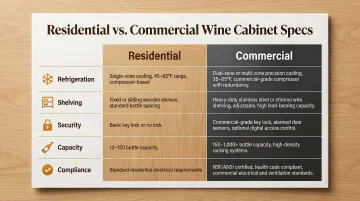
For restaurant groups working with cabinetry specialists experienced in commercial builds, the finish selection should align with the venue's interior design language — whether that's blackened steel framing for an industrial dining room or warm walnut for a traditional wine bar.
8. Multi-Temperature Zone Wine Cabinet
One persistent problem for collectors and sommeliers: reds and whites need different temperatures, but they're often stored in the same unit. A dual-zone custom cabinet solves this without requiring two separate systems.
Temperature targets by zone:
- Aging zone: 55°F for all long-term storage (reds, whites, sparkling)
- Serving zone: 40–46°F for sparkling and light whites ready to drink; 55–65°F for reds at serving temperature
Wine Spectator recommends dedicating one zone to long-term storage at 55°F and the second to bringing wines to their ideal serving temperature. The cabinet reads as a single cohesive piece — the zone separation is functional, not visually disruptive.
Aesthetic execution:
- Separate compartment doors with clear zone labeling
- Dark stained oak or blackened steel framing to visually separate zones
- Dual-zone cooling units integrated cleanly into the cabinet structure
- Premium materials throughout to maintain cohesion across both zones
This format works well as a standalone cabinet or as part of a larger wine wall where different sections serve different functions.
What Makes a Great Custom Wine Cabinet in the NJ & NYC Market
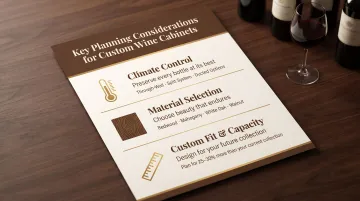
Three things separate a well-specified wine cabinet from an expensive mistake:
1. Climate control matched to the space. NJ's variable seasons and NYC's climate-controlled high-rises present different challenges. Any cabinet outside a temperature-stable basement requires active cooling. The right system — through-wall, split, or ducted — depends on cubic footage, ambient temperature, and how the unit will vent heat.
2. Material durability and finish quality. All-heart redwood and mahogany are top choices for wine racking — both resist moisture and won't emit odors that can affect wine through corks. White oak and walnut work well for cabinet exteriors. If stain is used, water-based products only; oil-based finishes off-gas into the cabinet.
3. Accurate measurements and custom fit. No two spaces in the NJ/NYC market are identical. Built-ins that fit the actual dimensions of a room perform better and look better than adapted freestanding units.
Additional factors worth planning for:
- Bottle capacity: design for 25–30% more than your current collection
- Finish coordination: wine cabinet doors should match or intentionally contrast with adjacent cabinetry
- Permits and approvals: NYC co-ops require board approval for electrical work; commercial installations must meet local building codes
The permit and measurement requirements above are exactly where working with an experienced local firm pays off. Broadway Kitchens & Baths handles projects across Bergen County, Hudson County, Manhattan, and Brooklyn — covering field measurements, design rendering, material selection, and professional installation for both residential and commercial clients in the tri-state area.
Conclusion
Custom wine cabinets are one of the highest-ROI upgrades available for NJ and NYC homes and businesses. They protect your investment in wine, increase property value, and bring a level of design cohesion that freestanding units can't match.
Whether you're designing a basement wine room in a Bergen County home, a floating display wall for a Manhattan apartment, or a commercial display cabinet for a restaurant dining room, the right cabinetry partner ensures the finished result is precise, code-compliant, and built to last.
Broadway Kitchens & Baths handles every stage of the process — from field measurements and design to installation and punch-list — so your wine cabinet integrates seamlessly into the space rather than simply occupying it.
To discuss your project, contact Broadway Kitchens & Baths at +1 201-567-9585 for a consultation on custom wine cabinet solutions tailored to your space, style, and budget in the tri-state area.
Frequently Asked Questions
Are wine cabinets worth the investment?
Custom wine cabinets protect wine quality through climate control, which directly preserves the value of your collection. On the property side, Zillow data shows wine rooms can increase home sale prices by up to 31%, and 45% of affluent buyers actively seek homes with wine storage. For restaurants, visible wine displays consistently support higher wine sales.
How much does it cost to build a wine closet?
Costs range from around $2,500 for a basic closet conversion to $32,000+ for a 1,000-bottle dedicated room, with premium basement builds starting at $75,000. The biggest cost drivers are the cooling system, insulation, racking material, and square footage.
What wood is best for custom wine cabinets?
All-heart redwood and mahogany are the top choices — both resist moisture and won't emit odors that affect wine. White oak and walnut work well for cabinet exteriors and visible framing. Avoid cedar and pine for interior racking, as both can off-gas odors that penetrate corks over time.
Do custom wine cabinets need a cooling system?
Any cabinet outside a naturally stable basement requires active cooling — through-wall units ($1,000–$3,500) suit small closets, split systems ($5,000–$15,000) handle medium to large installations, and ducted systems cover large commercial builds. Passive storage is only reliable when ambient temperatures hold consistently near 55°F.
Can a custom wine cabinet be installed in a small NYC apartment?
Yes — floating wall-mounted cabinets, undercounter wine drawers, and kitchen-integrated wine cubbies are all designed specifically for compact urban spaces. These formats can store 20–100+ bottles without consuming floor space, and can be built to fit whatever dimensions your apartment offers.