The catch? NJ and NYC homes are rarely standard. Pre-war co-ops, century-old Colonials, galley layouts squeezed into brownstones — these spaces have wall lengths, ceiling heights, and corner configurations that stock cabinets simply weren't built for. That's where custom cabinetry becomes less of a luxury and more of a practical necessity.
This article covers 10 custom kitchen cabinet ideas specifically suited to the diverse homes across the tri-state area — from minimalist handleless doors to bold two-toned designs and floor-to-ceiling storage walls. Each one is chosen for visual impact, functional value, and real-world applicability in NJ and NYC spaces.
Key Takeaways
- Custom cabinets are built to your exact dimensions — essential in NJ/NYC homes where non-standard layouts are the norm
- The 10 ideas range from Shaker inset doors to integrated appliance panels and statement wood stains
- Smaller kitchens benefit most from floor-to-ceiling cabinetry, handleless doors, and pull-out storage systems
- Kitchen remodels consistently return 60–80% of project costs at resale — among the strongest ROI of any home improvement in the Northeast
- Broadway Kitchens & Baths handles everything from field measurements and design to final installation — one team, one process
Why Custom Kitchen Cabinets Make Sense for NJ and NYC Homes
Stock vs. Semi-Custom vs. Custom — What's the Difference?
The three cabinet tiers differ in one essential way: how much they're built around your space.
| Type | Sizing | Lead Time | Best For |
|---|---|---|---|
| Stock | Fixed standard sizes | Days | Rentals, quick flips |
| Semi-Custom | Limited modifications | 4–10 weeks | Mostly standard layouts |
| Custom | Built to exact spec | 8–16 weeks | Any non-standard space |
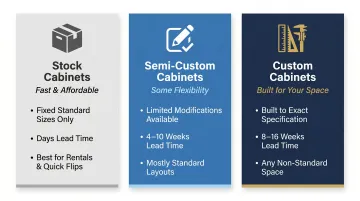
Custom cabinets are designed around your kitchen's actual dimensions — every wall length, ceiling height, and corner condition — not adjusted to fit them.
Why It Matters Especially Here
According to the 2021 NYC Housing and Vacancy Survey, 56% of NYC's housing units were built before 1947. Four out of five are in buildings constructed before 1974. NJ's older suburbs carry similar stories — Colonials, Cape Cods, and mid-century ranch homes with kitchens that predate modern cabinetry standards.
That history shows up in the details: irregular wall runs, soffits at odd heights, chimney chases that eat into cabinet space, and appliance placements that make no sense on paper. Stock cabinets respond with gaps, filler strips, and dead zones. Custom cabinetry is built around those conditions from the start.
That precision pays off at resale, too. The NAR's 2025 Remodeling Impact Report gives kitchen renovations a perfect Joy Score of 10/10, with 48% of Realtors citing kitchen upgrades as the project with the highest buyer demand.
10 Best Custom Kitchen Cabinet Ideas for Your NJ or NYC Remodel
These ideas are selected for visual impact, practical function, and suitability across the wide range of home styles found in the tri-state area — from classic Colonials to modern Manhattan condos.
1. Shaker-Style Inset Cabinets
Shaker remains the most-requested cabinet profile for good reason. The recessed center panel and clean lines work in traditional, transitional, and contemporary kitchens without looking out of place in any of them. According to the 2020 Houzz Kitchen Trends Study, 61% of renovating homeowners choose Shaker-style doors, far ahead of flat-panel (21%) and raised-panel (18%).
What separates inset Shaker cabinets from standard overlay is the door construction: inset doors sit flush inside the face frame, creating a furniture-quality look where the entire frame remains visible. It's the detail that signals serious craftsmanship.
A few things to know about inset:
- Requires more precise cabinetmaking and fitting than overlay — and costs more as a result
- Adds roughly 2 weeks to production timelines due to the precision fitting involved
- Pairs cleanly with simple bar pulls or cup pulls in brushed nickel, matte black, or unlacquered brass
If you want a kitchen that feels timeless rather than trendy, Shaker inset is the safest high-end choice in any NJ or NYC home.
2. Two-Toned Cabinet Design
The two-tone kitchen is no longer an experimental design choice. The 2026 Houzz Kitchen Trends Study found nearly 1 in 4 homeowners now choose contrasting cabinet colors — and for the first time in nearly a decade, wood tones (29%) have overtaken white (28%) as the most popular cabinet finish overall.
The visual logic is straightforward: a darker or bolder color on base cabinets or the island anchors the space, while lighter upper cabinets keep the room from feeling heavy. The result is depth and dimension that a single-color kitchen rarely achieves.
Popular combinations trending in the tri-state market:
- Warm white uppers with medium walnut lowers
- Navy or deep indigo base cabinets with off-white perimeter uppers
- Sage green island against white perimeter cabinets
- Greige uppers with smoky charcoal lowers
This style photographs exceptionally well — a meaningful advantage when listing a home in a competitive NJ or NYC market.
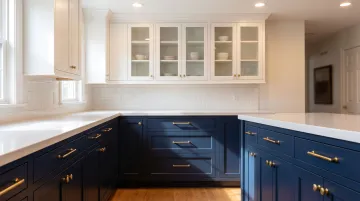
3. Floor-to-Ceiling Custom Cabinetry
The gap between the top of upper cabinets and the ceiling is one of the most consistently wasted spaces in any kitchen. It collects dust, looks unfinished, and does nothing. Extending cabinetry all the way to the ceiling solves that, while also making the room feel taller.
This idea is especially well-suited to NJ homes with standard 8- to 9-foot ceilings, where every visual inch matters. Floor-to-ceiling runs require custom height dimensions — which is precisely why stock and semi-custom cabinets can't pull it off cleanly.
Design options for the upper zone include:
- Closed storage (practical for infrequently used items)
- Glass-front panels for display without visual clutter
- Open niches for lighting or decorative objects
Broadway Kitchens & Baths handles professional measurement as part of their design process, which is essential here — ceiling transitions and crown molding integration need to be planned before a single cabinet is ordered.
4. Custom Built-In Appliance Panels
Panel-ready appliances — refrigerators, dishwashers, and sometimes range hoods — wrapped in custom cabinet panels create a kitchen that reads as furniture rather than a collection of equipment. The finish requires precise coordination between the cabinet maker and confirmed appliance specs; the tolerance for error is essentially zero. A refrigerator panel that's off by a quarter inch is immediately visible. Getting it right requires:
- Confirmed appliance model and rough-in dimensions before design is finalized
- Cabinet manufacturer review of those specs before production
- Field verification at delivery before installation begins
The result, when executed well, is a kitchen where the refrigerator disappears into the cabinetry and the dishwasher reads as a drawer. It's particularly popular in high-end NJ remodels and Manhattan apartments where a furniture-quality finish is the goal.
5. Glass-Front Upper Cabinets
Glass-front doors — whether clear, reeded, or lightly frosted — let a kitchen breathe without sacrificing enclosed storage. In smaller NYC kitchens that can feel boxed in by solid cabinet fronts on every wall, even a few glass-front upper cabinets shift the visual weight considerably.
The key to making this work:
- Organize the interior — glass fronts put everything on display, so the cabinet contents need to be intentional
- Paint the cabinet box a contrasting or complementary color to the door exterior for a layered effect
- Use reeded or fluted glass if you want the light-diffusing benefit without full visibility into the cabinet
Clear glass reads as formal and traditional. Reeded glass is more contemporary. Frosted splits the difference. The right choice depends on the surrounding cabinetry style.
6. Custom Kitchen Island Cabinetry
A custom island is one of the most impactful investments in any kitchen remodel — not because islands are inherently special, but because a custom-sized island fits the space without compromise. The cabinetry underneath can be designed around exactly how the kitchen is used.
Broadway Kitchens & Baths has executed a range of island configurations in NJ and NYC projects, including:
- Waterfall countertop edges — the countertop material runs vertically down the island sides
- Furniture-style legs at island ends for a transitional or traditional feel
- Integrated appliances including built-in microwaves and concealed compartments
- 15-inch seating overhangs — their preferred standard for comfortable leg clearance at bar stools
Stock islands are built to standard dimensions. A custom build is what makes the proportions, storage configuration, and finish work as a single cohesive unit.
7. Handleless or Push-to-Open Cabinets
The handleless kitchen has become the defining aesthetic of contemporary design. No hardware interrupts the cabinet face — just clean flat planes of door and drawer. Newly renovated NYC condos and modern NJ townhouses have adopted this look at a consistent rate over the past several years.
Broadway Kitchens & Baths offers hidden pull tabs and recessed hardware as contemporary solutions within their cabinet lines. Hidden pull tabs install on the outer edge of the door — under the countertop or at the base of wall cabinets — for a finish where the hardware essentially disappears. Recessed pulls go a step further, sitting flush within the door face.
Push-to-open mechanisms eliminate visible hardware entirely. What to know before choosing this route:
- Door alignment must be near-perfect — gaps or uneven reveals are immediately obvious
- Hinge quality matters more here than in any other cabinet style
- Professional installation is non-negotiable; this style does not tolerate DIY shortcuts
8. Custom Pull-Out and Deep-Drawer Storage
Storage customization has moved from optional to expected. The 2026 Houzz Kitchen Trends Study found 94% of homeowners who upgrade cabinets integrate specialty storage features — pull-out waste bins (64%), tray organizers (55%), spice racks (41%), and deep drawer systems (34%).
For smaller NJ and NYC kitchens where every cubic inch counts, this is where custom cabinetry pays for itself in daily use. Through their cabinet lines and partnerships with Rev-A-Shelf, Richelieu, and Hafele, Broadway Kitchens & Baths offers:
- Pull-out spice towers in 6-inch base cabinets adjacent to the range
- Double-bin trash and recycling pull-outs in 15"–24" base cabinets
- Corner pull-out systems in chrome, wire, and wood that eliminate the dead zone of standard corner cabinets
- Blum Legrabox metal drawers with 125 lb. static load ratings for deep pot-and-pan storage
- Touch-to-open drawer systems that eliminate the need for hardware on drawer fronts
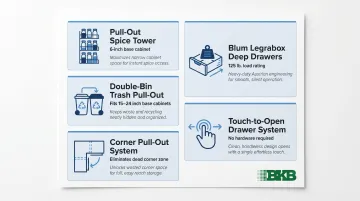
In kitchens under 200 square feet — common across both NJ and NYC — a purpose-built storage plan is often the difference between a kitchen that functions and one that frustrates.
9. Statement Painted or Stained Cabinet Finishes
The all-white kitchen dominated the last decade. Deep greens, charcoal, warm terracotta, and rich wood stains are replacing it across NJ and NYC remodels — not as novelties, but as deliberate finishes that homeowners and designers are committing to for the long term.
The NKBA's 2025 Kitchen Trends Report found 51% of designers prefer white oak as a cabinet wood species, with 59% identifying visible wood grain as a growing trend.
Custom cabinetry opens every finish option:
- Painted finishes: color-matched to Benjamin Moore, Sherwin-Williams, or Farrow & Ball — any swatch, any color
- Stained wood: white oak, walnut, maple, or cherry with species-specific grain character
- Mixed finishes: painted perimeter cabinets combined with a stained wood island
Wolf Classic cabinets through Broadway Kitchens & Baths are available in multiple paint and stain combinations. Plain & Fancy offers fully handcrafted cabinetry with even broader finish customization. Neither option is available through stock cabinet lines.
How to Choose the Right Custom Cabinet Idea for Your Space
Three Factors That Drive the Decision
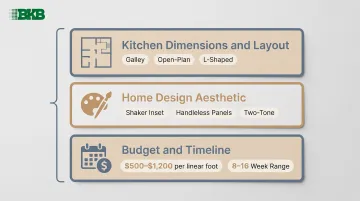
Before committing to a cabinet style, evaluate these three things honestly:
- Kitchen dimensions and layout: Galley kitchens benefit from handleless doors and floor-to-ceiling storage. Open-plan kitchens can support a statement island. L-shaped layouts might prioritize corner pull-out solutions.
- Home design aesthetic: Shaker inset fits traditional and transitional homes. Handleless panels belong in contemporary spaces. Two-tone works across styles but requires color confidence.
- Budget and timeline: Fully custom cabinets run $500–$1,200 per linear foot installed (HomeAdvisor, 2024), with production and installation timelines of 8–16 weeks from design approval. Plan accordingly.
Why Working With a Full-Service Partner Matters
Once you've nailed down your priorities, execution is where things go right or wrong. Field measurements that account for every wall condition, ceiling transition, and appliance spec — translated into perfectly fitted cabinets — are what separate a polished result from a compromised one.
Broadway Kitchens & Baths manages the full scope in-house: design consultation, field measurements, renderings, material sourcing, and installation by their own carpentry crews. They work with residential homeowners, builders, architects, and property managers across Bergen County, Manhattan, Brooklyn, and the wider tri-state area — in both union and non-union environments.
Whether you're renovating a single kitchen in Englewood or managing 50 units in Brooklyn, the process starts the same way: a conversation about the space.
Conclusion
Custom kitchen cabinets are the foundation of any serious NJ or NYC kitchen remodel. The right choice matches your specific space, storage needs, and aesthetic — not a showroom template that happens to come close.
Every idea in this article depends on precise execution — accurate measurements, quality materials, and a team that builds around your kitchen rather than around their inventory.
If you're planning a kitchen remodel in NJ or NYC, Broadway Kitchens & Baths offers free design consultations at their Englewood, NJ showroom and works with homeowners across the tri-state area. Call +1 201-567-9585 to schedule — and bring your kitchen vision to life.
Frequently Asked Questions
What is the average cost of custom kitchen cabinets?
Fully custom cabinets typically run $500–$1,200 per linear foot installed, compared to $100–$300 for stock. In the NJ/NYC market, labor costs and delivery logistics generally push pricing toward the higher end of that range. Total cabinet project costs commonly fall between $20,000 and $55,000+ depending on kitchen size and finish level.
What is the difference between custom, semi-custom, and stock kitchen cabinets?
Stock cabinets come in fixed sizes off the shelf and are available immediately. Semi-custom offer limited size adjustments and more finish choices with a 4–10 week lead time. Fully custom cabinets are built to your exact room dimensions with unlimited design options — the only real solution for non-standard spaces common in NJ and NYC homes.
How long does it take to get custom kitchen cabinets installed?
From design approval to completed installation, fully custom cabinets typically take 8–16 weeks total. Inset construction or specialty finishes can add 1–3 weeks on top of that. Plan your remodel timeline accordingly, especially if coordinating with other trades.
What cabinet styles work best for small NYC or NJ kitchens?
Floor-to-ceiling cabinetry, handleless doors, and integrated appliance panels are the three most effective choices for compact kitchens. They reduce visual clutter, eliminate wasted space, and maximize storage without making the room feel crowded.
Are custom kitchen cabinets worth the investment when selling a home in NJ or NYC?
Yes. Minor kitchen remodels return 112.9% of their cost nationally, with Northeast markets among the highest performers. The NAR ranks kitchen upgrades as the top project for buyer demand — and quality custom cabinetry is consistently what buyers notice first.
What materials are most commonly used in custom kitchen cabinets?
High-quality custom cabinets typically use plywood for cabinet boxes due to superior moisture resistance and durability. Door materials vary by finish: solid hardwood (maple, cherry, oak, walnut) for stained doors and MDF for painted finishes, as it resists grain bleed-through. Solid wood costs approximately 2–3 times more than plywood, which runs nearly double the price of MDF.