Introduction
Kitchens in the New York metro area don't follow rules. A Manhattan studio might have 90 square feet of kitchen space wedged into an awkward galley. A Brooklyn brownstone could have non-parallel walls that make every standard cabinet run a guessing game. And a Bergen County colonial might have generous square footage but outdated soffits and an awkward peninsula that hasn't aged well.
Force standard sizing into non-standard homes and the results are predictable: ill-fitting gaps, wasted vertical space, and generic aesthetics that drag down resale value. Stock cabinets don't fix these problems — they compound them.
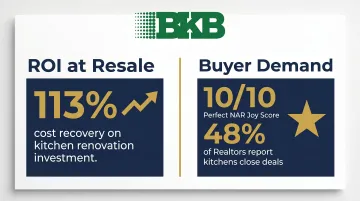
Custom cabinetry changes that equation. Beyond the aesthetic payoff, a midrange minor kitchen remodel returns 113% of its cost at resale, according to the 2025 Cost vs. Value Report — making it one of the few home improvements that genuinely pays for itself.
The 8 ideas below are drawn from the spatial realities, design expectations, and everyday lifestyle demands of NJ and NYC kitchens specifically.
Key Takeaways
- Custom cabinets are built to your exact dimensions — critical for the irregular layouts common in NJ and NYC homes
- The 8 ideas range from two-tone cabinetry and floor-to-ceiling storage to glass-front uppers and deep drawer systems
- Each idea solves a real problem: tight square footage, inefficient storage, or kitchens that haven't been touched since the 90s
- Your best starting point is understanding your layout constraints, cooking habits, and how much of the kitchen you're willing to open up
- In NJ and NYC, where no two kitchens are plumb or square, a partner who handles field measurement through final installation saves costly mid-project surprises
Why NJ & NYC Kitchens Demand Custom Cabinet Solutions
The Spatial Reality
The average Manhattan one-bedroom offers roughly 90 square feet of kitchen space — barely above the 80-square-foot NYC code minimum for kitchenettes. Galley and one-wall layouts dominate because narrow footprints leave no other option. Meanwhile, older NJ homes in Bergen County, Hoboken, and Jersey City frequently present angled walls, irregular soffits, and structural quirks from decades of layered renovations.
Stock cabinets are built to standardized dimensions — which means they fit an idealized blueprint, not your actual kitchen. The result: gap-filling strips, misaligned sightlines, and the unmistakable look of a renovation that cut corners.
The Design and Value Stakes
Those spatial constraints have direct financial consequences. NJ and NYC buyers expect finished kitchens. The NAR's 2025 Remodeling Impact Report gave kitchen upgrades a perfect Joy Score of 10, with 48% of Realtors reporting increased buyer demand for kitchen improvements — the highest of any interior project category.
Custom cabinetry solves both problems directly: it fits the actual space rather than a standardized template, and it signals the craftsmanship that buyers in this market expect when they walk through the door.
8 Best Custom Cabinet Design Ideas for NJ & NYC Kitchens
These ideas are selected for their ability to solve real problems — limited space, poor storage, outdated looks — that NJ and NYC kitchens face most often. Most successful renovations in this market combine two or three of them.
1. Two-Tone Cabinetry
Pair darker lower cabinets — navy, charcoal, forest green — with lighter uppers in white, cream, or light gray. The contrast adds visual depth and a grounded, layered quality without making the kitchen feel heavier.
This matters in NJ and NYC kitchens because a fully dark kitchen in a compact space feels cave-like. Two-tone keeps the upper zone bright and visually recessive while letting the lower cabinets carry a design statement.
This approach has moved well past trend territory. MasterBrand's 2026 survey found that most kitchens now feature at least two finishes, with a 15% increase over two years in color being applied to perimeter cabinetry — not just islands. Broadway Kitchens & Baths carries lines like Plain & Fancy and UltraCraft that accommodate custom paint finishes, giving homeowners flexibility across a wide color palette.
2. Shaker-Style Cabinets with Integrated Pulls
Shaker remains the dominant cabinet style in the US for good reason — recessed-panel doors work equally well in a modern Hoboken loft and a traditional NJ colonial. Handle-less or integrated pull configurations are increasingly popular in NYC kitchens where a clean, uncluttered sightline is valued.
From a resale standpoint, Shaker is the safest specification you can make. Houzz's 2025 U.S. Kitchen Trends Study found Shaker holds approximately 61% of the market share for upgraded cabinetry. It pairs with virtually every countertop material and hardware finish, which keeps your renovation relevant across buyer pools.
Broadway Kitchens & Baths offers Shaker options through Wolf Classic Cabinets, including:
- Dartmouth — a modern Shaker door available in multiple stains and paint colors
- Somerset — suited to both transitional and contemporary kitchens
3. Floor-to-Ceiling Cabinetry
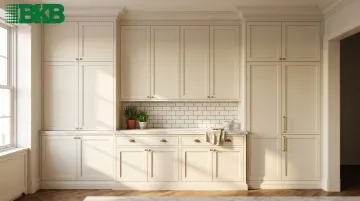
Standard wall cabinets typically stop 12 to 18 inches below the ceiling. In most kitchens, that gap collects dust and contributes nothing. Extending cabinetry all the way up — with or without crown molding — captures that space for storage and creates a built-in, custom look that reads as intentional craftsmanship.
This is particularly effective in NYC pre-war buildings, where ceiling heights often reach 9 feet or more compared to the 8-foot standard in post-war construction. That extra foot-plus of vertical run can add meaningful storage for seasonal items, freeing everyday-use cabinets below.
Practical benefits at a glance:
- Eliminates the dust-collecting gap above standard wall cabinets
- Signals custom quality to buyers and renters
- Stores seasonal or infrequently used items without consuming floor space
- Works with or without crown molding depending on your aesthetic
4. Open Shelving Mixed with Closed Cabinets
Replacing one or two runs of upper closed cabinets with open shelving creates a lighter, more open feel — particularly useful in NYC kitchens that lack natural light. Displayed dishware, glassware, or plants break up visual heaviness and let personality show through.
In active cooking kitchens, open shelving requires real maintenance — grease and dust accumulate quickly. If you go this route, limit it to one or two sections and keep ample closed storage elsewhere. Glass-front cabinets (covered in idea #7) offer a practical middle ground for those who want the airy look without the upkeep.
Broadway Kitchens & Baths has completed projects incorporating this hybrid approach — including designs in Tenafly, NJ featuring glass-doored wall cabinets alongside open storage — demonstrating that the mix can work beautifully when planned deliberately.
5. Deep Drawer Systems for Base Cabinets
Traditional lower cabinet doors require kneeling, reaching, and rummaging. Deep drawers replace that process with a single pull that brings everything to eye level. For homeowners cooking frequently in compact galley kitchens, this is one of the most practical upgrades available.
Soft-close deep drawers with interior organizers can hold pots, pans, dry goods, and small appliances in a fraction of the space that door-access cabinets require.
Through UltraCraft, Broadway Kitchens & Baths offers two deep drawer configurations worth knowing:
- Hardwood Dovetail Drawers — 5/8" solid wood construction, full-extension soft-close glides, standard on most door styles
- Blum Legrabox Metal Drawers — fingerprint-resistant metal sides, 125 lb. static load capacity, undermount soft-close glides standard on Acrilux styles
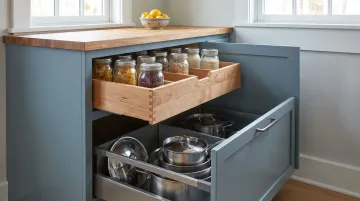
Interior organizers through Rev-A-Shelf, Richelieu, and Hafele are available as additions to these systems.
6. Custom Kitchen Island with Built-In Storage
A custom island combines prep surface, concealed storage, and often seating into a single unit that anchors an open-concept kitchen. In larger NJ suburban homes, it increases usable storage while defining the kitchen zone within an open floor plan.
For larger NJ kitchens: More than half of upgraded kitchen islands now exceed 7 feet in length per Houzz 2025 data. NKBA guidelines require a minimum 42-inch work aisle clearance on all sides — so plan around that constraint before committing to island size.
For smaller NYC kitchens: A compact or mobile island with two or three drawers still provides meaningful added storage without sacrificing walkway clearance. Contrasting the island finish from perimeter cabinets (a natural wood island against white surroundings, for example) is a common choice in this market.
Broadway Kitchens & Baths' portfolio includes islands with contrasting finishes: lighter islands against dark perimeter cabinetry, and natural wood islands alongside painted surroundings. The design team manages finish coordination across all cabinet lines.
7. Glass-Front Upper Cabinets
Inserting glass panels into some upper cabinet doors — clear, reeded, or frosted — creates visual depth and makes a kitchen feel larger. In NYC kitchens where every spatial trick matters, the effect is meaningful. It also creates an opportunity to display curated dishware as a design element rather than hiding it.
Glass-front cabinets have emerged as the leading accent door choice: 36% of renovators who added accent cabinets in the Houzz 2025 study chose glass-front doors, making it the top accent category. Reeded and fluted glass variants are particularly popular, offering visual interest while obscuring contents partially.
A few practical notes:
- Limit glass-front doors to roughly 30–40% of your upper run — not every door
- Add interior LED lighting to maximize the display effect
- Organize contents thoughtfully; glass-front cabinets put everything on display
Broadway Kitchens & Baths notes that lighting is frequently added to glass cabinets to showcase household items, and their designers can advise on both glass type and interior lighting placement.
8. Matte Finish Cabinets with Integrated Under-Cabinet Lighting
Matte and suede finishes have largely displaced high-gloss lacquer in current NJ and NYC kitchen design. Matte white, warm greige, and muted sage are the dominant directions — they hide fingerprints better, photograph well for listings, and feel current without chasing a fleeting trend.
Paired with integrated LED under-cabinet lighting, matte uppers create a layered, high-end effect at the task areas where it matters most.
The dual benefit is real:
- Task lighting: Improves visibility for food prep — critical in darker NYC kitchens with limited window exposure
- Ambient effect: When overhead lights are dimmed, under-cabinet LEDs create warmth that overhead fixtures alone can't replicate
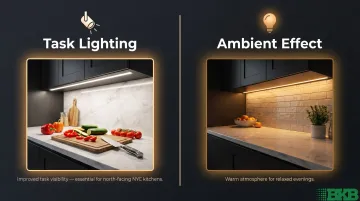
Broadway Kitchens & Baths explicitly positions under-cabinet lighting as essential in kitchen design and has installed colored LED systems above cabinets at the ceiling level for projects requiring an elevated urban aesthetic.
How to Choose the Right Custom Cabinet Design for Your Kitchen
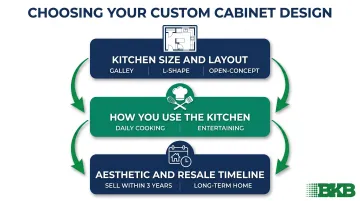
Before committing to any design direction, assess three things honestly:
Kitchen size and layout — galley, L-shape, and open-concept footprints each have different constraints and opportunities. Floor-to-ceiling cabinetry and deep drawers deliver the most in galley kitchens. Islands and two-tone treatments shine in open-concept layouts.
How you actually use the kitchen — heavy daily cooking calls for deep drawer systems and closed storage. Primarily entertaining? Glass-front display cabinets and a statement island make more sense.
Target aesthetic and resale timeline — if you're renovating to sell within 3 years, Shaker in a two-tone application with warm wood tones is the most defensible choice. For a long-term home, there's more room to pursue a singular design vision.
Common Mistakes to Avoid
- Choosing a finish based on showroom samples without accounting for your kitchen's light exposure (north-facing versus south-facing kitchens read the same finish very differently)
- Selecting storage configurations based on aesthetics rather than how you actually cook and organize
- Assuming walls are square — in NJ and NYC homes, they rarely are
That last point is where NJ and NYC renovations succeed or fail. Broadway Kitchens & Baths takes site measurements before anything is ordered, building cabinetry to the actual space rather than the plan. Their crews work across Bergen County, Hoboken, Manhattan, and Brooklyn and know pre-war buildings and older NJ construction well enough to plan around them.
Conclusion
NJ and NYC kitchens share a common challenge: the space rarely cooperates with standard solutions. Non-square walls, compressed footprints, vertical opportunities that stock cabinets miss entirely — these are the conditions that make custom cabinetry worth the investment.
The 8 ideas covered here aren't mutually exclusive. A Hoboken kitchen renovation might combine two-tone Shaker cabinetry with floor-to-ceiling uppers and a deep drawer base system. A Manhattan apartment might layer glass-front display cabinets with matte finishes and targeted under-cabinet lighting. The best renovations in this market use several of these ideas in deliberate combination.
The design partner you choose matters as much as the design itself. Broadway Kitchens & Baths operates showrooms in both Englewood, NJ and Manhattan, with direct experience across the tri-state market's specific constraints. The team works alongside architects, builders, and homeowners — from field measurements and design through installation and final punch-list.
Ready to start? Call +1 201-567-9585 or stop by the Englewood showroom at 257 South Dean Street to walk through your options in person.
Frequently Asked Questions
How much do custom cabinets cost?
Custom cabinets typically run $500 to $1,200 per linear foot installed nationally, with premium full-custom work reaching $900 to $2,500 per linear foot. In the NJ and NYC market, expect to land at the higher end of that range due to local labor costs and the complexity of working in residential buildings with elevator access, co-op boards, and non-standard layouts.
How can I update my kitchen cabinets without replacing them?
Repainting or refinishing, swapping hardware, replacing door fronts only, and adding under-cabinet lighting are all viable refreshes. The 2025 Cost vs. Value Report shows minor kitchen remodels recoup 113% of cost at resale — often outperforming full replacements. If cabinets are structurally failing or severely out of square, full replacement typically becomes the more cost-effective path.
Are solid wood cabinets worth the money?
For NJ and NYC homes, solid wood and plywood-box construction outperform MDF in humid conditions — MDF is more prone to moisture swelling over time. Broadway Kitchens & Baths carries hybrid options across their lines: Wolf Classic uses solid maple face frames with plywood box sides, while UltraCraft offers all-plywood construction as an upgrade.
Is $10,000 enough for a kitchen remodel in NJ or NYC?
Unlikely for a full renovation. The national average for a midrange minor kitchen remodel is $28,458, and NJ and NYC labor and logistics push that higher. A $10,000 budget is more realistic for targeted cosmetic updates — cabinet refacing, new hardware, or a backsplash swap — than a full custom cabinet installation.
What is the 1/3 rule for cabinets?
The 1/3 rule holds that upper cabinets, the countertop and backsplash zone, and lower cabinets should each occupy roughly one-third of the kitchen's visible vertical space. Designers use it as a proportioning guide to keep the kitchen visually balanced — neither top-heavy nor base-heavy.
Does anyone make solid wood kitchen cabinets?
Yes — Broadway Kitchens & Baths carries several lines with solid wood options. The key distinction: solid wood doors and face frames (standard in mid-tier custom lines) differ from solid wood box construction throughout, which is a premium upgrade available through lines like Plain & Fancy.