Introduction
A commercial kitchen can make or break a food service operation before a single ticket is fired. The space a team works in determines whether they can execute at all. Poorly designed kitchens create bottlenecks at peak service, expose staff to preventable injuries, and invite health code violations that can shutter an operation mid-season.
The stakes during the design phase are high. According to ContekPro, 90% of commercial kitchen construction projects experience budget overruns—and renovation-specific overruns average 15–25% above initial estimates. Most of that waste traces back to decisions made too late, or not made at all, during the planning stage.
This guide covers the 7 critical factors every architect, general contractor, and management company must address to deliver a commercial kitchen built for efficiency, compliance, and long-term operational throughput.
Key Takeaways
- Successful commercial kitchen design balances workflow, safety, compliance, and budget from day one
- Each of the 7 factors covered here — from ventilation to ergonomics — directly affects operational efficiency, inspection outcomes, and long-term costs
- One weak link in the design chain can trigger cross-contamination risks, failed inspections, staff injuries, and inflated operating costs
- Every design decision should reflect the specific menu type, service volume, and team size of the operation
- Engaging design-build specialists early prevents costly redesigns and schedule overruns
What Is Commercial Kitchen Design?
Commercial kitchen design is the strategic planning of a professional food preparation space. It covers layout selection, equipment placement, zone configuration, utility infrastructure, and material specification, all calibrated to a specific foodservice operation's workflow and output volume.
Main Layout Types
| Layout | Best For |
|---|---|
| Assembly Line | High-volume single-concept operations (pizza, delis) |
| Zone-Style | Full-service restaurants with multiple cooking stations |
| Island | Larger teams in square kitchens; supports supervision |
| Galley | Narrow footprints or space-constrained environments |
| Open | Upscale dining with visible kitchen as theater |
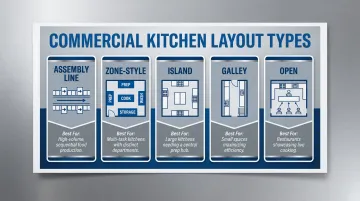
Matching layout to operation type is critical. A mismatch forces costly retrofits down the line — reconfigured utility runs, relocated equipment, and disrupted workflows that could have been avoided at the planning stage.
Foundational Components Every Plan Must Address
Any complete design plan should cover:
- Cooking and prep zones
- Receiving and storage areas (dry, refrigerated, frozen)
- Warewashing and sanitation stations
- Waste management areas
- Ventilation systems (exhaust hoods, makeup air, exhaust fans)
- Utility connection points: gas, water, and electrical
Unlike residential kitchens, commercial spaces must satisfy health department inspections, NSF/ANSI equipment standards, and local building codes. These requirements need to be built into the design from day one, not reconciled during final walkthrough.
The 7 Critical Factors When Designing a Commercial Kitchen
1. Workflow and Kitchen Layout
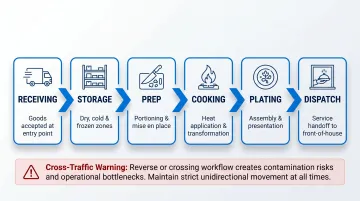
Workflow—the logical movement of food from receiving through prep, cooking, plating, and dispatch—is the single most critical design variable. A kitchen where staff cross paths, backtrack, or compete for equipment at peak service will underperform regardless of how good the equipment is.
The FDA Food Code emphasizes unidirectional flow: ingredients move from raw to ready-to-eat in a single direction to maximize efficiency and minimize contamination risk. When that flow breaks down, so does everything else. The U.S. Bureau of Labor Statistics recorded approximately 93,800 nonfatal injuries in full-service restaurants in 2019 alone, with cramped, poorly sequenced layouts contributing significantly to those numbers.
Common bottleneck causes:
- High-use items stored far from cooking stations
- Dirty dish return paths crossing food prep or service areas
- No clear separation between incoming goods and outgoing plates
Layout-to-operation matching:
- Assembly line → high-volume quick-service concepts
- Zone-style → full-service restaurants with diverse stations
- Island → larger teams with varied cooking tasks in spacious kitchens
The layout decision cannot be separated from the menu. A hotel banquet kitchen running 500 covers in two hours has completely different spatial logic than a 40-seat neighborhood restaurant.
2. Space Planning and Zoning
Every commercial kitchen needs dedicated functional zones: receiving, dry storage, cold storage, prep, cooking, plating, warewashing, and waste. This isn't just good practice — clean/dirty zone separation is a regulatory requirement in most jurisdictions under the FDA Food Code 2022.
A commonly cited industry benchmark is 5 square feet of kitchen space per dining seat, and a survey of over 700 U.S. restaurants found the average commercial kitchen runs 1,051 square feet. But averages don't design kitchens. The right square footage depends on the specific operation's volume, staff count, and menu complexity.
The most common — and costly — zoning mistakes:
- Underestimating storage square footage (dry goods and walk-ins both)
- Squeezing the warewashing area to give more room to cooking stations
- Allowing dirty dish traffic to merge with food prep circulation
Structural inefficiencies from poor zoning compound over time. Cluttered work areas slow production, create compliance risks, and shorten equipment lifespans. Fix them after construction and you're looking at significant demo and rebuild costs.
3. Safety and Code Compliance
Commercial kitchens must simultaneously satisfy local building codes, NFPA 96 (ventilation and fire protection), FDA Food Code 2022, NSF/ANSI equipment standards, and ADA requirements where applicable. Missing any one of these at inspection can delay an opening, trigger expensive retrofits, or result in fines.
The fire risk data is unambiguous: NFPA reports an average of 7,410 restaurant fires per year, with cooking equipment causing 57% of incidents and grease or oil the first item igniting in 43% of those fires.
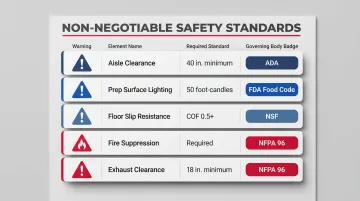
Non-negotiable safety design elements:
| Element | Standard |
|---|---|
| Aisle clearance (pass-through) | 40 inches minimum (ADA) |
| Lighting at prep surfaces | 50 foot-candles minimum (FDA Food Code) |
| Floor slip resistance | Coefficient of friction 0.5 or higher |
| Fire suppression above cooking equipment | NFPA 96 required |
| Clearance to combustibles from exhaust | 18 inches minimum (NFPA 96) |
One process note: design teams and general contractors should coordinate with the local health authority and fire marshal during schematic design — not after permit submission. Catching a compliance gap on paper costs far less than catching it in the field.
4. Ventilation and Air Quality
Ventilation is not optional, and it cannot be sized or positioned as an afterthought. Commercial cooking generates heat, grease-laden vapor, smoke, and carbon dioxide continuously.
Without a properly designed exhaust system, grease accumulates on surfaces — a direct fire hazard — working temperatures become unsafe, and health code violations follow.
The two hood types and when each applies:
- Type I hoods — required above any equipment producing grease or smoke (fryers, griddles, ranges, broilers); fire suppression systems are mandatory
- Type II hoods — used above equipment producing heat or steam without grease (steamers, dishwashers, kettles); no fire suppression required
Hood placement must be determined relative to equipment layout. When the equipment plan changes after the hood positions are set, the entire ventilation system may need to be redesigned. That sequencing error is common and avoidable.
ASHRAE Standard 154 governs makeup air requirements: the makeup air system must interlock with the exhaust hood, and makeup air temperature must stay within 10°F of the conditioned space. Exhaust fans must terminate at least 40 inches above the roof and 10 feet above grade.
An undersized system forces staff to work in excessive heat — a staff retention problem that surfaces long before it becomes a regulatory one.
5. Storage and Cabinetry
Storage is consistently undervalued in the design phase, then desperately missed during operations.
When organized, accessible storage runs out, staff improvise: ingredients get stacked on prep surfaces, cleaning chemicals end up near food items, and clutter slows every task.
Improper food storage is one of the most frequently cited health code violations in commercial foodservice inspections. The 2022 FDA Food Code specifically tightened provisions around storage practices — prohibiting the reuse of containers for storage purposes they weren't designed for — reflecting just how directly storage failures drive contamination risk.
Specify these cabinetry standards in every commercial kitchen design:
- NSF-rated materials in any food-contact zone
- Stainless steel construction where durability and sanitation are both required
- Accessible shelving heights that reduce excessive bending or reaching
- Lockable compartments for cleaning chemicals and controlled supplies
- Zone-specific configurations: dry storage shelving differs from smallwares storage, which differs from the plating station
If you're working with a cabinetry partner on commercial builds, Broadway Kitchens & Baths coordinates directly with architects and contractors from field measurements through punch-list. They handle manufacturing modifications for non-standard footprints, which means storage specifications get resolved before construction starts — not retrofitted around it.
6. Energy Efficiency and Sustainability
Energy costs account for over 10% of total operating expenses in a typical restaurant. That number is determined at the specification stage — equipment choices, insulation quality, lighting type, and HVAC design all become fixed costs for the life of the operation.
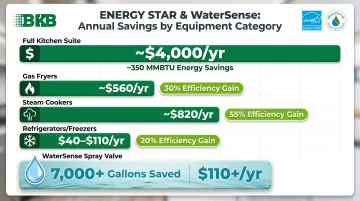
ENERGY STAR equipment savings at a glance:
| Equipment | Efficiency Gain | Annual Savings |
|---|---|---|
| Full certified kitchen suite | ~350 MMBTU/year | ~$4,000/year |
| Commercial gas fryers | 30% more efficient | ~$560/year |
| Commercial steam cookers | ~55% more efficient | ~$820/year |
| Commercial refrigerators/freezers | 20% more efficient | $40–$110/year |
Beyond equipment, pre-rinse spray valve selection matters more than most designers realize. According to the EPA, replacing one old spray valve with a WaterSense-labeled model (max 1.28 gpm) saves more than 7,000 gallons of water annually and over $110 in energy and water costs per year per valve.
Additional efficiency strategies worth specifying:
- LED lighting with motion sensors in low-traffic areas
- Walk-in coolers positioned away from heat-producing equipment
- Well-insulated cooler doors and walls to minimize compressor load
Property managers and institutional clients increasingly expect sustainability commitments. Energy-efficient design serves both the operating budget and those expectations simultaneously.
7. Staff Ergonomics and Comfort
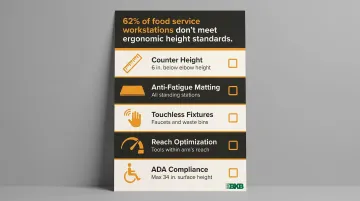
A kitchen designed without ergonomics in mind injures people — and the data bears that out. Research published in PMC found that among kitchen workers, cuts accounted for 67.7% of work-related injuries, thermal burns for 63.7%, and slips/falls for 33.7%. NIOSH data shows that 62% of food service workstations don't meet recommended ergonomic height standards, and 68% of workers report discomfort at poorly configured stations.
In kitchens serving hotels, hospitals, or universities — where staff work extended shifts with no real service break — ergonomic deficiencies compound into higher injury rates, elevated turnover, and slower throughput at exactly the wrong moments.
Ergonomic design elements that belong in every commercial kitchen spec:
- Countertop and cutting surface heights set approximately 6 inches below elbow height for primary tasks
- Anti-fatigue matting at all standing workstations
- Touchless faucets and waste bins to reduce repetitive motion
- Frequently used tools and ingredients within arm's reach of each primary station
- ADA-compliant work surface heights (maximum 34 inches) where applicable
Ergonomics rarely makes it onto the first draft of a design checklist. Given that injury rates and staff turnover are directly tied to workstation configuration, it deserves a fixed place in every initial brief.
How Broadway Kitchens & Baths Can Help
Broadway Kitchens & Baths operates as a single-source renovation partner for commercial kitchen projects across the tri-state area, working directly with architects, general contractors, and management companies from initial field measurements through final punch-list. Their process is built to close the coordination gaps that push commercial kitchen projects over budget and behind schedule.
Capabilities for commercial kitchen projects:
- Customizable cabinetry and stone solutions in materials including woods, melamine, high-pressure laminate, metal, and thermofoils
- Integrated manufacturing modifications for non-standard footprints and custom configurations
- Proficiency in both union and non-union labor environments, with full insurance documentation and compliance
- Collaborative relationships with manufacturers, builders, and architects that accelerate the specification process
- Multi-unit project management for property managers and hospitality groups renovating multiple locations
Their builders division carries over 12 years of specialized experience on multi-unit and commercial projects. The team works directly alongside other trades on-site, which means architects and contractors have a single accountable point of contact through every phase of the kitchen and bath scope — not just during specification.
Showrooms are open to trade professionals in Englewood, NJ and Manhattan, NY for specification review and material selection. Contact Broadway Kitchens & Baths at +1 201-567-9585 to schedule a consultation.
Conclusion
Commercial kitchen design is not a checklist exercise. Every factor—workflow, zoning, code compliance, ventilation, storage, energy, and ergonomics—connects to every other. A weak decision in any one area creates problems across the board.
The goal isn't the most expensive kitchen or the most complex one. It's the kitchen most precisely matched to the specific operation: the menu it serves, the volume it handles, the team that works in it, and the regulations it must satisfy.
If you're an architect, contractor, or management company planning a commercial kitchen project, bring your renovation partner in early. Locking in cabinetry, storage, and finish specifications before construction begins means fewer redesigns and fewer delays down the line. Broadway Kitchens & Baths works directly with architects, contractors, and management companies on commercial kitchen projects throughout the tri-state area. Call +1 201-567-9585 to get started.
Frequently Asked Questions
What should you consider when designing a commercial kitchen?
The core considerations are workflow layout, dedicated functional zoning, safety and code compliance, ventilation, storage, energy efficiency, and staff ergonomics. Each factor should be evaluated against the specific type of operation—a high-volume hotel kitchen has very different requirements than a boutique restaurant.
What is the best layout for a commercial kitchen?
There's no universal answer. Assembly-line layouts work for high-volume quick-service; zone-style suits full-service restaurants with multiple stations; island layouts benefit larger teams in spacious kitchens. The priority in any layout is minimizing unnecessary staff movement and eliminating workflow bottlenecks at peak service.
How much does it cost to design and renovate a commercial kitchen?
Renovation of an existing commercial kitchen space typically runs $120–$300 per square foot, while ground-up new construction ranges from $200–$450 per square foot. A 1,500-square-foot renovation could cost $180,000–$450,000. Budget at least a 20% contingency for hidden infrastructure issues.
Do I need permits to renovate a commercial kitchen?
Yes. Most commercial kitchen renovations require building permits, health department plan reviews, fire marshal approval, and mechanical or plumbing permits depending on scope. Factor permitting timelines into the schedule from day one, as permit delays are among the most common causes of project overruns.
What materials are best for commercial kitchen surfaces and countertops?
Stainless steel is the industry standard for prep surfaces, countertops, and equipment due to its durability, non-porous construction, and ease of sanitization. Other NSF-approved materials may be appropriate in specific zones—the right choice depends on the task and applicable health code requirements.
How long does a commercial kitchen renovation typically take?
Renovations generally run 3 to 6 months from design through completion; new builds typically require 6 to 12+ months. Supply chain delays or permit backlogs can extend either timeline significantly.