Introduction
In a city where Midtown Manhattan restaurant space runs $150–$400 per square foot annually, a misplaced workstation isn't just an inconvenience — it's a margin problem. Commercial kitchen design in NYC and NJ carries stakes that most renovation projects don't.
A poor layout creates bottlenecks during dinner rush, invites failed DOH inspections, and forces expensive retrofits after opening. Get it right and ticket times drop, staff move without colliding, and compliance becomes a non-issue.
This guide breaks down the 7 commercial kitchen layouts best suited to NYC and NJ restaurants — with honest guidance on which layout fits your concept, your square footage, and your local code requirements.
Key Takeaways
- Kitchen layout directly affects workflow speed, food safety compliance, and long-term profitability
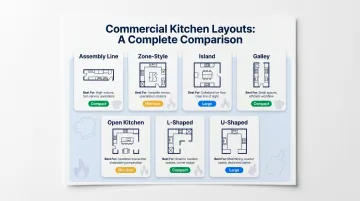
- The 7 layouts: Assembly Line, Zone-Style, Island, Galley, Open Kitchen, L-Shaped, and U-Shaped
- NYC/NJ operators deal with tighter square footage, stricter DOH rules, and higher buildout costs than most US cities
- Choose your layout based on menu complexity, service volume, and available footprint — before signing a lease
- Building for compliance from day one costs significantly less than retrofitting after a failed inspection
Why Commercial Kitchen Layout Matters for NYC & NJ Restaurants
In Midtown, Tribeca, and the West Village, commercial space runs $150–$400 per square foot annually. A poorly planned kitchen isn't a design inconvenience — it's a cost that compounds on every square foot you're paying for, every day you're open.
The cost of poor layout goes well beyond rent. Industry benchmarks in foodservice design put productivity gains from an efficient kitchen at up to 50%. Poor workflow forces staff to cross paths, adds unnecessary steps between stations, and stretches ticket times during peak hours.
What NYC and NJ Codes Actually Require
Both markets impose non-negotiable layout constraints that must be planned from the start — not retrofitted after construction is underway.
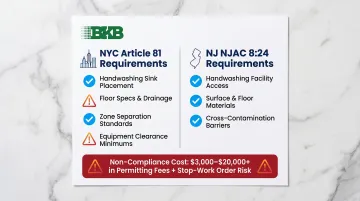
NYC Article 81 requirements that shape layout:
- Handwashing sinks must be within 25 feet of any food prep, service, or warewashing area
- Food prep and warewashing floors must be smooth, non-absorbent, and graded to drain
- Raw and ready-to-eat food must have physically separate prep zones
- Fixed equipment needs clearance for cleaning or must be sealed to surfaces
NJ NJAC 8:24 parallel requirements:
- Designated zones for prep, cooking, storage, washing, and waste disposal
- Adequate exhaust ventilation for heat, steam, and airborne grease
- Handwashing stations with hot/cold water, soap, and paper towels accessible to all staff
Ignoring these requirements at the design phase is expensive. Permitting fees alone run $3,000 to $20,000+, and stop-work orders during construction cost significantly more. Getting the layout right from the start is what separates a smooth build from a costly one — which is where the choice of kitchen layout type becomes critical.
7 Best Commercial Kitchen Layout Designs for NYC & NJ Restaurants
These layouts are selected for their proven performance across different restaurant types and their adaptability to the space constraints and compliance demands common in NYC and NJ.
Assembly Line Layout
The assembly line moves food in one direction: from storage through prep, cooking, and plating, with each station feeding the next. Think pizza counters, sandwich shops, and fast-casual concepts where speed and menu consistency are the entire business model.
Why it works in NYC/NJ:
- Maps naturally to narrow, rectangular kitchen footprints common in urban storefronts
- Supports high ticket volume without station collisions
- Enables a dedicated delivery pickup zone that doesn't interrupt dine-in plating
- Reduces training time through repeatable, predictable workflows
Limitation: Limited flexibility for diverse or changing menus. If your concept requires multi-technique cooking across varied dishes, this layout will fight you.
Best for: Pizza shops, sandwich counters, poke bowls, fast-casual concepts in the five boroughs and NJ urban centers.
Zone-Style Layout
Zone-style divides the kitchen into dedicated functional blocks — typically prep, cooking, plating, and cleaning — positioned along the walls with the center kept open for movement. Each station has its own equipment cluster, prep space, and storage access.
This layout has a compliance advantage worth noting: the physical separation of stations makes it easier for health inspectors to verify that raw and ready-to-eat foods aren't crossing paths — a direct requirement under both NYC Article 81 and NJ NJAC 8:24.
Why it works in NYC/NJ:
- Supports multi-tasking across stations during complex service
- Staff stay "in their lane," reducing cross-contamination risk
- Cleaner DOH inspection outcomes due to visible zone separation
Trade-off: Requires more total square footage than simpler layouts. Each station needs its own footprint, so this isn't the right call for a 400-square-foot kitchen. Budget and space must support it.
Best for: Full-service restaurants with varied menus and mid-size kitchen footprints.
Island Layout
The island places primary cooking equipment (ranges, grills, fryers) on a central module, with prep, storage, and washing stations wrapping the perimeter. The result is 360-degree circulation and clear sightlines for the chef or expeditor across the entire kitchen.
Industry guidance recommends maintaining 48–60 inch aisles around the central island for safe multi-person traffic flow. That's a substantial footprint requirement.
Fit for NYC/NJ footprints: Truly square or wide kitchen footprints are uncommon in NYC. This layout is better suited to larger NJ establishments, hotel kitchens, or newer restaurant build-outs in outer boroughs where floorplates allow it. In multi-brigade kitchens operating under union agreements, the central island lets an executive chef monitor all stations simultaneously — a real workflow advantage at scale.
Best for: Fine dining, hotel kitchens, chef-driven concepts with larger square footprints.
Galley Layout
Two parallel runs of counters and equipment along opposing walls with a central aisle. It's the most space-efficient layout available — which is exactly why it's one of the most practical choices for NYC's typical narrow kitchen footprints.
Aisle width requirements:
- Single-sided work aisle: minimum 36 inches
- Equipment on both sides: 42–48 inches
- ADA-compliant configuration: 48–60 inches
The galley shines in ghost kitchens, delivery-focused operations, and small neighborhood spots where you're running a tight, focused menu with one or two kitchen staff.
Limitation: Congestion becomes a real problem once you add a third person to the aisle. Staff movement is linear, so if two people need to pass, service slows.
Best for: Ghost kitchens, delivery-only operations, cafes, small neighborhood restaurants with lean staffing.
Open Kitchen Layout
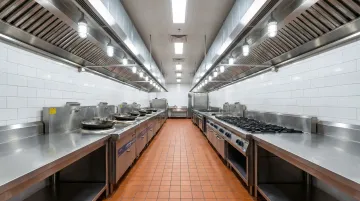
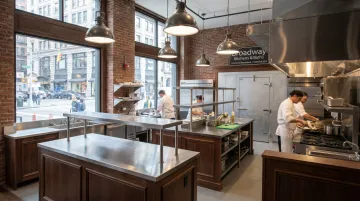
Open kitchens remove the visual barrier between the kitchen and dining room entirely. The cooking becomes part of the guest experience, a format that's grown popular in upscale NYC restaurants, omakase counters, sushi bars, and concept dining venues across NJ.
A 2025 peer-reviewed study of 702 respondents published in the British Food Journal found that open kitchen designs significantly enhance customer trust, brand credibility, and likelihood of repeat visits. For brand-driven concepts, the investment case is real.
What this layout demands in NYC/NJ:
| Requirement | Detail |
|---|---|
| Ventilation compliance | NYC Mechanical Code Chapter 5 + NFPA 96 |
| Hood type (heavy-duty) | 400 CFM/linear ft (wall) or 600 CFM (island) |
| Hood construction | Min. 18-gauge steel or 20-gauge stainless |
| Grease filters | UL 1046 listed, with automatic fire suppression |
Cleanliness standards are heightened because the kitchen is customer-facing. Noise and odor management require real investment. This is not a layout to choose for cost savings — it's a deliberate brand decision that carries specific infrastructure costs.
Best for: Upscale dining, chef's counter concepts, sushi bars, concept restaurants in NYC and NJ.
L-Shaped Layout
Equipment and workstations run along two adjacent perpendicular walls, forming an L. It suits corner kitchen spaces and the irregularly shaped footprints common in NYC brownstones, converted retail spaces, and older NJ commercial buildings.
What it does well:
- Accommodates 2–3 staff comfortably without crossing paths
- Creates a natural flow from prep on one wall to cooking on the other
- Adapts well to spaces that won't accommodate a rectangular or square layout
- Leaves floor space open for equipment like rolling racks or a portable prep station
The L-shape handles moderate menu complexity better than a galley while requiring less square footage than zone-style. It's a practical middle ground for mid-volume operations.
Best for: Corner spaces, converted commercial footprints, mid-volume restaurants with moderate menu complexity.
U-Shaped Layout
Three walls of stations and equipment wrap around a single operator, putting everything within a few steps. A single cook can pivot between all stations in under three steps, which is why this layout suits ghost kitchens, food stalls, and small neighborhood restaurants where the staffing model stays lean.
NYC/NJ fit:
- Ideal for very compact kitchens where square footage is at a premium
- Works well for 1–2 person operations; 3 staff makes it congested
- Frequently used in delivery-only concepts where speed per order matters more than multi-station coordination
Push past 2–3 kitchen staff and the layout's constraints become liabilities quickly.
Best for: Ghost kitchens, food stalls, small delivery-focused operations, single-chef restaurants.
How to Choose the Right Commercial Kitchen Layout
Start With Your Menu
Layout selection begins with what you're actually cooking and how many covers you're turning.
| Menu Type | Recommended Layout |
|---|---|
| High-volume, limited menu (QSR, fast-casual) | Assembly Line, Galley |
| Complex, multi-technique menu | Zone-Style, Island |
| Single operator or small team | U-Shaped, Galley |
| Chef-driven or experiential | Open Kitchen, Island |
| Corner or irregular footprint | L-Shaped |
Apply the Square Footage Filter
The industry benchmark is approximately 5 square feet of kitchen space per dining seat, with the standard 60/40 split allocating 40% of total square footage to kitchen and back-of-house. For a 60-seat restaurant, that means a minimum of 300 square feet of kitchen space.
In NYC, you'll often work with less. That reality eliminates certain layouts — island configurations require wide, open floorplates that Manhattan storefronts rarely offer. Galley, L-shaped, and U-shaped layouts exist precisely because urban kitchen footprints are narrow, irregular, and compact.
Build Compliance Into the Design From Day One
Compliance shapes your layout before a single piece of equipment is placed. NYC DOH requirements constrain your options early:
- Handwashing sinks within 25 feet of any prep or warewashing area
- Floor drainage placement tied to equipment zones
- Ventilation standards that dictate hood and duct positioning
- Zone separation rules for raw, cooked, and ready-to-eat food handling
Retrofitting a kitchen for compliance after construction is far more expensive than designing for it upfront. Permitting fees run $3,000–$20,000+ and review cycles extend timelines significantly.
Work With Someone Who Knows This Market
The combination of dense urban footprints, strict multi-agency permitting, and high buildout costs — NYC commercial construction runs $350–$870 per square foot — means that layout decisions carry real financial weight.
Broadway Kitchens & Baths works with NYC and NJ restaurant operators on commercial renovation and new construction, covering design and space planning through material supply, installation, and final punch-list. The team operates in both union and non-union environments — a practical reality for Manhattan buildouts where labor requirements vary by project and building. That full-scope capability means one point of contact from initial concept through job closeout.
Conclusion
For NYC and NJ restaurant owners, the right kitchen layout directly shapes how fast tickets move, whether inspections pass, and how long a buildout stays within budget. In one of the most expensive restaurant markets in the country, a poor layout doesn't create one problem — each one compounds the next: slower service leads to lower table turns, failed inspections trigger costly rework, and unplanned redesigns stretch timelines.
Before committing to a layout, the key decisions come down to:
- Menu and service style — high-volume kitchens need assembly-line or island setups; full-service restaurants benefit from zone-based designs
- Square footage and shape — galley and L-shaped layouts work for tight urban footprints; open and parallel configurations suit larger spaces
- Health code compliance — NYC and NJ both enforce specific clearance, ventilation, and flow requirements that vary by occupancy type
If you're planning a commercial kitchen renovation or new buildout in the NYC or NJ area, Broadway Kitchens & Baths offers a free, no-obligation consultation to help you move from concept to compliant, functional kitchen. Reach their Englewood, NJ showroom at (201) 567-9585 or their NYC office at (212) 260-7768.
Frequently Asked Questions
How much does it cost to build a commercial kitchen?
Full commercial kitchen construction typically runs $250–$500+ per square foot nationally. NYC projects trend significantly higher at $350–$870 per square foot due to union labor, multi-agency permitting, and dense urban logistics. A complete 1,000-square-foot kitchen commonly falls between $250,000 and $400,000 before equipment.
Is $10,000 enough to renovate a commercial kitchen?
Not for a full renovation in NYC or NJ. At $10,000, you're limited to targeted upgrades — cabinetry replacement, new countertops, or minor fixture changes. Realistic full renovation budgets for NYC/NJ operators start around $50,000–$75,000 for modest projects and scale from there based on scope and equipment needs.
What are the key rules for designing a commercial kitchen?
Six core principles guide commercial kitchen design: flexibility, simplicity, unidirectional flow, ease of sanitation, ease of supervision, and space efficiency. In NYC and NJ, these stack on top of DOH and local building code requirements covering handwashing station placement, ventilation, floor drainage, and food zone separation.
What are the common types of commercial kitchen layouts?
Seven primary layouts cover most commercial kitchen needs:
- Assembly Line — high-volume, limited menus
- Zone-Style — complex, multi-station operations
- Island — chef-driven, larger footprints
- Galley — small spaces, lean teams
- Open Kitchen — experiential dining concepts
- L-Shaped — corner or irregular spaces
- U-Shaped — ultra-compact, single-operator kitchens
What is a good size for a commercial kitchen?
The general benchmark is approximately 5 square feet of kitchen space per dining seat, with kitchens occupying roughly 30–40% of total restaurant square footage. NYC and NJ restaurants frequently operate below these guidelines, which makes smart layout selection even more important than it would be in larger, lower-cost markets.
What do you need to set up a small commercial kitchen?
Every small commercial kitchen needs these basics:
- Code-compliant zones for prep, cooking, washing, and storage
- Compliant hood ventilation, floor drainage, and adequate plumbing
- In NYC: a Food Service Establishment Permit from DOHMH ($280), DOB building permits, and a DEP-compliant grease interceptor
Budget 3–6 months from lease signing to opening for the full permitting process in NYC.