
Introduction
Renovating a commercial kitchen in New Jersey or New York City comes with a level of complexity most markets don't face. Dense regulations, multiple permitting jurisdictions, union labor requirements, and some of the highest construction costs in the nation mean every decision carries real weight.
The food service industry here is massive. New York State alone has over 50,000 restaurant locations generating $98.4 billion in annual sales, and New Jersey's eating and drinking sector supports nearly 352,000 direct jobs. In a market this competitive, even a few weeks of kitchen downtime hits revenue hard — and renovation missteps are one of the fastest ways to end up there.
Failed inspections, unplanned closures, and costly rework are avoidable — but only with the right planning, realistic budgeting, and a contractor who actually knows this market. Get those pieces right, and the result is a code-compliant, high-performance kitchen that doesn't blow your schedule or your budget.
Here are 10 tips to get it right.
Key Takeaways
- Define project scope and operational goals before any contractor sets foot on-site
- NJ and NYC have separate, distinct permitting processes — start applications 8–12 weeks early
- Budget 15–25% above base estimates for union labor, logistics, and code surprises
- Layout, equipment, and surface choices drive efficiency, durability, and code compliance
- Choosing the right local contractor determines whether your project stays on schedule and on budget
Why Commercial Kitchen Renovations in NJ & NYC Require a Different Approach
Most markets have one permitting authority to deal with. NYC has three: the Department of Buildings (DOB) for construction permits, the Department of Health and Mental Hygiene (DOHMH) for food service establishment approval, and the FDNY for commercial cooking systems including hoods and fire suppression. Miss one filing and your project stalls.
New Jersey adds its own layer. Commercial kitchen renovations are governed at the municipal level under the NJ Uniform Construction Code (NJAC 5:23), meaning requirements vary by town — what satisfies inspectors in Hoboken may not pass in Fort Lee.
Beyond permits, four compounding factors separate commercial kitchen projects here from renovations elsewhere:
- Union labor requirements: Many NYC commercial buildings mandate union crews, affecting subcontractor selection, labor costs, and scheduling. Contractors without union experience routinely underprice projects and create compliance issues.
- NYC work-hour restrictions: Construction is permitted weekdays from 7 AM to 6 PM only. Work outside those hours requires an After Hours Variance permit — a step that's easy to overlook and costly to miss.
- Urban site logistics: Elevator access windows, limited loading zones, and restricted delivery hours add coordination complexity that suburban projects simply don't face.
- Municipal variance in NJ: Code interpretation differs town by town, so a detail approved in one municipality may trigger a correction notice in the next.
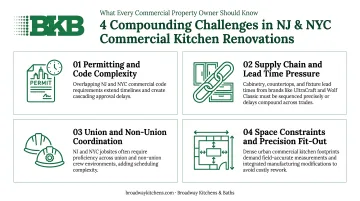
Each of these factors compounds the others. A contractor without direct NJ/NYC commercial experience won't just slow the project — they'll increase your exposure to permit violations, cost overruns, and failed inspections.
Tips 1–3: Plan Before You Break Ground
Tip 1: Define Your Scope and Operational Goals First
Before engaging any designer or contractor, create a clear scope document. Doing this upfront prevents the costliest problem in commercial kitchen renovations — scope creep that surfaces mid-construction.
Assess the following before any design work begins:
- Equipment age and condition — What's worth keeping vs. replacing?
- Workflow inefficiencies — Where do tickets slow down? Where do staff collide?
- Capacity gaps — Can the current kitchen support menu expansion or volume growth?
- Utility infrastructure — Does existing electrical and gas capacity support planned equipment loads?
Then translate those goals into specific renovation requirements:
- Faster ticket times → reconfigured station layout
- Expanded menu capacity → additional hood runs
- Food safety upgrades → new surface materials throughout
Getting this right on paper costs nothing. Discovering it wrong mid-construction costs everything.
Tip 2: Know Your NJ & NYC Permit and Regulatory Requirements
Incomplete permit applications are among the top causes of commercial kitchen project delays in both NYC and NJ — and the review queues don't pause while you fix them.
In NYC, a typical commercial kitchen renovation requires:
| Permit Type | Issuing Agency | Estimated Timeline |
|---|---|---|
| Building alteration (Alt1/Alt2) | NYC DOB | 3–6 weeks |
| Electrical, plumbing, mechanical | NYC DOB | Included in Alt filing |
| Food service establishment permit | NYC DOHMH | 3–6 weeks |
| Commercial cooking systems permit | FDNY | 2–4 weeks |
In NJ, permits are issued at the municipal level under the NJ UCC — building, electrical, HVAC, and plumbing sub-permits are all separate applications. Each municipality runs its own process.
Key regulatory frameworks every renovation must address:
- 2022 FDA Food Code — the model standard for food safety at retail
- NFPA 96 (2024 edition) — covers hood design, exhaust, ductwork, and fire suppression
- NSF/ANSI standards (NSF/ANSI 2, 3, 4, 7) — material safety and cleanability for food-contact surfaces and equipment
- 2010 ADA Standards — minimum 36" aisle clearances, 34" maximum work surface height
Non-compliance carries real costs. In NJ, first-offense violations at retail food establishments carry penalties of $200–$500, rising to $500–$1,000 for repeat offenses. NYC's DOHMH penalty schedule is condition-based — some violations carry $0 penalties if corrected quickly, but others trigger fines and operational shutdowns.
Submit permit applications 8–12 weeks before planned construction start to absorb review and revision cycles.
Tip 3: Budget Realistically for the NJ & NYC Market
National restaurant renovation benchmarks run $200–$250 per square foot, with kitchen-specific overhauls ranging from $12,000 to over $180,000 depending on scope. NYC and NJ costs consistently exceed those figures due to union labor, permit overhead, and urban site logistics.
Build a contingency fund of 15–25% above your base estimate. This isn't padding — it's insurance against the hidden costs that catch NJ/NYC operators off-guard:
- Union labor premiums — NYC union trades command notably higher total compensation than national non-union averages
- Permit expediting fees — professional expediters charge $2,000–$8,000 depending on project complexity, but can reduce approval timelines by 30–50%
- Urban logistics — elevator scheduling, restricted delivery windows, debris removal, and parking limitations add real cost
- Temporary kitchen setup — maintaining food service during renovation requires investment in off-site or temporary facilities
- Inspection scheduling delays — DOB and DOHMH inspection queues can add weeks to your timeline
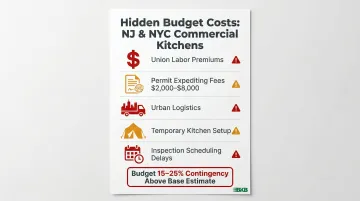
Factor these into your initial budget model — not as afterthoughts. Operators who treat contingency as optional typically exhaust it first and cut scope second.
Tips 4–6: Design Smart and Equip for Performance
Tip 4: Optimize Your Kitchen Layout for Workflow Efficiency
Per the Foodservice Consultants Society International, kitchens should occupy 25–35% of total establishment space, with the menu serving as the primary layout guide. In NYC and NJ, space is often tight enough that layout optimization becomes as important as equipment selection.
The four primary commercial kitchen layouts:
| Layout | Best For | Key Trade-off |
|---|---|---|
| Assembly line | High-volume, limited-menu operations | Fast throughput; limited flexibility |
| Zone/station-based | Diverse menus with multiple cooking methods | Flexible; requires more square footage |
| Island | Chef-centric or open kitchen concepts | Good sight lines; needs adequate clearance |
| Galley | Narrow or constrained urban spaces | Space-efficient; limits simultaneous staff |
In dense urban kitchens, multi-functional equipment — combination ovens that steam, bake, and fry — reduces the footprint needed without sacrificing output. Prioritize flow paths that minimize staff crossover: the fewer steps between prep, cooking, and plating, the faster service runs and the lower the injury risk.
Tip 5: Select Commercial-Grade, Energy-Efficient Equipment
Once your layout is set, equipment selection shapes both your compliance standing and your monthly operating costs. Two criteria drive every purchase decision in this market: NSF certification and ENERGY STAR ratings.
NSF certification (NSF/ANSI 2, 3, 4, or 7 depending on equipment type) ensures materials are safe for food contact and surfaces can be sanitized to health code standards. DOH inspectors check for it — missing certification can fail your pre-opening inspection.
ENERGY STAR matters more in NYC than almost anywhere. New York State electricity prices average 26.49 cents/kWh — 49% above the national average and among the highest in the country. ENERGY STAR-certified commercial food service equipment can save approximately $4,000 per year in utility costs — roughly $20,000 over five years.
Two process points that prevent expensive mistakes:
- Involve your head kitchen staff in equipment decisions before specs are finalized — they'll identify operational requirements designers miss
- Coordinate installation sequencing with your contractor early — equipment that arrives before rough-in is complete creates congestion; equipment that arrives late delays final MEP inspections
Tip 6: Choose Durable, Code-Compliant Surfaces
Commercial kitchen surfaces aren't an aesthetic decision — they're a compliance one. Every surface that contacts food or is in a food prep area must meet NSF and local health code standards for cleanability and durability.
Recommended materials by area:
- Walls: Stainless steel panels, FRP (fiberglass-reinforced panels), or ceramic/quarry tile — all moisture-resistant and cleanable to DOH standards
- Floors: Quarry tile (preferred for durability) or epoxy coatings (cost-effective, seamless, slip-resistant when properly specified)
- Countertops: Non-porous quartz or stainless steel for food prep surfaces; granite where aesthetics matter in customer-visible areas
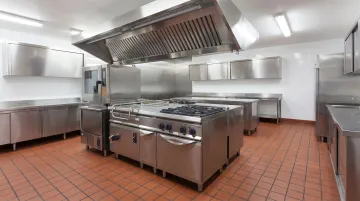
Cabinetry selection affects both function and budget — and material choices here are as compliance-driven as flooring. Broadway Kitchens & Baths offers commercial-grade cabinetry in woods, melamine, high-pressure laminate, metal, and Italian veneer, with countertop options including Caesarstone, Silestone, and MSI Stone, all fabricated and installed by in-house crews.
For tight urban footprints, working from field measurements before materials are ordered eliminates the rework that typically inflates both timelines and costs.
Tips 7–9: Manage the Build for Minimal Disruption
Tip 7: Decide Between Phased Construction and Full Shutdown Early
This decision shapes your entire project budget and timeline. The three options:
- Full shutdown: Fastest completion, lowest total labor cost, cleanest inspection process. Best for small spaces or comprehensive renovations where phasing isn't practical
- Phased construction: Stay partially open while sections are completed in sequence. Extends the timeline and labor costs — especially in union environments — but preserves some revenue
- Temporary kitchen setup: Maintains full service off-site while renovation runs in parallel. The highest-cost option, but it protects revenue for high-volume operations
Make this call before design is finalized. Phased construction affects layout sequencing, utility tie-ins, and inspection scheduling — decisions you can't easily reverse mid-project.
Tip 8: Prioritize Ventilation, Plumbing, and Electrical Infrastructure
MEP (mechanical, electrical, plumbing) work is where most commercial kitchen renovations run into their biggest and most expensive problems — and where older NJ/NYC buildings create the highest risk.
The high-stakes items:
- Hood and exhaust systems — must comply with NFPA 96 (2024 edition), covering duct design, grease removal devices, clearances, and fire suppression. FDNY requires a preliminary inspection and test upon installation before the kitchen can operate
- Grease traps — undersized or non-compliant interceptors are a top DOH inspection failure point
- Electrical capacity — modern commercial equipment draws far more power than what older urban buildings were wired to handle; insufficient capacity means equipment can't run simultaneously
Have a licensed MEP engineer review existing infrastructure before design is finalized. Discovering that a building's electrical service needs upgrading after walls are closed costs two to five times more than catching it during planning.
Tip 9: Build a Realistic Timeline and Manage Milestones
Those MEP sign-offs feed directly into your overall schedule. A comprehensive commercial kitchen renovation typically takes 8–24 weeks depending on scope. For most NJ/NYC projects, plan for 12–20 weeks for a standard comprehensive renovation — and build buffer into any public reopening date.
The critical path milestones, in sequence:
- Permits approved → demolition begins
- Utility rough-in complete → rough-in inspections (must pass before walls close)
- Equipment on-site → final MEP connections and inspections
- FDNY suppression system test → passed
- DOHMH pre-operating inspection → health department sign-off
- Reopening
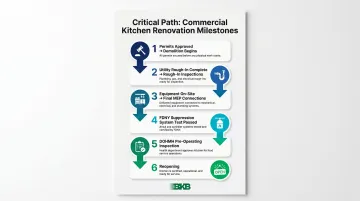
Missing any single milestone cascades into delays across every subsequent step. NYC DOB inspection scheduling alone can add one to three weeks per phase, and inspectors won't always be available when you call. Build that time in from the start.
Tip 10: Partner with an Experienced NJ & NYC Commercial Renovation Specialist
The contractor you choose will determine whether your project clears permits on schedule or stalls for months. A general remodeler who doesn't know the difference between an Alt1 and Alt2 filing — or who has never coordinated with an FDNY suppression system inspector — will cost you far more in delays than they save in fees.
Look for these qualifications before committing:
- Documented experience completing commercial kitchen projects in both NYC and NJ — not just residential
- Ability to manage permits end-to-end across DOB, DOHMH, and FDNY (NYC) and municipal building departments (NJ)
- Proven proficiency in both union and non-union labor environments
- Established relationships with inspectors, permit offices, and trade subcontractors
- A clear process from field measurements through punch-list, with a single point of accountability
Ask these questions before signing any contract:
- Can you show me completed commercial kitchen projects in NYC or NJ specifically?
- Do you handle permit applications, or does the client manage that independently?
- Have you worked in union buildings in Manhattan or Jersey City?
- What does your project management process look like from design through final inspection?
If you're looking for a contractor who checks these boxes, Broadway Kitchens & Baths works with restaurant operators, media companies, and commercial property owners across Bergen County, Hudson County, and the greater NYC metro. With showrooms in Englewood, NJ and Manhattan, the team manages every phase from field measurements through punch-list — coordinating directly with trades and navigating permitting across both markets.
Conclusion
A successful commercial kitchen renovation in NJ or NYC comes down to four things: thorough pre-planning, local regulatory expertise, smart design choices, and a contractor who genuinely knows this market. Miss one, and the others can't compensate — especially in jurisdictions where inspectors and timelines are unforgiving.
Ready to put those four pieces together? Contact Broadway Kitchens & Baths to schedule a consultation for your commercial kitchen renovation in NJ or NYC — call the Englewood, NJ showroom at (201) 567-9585 or the Manhattan office at (212) 260-7768.
Frequently Asked Questions
Frequently Asked Questions
How much does it cost to renovate a commercial kitchen?
National benchmarks run $200–$250 per square foot, with full kitchen overhauls ranging from $12,000 to over $180,000 depending on scope. NJ/NYC costs exceed these averages due to union labor, permitting complexity, and urban logistics — budget a 15–25% contingency above any base estimate.
Is $30,000 enough for a commercial kitchen renovation?
In NJ/NYC, $30,000 is generally insufficient for a comprehensive remodel. At current area pricing, that budget is more realistic for targeted equipment replacement, surface refreshes (new flooring, wall panels), or upgrades to a single station — not a full gut renovation.
Do I need permits to renovate a commercial kitchen in NJ or NYC?
Yes — both jurisdictions require permits. NYC filings involve the DOB, DOHMH, and FDNY; NJ permits are issued municipally under the Uniform Construction Code. Start applications 8–12 weeks before planned construction.
How long does a commercial kitchen renovation take in NJ or NYC?
Most comprehensive renovations in this market take 12–20 weeks. NYC DOB and DOHMH inspection scheduling frequently adds time beyond what contractors initially project — build buffer into any public reopening date.
Can I stay open during a commercial kitchen renovation?
Phased construction or a temporary kitchen setup can allow partial or full continued service, but both increase cost and timeline — particularly in union environments. A full shutdown often results in faster completion and lower total labor cost for most project scopes.
What are the most common mistakes in commercial kitchen renovations?
The most frequent pitfalls are underestimating costs (especially union labor and permits), starting construction before all permits are secured, excluding kitchen staff from equipment decisions, and hiring a contractor without NJ/NYC commercial regulatory experience.