In NJ and NYC, the stakes are particularly high. These jurisdictions run parallel but distinct code frameworks — NYC's Department of Buildings, the NYC Fire Code, and FDNY oversight on one side; the NJ Uniform Construction Code with municipal enforcement on the other. Neither tolerates shortcuts.
This guide covers the five practices that separate code-compliant, high-performing hood installations from expensive failures — with specific attention to what each jurisdiction actually requires before you operate a single burner.
Key Takeaways
- Hood type must match your equipment — Type I handles grease-producing cooking; Type II covers heat and steam only. Using the wrong type fails code before your kitchen opens
- CFM must be calculated, not guessed — undersized airflow means smoke buildup, failed health inspections, and fire risk
- NYC and NJ permits are non-negotiable — stamped engineering drawings, DOB filings, and multi-stage inspections are required before operation
- Plan fire suppression before installation begins: retrofitting a UL 300 system after the hood goes in creates compliance gaps that will surface at inspection
- Trade sequencing determines project success — out-of-order work is the leading cause of rework and blown timelines
Best Practice 1: Match Hood Type to Your Cooking Equipment and Menu
Type I vs. Type II: The Distinction That Drives Everything
Installing the wrong hood type doesn't just cost money to fix — it shuts down your inspection and forces a reinstall. The distinction is non-negotiable.
| Hood Type | Required For | Fire Suppression Required? |
|---|---|---|
| Type I | Grease-producing equipment: fryers, griddles, charbroilers, wok ranges, solid-fuel ovens | Yes — baffle filters + integrated suppression system |
| Type II | Heat and steam only: dishwashers, combi ovens, steamers | No |
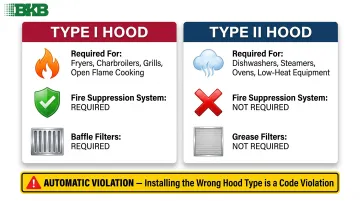
In NYC and NJ, health inspectors and fire marshals verify hood type against the actual equipment present. A Type II hood installed over a fryer is an automatic violation, regardless of how clean or well-built everything else is. There's no variance for this.
The Pizza Oven Trap
Many operators assume pizza ovens and convection ovens don't produce grease-laden air. That assumption fails inspection. Under NYC Fire Code 609.4.2, Type I hoods are explicitly required for solid-fuel commercial cooking operations — including wood-fired ovens. Cheese fat, oil, and flour combustion particles all qualify as grease-laden vapor. NYC DOB guidance also requires UL 2162 listing compliance for solid-fuel appliances.
Sizing and Overhang Requirements
Getting the hood type right is only half the equation. Linear footage must extend beyond the cooking equipment footprint on both sides — NFPA 96 Chapter 5.2 requires hoods to be sized and configured to fully capture grease-laden vapors, with overhang dimensions governed by the hood's UL 710 listing and applicable NYC Mechanical Code sections.
Undersized hoods push grease migration into unprotected spaces — a fire hazard and an inspection failure waiting to happen.
High-output equipment like charbroilers or pizza ovens may require proximity hoods or back-shelf configurations rather than standard wall canopy designs. Verify specific clearance requirements against the hood listing and the adopted NFPA 96 edition before finalizing design.
Hood Placement in NJ and NYC Buildings
Urban kitchens add another layer. Low ceilings, limited vertical clearance to the roof, load-bearing walls, and historic building restrictions all affect placement options. When structural constraints prevent standard installation, you'll need variance approvals from the NYC DOB or the local NJ building department before design is finalized — not after.
Best Practice 2: Size CFM and Design Ductwork for Long-Term Airflow Performance
Getting CFM Right
CFM (cubic feet per minute) determines whether your hood can actually evacuate smoke, grease vapor, and heat at peak cooking capacity. Undersizing is a leading cause of smoke-filled kitchens and failed health department inspections, and it happens more often than most operators expect.
CFM requirements are calculated based on:
- Equipment type — high-heat equipment like charbroilers requires more airflow than low-heat equipment like steamers
- Hood length — longer hoods covering more cooking surface require proportionally higher exhaust volumes
- Cooking volume — peak service periods drive the design load, not average throughput
ASHRAE Standard 154 provides the primary methodology for commercial kitchen ventilation airflow sizing by equipment duty category. NFPA 96 Chapter 5.2 requires exhaust volumes sufficient for complete capture and removal of grease-laden vapors. During design, both references — combined with the listed hood manufacturer's data — should govern your CFM specification.
Ductwork Construction Requirements
Once CFM is locked in, the duct system has to be built to match. NYC Mechanical Code and NFPA 96 Section 7 mandate continuously welded, grease-tight construction for Type I exhaust systems. The practical requirements:
- 16-gauge carbon steel (or 18-gauge stainless steel, per adopted edition) for grease ducts
- Continuously welded, liquid-tight seams — no screws through the duct wall, no slip joints
- Grease-tight access panels at required intervals for inspection and cleaning
Inspectors check weld quality, material gauge, and access panel placement. Deviations get flagged immediately.
Duct routing in NJ and NYC buildings adds another layer of complexity. Multi-floor restaurants, basement kitchens, and buildings requiring penetration through fire-rated assemblies all trigger additional permit requirements and enclosure construction.
Each turn in the duct run increases static pressure. Longer or more complex routes may require a more powerful exhaust fan to maintain adequate airflow at the hood face.
Makeup Air: The Often-Overlooked Half of the Equation
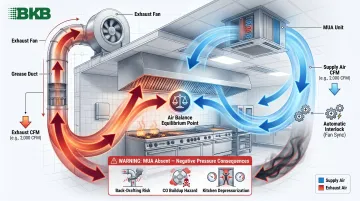
Every CFM exhausted must be replaced. Neglecting makeup air (MUA) creates negative pressure, which causes back-drafting on gas equipment, dangerous carbon monoxide buildup, uncomfortable working conditions, and entry doors that feel like they're sealed shut.
NYC Mechanical Code Section 508 requires MUA to operate simultaneously with the exhaust system, with an automatic interlock and a submitted air-balance schedule. NJ mechanical codes carry equivalent requirements. MUA needs to be designed in parallel with the exhaust system, not added as an afterthought once the hood is already sized.
Best Practice 3: Navigate NJ and NYC Permits, Codes, and Inspections Before Breaking Ground
Two Jurisdictions, Two Frameworks
NYC and NJ operate under distinct but equally demanding code structures:
| Jurisdiction | Governing Code | Permit Authority | Inspection Authority |
|---|---|---|---|
| NYC | NYC Mechanical Code, NYC Fire Code | NYC DOB | DOB + FDNY |
| New Jersey | NJ Uniform Construction Code (UCC) | Municipal Building Dept | Building Official + Fire Sub-code Official |
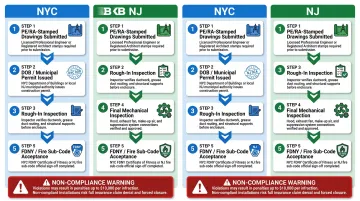
NYC: Mechanical work requires DOB permit applications with PE/RA-stamped drawings before installation begins — filed as an ALT1, ALT2, or ALT3 depending on scope. NYC DOB requires a licensed New York State Professional Engineer or Registered Architect to stamp and file the plans. Unstamped drawings are rejected without review.
New Jersey: The municipal building department administers UCC permits, with the Mechanical Inspection Technical Section (Form F145) and Fire Protection Subcode (Form F140) governing relevant scopes. Licensed engineers must prepare plans for commercial mechanical work.
The Inspection Sequence
After permit issuance, installations go through a mandatory multi-stage inspection process:
- Rough-in inspection — structural supports, duct routing, and penetrations verified before walls close
- Final mechanical inspection — hood, ductwork, and MUA system reviewed for code compliance
- FDNY acceptance inspection — fire suppression system tested and certified before the system can operate (NYC)
NJ follows a parallel sequence through the building official and fire sub-code inspector. Only after all inspections pass can the system be legally operated.
The Cost of Non-Compliance
NYC Fire Code Section 109.2 sets penalties up to $10,000 per offense, with potential criminal liability for serious violations. NYC DOH Chapter 23 authorizes immediate permit suspension and revocation for sustained violations. Insurance carriers may deny grease fire claims entirely if the system wasn't code-compliant at the time of the incident.
Skipping or rushing the permit process doesn't save time — it creates liability. Working with a renovation partner experienced in the NJ/NYC permitting environment, such as Broadway Kitchens & Baths, can cut permit delays and prevent costly plan rejections on commercial projects across the tri-state area.
Best Practice 4: Integrate Fire Suppression Systems at the Design Stage, Not as an Add-On
UL 300-compliant wet chemical fire suppression systems are mandatory under NFPA 96 for all Type I hood installations in NJ and NYC. This is a code requirement with FDNY plan filing and acceptance testing requirements attached — not optional equipment.
These systems cannot be cleanly retrofitted after the hood and ductwork are installed. Trying to add suppression after the fact creates nozzle placement problems, access conflicts, and compliance gaps that inspectors will identify.
What a Compliant System Includes
A properly designed suppression system contains:
- Wet-chemical nozzles positioned over each protected cooking appliance, per the system listing
- A chemical agent tank sized for the number of hazard points
- Mechanical or electrical detection links/sensors
- A manual pull station accessible to kitchen staff
- Automatic fuel shut-off for all gas appliances (required — not optional)
Under NFPA 96 Chapter 11 and NYC Fire Code regulations, suppression systems require semi-annual inspection and servicing by a qualified contractor. Fusible links must be replaced at each service interval, so build that servicing schedule into your maintenance plan from day one.
The Coordination Requirement
Suppression system design must happen in parallel with hood and ductwork layout, not afterward. Nozzle placement, tank location, pull station positioning, and detection link placement are all governed by the hood geometry and cooking equipment arrangement. If the cooking line changes after suppression installation, that typically triggers a costly system reconfiguration.
That reconfiguration risk isn't theoretical. USFA data shows roughly 5,600 restaurant fires occur annually in the US, with cooking as the leading cause in approximately 61–64% of incidents. A well-maintained suppression system — integrated from the start — is the primary mechanical defense against that risk.
Best Practice 5: Coordinate Licensed Trades and Understand NYC Union Labor Requirements
Multi-Trade Reality
Commercial kitchen hood installation is never a single-trade job. A complete installation requires:
- Licensed mechanical contractor — hood, ductwork, and exhaust fan
- Licensed electrician — hood controls, suppression system wiring, and interlocks
- Fire suppression contractor — UL 300 system design, installation, and FDNY filing
- Licensed plumber or gas fitter — gas line modifications for automatic shut-off integration
Every one of these licenses must be valid in New York or New Jersey specifically. Out-of-state licenses are not accepted by NYC DOB or NJ DCA. Verify licensure before any contractor mobilizes.
NYC Union Labor: What It Means in Practice
Many commercial buildings in NYC — particularly those covered by union agreements or subject to prevailing wage requirements — require that mechanical and electrical work be performed by union tradespeople. The NYC Comptroller's 2025-26 prevailing wage schedule illustrates the labor cost reality for public works projects:
| Trade | Base Wage (per hr) | Supplements (per hr) |
|---|---|---|
| Plumber | $76.30 | $45.15 |
| Steamfitter | $61.80 | $61.89 |
| Sheet Metal Worker | $54.60 | $60.18 |
Source: NYC Comptroller Prevailing Wage Schedule 2025-26
Private commercial work may not always be subject to prevailing wage, but union scales often apply regardless of public/private status depending on building ownership and existing labor agreements. Understand this before you price a project.
Broadway Kitchens & Baths works in both union and non-union environments — a practical requirement in NYC, where building ownership and labor agreements can determine whether a non-union contractor can set foot on the job site.
The Sequencing Rule
Out-of-sequence trade work is the single leading cause of rework, failed inspections, and blown project timelines. The correct sequence:
- Structural supports and ceiling/roof penetrations
- Ductwork installation and grease shaft construction
- Suppression piping rough-in (before walls close)
- Electrical rough-in and conduit
- Hood mounting and final connections
- Suppression system completion and testing
- Inspections in required sequence
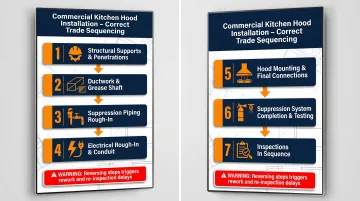
Reversing any of these steps — particularly installing suppression piping after the hood is mounted — forces destructive rework. That rework isn't just expensive; it triggers re-inspection cycles that can delay a restaurant opening by weeks. Lock the sequence into the project schedule before the first crew arrives.
Frequently Asked Questions
How much does it cost to install a commercial kitchen hood?
Basic hood-only installations typically run $950–$1,200 per linear foot, while full turnkey systems including ductwork, makeup air, fire suppression, and permits can reach $4,000–$5,000 per linear foot. NJ and NYC projects generally land at the higher end due to complex duct routing, FDNY/DOB fees, and union labor costs.
What are the requirements and codes for commercial kitchen hood installation?
NFPA 96 is the national baseline standard. NYC projects are governed by the NYC Mechanical Code and NYC Fire Code — requiring DOB permit filings and FDNY acceptance testing — while NJ projects follow the NJ Uniform Construction Code. Both jurisdictions require PE/RA-stamped engineering plans and multi-stage inspections before operation.
What is the difference between a Type I and Type II commercial hood?
Type I hoods are required over grease-producing equipment (fryers, griddles, charbroilers) and include baffle filters with integrated fire suppression. Type II hoods handle heat and steam only — dishwashers, steamers — and require no suppression system. Using a Type II over grease-producing equipment is an automatic code violation in both NYC and NJ.
What kind of professional installs commercial kitchen hoods?
Installation requires a licensed mechanical contractor for the hood and ductwork, a licensed electrician for controls and suppression wiring, and a certified fire suppression contractor for the UL 300 system. All licenses must be valid in New York or New Jersey — out-of-state credentials are not accepted.
How many CFM does a commercial kitchen hood need, and what duct size is required?
CFM is calculated from equipment type, hood length, and cooking volume using ASHRAE Standard 154 — high-heat equipment like charbroilers typically requires 50–100% more airflow than low-heat equipment. Duct sizing must match the calculated CFM, with construction governed by NFPA 96 Section 7.