Why Hiring the Right Cabinet Installer in NJ Makes or Breaks Your Kitchen Remodel
Cabinets aren't just storage — they're the most expensive single component of most kitchen remodels. According to Angi's 2026 data, cabinetry represents 30% to 40% of total kitchen remodel costs, with the average NJ homeowner spending anywhere from $14,590 to $41,542 on a full kitchen renovation.
That financial exposure makes contractor selection critical. The NJ Division of Consumer Affairs receives thousands of home improvement complaints every year: shoddy workmanship, contractors who vanish after taking deposits, and projects that drag months past the promised finish date.
This guide covers five practical, NJ-specific tips to help you vet and hire a qualified kitchen cabinet installation contractor, and avoid the mistakes that turn a remodel into a legal dispute.
TL;DR: 5 Tips at a Glance
- Confirm the contractor has a valid NJ HIC registration and $500,000+ in liability insurance
- Review portfolios of at least 3–5 completed NJ cabinet projects and call references directly
- Get three itemized written quotes and compare scope, not just the final price
- Judge communication quality during quoting — a written project schedule is non-negotiable
- Read the full contract before signing; pay close attention to payment milestones and warranty terms
Tip 1: Verify NJ Contractor Licenses, Insurance, and Registrations
New Jersey law (N.J.S.A. 56:8-136 et seq.) requires every home improvement contractor to register with the NJ Division of Consumer Affairs under the Home Improvement Contractor (HIC) program. Kitchen cabinet installation falls squarely within that definition — and hiring an unregistered contractor puts you at serious legal and financial risk.
You can verify any contractor's active registration status at newjersey.mylicense.com — the process takes two minutes and the enforcement data below shows exactly why it matters.
HIC Registration vs. Trade Licenses
HIC registration covers general home improvement work. But if your cabinet project involves:
- Relocating a sink — a separately licensed NJ Master Plumber is required
- Adding under-cabinet lighting or new circuits — a licensed NJ electrician must handle the work
Your cabinet contractor cannot legally perform these tasks under an HIC registration alone. Confirm upfront whether they'll be subcontracting those trades, and verify those subcontractors' licenses separately.
Insurance Requirements
Licensing and insurance are two separate checks — both required. Under N.J.S.A. 56:8-142, every registered NJ contractor must carry:
- Commercial general liability insurance — minimum $500,000 per occurrence
- Workers' compensation insurance — required unless specifically exempted
If a worker is injured on your property and the contractor lacks workers' comp, you can be held financially responsible. Don't take the contractor's word for it. Request certificates of insurance directly from their insurer and confirm:
- The policy names your project address
- Coverage doesn't lapse before project completion
The Red Flag to Watch For
Contractors who offer significantly lower bids but can't produce proof of registration or insurance aren't saving you money. In a 2016 NJ enforcement sweep, individual homeowners lost between $250 and $134,093 to unregistered contractors. The state actively prosecutes violations — in December 2025, another undercover operation caught 18 unregistered operators. If a contractor balks at providing credentials upfront, treat that as your answer and move on to the next bid.

Tip 2: Evaluate the Contractor's Portfolio and Speak With Past Clients
Not every remodeler has hands-on experience with semi-custom or custom cabinetry — and the installation challenges vary more than most homeowners realize.
What to Look for in a Portfolio
Ask for before-and-after photos of at least 3–5 completed NJ kitchen cabinet projects. When reviewing them, focus on:
- Reveals — consistent, even gaps between doors and frames
- Level runs — wall cabinets that sit flush and true, not visibly tilted
- Finish work — tight crown molding joints, properly fitted filler strips, clean scribe work
Also ask whether the contractor has experience with both face-frame and frameless (European-style) cabinet construction. Frameless cabinets offer roughly 10–15% more interior storage but require precise leveling — there's no face frame to mask alignment errors. A contractor who's only installed traditional face-frame cabinetry may struggle with a frameless layout.
Questions to Ask References Directly
Don't just collect names — actually call them. Ask:
- Did the contractor stick to the quoted timeline?
- Were there costs that weren't in the original estimate?
- How did they handle a problem or unexpected issue?
- Would you hire them again?
Those calls should be just one part of your vetting. A recent BrightLocal Local Consumer Review Survey found that 97% of consumers read online reviews before choosing a local business. Check Google, Houzz, and the BBB — look for patterns, not individual outliers. Multiple reviews flagging the same issue (delays, surprise invoices, poor communication) are reliable signals.
When both references and reviews consistently check out, that's a strong signal of a contractor who operates with real accountability. Broadway Kitchens & Baths in Englewood, NJ, for example, manages projects from initial field measurements through final punch-list — covering cabinet design, installation, countertops, and trade coordination under one roof. Contractors with that level of integration typically have documented quality control processes, which is worth asking about directly.
Tip 3: Get Multiple Detailed, Written Quotes and Know What to Compare
The NJ Division of Consumer Affairs explicitly recommends getting written estimates from at least three contractors before committing. This isn't just about finding the lowest price — it's about understanding what each bid actually includes.
What a Complete Cabinet Installation Quote Should Cover
A written quote should itemize:
- Cabinet materials (brand, line, linear footage)
- Labor and installation fees
- Demolition and disposal of existing cabinets
- Hardware (hinges, pulls, soft-close mechanisms)
- Filler strips, crown molding, and trim work
- Delivery and setup fees
- Permit fees, if plumbing or electrical work is involved ($50–$400 typically)
- Touch-up materials and cleanup
How to Compare Quotes Accurately
Once you know what each quote covers, pricing makes more sense in context. National data from Angi puts average professional cabinet installation at $6,198, ranging from $1,934 to $10,769 — with NJ costs likely running higher given regional labor rates. Per linear foot, expect roughly:
| Cabinet Type | Cost per Linear Foot |
|---|---|
| Stock | $100–$300 |
| Semi-custom | $200–$650 |
| Custom | $500–$1,200 |
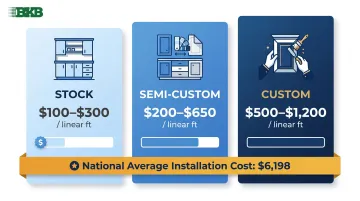
To compare quotes fairly, ask each contractor to bid on the same cabinet brand and scope. Then evaluate labor rates and inclusions separately. A quote that's $2,000 lower but excludes crown molding installation, interior organizers, and haul-away will typically cost more by the time the final invoice arrives.
A suspiciously low bid usually means something is missing. If a quote omits line items that competitors include, ask specifically why — then get the answer in writing.
Tip 4: Assess Communication, Timeline Commitments, and Project Management
How a contractor communicates during the quoting phase tells you exactly how they'll handle problems mid-project. And problems always arise.
Realistic Timeline Expectations for NJ Kitchens
Most homeowners underestimate total project time because on-site installation is fast. A professional crew can install an average kitchen in 1 to 3 days. The hidden timeline driver is cabinet lead time:
| Cabinet Type | Lead Time |
|---|---|
| Stock (pre-built) | Days to 2 weeks |
| Semi-custom | 12–16 weeks |
| Custom | 8–12+ weeks |
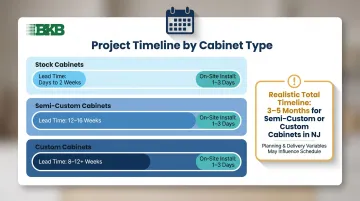
Add regional renovation backlogs — the Northeast market runs well above the national average according to the Q2 2025 Houzz Renovation Barometer — and a realistic total timeline from decision to completion is 3 to 5 months for semi-custom or custom cabinets. Any contractor promising faster turnaround without explaining why deserves a follow-up question.
What Good Project Management Looks Like
Before hiring, confirm the contractor can provide:
- A single point of contact for the duration of the project
- A written project schedule with defined milestones
- A clear policy for supply delays or scope changes, confirmed in writing
If they're vague about any of these during the sales process, that vagueness won't improve once your kitchen is torn apart.
Tip 5: Read the Contract Carefully Before Signing Anything
Under NJ law, any home improvement contract over $500 must be in writing. That covers virtually every cabinet installation project. But having a written contract isn't enough — what's in it matters.
Non-Negotiable Contract Elements
Every cabinet installation contract in NJ should include:
- Contractor's legal name, business address, and HIC registration number
- Detailed scope of work — specific cabinet brands, door styles, hardware
- Itemized pricing
- Projected start and completion dates
- Payment schedule tied to milestones
- Warranty terms on both labor and materials
Payment Schedule Red Flags
NJ Consumer Affairs warns that any contractor requesting more than one-third of the total project cost upfront is a major warning sign. The law also prohibits demanding final payment before the work is complete. Structure payments around milestones — design approval, material delivery, installation completion, and final walkthrough.
Never pay the full project cost before work begins. Before signing, request a lien waiver. This protects you if the contractor fails to pay subcontractors or material suppliers, who could otherwise place a lien on your property.
Change Order Protection
When a cabinet run gets extended or a new pantry gets added, every change should trigger a written change order signed by both parties — with agreed pricing confirmed before any additional work begins. Verbal agreements about changes are one of the most common sources of final invoice disputes.
Worth keeping in your back pocket: NJ law gives homeowners the right to cancel a signed home improvement contract within three business days of receiving a copy, for any reason.
Frequently Asked Questions
Frequently Asked Questions
How much should I expect to pay to have kitchen cabinets installed?
National averages from Angi put professional installation at $6,198, with most projects ranging from $1,934 to $10,769. NJ costs run higher due to regional labor rates — stock cabinets average $100–$300 per linear foot installed, semi-custom $200–$650, and custom $500–$1,200, with kitchen size, cabinet type, and demolition scope all affecting the final number.
How much does it cost to install a kitchen sink and cabinet?
Sink base installations cost more than standard cabinets because plumbing modifications require a separately licensed NJ Master Plumber. Budget an additional $500–$1,500 for plumbing labor, a permit, and trade coordination — more if the plumbing scope is complex.
Do I need a permit for kitchen cabinet installation in NJ?
Standard cabinet replacement with no utility changes qualifies as "ordinary maintenance" under NJAC 5:23-2.7 and does not require a permit. Any project involving plumbing, electrical, or structural modifications requires the appropriate subcode permit. When in doubt, confirm with your local municipal building department before work begins.
How long does kitchen cabinet installation take?
On-site installation takes 1 to 3 days for an average kitchen, but cabinet lead time drives the real schedule: stock cabinets arrive in days, semi-custom in 12–16 weeks, and custom in 8–12+ weeks. For semi-custom or custom orders, plan a total timeline of 3 to 5 months from contractor selection to completed installation.
What's the difference between a cabinet supplier and a cabinet installation contractor?
A supplier sells and delivers the cabinetry; an installation contractor handles the physical fitting, leveling, and finish work. Some full-service companies — like Broadway Kitchens & Baths in Englewood, NJ — handle both under one roof, which simplifies coordination and accountability across the project.
What questions should I ask a cabinet contractor before hiring?
Ask these five before signing anything:
- Are you HIC-registered with the NJ Division of Consumer Affairs?
- Can you provide current certificates of insurance (GL and workers' comp)?
- Do you have specific experience with the cabinet type I'm installing?
- What does your warranty cover on installation labor?
- How do you document and price change orders?