The challenge is that NJ and NYC kitchens are genuinely different animals. A Manhattan co-op with 103 square feet of kitchen space requires completely different thinking than a 4,000-square-foot colonial in Summit. One-size-fits-all trend lists don't account for that reality.
This article covers the 10 custom kitchen design trends that actually work across both markets — selected for their adaptability, staying power, and relevance to the specific constraints of tri-state homes.
Key Takeaways
- Custom kitchen design in NJ and NYC means balancing style against real constraints: co-op rules, square footage limits, and resale expectations
- The 10 trends below cover two-tone cabinetry, waterfall countertops, smart tech, and sustainable materials
- These trends scale across sizes and budgets, from compact NYC kitchens to larger NJ suburban spaces
- Cabinetry construction and countertop material are the foundation — cheap materials undercut any trend
- A local design partner who knows the tri-state market ensures the trend actually fits your space
Why NJ & NYC Kitchens Need Their Own Design Playbook
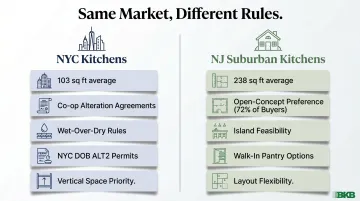
The average kitchen in a home under 1,500 square feet — typical of NYC apartment stock — runs around 103 square feet. In homes over 4,000 square feet, common in NJ suburban construction, that figure climbs to roughly 238 square feet. The difference isn't just aesthetic — it's structural, and it shapes every design decision that follows.
NYC kitchens face constraints that NJ kitchens simply don't:
- Co-op alteration agreements govern everything from construction hours to which walls can move
- The "wet-over-dry" rule in many Manhattan buildings prohibits expanding kitchens over dry spaces below
- NYC DOB ALT2 permits are required for most work involving plumbing, gas, or electrical changes — and must be filed by a licensed PE or RA
- Vertical space matters more than square footage when the footprint is fixed
NJ suburban kitchens deal with different decisions: whether to open the layout to the living room (72% of buyers want exactly that, per NAHB data), how large an island is practical, whether a walk-in pantry makes sense.
The tri-state market also leans transitional — mixing warm materials with clean lines rather than committing to either extreme — and resale considerations weigh heavily on which choices hold long-term value. Each of the 10 trends below is grounded in these specific constraints.
The 10 Best Custom Kitchen Design Trends for NJ & NYC Homes
These trends are selected for current market relevance, design longevity, and applicability across different home types and budget tiers.
Trend 1: Two-Tone Cabinetry
Two-tone cabinetry — darker lower cabinets paired with lighter uppers, or a contrasting island finish — has moved well past niche status. The 2024 Houzz Kitchen Trends Study found nearly one-quarter of homeowners now choose different colors for upper and lower cabinets, with white uppers (52%) and wood-tone lowers (28%) leading the combinations.
In NYC kitchens, this trend solves a specific problem: full dark cabinetry in a small space feels oppressive. Two-tone adds visual depth without requiring more square footage. In NJ open-concept kitchens, the color separation helps define zones — kitchen versus dining versus living — within a single flowing space.
Cabinet brands like UltraCraft, Plain & Fancy, and Wolf Classic (all carried at Broadway Kitchens & Baths' showrooms in Englewood and Manhattan) offer the finish flexibility this trend demands.
Trend 2: Waterfall Countertops
A waterfall countertop extends the surface material continuously down the sides of an island or cabinet run — creating a seamless, sculptural effect. It has become a signature feature in high-end NJ and NYC remodels, functioning as both a design statement and a practical surface.
Engineered quartz dominates this application, rising 4 percentage points year over year in Houzz's 2024 data. Marble and quartzite remain popular for premium projects. Broadway Kitchens & Baths carries countertop lines from Caesarstone, Silestone, Corian Quartz, and MSI Stone — all well-suited for waterfall fabrication.
The effect scales well. A waterfall island becomes the focal point in a compact NYC kitchen; in a larger NJ space, it anchors an oversized island without crowding other design elements.
Trend 3: Integrated and Panel-Ready Appliances
Panel-ready appliances — refrigerators, dishwashers, and range hoods concealed behind custom cabinetry panels — create an uninterrupted visual line through the kitchen. In NYC apartments, the seamless aesthetic suits compact layouts. In NJ luxury renovations, it signals premium quality — when every surface reads as cabinetry, the kitchen feels considered rather than assembled.
54% of homeowners replace all appliances during a kitchen renovation (Houzz 2024), making this a natural integration point. One planning note: panel-ready appliances require precise cabinetry dimensions and must be specified early — not after cabinets are ordered.
Trend 4: Statement Lighting
Lighting has crossed from functional to foundational. 91% of homeowners upgrade lighting during a kitchen renovation, with pendant lights chosen by 42% and under-cabinet lighting by 54% (Houzz 2024).
Oversized pendants, mixed metals, and sculptural fixtures now serve as primary focal points over islands and dining zones. The design principle that matters most: layered lighting.
A well-lit NJ or NYC kitchen uses three distinct layers:
- Ambient — general overhead illumination
- Task — under-cabinet and focused work lighting
- Accent — decorative pendants, toe-kick lighting, or above-cabinet LED strips
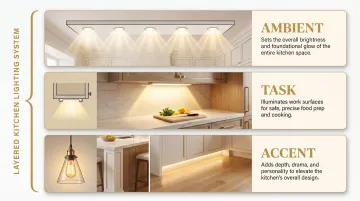
Broadway Kitchens & Baths incorporates lighting planning directly into its design consultations, coordinating placement with cabinetry layout from the start — not as an afterthought once cabinets are installed.
Trend 5: Bold Backsplashes — Large-Format Tile and Slab
Traditional subway tile is losing ground. 78% of NKBA-surveyed designers identify full-height backsplashes in the same material as the countertop as a leading trend — a "countersplash" approach using large-format slabs that minimize grout lines and maximize visual impact.
The practical appeal is real: fewer grout lines mean easier cleaning. The design appeal is equally strong — a full-height slab backsplash makes a kitchen feel taller, which matters enormously in spaces with standard 9-foot ceilings.
86% of homeowners update their backsplash during a kitchen renovation (Houzz 2024). Porcelain slabs and matched-material countertop extensions are the moves worth considering in both NJ new builds and NYC renovation projects.
Trend 6: Smart Kitchen Technology
44% of homeowners now incorporate smart features in kitchen renovations, with 30% choosing Wi-Fi-connected appliances and 29% preferring smartphone-controllable options (Houzz 2024). In the NJ/NYC market, where tech-forward living is a baseline expectation for many buyers, these numbers trend higher.
Smart kitchen integrations worth planning for:
- Touch-activated and sensor faucets
- Built-in USB and wireless charging stations
- App-connected ranges and refrigerators
- Programmable under-cabinet and accent lighting
The critical planning note: electrical layout and connectivity need to be addressed during the renovation design phase. Running conduit and rough-in wiring after cabinets are installed is expensive and disruptive. Discuss smart tech with your designer before a single measurement is taken.
Trend 7: Warm Natural Materials
The all-white, high-gloss kitchen is giving way to something warmer. Nearly 70% of designers identify nature and harmony as key design goals (NKBA), and the materials reflect it — natural wood cabinetry, stone-look surfaces, honed finishes, and warm metal hardware.
The data supports the shift: wood-tone cabinetry has climbed to 25% market share, and 49.5% of industry professionals predict gold will be the leading faucet and hardware finish over the next three years (NKBA survey data).
In practice, this trend looks like:
- Natural wood open shelving or lower cabinetry (Wolf Classic's Honey and Chestnut finishes are solid starting points)
- Unlacquered brass or brushed gold cabinet hardware
- Honed or matte stone countertops rather than high-gloss
- Warm white walls that read as cream rather than stark white
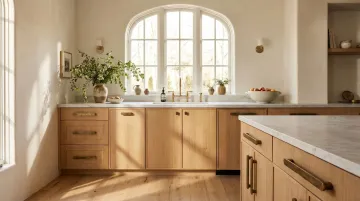
Unlike bolder changes, this trend layers into an existing design without a full overhaul.
Trend 8: Hidden Storage and Butler's Pantry Zones
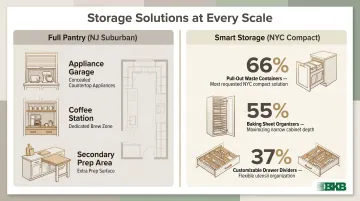
Over 50% of NKBA-surveyed designers report growing demand for walk-in, butler's, and built-in pantries. The concept is practical: a butler's pantry or appliance garage keeps countertops clear while handling the functional workload — coffee station, mixer storage, secondary prep space.
For NJ suburban kitchens with the square footage, a dedicated butler's pantry zone is increasingly standard in mid-to-high renovations. Broadway Kitchens & Baths offers pull-out pantry systems, spice pull-outs, corner cabinet solutions, and custom pantry configurations through accessory partnerships with Rev-A-Shelf, Richelieu, and Hafele.
For NYC kitchens where a dedicated pantry room isn't possible, the principle scales down:
- 66% of homeowners install pull-out waste containers
- 55% add baking sheet/tray organizers
- 37% include customizable drawer dividers
Even without a dedicated pantry, smart storage choices add up to a kitchen that works harder.
Trend 9: Open Shelving Mixed with Closed Cabinetry
Open shelving remains a niche choice — below 15% popularity among homeowners per NKBA data — but the hybrid approach is gaining traction. A few well-placed open shelves within a predominantly closed cabinetry run creates visual breathing room and a display opportunity without sacrificing storage.
The trend works best when it's restrained. Open shelves should hold items that are visually cohesive — a curated set of ceramics, glassware, or cookbooks — not become catch-all storage. In NJ transitional kitchens and NYC spaces where personality matters, this mix signals intentionality rather than unfinished design.
The practical rule: plan the open sections alongside the closed cabinetry layout, not as an afterthought.
Trend 10: Sustainable and Eco-Conscious Design
Sustainability has become a baseline expectation rather than an optional feature. The 2024 Houzz Kitchen Trends Study found sustainability factors into decisions for over 90% of homeowners, with 67% choosing LED lighting, 62% selecting energy-efficient appliances, and 32% opting for water-efficient fixtures.
For NJ and NYC homeowners, eco-conscious choices also carry resale value. Buyers increasingly ask about appliance energy ratings, cabinet material certifications, and finish VOC levels — especially in markets where environmental awareness is high.
One construction detail worth knowing: MDF (medium-density fiberboard) emits the highest formaldehyde levels among pressed wood materials. Plywood-box cabinets with low-VOC finishes are both better for indoor air quality and more durable long-term.
Materials and Cabinetry: The Foundation Behind Every Trend
No trend delivers its full impact without quality materials underneath. A two-tone cabinet scheme in particleboard with cheap hardware will look dated in three years. The same concept in plywood-box construction with soft-close hardware lasts decades.
Three things to prioritize in every custom kitchen:
- Plywood box construction — holds screws better, resists moisture, and outlasts particleboard in demanding kitchen environments (Wolf Classic, Plain & Fancy, and UltraCraft all offer full or partial plywood options)
- Engineered quartz countertops — durable, low-maintenance, and available in formats suited to waterfall islands and full-height backsplashes; Caesarstone, Silestone, Corian Quartz, and MSI Stone cover the range
- Hardware finish — soft-close hinges and drawer glides are the baseline; the finish itself (brushed gold, matte black, unlacquered brass) ties the visual story together
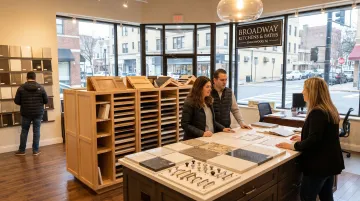
Seeing these materials in context makes a real difference. Broadway Kitchens & Baths operates showrooms in Englewood, NJ, and Manhattan where clients can compare cabinetry and stone options before committing.
For non-standard spaces — NYC apartments where standard sizing rarely fits, or NJ builds with unusual configurations — integrated manufacturing modifications allow cabinets to be sized in 1/16" increments to match the actual space.
How to Choose the Right Trends for Your Kitchen Remodel
Not every trend belongs in every kitchen. Before committing to a design direction, evaluate three factors:
- Kitchen size and layout — a 100-square-foot NYC kitchen and a 240-square-foot NJ open-concept space require different solutions for the same trend
- Architectural style of the home — warm natural materials suit a NJ craftsman; sleek panel-ready appliances suit a modern Manhattan apartment
- Long-term budget reality — waterfall countertops in quartzite cost significantly more than the same profile in engineered quartz; both are valid choices at different price points
Beyond layout and budget, longevity is worth factoring in. Two-tone cabinetry, warm natural materials, and layered lighting have held up through multiple color cycles because they're grounded in proportion and contrast — not novelty. Hyper-specific palettes and statement finishes, by contrast, tend to date within five to seven years.
For NYC homeowners specifically, design choices often intersect with regulatory ones. Co-op alteration agreements can restrict structural changes, and ALT2 permits require a licensed PE (Professional Engineer) or RA (Registered Architect), which adds time to the schedule.
NJ and NYC permit requirements differ significantly. Working with a partner experienced in both union and non-union environments — and familiar with NYC DOB processes versus NJ municipal approvals — avoids costly mid-project surprises.
Conclusion
The best custom kitchen design isn't about applying every trend — it's about applying the right trends for the right home. A Jersey City condo renovation calls for different thinking than a colonial in Montclair. Both can be exceptional; they just need different approaches.
A kitchen remodel is a long-term investment. The decisions made in the design phase — cabinetry construction, material selection, layout logic — determine whether the space still feels right in 15 years or needs refreshing in five. Getting those calls right from the start is what separates a kitchen that ages gracefully from one that dates quickly.
Broadway Kitchens & Baths works with NJ and NYC homeowners, architects, and multi-unit developers across the tri-state area — from Bergen County renovations to Manhattan apartment builds, with showrooms in Englewood, NJ, and Manhattan. If you're ready to see how these trends apply to your specific space, reach out for a consultation:
+1 201-567-9585
Frequently Asked Questions
How much does it cost to build a custom kitchen?
In the NJ/NYC market, midrange kitchen remodels in the Middle Atlantic region average $28,844, while major NYC remodels reach $90,141 or more (2025 Cost vs. Value Report). The main cost drivers are cabinetry, countertops, appliances, and labor — all of which vary significantly by material tier and whether the project involves structural changes.
What are the 5 basic kitchen layouts?
The five layouts are L-shaped, U-shaped, galley, one-wall, and island/peninsula. Galley and one-wall layouts suit NYC apartments where square footage is limited; L-shaped, U-shaped, and island configurations work best in NJ suburban kitchens with room to expand.
What is the 60/30/10 rule for kitchens?
It's a color balance principle: 60% dominant color (typically cabinetry or walls), 30% secondary color (countertops or backsplash), and 10% accent (hardware, lighting, or décor). This keeps two-tone or bold backsplash choices visually grounded without overwhelming the space.
How long does a kitchen renovation take in NJ or NYC?
Full custom kitchen renovations typically span 6 to 9 months from initial design through final walkthrough, with custom cabinetry carrying 6–12 week lead times on its own. In NYC, co-op board reviews and alteration agreement approvals can add weeks or months before physical work begins, so factor that into your project timeline.
What is the difference between custom and semi-custom kitchen cabinets?
Custom cabinets are built to exact measurements in any configuration or dimension — critical for NYC apartments and older NJ homes where standard sizing rarely fits. Semi-custom cabinets come in standard increments with limited modification options. For non-standard spaces, custom is typically worth the investment; UltraCraft, for example, allows sizing adjustments in 1/16" increments at no extra charge.