
The financial stakes are equally real. A mid-range kitchen remodel in the NJ/NYC metro typically runs $30,000–$55,000, while full gut renovations frequently exceed $100,000 — well above national averages. Without a clear plan, permit surprises, scope creep, and contractor issues can push those numbers much higher.
This checklist walks you through 15 actionable steps, organized by phase, built specifically for the tri-state market.
TLDR: Your 15-Step Kitchen Renovation Checklist at a Glance
- Steps 1–3: Set your goals, build a realistic NJ/NYC budget, and measure your existing space
- Steps 4–6: Pull permits, get HOA or board approvals, and test for lead/asbestos before any demo starts
- Steps 7–9: Finalize your layout, select cabinetry, and choose countertops and finishes
- Steps 10–12: Order appliances early, plan electrical and lighting, and lock in plumbing locations
- Steps 13–15: Hire a vetted contractor, track milestones during the build, and close out with a punch list
Steps 1–3: Pre-Planning — Set Your Goals, Budget & Assess Your Space
Pre-planning is where NJ/NYC renovations are won or lost. Every downstream decision — layout, cabinetry, contractor — flows from what you define here. Skipping it is the single most common reason projects run over budget or fail to meet expectations.
Step 1: Define Your Goals and Renovation Scope
Start by separating your priorities into two buckets:
- Functional goals: More storage, better workflow, updated appliances, improved lighting
- Aesthetic goals: Modern finishes, open-concept feel, cohesive design
Then decide whether you're renovating for resale or long-term personal use. This distinction drives every material and layout decision — resale projects favor neutral, broadly appealing choices, while a forever-home renovation can reflect your specific lifestyle.
In older NJ homes and NYC apartments, scope creep is a serious risk. A cabinet refresh that uncovers rotted subfloor or outdated knob-and-tube wiring can double a budget overnight — so defining scope early gives your contractor a clear mandate and limits financial exposure.
Step 2: Set a Realistic Budget — With NJ & NYC Cost Ranges in Mind
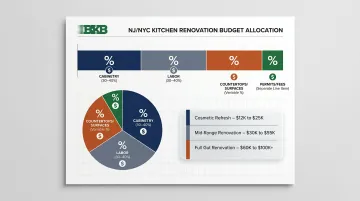
Budget by project scale for this market:
| Project Scale | NJ/NYC Cost Range |
|---|---|
| Cosmetic/surface refresh | $12,000–$25,000 |
| Mid-range remodel | $30,000–$55,000 |
| Full gut renovation | $60,000–$100,000+ |
Per Cucine Design NYC's 2025 cost guide, these figures reflect higher regional labor rates, permit costs, and the remediation work common in older housing stock.
Always set aside a 15–20% contingency. In pre-war homes and aging NJ suburbs, behind-the-wall surprises — galvanized pipes, undersized panels, deteriorated insulation — are routine.
Budget allocation benchmarks:
- Cabinetry: 30–40% of total budget (the largest single line item)
- Labor: 30–40%
- Countertops/surfaces: Varies; premium materials significantly increase this share
- Permits and fees: Budget separately; don't absorb into labor estimates
Step 3: Measure Your Space and Document Existing Conditions
Before any design conversation, photograph and document everything:
- Precise room dimensions (length, width, ceiling height)
- Plumbing locations (sink drain, supply lines, gas line if applicable)
- Window and door placements, including swing directions
- Load-bearing wall locations
- Electrical panel location and available circuits
NYC apartments typically treat ceiling heights and structural walls as fixed — the building's architecture sets hard limits. NJ suburban homes often allow more flexibility, including removing non-load-bearing walls for an open-concept layout. Knowing which constraints apply before design begins avoids costly revisions mid-project.
Steps 4–6: Navigate NJ & NYC-Specific Requirements Before You Touch a Thing
Permit research, board approvals, and hazardous material testing aren't exciting — but skipping any of them is how tri-state renovations stall mid-project or fail at closing. These three steps must be completed before demolition begins.
Step 4: Research Permit Requirements for Your Municipality
For New Jersey: Permit requirements vary by municipality. Some towns require permits for electrical work and cabinet replacement; others only for structural changes. Check with your local building department before starting. Working without required permits can kill a sale or force costly retroactive permits at closing — title companies and buyers' attorneys flag unpermitted work routinely.
For NYC: The NYC Department of Buildings requires permits for structural modifications, most electrical work, and plumbing relocations. Cosmetic work — painting, in-kind fixture replacement, new cabinet installation — generally does not require a DOB permit, but contractors must hold a DCWP Home Improvement Contractor license. Any plumbing work, even without a permit, must be performed by a Licensed Master Plumber.
Step 5: Get Co-op Board, Condo Association, or HOA Approval (If Applicable)
NYC's co-op and condo ownership structure makes this step mandatory for most apartment renovations. With 450,000 occupied co-op units and 318,000 condo units representing 22% of all occupied NYC housing (NYC Comptroller, 2024), the majority of NYC kitchen renovations require board approval before work begins.
The alteration agreement process typically requires:
- Architectural plans or scope-of-work documentation
- Proof of contractor licensing and insurance
- General liability and workers' compensation certificates
- Building architect or engineer review (in some buildings)
Budget 8–16 weeks for board review alone — not including time to prepare documentation. Start this process before finalizing your design, not after.
NJ homeowners in HOA communities should also confirm whether exterior modifications (window replacements, venting changes) require association approval.
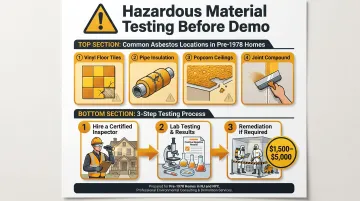
Step 6: Test for Lead Paint and Asbestos in Pre-1978 Homes
Roughly 80% of NY metro homes were built before 1978, so this step applies to most tri-state renovations. Under the EPA's Lead RRP Rule, any contractor disturbing more than 6 square feet of interior painted surface in a pre-1978 home must be EPA-certified and trained in lead-safe work practices. Penalties for non-compliance reach $37,500 per day per violation.
Asbestos is also commonly found in:
- Vinyl floor tiles
- Pipe insulation
- Popcorn or textured ceilings
- Joint compound in older drywall
Hire a certified inspector before demo day — not after an issue is discovered. Remediation typically runs $1,500–$5,000 for localized kitchen areas; build that range into your contingency before finalizing your overall budget.
Steps 7–9: Design Decisions — Layout, Cabinetry & Countertops
Design decisions lock in the aesthetic and functional character of your kitchen for years. Changes become expensive fast once cabinetry is ordered — so get these right before anything goes to production.
Step 7: Finalize Your Kitchen Layout and Workflow
Match your layout to your actual space:
| Layout Type | Best For |
|---|---|
| Galley | Narrow NYC apartments, efficient single-corridor workflow |
| L-Shape | Corner kitchens, open adjacent dining/living |
| U-Shape | Larger NJ kitchens, maximum storage and counter space |
| Island | Spacious NJ homes with open floor plans |
Beyond layout type, think in work zones — prep, cooking, and cleanup. The triangle formed by your refrigerator, range, and sink determines daily efficiency. Traffic flow matters too: if your kitchen is a through-way to another room, your layout needs to account for it.
Step 8: Select Your Cabinetry — Custom, Semi-Custom, or Stock
Cabinetry typically represents 30–40% of your total kitchen budget per Angi's 2026 cost data, making it the most consequential single purchase in the project.
Lead times by cabinet type:
| Cabinet Type | Typical Lead Time |
|---|---|
| Stock | 1–2 weeks |
| Semi-custom | 4–8 weeks |
| Fully custom | 8–12+ weeks |
In NJ/NYC homes with non-standard ceiling heights, angled walls, or tight dimensions, stock cabinets often don't fit properly. Semi-custom or fully custom solutions become necessary — not a luxury.
When evaluating cabinet quality, look at:
- Plywood box construction — outperforms particleboard for long-term durability
- Soft-close undermount drawer glides — a reliable indicator of overall build quality
- European-style concealed hinges with soft-close — now the standard in quality cabinetry
- Finish type (thermofoil, painted, or stained) — each carries different maintenance requirements
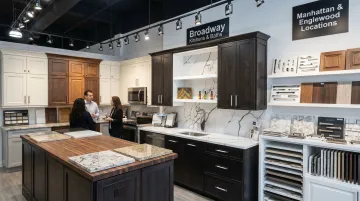
Broadway Kitchens & Baths carries brands including UltraCraft, Plain & Fancy, Wolf Classic Cabinets, Hanssem, and Great Northern — spanning stock through fully custom options.
Plain & Fancy, in particular, offers handcrafted, fully customizable cabinetry suited to the irregular dimensions common in pre-war NYC apartments and older NJ homes. Their design team conducts professional field measurements and produces detailed renderings before any order is placed.
Step 9: Choose Countertops, Backsplash & Flooring
Countertop options by use case:
| Material | Installed Cost/Sq Ft | Best For |
|---|---|---|
| Quartz | $45–$100 | High-traffic kitchens; non-porous, low-maintenance |
| Granite | $75–$250 | Natural variation preferred; requires sealing |
| Quartzite | Premium tier | Natural stone look with harder durability than marble |
| Butcher block | Lower range | Warmth and character; requires oiling and maintenance |
For busy NJ/NYC households, quartz is the practical default. It's non-porous, resists staining, and skips the sealing requirement — which is why it ranks as the most popular countertop material among kitchen design professionals, per the NKBA/KBIS 2026 Trends Report.
For backsplash, ceramic or porcelain tile leads the market at 54% of installations (2024 Houzz Kitchen Trends Study). Slab backsplash options — quartz or porcelain panels — eliminate grout lines entirely, which reduces maintenance in high-use kitchens.
Broadway Kitchens & Baths works with suppliers including Caesarstone, Silestone, Corian Quartz, and MSI Stone, giving clients access to a wide range of quartz and granite options through their Englewood, NJ and Manhattan showrooms.
Steps 10–12: Appliances, Electrical & Plumbing
Step 10: Select and Order Appliances Before Cabinetry Is Finalized
Appliance dimensions must be confirmed before cabinet orders are placed. This is one of the most common — and expensive — sequencing mistakes in kitchen renovations.
Before ordering, verify:
- Exact dimensions (height, width, depth) for every appliance
- Doorway and hallway clearances the appliances must pass through (critical in NYC apartments)
- Delivery lead times; high-end appliances can run 10–16 weeks from order to delivery
- For NYC: whether your building has active gas service, or is electric-only
NYC's Local Law 154 of 2021 phases fossil fuels out of gut renovations — shorter buildings starting in 2024, taller buildings by mid-2027. If your renovation qualifies, you'll be selecting an induction range.
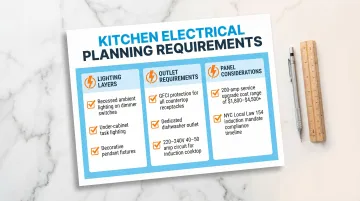
Induction requires a dedicated 220–240V circuit at 40–50 amps (per NYSERDA). Confirm your electrical panel can support this before finalizing appliance selections.
Step 11: Plan Your Electrical, Lighting & Outlet Layout
Layered lighting makes a kitchen more functional and easier to work in. Plan for:
- Recessed ambient lighting on dimmers for general illumination
- Under-cabinet task lighting for prep areas
- Decorative pendants over islands or peninsulas
Plan all lighting runs before walls close up — retrofitting lighting after drywall installation is expensive and disruptive.
Outlet placement deserves equal attention. The 2020 NEC requires GFCI protection for all kitchen receptacles (125V through 250V) — not just those near sinks — including dishwasher outlets. Both NJ and NYC adopt versions of the NEC; verify local amendments with your contractor.
Older homes frequently have undersized 100-amp panels that can't support modern kitchen loads. Upgrading to 200-amp service runs approximately $1,800–$4,500 nationally — NJ/NYC labor rates typically push this higher.
Step 12: Confirm Plumbing Locations Early
Moving plumbing is among the most expensive changes in any kitchen renovation. In NYC, building riser locations are fixed — relocating a drain stack may require building approval and can cost several times more than designing around the existing location.
Before finalizing your layout:
- Mark existing sink drain, water supply, and gas line locations on your floor plan
- Confirm any relocations are feasible given your building or home's structure
- Factor plumbing rough-in costs into your budget if relocations are planned
In NJ homes, the same principle applies — even minor drain relocations can require opening floors or walls, adding $1,500–$4,000 or more to your project. Know where your pipes are before your designer draws the final layout.
Steps 13–15: Hiring, Managing & Completing Your Renovation
Step 13: Hire the Right Contractor for the NJ/NYC Market
Vetting contractors in this market requires specific checks:
For New Jersey: Verify NJ Home Improvement Contractor (HIC) registration under N.J.S.A. 56:8-136. Registered contractors must carry minimum $500,000 in liability insurance and workers' compensation coverage, and must provide written contracts for any project over $500. Penalties for unregistered work reach $10,000 per first offense. Check registration status through the NJ Division of Consumer Affairs.
For NYC: Contractors must hold a license from the NYC Department of Consumer and Worker Protection (DCWP). Verify any contractor's license before signing anything.
Red flags to watch for:
- Upfront deposit demands exceeding 10–15% of the total contract
- No written contract provided
- Resistance to pulling permits
- Lump-sum estimates with no line-item breakdown
- No verifiable license or insurance documentation
Getting at least three itemized bids — not lump-sum estimates — gives you a meaningful basis for comparison. If you'd rather work with one firm from design through installation, Broadway Kitchens & Baths handles both — working in union and non-union environments across NJ and NYC. Their in-house carpentry crews and direct trade relationships reduce the back-and-forth between designers, subcontractors, and suppliers that typically slows a kitchen renovation down.
Step 14: Set Up a Temporary Kitchen and Manage the Build Timeline
A full gut kitchen renovation in NJ/NYC typically runs 6–12 weeks for construction alone — longer in NYC due to restricted work hours (7 AM–6 PM weekdays; 10 AM–4 PM weekends for qualifying one- and two-family homes).
Set up a functional temporary kitchen before demo begins:
- Microwave and electric kettle for hot meals
- Mini-fridge for perishables
- Secure storage space (garage, building storage, or pod) for displaced items
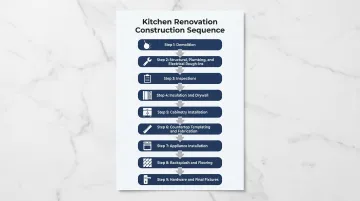
The general construction sequence to track:
- Demolition
- Structural, plumbing, and electrical rough-ins
- Inspections
- Insulation and drywall
- Cabinetry installation
- Countertop templating and fabrication
- Appliance installation
- Backsplash and flooring finishing
- Hardware and final fixtures
Get a written project schedule with milestone dates before work begins. Regular check-ins at each phase transition prevent small issues from becoming expensive problems.
Step 15: Conduct the Final Walkthrough and Punch List
A punch list is a written record of every unfinished or improperly completed item that must be resolved before final payment. Don't skip it — even with a reliable contractor.
Items to inspect systematically:
- Cabinet doors and drawers: alignment, soft-close function, hardware placement
- Countertop seams, edges, and caulk lines at walls and backsplash
- Grout consistency and completeness in tile work
- All appliances: test every function, not just power-on
- Electrical outlets: test each one, verify GFCI function near the sink
- Under-sink plumbing: check for leaks after running water
- Final cleanup: no construction debris, dust, or protective film left on surfaces
Withhold a portion of the final payment — typically 10% — until all punch list items are resolved. This is standard practice and protects your interests.
Frequently Asked Questions
What is a realistic budget for a kitchen remodel?
In the NJ/NYC market, expect $30,000–$55,000 for a mid-range remodel and $60,000–$100,000+ for a full gut renovation — significantly above the national average of roughly $26,944. Always build in a 15–20% contingency, and get itemized bids for your specific scope before committing to a number.
In what order should you renovate a kitchen?
The general sequence is: demolition → structural, plumbing, and electrical rough-ins → inspections → insulation and drywall → cabinetry → countertops → appliances → backsplash and finishing → hardware. Deviating from this order creates expensive rework.
What are the stages of a renovation project?
Five main phases: pre-planning and design, permitting and approvals, demolition and construction, installation and finishing, and final inspection and punch list. Each phase is sequential — permitting must clear before demo starts, and cabinetry must be set before countertops can be templated.
What does a remodeling project manager do?
A project manager coordinates all trades, manages the schedule and material deliveries, and ensures work meets code and contract specifications. In NJ/NYC renovations, they're the homeowner's primary contact and the key to keeping sequencing on track.
What not to do when renovating a kitchen?
The costliest mistakes: skipping permits, finalizing cabinetry before appliance dimensions are confirmed, underestimating the contingency budget, hiring on lowest bid alone, and making major design changes once construction has started.