The challenge is that custom cabinet costs don't follow a simple formula. Materials, kitchen size, design complexity, hardware choices, and local labor rates all move the number — sometimes dramatically. A homeowner who budgets based on a quick per-linear-foot estimate without accounting for installation, demolition, and hardware often finds the actual project cost 20% to 40% higher than expected.
This guide breaks down current price ranges by tier, the factors that drive costs up or down, a full line-item cost breakdown, and the estimation methods professionals actually use — so you can plan accurately from the start.
Key Takeaways
- Custom cabinets run $500 to $1,200 per linear foot installed, with full kitchens typically totaling $15,000 to $30,000
- Material, construction type, and door style drive cost most — inset doors alone can double the price of overlay framing
- Stock, semi-custom, and fully custom cabinets occupy different price bands with different trade-offs in fit and flexibility
- The "cabinet cost" and the "installed project cost" are two different numbers — hardware, labor, and demolition add 30–50% on top
- Always build in a 10% to 20% contingency and finalize all specifications before fabrication begins
How Much Do Custom Cabinets Cost?
Custom cabinets don't carry a fixed price tag. Costs shift based on the type of cabinet, level of customization, materials chosen, and local labor rates. Misreading these ranges at the estimating stage is one of the most common causes of budget overruns — and the hardest to recover from mid-project.
Budget and Entry-Level Options
Semi-custom and entry-level custom cabinets generally run $150 to $700 per linear foot installed, per HomeAdvisor's 2025 custom cabinet guide. For a full kitchen, expect total costs in the $4,500 to $15,000 range for stock or semi-custom work.
At this tier, you're typically getting:
- Standard wood species (often maple or oak) or MDF construction
- Basic door styles with limited finish options
- Overlay doors (full or partial) rather than inset
- Functional but basic hardware
Ideal for: rental units, straightforward layouts, and budget-constrained renovations where custom sizing isn't critical.
Mid-Range Custom Cabinets
Mid-range custom work lands in the $500 to $800 per linear foot neighborhood. This is where semi-custom transitions to fully custom construction, and where box construction, finish quality, and hardware durability diverge meaningfully from stock options.
What you typically get at this level:
- Plywood box construction (more durable than MDF for long-term use)
- Wider door style selection and more finish options
- Soft-close hinges and drawer slides standard
- More flexibility on cabinet dimensions and configurations
Good fit for: primary residences undergoing a meaningful renovation, projects with design complexity, and homeowners planning to stay 10+ years.
High-End and Fully Custom Cabinets
Fully custom cabinetry from specialty fabricators can reach $1,200 per linear foot or more. Total kitchen projects at this level frequently run $30,000 and above, with complex builds in high-cost markets reaching $60,000 or more.
This tier covers:
- Inset door construction (doors set flush within the face frame)
- Exotic wood veneers, hand-applied finishes, or lacquer
- Complex layout accommodations — angled walls, high ceilings, custom islands
- Full design consultation and field measurement services
- Hardware from specialty manufacturers
Best for: luxury builds, architecturally complex kitchens, multi-unit commercial projects, and projects where long-term durability and design precision justify the investment.
What's Typically Included vs. Excluded
| Usually Included | Usually Excluded |
|---|---|
| Cabinet boxes, doors, drawer fronts | Countertops |
| Basic hardware (hinges, standard slides) | Demolition of existing cabinets |
| Standard installation labor | Plumbing or electrical modifications |
| Design consultation (varies by supplier) | Permit fees |
Key Factors That Affect Custom Cabinet Costs
Custom cabinet pricing shifts dramatically based on what you're building, what it's made of, and where you're installing it. Knowing which variables carry the most weight leads to more accurate estimates — and fewer budget surprises mid-project.
Cabinet Type and Construction
The choice between semi-custom and fully custom construction is the first major cost fork. Semi-custom allows limited modifications to standard sizes; fully custom is built to your exact specifications.
Beyond that, construction style matters:
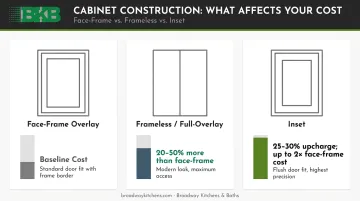
- Inset vs. overlay doors: Inset cabinetry — where doors sit flush within the face frame — typically carries a 25% to 30% upcharge over standard overlay, per Cabinet Joint. HomeGuide notes inset cabinets can cost up to twice as much as standard framed cabinets
- Frameless vs. face-frame: Frameless or full-overlay styles run 20% to 50% more than traditional face-frame construction
- Stacked uppers, tall pantries, corner solutions: Each specialty configuration adds both material and labor cost
Materials and Build Quality
Material selection affects both the unit price and how the cabinets hold up over 10 to 20 years.
- MDF: Lower cost, paints well, but less moisture-resistant — Angi estimates MDF kitchen cabinets at $2,000 to $7,000 for a full kitchen
- Solid wood (oak, maple, cherry, walnut): Considerably more — $5,000 to $25,000 for a full kitchen per Angi
- Plywood box construction: The industry standard for mid-range and custom work; more dimensionally stable than MDF and holds fasteners better over time
Finish type is an easy line item to overlook. Painted finishes require more prep and labor than stained wood; high-gloss and lacquer finishes add cost over standard matte or satin. Interior box material — what's lining the inside — also bumps the price when upgraded.
Kitchen Size, Layout, and Complexity
More linear feet equals more cabinets, which scales cost directly. But layout complexity drives cost per unit as well.
- Corner solutions (blind corners, lazy Susans) require specialty cabinets at a premium
- Islands add both upper and lower cabinet runs
- High ceilings requiring stacked uppers or full-height panels add material and labor
- Awkward angles or non-standard wall configurations require more fabrication time
Once you've mapped these complexity factors, benchmarking becomes easier. The 10x10 kitchen (20 linear feet) is an industry-standard reference point for comparing supplier quotes on equal footing — useful for initial comparisons, but not a final estimate for anything beyond a basic rectangular layout.
Hardware and Accessories
Hardware costs add up fast in a kitchen with 30+ doors and drawers — and they're easy to underestimate at the quoting stage.
- Cabinet pulls and handles: $6 to $60 per handle, plus installer labor of $5 to $30 per piece, per HomeGuide
- Whole-project hardware can range from under $100 to over $10,000 depending on selections
- Pull-out shelves, built-in organizers, and specialty drawer inserts add hundreds per unit
Location and Labor Rates
Labor rates vary considerably by region. Urban markets — particularly the New York, New Jersey, and Connecticut tri-state area — command higher installation rates than rural markets. Union versus non-union environments, local contractor availability, and market demand all affect what you'll pay.
Broadway Kitchens & Baths, which serves residential and multi-unit clients across the tri-state area, operates in one of the higher-labor-cost markets in the country. Factor that into your baseline when budgeting for any NYC/NJ metro project — quotes here will run higher than national averages, and that gap is real.
Full Cost Breakdown for Custom Cabinets
Custom cabinet quotes rarely tell the full story. A reliable estimate covers every cost stage — from initial design through final installation.
| Cost Component | Typical Range | Notes |
|---|---|---|
| Cabinet fabrication + materials | $500–$1,200/linear ft installed | Full kitchen: $15,000–$30,000+ |
| Installation labor (custom) | $200–$300/linear ft | Per HomeGuide; separate from fabrication |
| Hardware and accessories | $100–$10,000+ | Depends on pulls, soft-close, organizers |
| Design and consultation | Varies | Some suppliers include it; others charge separately |
| Demolition and removal | $180–$1,000 | Angi reports $500 average; varies by kitchen size |
| Permits | $460–$2,770 | Depends on scope and municipality |
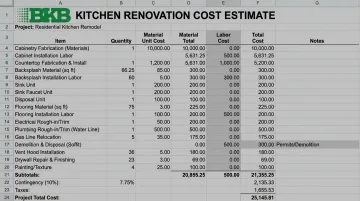
Ask every supplier upfront whether design sessions and field measurements are included in their quote or billed separately. Broadway Kitchens & Baths, for example, includes demolition within its turnkey project scope — covering field measurements through punch-list — so contractors and architects aren't managing separate vendor invoices for that phase.
Long-Term Costs to Factor In
Cabinets aren't a one-time expense in the full financial picture:
- Refinishing runs $1,992 to $4,496 on average (per Angi) — budget for this if a repaint is likely in 10 to 15 years
- Swapping 30+ pulls at $20–$100 each adds up fast; confirm hardware costs before finalizing a finish direction
- Custom manufacturers often provide limited lifetime workmanship warranties, while hardware components carry separate manufacturer coverage — confirm both before signing
Methods for Estimating Custom Cabinet Costs
There's no single right method for estimating custom cabinet costs. Professionals use different approaches depending on project complexity, timeline, and how much information is available at the time of quoting.
Per Linear Foot Estimation
The most widely used quick-estimate method. Measure total linear feet of cabinetry (uppers, lowers, and tall units typically priced separately) and multiply by a per-foot rate.
Use this approach for initial budgeting and for comparing multiple supplier quotes on the same basis. It doesn't account for specialty units, complex configurations, or the pricing difference between uppers and lowers — so treat the result as a ballpark, not a final number.
Per Box / Cabinet-by-Cabinet Estimation
Each cabinet unit is priced individually based on its dimensions, configuration, and features. Custom cabinet boxes run $600 to $1,600+ each installed per HomeGuide.
This is how detailed contractor quotes are actually built — particularly for complex kitchens with a mix of standard base cabinets, tall pantries, blind corners, and specialty units. Two kitchens with the same linear footage can have dramatically different costs if one has six specialty units and the other is all standard boxes.
Once you've chosen an estimation method, the next step is putting together a complete line-item estimate. Follow this sequence to avoid mid-project surprises:
Building a Full Cost Estimate: Step by Step
- Measure total linear feet — uppers and lowers separately; identify each specialty unit (corners, islands, pantries)
- Select materials and finishes — get unit costs for your chosen wood species, box material, and finish type
- Price hardware separately — pulls, hinges, drawer slides, and any specialty organizers add up quickly
- Get an installation quote — labor is a separate line item; confirm whether it includes delivery coordination and site measurement
- Add demolition and disposal — don't assume it's included; confirm with your contractor
- Build in a 10% to 20% contingency — change orders, site conditions, and unexpected structural issues are common enough to plan for
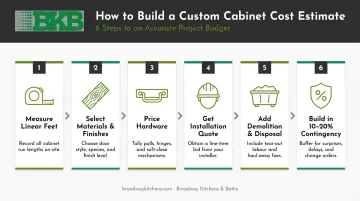
Broadway Kitchens & Baths handles project coordination from field measurements through punch-list for residential and multi-unit projects across the tri-state area — covering steps 1 through 5 so contractors and architects aren't managing those details independently.
What Most People Get Wrong When Estimating Cabinet Costs
Confusing "Cabinet Cost" with "Installed Project Cost"
The per-linear-foot number you see in a supplier quote typically covers fabrication. Hardware, installation labor, demolition, and design fees often aren't included — and together they can add 40% to 60% on top of the fabrication price. Always ask what a quote does and doesn't cover before comparing numbers.
Choosing the Lowest Bid Without Reading the Scope
Two quotes for the same kitchen can differ by $10,000 — one may include demolition, design, and premium hardware while the other covers fabrication only. This gap isn't always visible until you read the scope. Request line-item quotes and confirm:
- Is design and measurement included?
- Is demolition and disposal in scope?
- What hardware tier is specified?
- What installation rate is being used?
Adding Features After Fabrication Starts
Custom cabinets are built to spec. Once fabrication begins, change orders are expensive — the cabinet may need to be scrapped and rebuilt. Locking in all selections — materials, finishes, hardware, and layout — before signing the contract is the most reliable way to keep costs from climbing once work is underway.
Conclusion
Custom cabinet costs vary significantly based on materials, kitchen complexity, hardware, labor, and location — but that variability is manageable once you understand the components behind any estimate. The homeowners and professionals who stay on budget are the ones who start with a detailed line-item quote, account for every cost category from demolition through hardware, and lock in their selections before fabrication begins.
A detailed, transparent quote gives you scope clarity, line-item cost control, and a realistic timeline before fabrication begins. Broadway Kitchens & Baths works with contractors, architects, and management companies across the tri-state area on residential and multi-unit cabinetry projects — from field measurements through final punch-list.
Frequently Asked Questions
How do I price out custom cabinets?
Start by measuring total linear feet and selecting your materials and finishes. Then request a line-item quote from a fabricator that breaks out cabinet construction, hardware, and installation labor as separate costs.
What is the average cost of custom cabinets per linear foot?
Custom cabinets currently run $500 to $1,200 per linear foot installed, based on 2025 data from HomeAdvisor and HomeGuide. The range shifts based on materials, finish complexity, construction type, and local labor rates — with tri-state area projects typically land at the higher end.
Are custom cabinets worth the extra cost over semi-custom?
For kitchens with complex layouts, unique dimensions, or specific storage requirements, yes. Custom cabinets offer better fit, higher-quality materials, and longer lifespan. In a straightforward rectangular kitchen with standard ceiling heights, well-specified semi-custom cabinets often deliver most of the value at a lower price point.
What should be included in a custom cabinet quote?
A complete quote should itemize:
- Cabinet fabrication and material/finish specifications
- Hardware, design, and consultation fees
- Installation labor and demolition/disposal of existing cabinets
- A contingency allowance
If any of these are missing, ask before signing.
How long does it take to get custom cabinets built and installed?
Lead times vary by manufacturer and complexity. Angi cites 6 to 8 weeks for build time; specialty fabricators often run 8 to 12 weeks for fully custom work. Installation adds another 1 to 3 weeks depending on kitchen size.
How do I know if I'm getting a fair price for custom cabinets?
Collect at least two or three detailed, line-item quotes and confirm what each one includes. Check references and past project examples. Compare per-linear-foot rates against the $500 to $1,200 installed range for custom work, adjusting for your region and the complexity of your specific kitchen.