The cost gap alone can surprise people. A standard framed door installed typically runs $400–$1,100, while a frameless installation often lands between $1,000 and $2,500 — and custom configurations push higher. But price is only one piece of it. Wall conditions, bathroom size, design goals, and whether the property is owner-occupied or a rental all factor into which option actually makes sense.
This guide breaks down both door types honestly — what they cost, what they're genuinely better at, and where each one falls short.
Key Takeaways
- Framed doors cost less upfront ($400–$1,100 installed) and tolerate imperfect walls better
- Frameless doors cost more ($1,000–$2,500+ installed) but are easier to clean and stronger for resale appeal
- Semi-frameless is a real middle-ground option, typically $600–$900 installed
- Frameless doors require plumb walls; many models offer little to no out-of-plumb tolerance
- The right choice depends on your bathroom conditions, budget, and renovation goals
Framed vs. Frameless Shower Doors: Quick Comparison
| Factor | Framed | Frameless |
|---|---|---|
| Installed Cost | $400–$1,100 | $1,000–$2,500+ |
| Glass Thickness | 3/16″ – 1/4″ tempered | 3/8″ tempered (1/2″ for premium/custom) |
| Frame Material | Anodized aluminum | Stainless steel hardware; no frame |
| Maintenance Level | Higher — tracks and channels collect buildup | Lower — flat glass surfaces wipe clean faster |
| Aesthetic Style | Traditional, transitional | Modern, minimalist, spa-like |
| Warranty Evidence | Kohler: 10-year limited (qualifying purchases post Jan. 2024) | DreamLine: limited lifetime (excludes glass damage, wear items) |
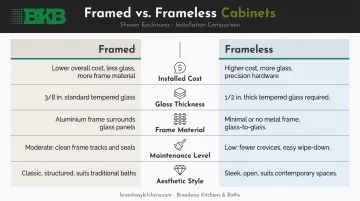
The table gives you the numbers. The sections below explain what those numbers actually mean for your project — cost tradeoffs, maintenance realities, and which style fits which bathroom.
Framed Shower Doors: Pros, Cons, and Best Uses
A framed shower door has a metal border — typically anodized aluminum — running along the full perimeter of the glass panel. That frame supports thinner tempered glass, usually 3/16″ to 1/4″ thick, and is available in finishes like matte black, satin nickel, and chrome. Because the frame does the structural work, the glass doesn't need to be as heavy.
Pros of Framed Shower Doors
Standard-size framed doors are widely available off the shelf, which keeps both material and labor costs down. The frame also covers minor wall imperfections — DreamLine's adjustable models, for example, offer between 1/2″ and 1″ of out-of-plumb adjustment depending on the configuration. That's a meaningful advantage in older tri-state housing stock where perfectly plumb walls aren't guaranteed.
The metal frame, bottom track, threshold seals, wall jambs, and 100% silicone sealant work together to create multiple barriers against water escape. For bathrooms with older subfloor waterproofing or adjacent rooms sensitive to moisture, that layered containment matters.
Cons of Framed Shower Doors
The bottom track, vertical channels, and frame crevices collect soap scum, hard water deposits, and mildew — and clearing them out requires a brush and targeted cleaning solution, not just a surface wipe. Aluminum frames can also oxidize over time in high-humidity environments, though anodized finishes and powder-coated options offer better corrosion resistance than bare metal.
The metal border competes with tile work and tends to segment the space visually. In small bathrooms, that visible frame can make the room feel more closed-in — not ideal when the goal is to maximize a tight footprint.
Best Uses for Framed Doors
- Rental and multi-unit properties where upfront cost is the priority
- Bathrooms with walls that are significantly out of plumb
- Traditional or transitional design aesthetics
- Projects with tight renovation budgets
Frameless Shower Doors: Pros, Cons, and Best Uses
With frameless doors, the glass itself carries the structural load — no metal frame required. That requires thicker tempered glass — typically 3/8″, with 1/2″ used in premium and custom configurations. Hardware is minimal: hinges, clips, a rubber sweep, and silicone caulk at wall edges. A semi-frameless variation adds framing to fixed panels but leaves the door panel open, offering a middle ground worth knowing about.
Pros of Frameless Shower Doors
Cleaner aesthetics and a more open feel. Without a metal perimeter, tile, stone, and design features read without interruption. The visual effect in smaller bathrooms is most noticeable: removing the frame boundary makes the space feel larger and more connected. The NKBA's 2026 Bath Trends Report found that 89% of respondents prioritize larger shower spaces. Frameless enclosures contribute directly to that perception, even when the footprint doesn't change.
Easier day-to-day maintenance. No tracks, no channels, no frame crevices. Soap scum and mineral deposits have far fewer places to accumulate, and flat glass surfaces wipe down quickly. Protective hydrophobic coatings — such as those from EnduroShield and Diamon-Fusion — can reduce cleaning time by up to 90% per manufacturer claims, though independent verification is limited.
Resale presentation. Zillow's bathroom ROI data shows that 29% of sellers make a bathroom upgrade before listing, and updated bathrooms attract buyers who might otherwise pass. Frameless glass is consistently cited as part of what makes a bathroom feel premium. No source isolates a door-only ROI figure, so treat it as a supporting element of buyer appeal within a broader renovation, not a standalone return driver.
Cons of Frameless Shower Doors
Higher cost and less room for error during installation. Frameless doors require custom-cut glass, precision wall alignment (some models allow zero out-of-plumb adjustment), and specialized drilling for tile. DreamLine's single Unidoor, for instance, states no adjustment for out-of-plumb conditions. That's a firm specification, not a guideline installers can work around.
Silicone maintenance over time. Without a metal frame, silicone caulk and rubber gaskets carry the waterproofing load. Bathroom sealant can last around five years when well-applied, but periodic inspection and re-caulking are part of the long-term ownership commitment.
Best Uses for Frameless Doors
- Primary bathroom renovations with modern or minimalist design
- Smaller bathrooms where visual openness matters
- High-end residential and commercial projects
- Anywhere tile or stone work should be fully visible
Cost Breakdown: Framed vs. Frameless Shower Door Pricing
Upfront Material and Installation Costs
Here's what current cost data shows across major sources:
| Source | Framed (Installed) | Frameless (Installed) |
|---|---|---|
| HomeAdvisor, 2025 | $190–$500 (door only); labor $200–$400 | $300–$3,300 (door); labor $500–$1,000 |
| Home Depot Installation Guide | $400–$1,100 | $1,000–$2,500 typical; $4,200+ custom |
| Fixr (corroboration) | ~$300–$400 for 60″ | ~$900–$1,200 for 60″ |
Semi-frameless doors fall between these ranges — typically $600–$900 installed for standard configurations.
What Drives the Price Difference
Frameless doors cost more because of:
- Glass thickness — 3/8″+ glass costs significantly more than 3/16″
- Custom fabrication — frameless doors are almost always cut to the specific shower opening, not pulled from stock
- Labor intensity — precision alignment, tile drilling with specialized bits, and heavy-panel handling add time
- Hardware finish — matte black and brushed gold hardware costs more than chrome across most manufacturers
For framed doors, configuration matters too. Sliding bypass doors run lower labor than hinged or pivot configurations, and off-the-shelf sizing avoids fabrication premiums.
Long-Term Cost of Ownership
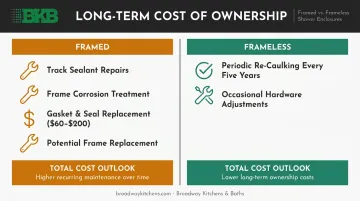
Purchase price isn't the full picture. Over a 10–20 year lifespan, framed doors accumulate maintenance costs that frameless doors largely avoid:
- Framed: track sealant repairs, frame corrosion treatment, gasket and seal replacement ($60–$200 per repair per Angi estimates), and potential frame replacement
- Frameless: periodic re-caulking of silicone seals (roughly every five years), occasional hardware adjustments
Neither type should need major structural replacement if installed properly.
Warranty coverage factors into that long-term math. Kohler covers qualifying bath and shower door components for 10 years; DreamLine offers a limited lifetime warranty, though wear items, rubber parts, and glass damage are excluded from both.
Which Shower Door Should You Choose?
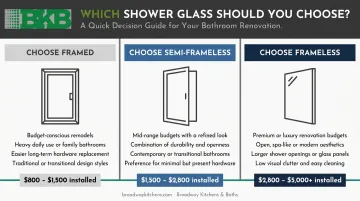
The honest answer is that it depends on four things: your budget, your walls, your design goals, and how long you plan to own the space.
Choose framed if:
- Budget is the primary constraint
- Walls are noticeably out of plumb (common in older NJ, NY, and CT homes)
- The property is a rental or multi-unit building
- The design is traditional or transitional
Choose frameless if:
- It's a primary bathroom renovation with a modern or minimalist direction
- Tile work or stone should read without visual interruption
- The bathroom is smaller and visual openness matters
- Long-term maintenance reduction is a priority
Choose semi-frameless if:
- You want a cleaner look than framed without the full cost of frameless
- Some out-of-plumb forgiveness is still needed
Because wall conditions, tile layout, and bathroom dimensions all affect which option works, a professional site assessment before committing is worth the time. Broadway Kitchens & Baths handles bathroom renovations across the tri-state area, covering everything from field measurements through final installation. A site visit can identify your specific wall conditions before you commit to a door type or a quote.
That conversation is easier to have once you know the gap between framed and frameless has narrowed as manufacturing has improved. Frameless is more accessible than it was a decade ago, and the long-term maintenance savings make the upfront premium easier to justify in the right context.
Frequently Asked Questions
What is the average cost to install a frameless shower door?
Most standard frameless shower door installations run $1,000–$2,500 for materials and labor combined. Custom sizes, premium glass, or high-end hardware finishes push that figure higher — sometimes to $4,200 or more. A site-specific quote accounts for glass size, hardware finish, and local labor rates.
Is it better to have a frameless or framed shower door?
Neither is universally better. Frameless suits modern aesthetics, smaller bathrooms, and owner-occupied renovations where maintenance and resale appeal matter. Framed is the practical choice for tighter budgets, older buildings with imperfect walls, and rental properties where upfront cost is the priority.
Do frameless shower doors increase home value?
Frameless doors contribute to the premium feel of a bathroom, which influences buyer perception and can support stronger offers — particularly in primary bathrooms. No reliable source isolates a door-only ROI — the impact registers as part of a well-executed bathroom renovation overall.
How long do frameless shower doors last?
Both door types can last 20–30 years with proper care; manufacturer warranties vary (Kohler covers qualifying components for 10 years, DreamLine offers a limited lifetime warranty). For frameless doors, the primary maintenance task is re-caulking silicone seals roughly every five years.
Are framed shower doors harder to clean than frameless?
Yes. Framed doors have bottom tracks, vertical channels, and header channels where soap scum and mildew collect — and those areas require scrubbing, not just wiping. Frameless doors have flat glass surfaces that clean faster, and hydrophobic coatings can reduce cleaning frequency further.
Can frameless shower doors be installed as a DIY project?
Frameless installation is not a DIY-friendly project. It requires millimeter-level wall plumb verification, specialized drill bits for tile, and a two-person lift for heavy glass panels. Errors in alignment or sealing can cause leaks or glass stress fractures — professional installation is the safer path for frameless doors.