
The standard renovation playbook — open up the space, add square footage, move walls — doesn't apply here. Pre-war buildings bring low ceilings, cast-iron plumbing, and co-op boards with strong opinions about wet work. Post-war concrete construction can limit what you can anchor, open, or reroute.
What does work is a different approach: strategic fixture choices, materials that trick the eye, and storage solutions that use depth and height rather than floor area. This article covers 10 ideas engineered specifically for small NYC bathrooms, ranked roughly by impact relative to effort. Most require no structural changes and no DOB permit.
Key Takeaways
- Floating fixtures, frameless glass, and large-format tile deliver the biggest visual space gains — and none require moving plumbing
- Recessed niches and pocket doors solve storage and clearance problems without adding square footage
- A monochromatic light palette paired with layered lighting can make a 38-square-foot bathroom feel open and considered
- Painting, retiling, and same-location fixture swaps typically don't require a NYC DOB permit
- Identify your renovation track (cosmetic vs. partial vs. gut) before committing to any layout changes
Why Small NYC Bathrooms Demand a Different Design Approach
The Typical NYC Bathroom Reality
Sweeten's NYC renovation guide classifies anything under 40 square feet as a small bathroom — which describes the majority of full baths in NYC apartment stock. The standard 5×8-foot layout is the benchmark; many pre-war units fall short of even that.
Constraints compound quickly in these spaces:
- Awkward plumbing locations — risers and drain stacks often can't be moved without significant cost and board approval
- Low ceilings: common in pre-war buildings, limiting the vertical storage options that could otherwise compensate for tight floor area
- Limited natural light — interior bathrooms with no window are standard in many co-ops and condos
- Board restrictions — co-op and condo alteration agreements frequently restrict wet work hours, require specific waterproofing standards, and mandate licensed contractors
Two Renovation Tracks
Those constraints shape your budget and timeline before a single tile is ordered. Before choosing any idea below, identify which track your project falls into:
| Track | Scope | Permit Required? |
|---|---|---|
| Cosmetic | Painting, retiling, same-location fixture swap | No DOB permit needed |
| Partial | New electrical circuits, minor plumbing adjustments | ALT2 permit, filed by licensed PE or RA |
| Gut | Plumbing reroute, layout changes, new bathroom addition | ALT2 permit + board approval |
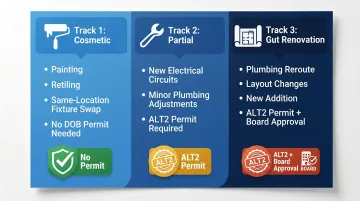
Ideas 1, 2, 4, 8, 9, and 10 below are cosmetic-to-partial scope. Ideas 3, 5, 6, and 7 cross into partial or gut territory in most NYC apartments — confirm your building's alteration agreement before committing to either.
10 Small NYC Bathroom Renovation Ideas That Maximize Every Inch
These ideas range from a single-afternoon fixture swap to a weekend tile project. All are proven in NYC renovation contexts, and several can be combined for compounding effect.
Idea 1: Install a Frameless Glass Shower Enclosure
A shower curtain or framed metal door creates a hard visual boundary that chops the room in half. Replace it with a frameless glass panel and the eye travels across the full floor plane uninterrupted — the shower reads as part of the room rather than a separate compartment.
The distinction between framing types matters here:
- Framed: Thick metal profiles on all four sides — the most visually heavy option
- Semi-frameless: Removes some framing but keeps a metal channel at the base
- Fully frameless: Glass panels with minimal hardware, creating the cleanest sightline
Practical notes:
- No plumbing rerouting required — qualifies as a cosmetic upgrade in most NYC buildings
- Maintenance is simpler than curtains: a daily squeegee keeps glass clear
- Works in tub-shower combos as well as walk-in configurations
Idea 2: Switch to a Floating (Wall-Mounted) Vanity
Mounting the vanity off the floor exposes the tile beneath it, extending the floor plane visually and making the room feel notably wider. Floor-to-ceiling sightlines are one of the cheapest ways to expand perceived space without touching a single plumbing line.
The NKBA recommends countertop heights between 32 and 43 inches from the finished floor, depending on user needs — wall-mounted vanities can be set precisely where they work for your household rather than defaulting to standard floor-mount height.
Storage configuration matters as much as the mounting itself. Look for:
- Integrated drawer organizers or pull-out trays
- Shallow-profile units (18–20 inch depth) that preserve clearance in tight bathrooms
- Units with toe-kick drawers to capture the lowest few inches
Broadway Kitchens & Baths carries floating vanity options across several cabinetry lines, including custom and semi-custom configurations sized for NYC bathroom proportions. A consultation can help confirm which dimensions fit your specific layout.
Idea 3: Install a Wall-Mounted Toilet
A standard floor-mount toilet's tank is its biggest space consumer. Concealing that tank inside the wall (via an in-wall carrier system) recovers 9 to 12 inches of floor depth, according to Geberit's carrier system specifications. In a 5×8 bathroom, that's a meaningful slice of usable space.
Carrier systems mount to wall studs and support up to 880 lbs. The toilet bowl height is adjustable at installation, typically ranging from 15 to 19 inches off the finished floor. That flexibility is useful in buildings with lower ceilings where standard ADA heights can feel disproportionate.
Two things to know upfront:
- This requires plumbing rough-in work — it's a partial or gut renovation task, not a cosmetic swap
- An ALT2 permit from NYC DOB is typically required since it involves plumbing rerouting
The cleaning advantage (fully exposed floor beneath the toilet) is a genuine quality-of-life improvement in a small, high-traffic room.
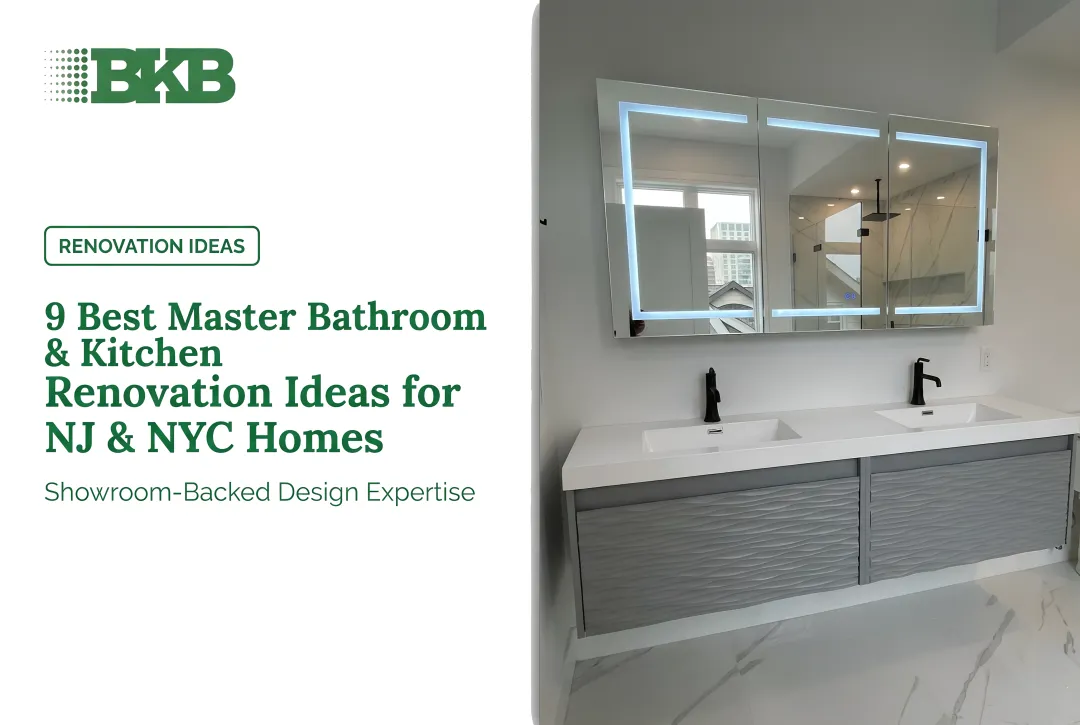
Idea 4: Hang an Oversized Mirror or Backlit Medicine Cabinet
A large horizontal mirror spanning the vanity wall reflects both light and the opposite wall, effectively doubling the room's perceived depth. The key word is large — a small decorative mirror creates a focal point; an oversized mirror creates an illusion of additional space.
The backlit medicine cabinet takes this further by combining two functions: it recesses into the wall (flat wall profile, no projection into the room) and provides integrated lighting that eliminates the need for a separate sconce in many layouts.
What to avoid: Surface-mounted medicine cabinets that project 4–5 inches from the wall. In a 36-square-foot bathroom, that projection is both a physical obstacle and a visual one.
Idea 5: Build Recessed Shower Niches
Corner shelves and caddy hooks add visual clutter to an already tight shower space. A recessed niche carved between wall studs provides the same storage without projecting into the shower area at all.
Standard prefabricated niche dimensions run 12×12 or 12×24 inches, with a depth of 3.5 inches (aligned with standard 2×4 framing). Recommended placement is around 48 inches from the finished floor — chest-to-eye level for most adults.
When tiled with a contrasting material or accent tile, a niche becomes an architectural feature rather than just a shelf. This is most cost-effective when planned during a full tile demo — retrofitting into an existing tiled wall means breaking the waterproof membrane and repatching, which adds labor cost.
Idea 6: Replace the Swing Door with a Pocket or Barn Door
A standard 28–30 inch swing door requires roughly 9 to 12 square feet of clearance arc inside the bathroom, per Doors and Beyond. In a 40-square-foot bathroom, that's nearly a quarter of the floor area dedicated to door swing.
Converting to a pocket door (slides into the wall cavity) or a barn door (slides along the exterior wall surface) reclaims that arc entirely.
| Option | Space Recovered | Wall Modification | Scope |
|---|---|---|---|
| Pocket door | Full swing arc | Wall framing required | Partial renovation |
| Barn door | Full swing arc | Surface-mounted hardware | Lighter scope |
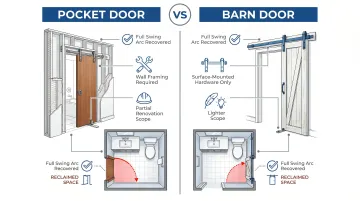
Pocket doors require adequate wall depth and no plumbing or electrical in the wall cavity — verify this before committing. Barn doors are the lighter-scope alternative when wall depth isn't available. Either way, co-op and condo boards may require notification even when no DOB permit is needed.
Idea 7: Choose Large-Format Tiles
Tile grout lines segment a floor and wall into visual units. More lines mean more segmentation, which makes a surface read as smaller. Large-format tile — anything with at least one edge longer than 15 inches — reduces that segmentation dramatically.
A floor covered in 12×12 tiles might have 50+ grout lines in one direction. A 24×48 porcelain slab floor has fewer than 15. The result is a cleaner, more continuous plane that reads as larger and requires less maintenance to keep looking sharp.
One important caveat for NYC buildings: Large-format tiles are less forgiving of uneven subfloors. Older buildings (pre-war construction especially) often have floors that deviate beyond the 1/4 inch in 10 feet that the TCNA requires for large-format installation. A professional installer will assess whether self-leveling underlayment is needed before laying tile. Lippage (tiles that don't sit flush) is far more visible on large-format tile than on smaller formats.
Idea 8: Commit to a Monochromatic Light Color Palette
Contrasting colors on walls, ceiling, trim, and vanity create a room that reads as a collection of boxes. A monochromatic approach erases those boundaries and lets the room read as one continuous volume.
The most effective choices for small spaces:
- White, soft warm gray, or pale greige — amplify light and expand perceived depth
- Matched grout color — contrasting grout fragments the tile surface into a grid; matching grout lets it read as a single plane
- Consistent trim color — painting trim the same shade as walls removes the visual "boxing" effect
Color drenching also works with deeper tones when lighting is handled well. And this approach scales to any budget: paint plus regrout achieves the fundamental effect without touching a single fixture.
Idea 9: Layer Your Lighting Strategically
A single overhead fixture creates flat, shadow-heavy light in a small bathroom. Those shadows make the room feel cramped and dim rather than deep.
A three-layer approach solves this:
- Task lighting — sconces flanking the mirror, or a backlit mirror, at vanity height. Eliminates facial shadows and makes the space feel more open
- Ambient lighting — recessed ceiling fixtures that provide overall illumination without harsh hotspots
- Accent lighting — LED strip under the floating vanity or in a ceiling cove, adding perceived depth and a spa-like quality

For color temperature, 2,700K to 3,000K warm white is the right range for bathrooms — flattering, comfortable, and effective for color accuracy. Cooler temperatures (4,000K+) tend to make small white bathrooms feel clinical rather than spacious.
Note: Replacing existing fixtures in the same location is generally cosmetic. Adding a new circuit requires an electrical permit and a NYC Licensed Master Electrician.
Idea 10: Go Vertical — Tall Storage and Wall-Mounted Shelving
When floor area is fixed, the ceiling is underused real estate. These vertical storage options shift storage off the floor entirely:
- Tall linen cabinets extending to the ceiling
- Open wall shelving stacked above the toilet
- Recessed medicine cabinets that use wall depth rather than room depth
Drawing the eye upward also creates the perception of taller ceilings, which compounds the effect of other space-expanding ideas.
NYC-specific note: Wall anchoring in pre-war buildings requires different hardware than standard drywall applications. Plaster over lathe — common in pre-war construction — needs toggle bolts or masonry anchors, not standard drywall screws. Surface-mounted shelving typically needs no DOB permit, but proper anchoring is non-negotiable for safety.
How to Prioritize These Ideas for Your NYC Bathroom
Start With Your Renovation Scope
Not every idea is compatible with every project type. Before selecting, identify your track:
- Cosmetic only: Ideas 1, 2, 4, 8, 9, 10 — no permit required for same-location fixture work
- Partial (permit likely): Ideas 5, 6, 7 — wall modifications and tile work in older buildings
- Gut (permit required): Idea 3 — plumbing rough-in for wall-mounted toilet
Factor In Your Building Type
Co-op and condo boards frequently impose rules beyond what DOB requires:
- Wet work hour restrictions (often 9am–5pm weekdays only)
- Specific waterproofing material requirements
- Contractor insurance and licensing minimums
Working with a contractor experienced in NYC multi-unit buildings — one who handles the board documentation — prevents delays that can stretch a 6-week project into a 4-month ordeal. Broadway Kitchens & Baths handles co-op and condo board submissions across the tri-state area, including required insurance documentation, as a standard part of the renovation process.
Once you've confirmed your building's constraints, budget decisions get much clearer. For a mid-range renovation without touching plumbing supply lines, this four-idea combination delivers the most visual impact per dollar:
The Highest-ROI Combination
Frameless glass enclosure + floating vanity + large-format tile + oversized mirror
Each idea amplifies the others: the glass opens the shower, the floating vanity exposes the floor, the large tile makes that floor read as continuous, and the mirror doubles the perceived depth of the whole room.

Conclusion
A 38-square-foot bathroom doesn't need to feel like one. The right combination of fixture choices, tile scale, color strategy, and lighting can shift the experience of a room dramatically, often without moving a single pipe or pulling a single permit.
Most of the ideas above are achievable in a weekend to a few weeks of work. Gut renovations make sense when the existing layout is inefficient, but for most NYC apartments, cosmetic and mid-scope work delivers most of the visual impact at a fraction of the cost and downtime.
For homeowners, architects, and property managers ready to move from ideas to execution, Broadway Kitchens & Baths handles cabinetry, tile, countertops, and full design coordination from initial field measurements through project completion, with showrooms in Englewood, NJ and Manhattan. Reach the team at +1 201-567-9585 to discuss your bathroom renovation.
Frequently Asked Questions
What is the average cost of a small bathroom renovation in NYC?
Sweeten's 2025 NYC cost guide puts small bathroom renovations (under 40 sq ft) in the $15,000–$25,000 range for a standard rip-and-replace. Gut renovations involving plumbing reroutes, asbestos remediation, or structural changes push costs significantly higher — $250–$300 per square foot is a common gut-renovation benchmark.
Do I need a permit to renovate a small bathroom in a NYC apartment?
Purely cosmetic work — painting, retiling, replacing fixtures in their existing locations — does not require a DOB permit. Any work involving plumbing rerouting, new electrical circuits, or layout changes requires an ALT2 permit filed by a licensed PE or RA. Co-op and condo boards may impose additional requirements beyond DOB rules.
How can I make a small bathroom look bigger without structural changes?
The three highest-impact non-structural moves: a frameless glass shower enclosure (eliminates visual boundaries), large-format tiles with matching grout (creates a continuous floor plane), and an oversized mirror spanning the vanity wall (doubles perceived depth). None require touching plumbing or load-bearing elements.
Should I replace a tub with a walk-in shower in a small NYC bathroom?
A tub-to-shower conversion frees significant floor space and removes the largest fixed object in the room. That said, if this is your only bathroom, keep the tub for resale — most NYC buyers with families expect at least one tub, a consistent signal across broker data.
How long does a small bathroom renovation typically take in NYC?
Active construction on a cosmetic-to-mid-scope renovation runs 4–6 weeks, but total timeline — including board approval, permits, and material lead times — commonly reaches 3–4 months in co-op or condo buildings. Pre-war buildings can add another 2–3 weeks if plumbing upgrades or asbestos remediation come into play.
What are the most common mistakes homeowners make in small NYC bathroom renovations?
Four mistakes account for most small-bathroom regrets:
- Small tiles that multiply grout lines across every surface
- Swing doors that consume up to a quarter of usable floor area
- A single overhead fixture in place of layered lighting
- Under-budgeting for contingencies in pre-war buildings, where hidden plumbing and asbestos surprises are common