For architects, builders, and property managers in the tri-state area, this distinction isn't academic. A restaurant fitted with residential-grade cabinetry can see delamination and structural failure within years. A boutique office over-specified with laboratory-grade casework wastes budget that could go elsewhere. Getting the specification right the first time matters — both for performance and for ROI.
This article breaks down the five key differences between commercial and residential cabinets, with the data to back each one up.
Key Takeaways
- Commercial cabinets prioritize structural integrity, chemical resistance, and high-cycle hardware; residential cabinets prioritize aesthetics and design flexibility
- The five differences: materials and build quality, design intent, hardware durability ratings, compliance requirements, and cost structure
- Hardware cycle ratings alone span an 8x gap — 25,000 cycles for residential baseline vs. 200,000 cycles for premium commercial hinges
- Multi-unit residential buildings often benefit from a hybrid approach — residential aesthetics backed by commercial-grade substrates and hardware
- Mismatching cabinet type to environment causes early replacement, higher maintenance costs, and potential code violations
Commercial vs. Residential Cabinets: Quick Comparison
Before going deeper, here's a side-by-side snapshot. Use this to match cabinet specifications to your project's real demands.
| Factor | Commercial Cabinets | Residential Cabinets |
|---|---|---|
| Primary materials | Stainless steel, HPL, epoxy resin, marine-grade plywood | Standard plywood, MDF, furniture-grade hardwood |
| Design priority | Workflow efficiency, compliance, accessibility | Aesthetics, personalization, resale value |
| Hardware grade | 50,000–200,000 cycle ratings | 25,000 cycle baseline (KCMA A161.1) |
| Compliance requirements | NSF/ANSI 2, SEFA 8M, ADA, AWI duty levels | Voluntary KCMA A161.1; local building codes |
| Typical budget role | Higher upfront cost, lower lifecycle replacement | Broader price range; higher risk if misapplied |
What Are Commercial Cabinets?
Commercial cabinets are engineered for high-traffic environments — restaurants, medical offices, retail spaces, laboratories, hospitality suites, and multi-unit buildings. Multiple users interact with the same storage systems daily, often with commercial cleaning products and under continuous load stress.
The Architectural Woodwork Institute's ANSI/AWI 0641-2019 standard defines commercial cabinetry through four performance duty levels:
- Duty Level 1 – Light Commercial
- Duty Level 2 – Commercial
- Duty Level 3 – Institutional
- Duty Level 4 – Laboratory
Each level imposes escalating structural requirements for load capacity, drawer slide ratings, and hardware cycle endurance. Specifying the correct AWI duty level in project documents is how architects and builders ensure the cabinetry is actually engineered for the intended use environment.
Material selection follows the environment. The most common categories buyers specify:
- Stainless steel for food service and healthcare, where sanitation and moisture resistance are non-negotiable
- High-pressure laminate (HPL) for offices and medical clinics, balancing durability with cost
- Epoxy resin for laboratories and pharmaceutical spaces requiring chemical resistance
- Custom millwork for high-end hospitality and commercial interiors where aesthetics matter as much as function
The Kitchen Cabinet Manufacturers Association (KCMA) also administers a Severe Use Certification, originally developed by HUD in 1993 for public housing and military barracks — environments where standard residential cabinets consistently failed ahead of schedule. That program was overhauled in 2024 and now targets public housing, dormitories, assisted living, and high-turnover apartment buildings.
What Are Residential Cabinets?
Residential cabinets are designed for personal living spaces — kitchens, bathrooms, closets, laundry rooms — where daily use is moderate and the primary users share an interest in the space's appearance and comfort.
The governing standard is ANSI/KCMA A161.1, a voluntary performance benchmark in operation for over 60 years. Certified cabinets earn the KCMA Blue Seal after passing 14 tests that simulate typical household use.
According to the NAHB/Bank of America Study of Life Expectancy of Home Components, residential kitchen cabinets are expected to last up to 50 years under normal household conditions. That benchmark assumes moderate wear — not the heat, moisture, and chemical cleaner exposure typical of commercial settings.
That durability range depends heavily on which cabinet category a buyer chooses. The three types residential buyers encounter most often:
- Stock cabinets – pre-made, budget-friendly, limited sizes and finishes
- Semi-custom – adjustable dimensions and finish options; accounts for about 46% of the U.S. residential cabinet market
- Fully custom – built to exact specifications, highest quality and cost; brands like Plain & Fancy operate in this tier
Per NKBA cost-breakdown guidelines, cabinetry and hardware represent 29% of the average kitchen remodel budget — the single largest line item — making cabinetry the single largest spending decision in any kitchen renovation.
5 Key Differences Between Commercial and Residential Cabinets
Difference 1: Materials and Build Quality
Commercial cabinetry uses heavier substrates to handle continuous load stress and frequent cleaning with industrial-grade products. The AWI standard's structural requirements scale with duty level:
| Metric | Residential (KCMA baseline) | Commercial DL2 | Institutional DL3 | Laboratory DL4 |
|---|---|---|---|---|
| Shelf load capacity | 15 lbs/sq ft | 40 lbs/sq ft | 50 lbs/sq ft | 50 lbs/sq ft |
| Drawer slide capacity | ~10 lbs/sq ft | 75 lbs | 100 lbs | 125 lbs |
| Hardware cycle test | 25,000 cycles | 50,000 cycles | 50,000 cycles | 100,000 cycles |
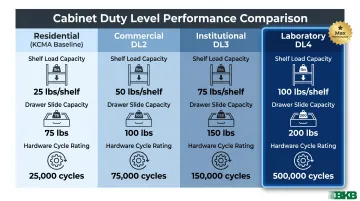
Residential cabinets — standard plywood, MDF, or furniture-grade hardwood — are optimized for visual warmth and finish quality. That's the right call for a home kitchen. The problem arises when those same materials meet a restaurant environment: repeated exposure to steam, commercial degreasers, and constant load leads to swelling, delamination, and joint separation well before the rated lifespan.
Laboratory environments push this further. Under SEFA 8M-2016, lab-grade metal casework must support 2,000 lbs on base cabinets and withstand exposure to 49 chemical reagents for 24 hours. Substituting residential cabinetry in those settings isn't just a performance issue — it's a compliance failure.
Difference 2: Design Intent — Function vs. Aesthetics
Commercial cabinetry design starts with operational requirements. Layout decisions are driven by workflow efficiency, staff movement patterns, ADA accessibility mandates, and — in food service and healthcare — regulatory compliance. The 2010 ADA Standards set non-negotiable thresholds for commercial storage:
- Accessible storage within 15–48 inches above finished floor
- Operable with one hand, requiring no more than 5 lbs of force
- Minimum 27-inch knee clearance at accessible work surfaces
These aren't design preferences — they're code obligations.
Residential cabinetry design prioritizes the homeowner's lifestyle and personal taste. Aesthetic outcomes — door style, color, hardware finish — carry significant weight in the decision process. The same functional logic applies (storage efficiency, ergonomic reach), but the design hierarchy is inverted. This distinction matters when specifying for mixed-use projects, where the visual vocabulary of residential design needs to coexist with commercial-grade structural performance.
Difference 3: Hardware and Durability Ratings
Hardware cycle ratings translate directly into service life — and the gap between residential and commercial specifications is substantial. The KCMA A161.1 residential standard requires 25,000 cycles for both hinges and drawer slides. Here's how commercial and premium residential hardware compares:
| Product | Cycle Rating | Load Capacity |
|---|---|---|
| KCMA A161.1 residential baseline | 25,000 cycles | ~10 lbs/sq ft |
| Hettich Sensys hinge (Level 2) | 40,000 cycles | Per door config |
| Hettich Sensys hinge (Level 3) | 80,000 cycles | Per door config |
| Blum MOVENTO runner | 100,000 cycles | 125–170 lbs |
| AWI Duty Level 4 hardware | 100,000 cycles | 125 lbs (slides) |
| Blum CLIP top BLUMOTION hinge | 200,000 cycles | Per door weight |
The spread between the residential baseline and Blum's CLIP top hinge is 8x. Even the mid-tier Hettich Level 3 rating is more than three times the KCMA minimum. Hardware that looks identical on the showroom floor can have significantly different engineering behind it.
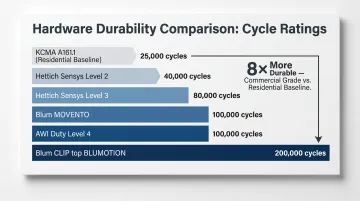
For multi-unit residential buildings — apartments and condos with tenant turnover — this gap has direct cost implications. Hardware rated for 25,000 cycles in a unit that sees three tenants over five years will degrade noticeably faster than hardware rated for 100,000 cycles, particularly on frequently used cabinet doors and drawers.
Difference 4: Compliance, Codes, and Safety Standards
Commercial cabinetry in specific environments carries mandatory certification requirements that residential cabinetry doesn't face.
Food service: NSF/ANSI 2 governs food-handling equipment including kitchen and pantry units. NSF/ANSI 51-2025 specifically restricts which materials can be used for food-contact surfaces — wood and wood-composite materials face significant limitations in splash and food-contact zones. Stainless steel (typically 304 grade) is the dominant material for NSF-compliant commercial kitchen cabinetry.
Laboratories: SEFA 8M-2016 requires resistance to 49 chemical reagents, 50,000 drawer cycles at 100 lbs, and base cabinet loads of 2,000 lbs. These aren't upgrades — they're pass/fail thresholds.
ADA compliance: Any commercial or multi-family project must incorporate accessible storage within the required reach ranges, with operable hardware that meets the force and grip requirements noted above.
Residential cabinets operate under a different framework. The KCMA A161.1 certification is voluntary, and there are no sector-specific mandates equivalent to NSF or SEFA requirements.
Architects and specifiers who carry residential-grade documentation into a commercial project review will find gaps that require correction — often at significant cost.
Difference 5: Cost Structure and Customization Options
Commercial cabinetry carries a higher per-unit cost, driven by several compounding factors:
- Material grade – marine-grade plywood, stainless steel, and phenolic-resin panels cost substantially more than standard particleboard or MDF
- Hardware specification – hardware rated for 50,000–200,000 cycles costs more than the 25,000-cycle residential baseline
- Custom fabrication – commercial cabinetry is predominantly fabricated to site-specific dimensions and compliance requirements; stock options are rare
- Certification costs – meeting NSF/ANSI 2, SEFA 8M, or KCMA Severe Use adds testing and documentation cost
The lifecycle argument favors commercial-grade cabinetry in demanding environments. KCMA Severe Use certification was developed precisely because residential cabinets installed in high-turnover public housing failed prematurely — requiring replacement cycles that erased any initial savings on material cost. Once you factor in replacement frequency, installation labor, and operational disruption over a 10–15 year period, the cost advantage of residential-grade materials often disappears.
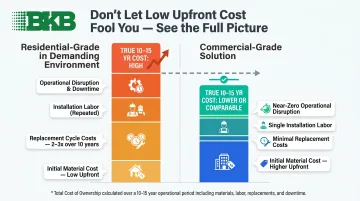
Residential cabinets offer a wider range of price points — from builder-grade stock to fully bespoke custom — making them genuinely economical for homeowners and appropriate for low-traffic commercial settings like boutique offices. The risk is deploying them in environments that will compress their effective lifespan significantly below the NAHB's 50-year residential benchmark.
Which Type Is Right for Your Project?
The decision comes down to how the space will actually be used.
Choose commercial-grade cabinetry for:
- Restaurants, cafeterias, and institutional kitchens (NSF/ANSI 2 compliance required)
- Medical offices, clinics, and healthcare facilities
- Laboratories and pharmaceutical environments (SEFA 8M)
- Co-working kitchenettes and common areas with multiple daily users
- Multi-unit building common areas and amenity spaces
Choose residential cabinetry for:
- Single-family homes and owner-occupied condos
- Low-traffic professional environments like boutique offices
- Individual apartment units where aesthetics and turnover cost drive the specification
Multi-unit residential buildings sit in a gray zone where many developers and management companies make costly specification mistakes. Individual apartment units can carry residential-style cabinetry without issue. But common areas, laundry rooms, and high-turnover units benefit from a hybrid approach: residential aesthetics paired with commercial-grade substrates and hardware that can withstand tenant turnover without requiring frequent replacement.
Broadway Kitchens & Baths encounters this scenario regularly across the tri-state area, working with developers, general contractors, and property management companies on exactly these decisions — matching the right material and hardware combination to actual use intensity.
Conclusion
The right cabinet for any project is determined by how the space will actually function — not how it looks in a showroom. Commercial and residential cabinetry each have clear engineering strengths, and the cost of mismatching them shows up predictably: early delamination in food service environments, hardware failure in high-turnover apartment buildings, or compliance gaps that surface during inspection.
The five differences covered here — construction grade, hardware cycles, finish durability, compliance requirements, and cost structure — give you a concrete framework for that alignment. Match the spec to the use case, and the cabinet performs. Mismatch it, and the budget absorbs the difference later. Whether you're sourcing for a restaurant kitchen in Manhattan or a multi-unit build across the tri-state area, that decision is worth getting right before the order is placed.
Frequently Asked Questions
What is the difference between commercial and residential cabinets?
Commercial cabinets are built for heavy, continuous use in high-traffic environments. They use materials like stainless steel or high-pressure laminate, with hardware rated for tens of thousands more open/close cycles than residential-grade products. Residential cabinets prioritize design flexibility, finish variety, and aesthetics for everyday household use.
Are commercial cabinets better than residential cabinets?
Neither is universally better. Commercial cabinets outperform in demanding, high-traffic environments where durability and compliance are non-negotiable. Residential cabinets offer superior customization options and better value in home settings. The right choice depends entirely on how intensively the space will be used.
Can you use wood cabinets in a commercial kitchen?
Wood and wood-composite materials face significant restrictions under NSF/ANSI 2 and NSF/ANSI 51-2025 for food-contact and splash-zone surfaces. Commercial food service environments typically require stainless steel or other NSF-certified non-porous materials for cabinetry in food-preparation zones.
How long do commercial cabinets last compared to residential cabinets?
The NAHB estimates residential kitchen cabinets can last up to 50 years under normal household conditions. Commercial cabinets are engineered for equivalent or longer service life under far greater use intensity. Residential cabinets installed in commercial environments will fall well short of that 50-year benchmark.
Can residential cabinets be used in a multi-unit building?
Residential-style cabinets work well in individual apartment units. Common areas and high-turnover units, however, benefit from commercial-grade substrates and hardware to reduce maintenance frequency and replacement cost over the building's lifecycle.
What hardware is required for commercial-grade cabinets?
Commercial environments require heavy-duty hinges and drawer slides rated for at least 50,000 cycles, often considerably more. Mounting hardware must support heavier loads than residential equivalents. Food service and healthcare settings also require corrosion-resistant or self-closing mechanisms that meet applicable health and safety codes.