That's not surprising when you consider that Bergen County's average home value has reached $773,069 (Zillow, April 2026). At that price point, the kitchen isn't just a room — it's a major selling feature. And nothing shapes a kitchen's identity more than the cabinets.
The challenge is that Bergen County homes span a wide architectural range: century-old colonials in Glen Rock, sleek new construction in Fort Lee, Craftsman bungalows in Allendale. The right cabinet style isn't universal. It's personal, architectural, and strategic.
This article covers the 10 custom cabinet styles local homeowners keep coming back to, plus a practical framework for choosing the right one for your home.
Key Takeaways
- Cabinet style is the single biggest visual decision in a kitchen remodel — every other finish decision follows it
- Shaker and Transitional styles dominate Bergen County, but Slab and two-tone designs are gaining fast
- 61% of homeowners choose Shaker cabinets during a remodel — and that number has held steady for five years
- Match cabinet style to your home's architecture, kitchen size, and resale timeline
- Working with a local cabinetry specialist prevents costly mismatches between style, scale, and layout
Why Cabinet Style Defines Your Bergen County Kitchen
Cabinets are a structural decision — not a decorative one. They define the visual weight of the room, determine storage capacity, and set the tone that countertops, backsplash, and flooring all have to respond to. Getting this wrong is expensive to fix.
The financial stakes are real. According to the 2024 Cost vs. Value Report, a minor midrange kitchen remodel in New Jersey's Middle Atlantic region returns 98.6% of its cost at resale — slightly above the national average of 96.1%. In a market as competitive as Bergen County, where homes regularly sell above list price, design quality directly influences that return.
The Three Style Families
Custom cabinet styles fall into three broad categories:
- Traditional: ornate detailing, raised panels, formal character; suits older colonials and Victorians
- Modern: clean lines, flat profiles, minimal ornamentation; favored in new construction and open-plan homes
- Transitional: the middle ground; blends structured simplicity with updated finishes
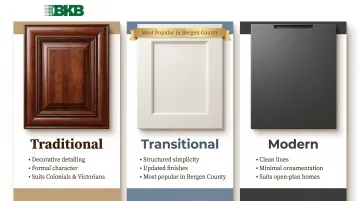
Bergen County kitchens gravitate toward Transitional more than any other category. According to the 2025 Houzz Kitchen Trends Study, Transitional is the No. 1 kitchen style nationally at 25% — and the variety of home types across Bergen County makes its versatility especially valuable here.
The 10 styles below are the most-requested custom cabinet designs among Bergen County homeowners — selected because they hold up across different home ages, floor plans, and resale timelines.
10 Custom Kitchen Cabinet Styles Bergen County Homeowners Love
1. Shaker Style Cabinets
Shaker cabinets dominate custom cabinetry for good reason — and the numbers confirm it. A five-piece door with a recessed center panel, clean rails, and no fussy ornamentation: it works in virtually every kitchen type.
In Bergen County, where transitional design dominates, Shaker is consistently the most-requested style. Nationally, 61% of homeowners who upgrade their cabinets choose Shaker doors, a figure confirmed by both the 2020 and 2025 Houzz Kitchen Trends Studies — meaning this isn't a trend, it's a baseline preference.
Wolf Classic's Dartmouth line, available through Broadway Kitchens & Baths, is a strong example: modern Shaker-style doors offered in five stains and two paint colors, with enough flexibility to go warm or cool depending on your countertop selection.
| Detail | Description |
|---|---|
| Aesthetic | Clean, timeless, versatile |
| Best Suited For | Colonial homes, open-concept kitchens |
| Popular Finishes | White, greige, navy, two-tone combinations |
2. Raised Panel Cabinets
Raised panel is the classic Bergen County traditional — especially appropriate for larger colonials, Victorians, and homes with formal dining rooms adjacent to the kitchen. The decorative center panel adds architectural depth and a sense of permanence that flat profiles can't replicate.
This style works best with generous square footage. In smaller kitchens, the visual weight of raised panel detailing can feel heavy. Pair it with natural wood stains or creamy whites for the most cohesive result.
| Detail | Description |
|---|---|
| Aesthetic | Ornate, formal, traditional |
| Best Suited For | Larger kitchens, dining-adjacent layouts |
| Popular Finishes | Natural wood stains, creamy whites |
3. Flat Panel (Slab) Cabinets
Slab cabinets — a single flat door with no frame detail — define the contemporary kitchen. They're growing faster than any other style: 69% of NKBA design professionals identified flat/slab doors as the style gaining the most popularity over the next three years, according to the 2026 NKBA Kitchen Trends Report.
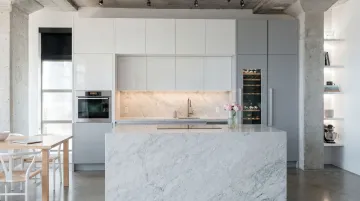
In Bergen County, slab cabinets appear most often in renovated newer construction, townhomes, and open-plan homes where the goal is visual spaciousness. High-gloss lacquer creates drama, while matte white keeps things quiet and clean. Concrete grey sits between modern and industrial — a useful middle ground for mixed-aesthetic spaces.
| Detail | Description |
|---|---|
| Aesthetic | Sleek, modern, minimal |
| Best Suited For | Open-plan layouts, smaller kitchens that need to feel larger |
| Popular Finishes | Matte white, concrete grey, high-gloss lacquer |
4. Inset Cabinets
Inset construction — where the door sits flush inside the cabinet frame rather than overlapping it — represents the highest tier of custom craftsmanship. The 1/8-inch gap required around the perimeter demands precision that most cabinet manufacturers can't achieve at scale.
The trade-off is cost: inset cabinets typically run 35% to 45% more than standard full overlay options. Bergen County homeowners who choose inset are usually prioritizing heirloom quality and furniture-grade detail over budget efficiency. The result is a kitchen that looks built-in, not installed.
| Detail | Description |
|---|---|
| Aesthetic | Refined, furniture-grade, architectural |
| Best Suited For | High-end remodels, farmhouse and traditional kitchens |
| Popular Finishes | Painted whites, warm wood tones |
5. Beadboard Cabinets
Beadboard brings vertical panel detailing to the door face — a cottage-inspired texture that reads as warm, nostalgic, and relaxed. It's particularly popular in Bergen County's suburban neighborhoods where formal design gives way to livable, family-centered kitchens.
This style suits smaller eat-in kitchens well. The vertical lines draw the eye upward, adding perceived height. Soft whites, sage green, and pale blue are the finishes that make beadboard feel intentional rather than dated.
| Detail | Description |
|---|---|
| Aesthetic | Cozy, cottage, nostalgic |
| Best Suited For | Smaller kitchens, eat-in layouts |
| Popular Finishes | Soft whites, sage green, pale blue |
6. Glass-Front Cabinets
Glass-front cabinets aren't usually a full-kitchen solution — they're a strategic accent. Clear, seeded, reeded, or frosted glass panels break up solid cabinetry runs, add visual lightness, and create a display opportunity for dishware or glassware collections.
The most common approach in Bergen County kitchens: glass-front uppers paired with solid lowers. Broadway Kitchens & Baths uses glass fronts regularly in wet bar areas and upper cabinet sections, often adding under-cabinet lighting to make the display striking.
| Detail | Description |
|---|---|
| Aesthetic | Elegant, airy, display-focused |
| Best Suited For | Upper cabinets in traditional and transitional kitchens |
| Popular Finishes | White or stained frames with clear or reeded glass |
7. Two-Tone Cabinets
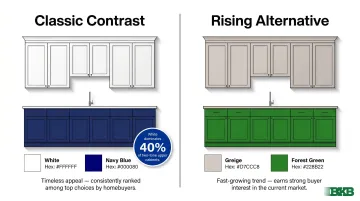
Two-tone kitchens have moved well past trend status. Nearly 1 in 5 homeowners now choose contrasting finishes for upper and lower cabinets, with white dominating upper cabinets in 40% of two-tone kitchens and wood leading lower cabinets at 37%.
Two-tone adds visual interest without committing to an all-dark kitchen — a practical consideration for Bergen County's resale-conscious market. Navy lowers with white uppers remain the most popular pairing. Forest green lowers with greige uppers are the rising alternative. Both combinations photograph well and hold up across market cycles.
| Detail | Description |
|---|---|
| Aesthetic | Dynamic, modern-transitional, layered |
| Best Suited For | Medium to large kitchens with good natural light |
| Popular Pairings | Navy lowers + white uppers, forest green lowers + greige uppers |
8. Transitional Style Cabinets
If one style defines Bergen County's remodeling market, it's Transitional. These cabinets blend Shaker simplicity with subtle traditional detailing — slightly wider rails, modest molding profiles, a finish that feels current without chasing trends.
72% of NKBA design professionals identified transitional/timeless design as the most popular style direction for the next three years. For Bergen County homeowners navigating homes built across multiple decades, Transitional is the safe long-term bet. It works equally well in a 1920s colonial and a 2010 new build.
| Detail | Description |
|---|---|
| Aesthetic | Balanced, timeless, updated classic |
| Best Suited For | Almost any Bergen County home style |
| Popular Finishes | Warm whites, greiges, light wood accents |
9. Craftsman / Mission Style Cabinets
Craftsman cabinets are defined by their horizontal and vertical rail detailing, square profiles, and deliberate celebration of natural wood grain. They resonate strongly with Bergen County's older Arts-and-Crafts-era homes — particularly in towns like Allendale and Westwood where bungalow architecture is prevalent.
Quarter-sawn oak is the wood of choice here. Its tight, straight grain takes stain beautifully and ages in a way that painted finishes can't match. Walnut stain and olive green are strong alternatives for homeowners who want warmth without going full-rustic.
| Detail | Description |
|---|---|
| Aesthetic | Structured, warm, artisanal |
| Best Suited For | Bungalows, Craftsman-style homes, warm-toned kitchens |
| Popular Finishes | Quarter-sawn oak, walnut stain, olive green |
10. Open Shelving and Floating Shelf Accents
Open shelving isn't a full cabinet replacement — it's a targeted design move. Replacing upper cabinets in one zone of the kitchen opens up the room, reduces visual weight, and creates a display space that feels editorial rather than utilitarian.
Broadway Kitchens & Baths incorporates open shelving as part of custom kitchen designs, often pairing floating wood shelves with metal brackets alongside closed cabinetry to give the kitchen a modern, layered character. The key is restraint: one or two runs of open shelving works; covering an entire wall creates maintenance headaches and a cluttered look.
| Detail | Description |
|---|---|
| Aesthetic | Casual, modern, editorial |
| Best Suited For | Upper zones in modern or transitional kitchens |
| Popular Materials | Wood shelves with metal brackets, painted wood, floating integrated units |
How to Choose the Right Custom Cabinet Style for Your Bergen County Home
Style selection comes down to three filters — architecture, layout, and resale — and the right answer sits at the intersection of all three.
Filter 1: Match Your Home's Architecture
Cabinet style should respond to the bones of the house. A Shaker or Transitional door works across most Bergen County architecture. Raised panel belongs in a traditional colonial, not a 2015 new build. Slab cabinets look intentional in contemporary homes and disjointed in Craftsman bungalows.
Broadway Kitchens & Baths' design team has matched cabinetry to architectural periods as specific as Edwardian-era homes — the kind of attention to historical context that prevents a beautiful kitchen from feeling like it belongs to a different house.
Filter 2: Consider Kitchen Size and Layout
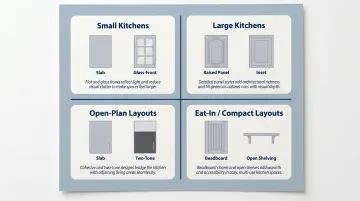
Some styles add visual weight; others create openness:
- Slab and glass-front cabinets make smaller kitchens feel larger
- Raised panel and inset add depth — best in generous square footage
- Open shelving opens up tight spaces without sacrificing storage elsewhere
- Two-tone works best with natural light — in dim kitchens, dark lowers can feel oppressive
Filter 3: Think About Resale
Bergen County's median sale price sits at $757,500, and homes frequently sell above list price. In that environment, dated cabinet styles carry real cost. Overly trendy choices — all-black kitchens, maximalist detailing — tend to narrow your buyer pool.
Shaker, Transitional, and two-tone designs have demonstrated staying power. Craftsman and inset appeal to buyers who specifically value craftsmanship. If resale is a priority, Shaker and Transitional are the lowest-risk choices in Bergen County's current market.
Common Mistakes to Avoid
Even strong style choices fall apart in execution. The most common missteps:
- Choosing a style from a single inspiration photo without accounting for your kitchen's actual scale
- Mixing more than two door profiles in one kitchen
- Selecting a finish that clashes with fixed elements — flooring, countertops, and appliances that aren't changing
During the design consultation process, Broadway Kitchens & Baths uses digital renderings and physical material samples at their Englewood, NJ showroom to show homeowners how their selected style will interact with existing fixed elements before any cabinets are ordered.
Conclusion
Bergen County kitchens are as varied as the homeowners who use them — from Ridgewood colonials to Teaneck contemporaries. The right custom cabinet style honors both the home's architecture and the family's daily life. Getting that balance right, though, depends entirely on how well the style is built out.
Execution is where good design either holds up or falls apart: precise field measurements, quality materials, and expert installation are what make the finished kitchen match the original vision.
To explore custom cabinetry options tailored to your Bergen County home, reach out to Broadway Kitchens & Baths at +1 201-567-9585 to schedule a design consultation at their Englewood, NJ showroom.
Frequently Asked Questions
What is the 1/3 rule for kitchen cabinets?
The 1/3 rule suggests upper cabinets should occupy roughly one-third of the vertical wall space between the countertop and ceiling, creating visual balance. In custom kitchen design, this guideline helps determine optimal cabinet height — particularly relevant when deciding between standard-height and tall upper cabinets.
What is the average cost of custom kitchen cabinets?
According to HomeAdvisor (December 2025), custom cabinets range from $500 to $1,200 per linear foot installed, with most projects falling between $2,796 and $12,934. Bergen County's high-value market typically trends toward the upper end of that range given material quality expectations and labor costs.
What is the most popular kitchen cabinet style right now?
Shaker-style cabinets remain the most popular choice nationally and in Bergen County, selected by 61% of homeowners who upgrade cabinets during a remodel. That figure has held steady for five consecutive years — longer than any other style on the market.
What is the difference between custom and semi-custom cabinets?
Custom cabinets are built to exact specifications for a specific kitchen — giving full control over dimensions, materials, door style, and finish. Semi-custom offers limited size and finish options from a pre-set catalog. For kitchens with unusual layouts or non-standard design requirements, custom is the more precise solution.
What wood is best for custom kitchen cabinets?
The most popular hardwoods are maple, cherry, oak, and walnut. Maple takes paint cleanly, making it ideal for Shaker and transitional styles. Oak suits Craftsman designs, where natural grain is part of the aesthetic. Walnut delivers warmth and depth for contemporary and two-tone kitchens.
Are custom kitchen cabinets worth the investment for Bergen County homeowners?
In Bergen County's competitive real estate market, custom cabinets offer long-term value through precise fit, material durability, and design cohesion. Kitchen remodels in the Middle Atlantic region return close to 99 cents on the dollar at resale, and cabinetry upgrades rank among the highest-returning line items in any kitchen budget.