Introduction
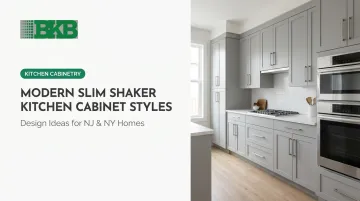
Slim shaker cabinets have become one of the most requested door styles in contemporary kitchen design. The narrower stiles and rails scale down the traditional frame profile, making them a natural fit for kitchens where clean lines matter without sacrificing the structure that shaker is known for.
"Slim shaker" isn't a single look. It's a category defined by those narrower proportions, and it spans three distinct finish directions — each with different design implications, maintenance requirements, and ideal use cases.
This guide breaks down what slim shaker cabinets actually are, walks through the three main style directions, and gives you a practical framework for choosing the right one for your specific kitchen.
Key Takeaways
- Slim shaker doors feature narrower stiles and rails than classic shaker — commonly around 1 inch, sometimes less
- Three finish directions define the style: white/neutral painted, natural wood-tone, and bold/dark painted
- White and neutral finishes remain the most popular, with white at 33% and wood tones at 23% of upgraded cabinet colors in 2025
- Hardware scale matters more with slim shaker — standard pulls can overhang narrow frames and cause damage
- Test physical samples in your actual space before committing to any finish
What Are Slim Shaker Kitchen Cabinets?
Slim shaker cabinets are a variation of the classic five-panel shaker door, distinguished by significantly narrower stiles and rails — the frame surrounding the center panel. Where traditional shaker frames typically run 2.5 to 3.5 inches wide, slim shaker profiles commonly land around 1 inch, with some manufacturers offering rails as narrow as ¾ inch or ½ inch.
How the Proportions Change the Look
That narrower frame does something specific: it increases the proportion of the center recessed panel relative to the overall door. The result is a cleaner, less segmented appearance — the door reads as a panel with a subtle border rather than a heavy framed structure.
Construction materials vary by manufacturer and price point:
- Solid wood frames with HDF or veneer core panels, typically specified for higher-end or custom lines
- MDF — the standard substrate for painted slim shaker doors; holds paint well and stays dimensionally stable
- Thermally fused laminate (TFL) — suited to high-humidity environments and commercial applications where moisture resistance matters
Slim Shaker vs. Slab Doors
Material choice affects durability and finishing options — but it doesn't change what defines the style itself. Slim shaker is not a frameless or flat-panel door. The recessed center panel is still present, and that's what separates it from fully slab-style cabinetry. The profile sits between the two: more refined than classic shaker, warmer than a completely flat door.
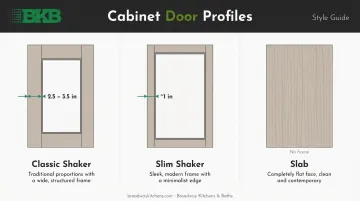
The style goes by several names in the market: skinny shaker, petite shaker, thin frame, and narrow frame shaker all refer to the same basic concept. Because naming isn't standardized, confirm actual stile and rail dimensions — not just the product name — when specifying for a project.
Why Slim Shaker Cabinets Suit Modern Kitchen Design
The narrower frame does more than change how a door looks in isolation — it changes how the entire kitchen reads.
Classic shaker frames segment the cabinetry visually. Each door is defined by its border, which creates a pattern of lines across the kitchen wall. Slim shaker reduces that visual segmentation, allowing the eye to move more freely across the space. In smaller or open-plan kitchens, this matters.
The Transitional Design Fit
Slim shaker lands in an interesting position relative to broader design trends. According to the 2025 US Houzz Kitchen Trends Study, 81% of renovating homeowners changed their kitchen style during renovation, with transitional remaining the top style choice at 25%, followed by modern at 12% and contemporary at 11%. That preference isn't fading — the NKBA's 2026 Kitchen Trends Report found 72% of respondents expect transitional and timeless design to hold for the next three years.
Slim shaker fits precisely into that transitional-modern overlap. It keeps a reference to traditional craftsmanship without the heaviness of a classic frame — which is why it pairs well with:
- Quartz and marble countertops
- Handle-less or minimal hardware configurations
- Frameless upper cabinet sections
- Integrated appliances and clean-line fixtures
Fully flat slab doors can feel stark in the wrong context, while classic shaker can read as too traditional against contemporary finishes. Slim shaker occupies the middle ground — familiar enough to feel warm, restrained enough to stay current.
Modern Slim Shaker Cabinet Styles
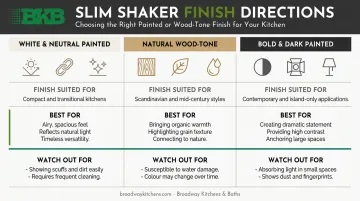
Slim shaker cabinets fall into three primary finish directions. Each one shapes the entire visual personality of the kitchen differently. The right choice depends on your space, not just your preferences.
White and Neutral Painted Slim Shaker
White and off-white painted slim shakers remain the most widely chosen version of the style. White holds the top position among upgraded cabinet colors at 33%, with off-white adding another 14%, per the 2025 Houzz data.
The painted surface emphasizes the geometry of the narrow frame against a bright, uniform backdrop. The result is clean and architectural — the cabinetry becomes structure rather than focal point.
Best suited for:
- Compact or galley kitchens where light reflection matters
- Open-plan spaces where cabinetry should recede into the background
- Neutral-foundation designs layered with color through backsplash or island accents
- Transitional, coastal, and Scandinavian aesthetic directions
Limitations to know:
- Matte white painted finishes show fingerprints and grime more readily than satin or semi-gloss options — Architectural Digest designers recommend semi-gloss or satin finishes for easier maintenance on kitchen cabinetry
- All-white kitchens can feel flat without deliberate contrast elements — hardware, countertop material, and backsplash texture all need to carry the visual weight
Natural Wood-Tone Slim Shaker
Wood-tone slim shakers introduce organic warmth through visible grain — oak, maple, natural brown stain, and eucalyptus are common choices. According to NKBA's Year in Review for 2025, wood-grain cabinetry overtook painted finishes as a leading trend, with white oak emerging as a standout material.
Unlike painted slim shakers, which emphasize geometry, wood-tone versions make the material itself the defining quality. The slim frame showcases the grain without letting it dominate.
Best suited for:
- Mid-century modern, Scandinavian, and contemporary-organic kitchen aesthetics
- Kitchens with natural stone, concrete, or raw wood accents
- Two-tone configurations where wood uppers pair with painted lowers (or vice versa)
Limitations to know:
- Stained finishes are harder to touch up cleanly if scratched or chipped
- Wood species must be selected carefully to coordinate with flooring tones. Warm-grain oak against cool gray floors can clash without deliberate bridging through countertops or grout color.
Bold and Dark Painted Slim Shaker
Deep navy, matte black, forest green, and jewel tones each make a strong visual statement. A thick, traditional shaker frame in these colors can feel oppressive. The narrow slim stile controls the drama, keeping the result sophisticated rather than heavy.
Dark cabinetry remains a deliberate, higher-commitment choice rather than a mainstream default. Houzz 2025 data shows black cabinets at only 2% of upgraded cabinet colors — but that doesn't diminish their design value. It does mean they require more deliberate planning.
Best suited for:
- Kitchens with generous natural light or high ceilings
- Island-only applications contrasted against lighter perimeter cabinetry
- Bold contemporary, art deco, and industrial design schemes
Limitations to know:
- Dark finishes show dust, water spots, and fingerprints readily
- Low-light kitchens with dark cabinetry can feel closed-in without supplemental lighting
- Resale appeal is narrower than neutral finishes — worth weighing if you're planning to sell within a few years
How to Choose the Right Slim Shaker Style
Trend data is a starting point, not a decision tool. The right slim shaker style for your kitchen depends on four specific factors.
Kitchen Size and Light Levels
Natural light changes how every finish reads in the space. Kitchen orientation affects how colors appear, with north-facing or low-light kitchens requiring warmer, brighter tones to avoid feeling dim.
- North-facing or small kitchens: White and light neutral finishes amplify available light and prevent the space from closing in
- Well-lit, larger, or south-facing kitchens: Wood tones and bold colors work without shrinking the room
Design Cohesion With the Rest of the Home
Slim shaker shouldn't be selected in isolation from the home's broader architectural character:
- Wood-tone slim shakers suit organic, rustic-modern, or mid-century homes
- Bold colors work best in contemporary or statement-driven interiors
- White and neutral painted options work across nearly any style
Countertop and Hardware Compatibility
Finish selection should happen alongside countertop and hardware decisions — not after. Physical samples make it significantly easier to coordinate cabinetry color, countertop material, and hardware finish when you can hold them together in the room.
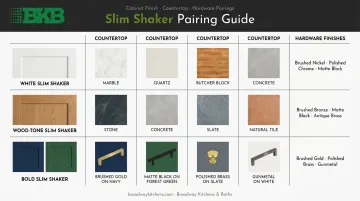
General pairing logic:
- White slim shaker pairs with almost any countertop — marble, quartz, butcher block, concrete
- Wood-tone slim shaker looks strongest against stone, concrete, or other natural surfaces
- Bold slim shaker benefits from high-contrast hardware — brushed gold or antique brass on navy, matte black on forest green
Maintenance and Household Reality
Dark painted finishes and matte white finishes both require regular upkeep in active kitchens. Wood-tone finishes with a protective sealed finish tend to be more forgiving for households with children or heavy daily use. Consider your actual lifestyle alongside aesthetics before committing to a finish.
Broadway Kitchens & Baths works with architects, contractors, and decorators across the tri-state area to resolve exactly these decisions — coordinating finish samples, countertop materials, and hardware in-showroom before a single cabinet is ordered.
Common Mistakes to Avoid
These three mistakes come up repeatedly in slim shaker projects — each is easy to avoid once you know to look for it.
Choosing From Photos Without Testing Samples
A finish that reads as warm white on a screen can appear yellow or gray under your kitchen's specific lighting conditions. Always request physical door samples and view them in the actual space — ideally at different times of day — before committing.
Going All-In on Dark Cabinetry Without Testing
If you're drawn to navy, black, or deep green, start with an island-only application. This lets you experience the visual weight of the color in your specific kitchen before applying it to every surface. Going all-in on dark cabinetry in a low-light kitchen is one of the more costly mistakes to reverse.
Pairing Standard Hardware With Narrow Frames
TaylorCraft specifically notes that standard knobs and pulls should not be installed on narrow slim shaker frames. Hardware bases can physically overhang stiles that are 1.5 inches or narrower, causing wobble and finish damage over time. Specify edge pulls, bar pulls, or micro-knobs proportioned for the narrow frame. Confirm compatibility against the actual door sample before ordering hardware.
Frequently Asked Questions
Are slim shaker cabinets more expensive?
Slim shaker cabinets can cost slightly more than classic shaker because they're produced in lower volumes and aren't as universally stocked. The premium tends to be modest — overall cost is driven more by material choice, finish type, and brand than by the slim profile itself.
What is a thin shaker cabinet called?
Several names are used interchangeably — slim shaker, skinny shaker, petite shaker, narrow shaker, and micro shaker — all describing a shaker door with narrower stiles and rails than traditional construction. There is no standardized terminology across manufacturers.
What is the narrowest kitchen cabinet?
Base and wall cabinet units can be as narrow as 6 inches wide, with some tall pantry units starting at 9 inches. Note that this refers to overall cabinet width — separate from the slim shaker door frame, which describes stile and rail proportions.
What design styles work best with slim shaker cabinets?
Slim shaker pairs well with contemporary, transitional, minimalist, Scandinavian, and mid-century modern kitchen aesthetics. The narrower frame complements clean lines and restrained detailing that define these styles.
Can slim shaker cabinets make a small kitchen look bigger?
Yes — particularly in white or light neutral finishes. The narrower frame reduces visual clutter and lets the eye move more freely across the space, creating the perception of more openness. In compact layouts, that reduced visual weight can make the difference between a kitchen that feels cramped and one that reads as intentionally streamlined.
What hardware works best with slim shaker cabinets?
Bar pulls, sleek cup handles, and recessed finger pulls in brushed nickel, matte black, chrome, or brushed gold are the most compatible options. Hidden hinges and soft-close mechanisms reinforce the clean profile. Always verify that any hardware base plate fits within the actual stile width before specifying or ordering.