Prices have shifted in 2026 due to ongoing changes in material costs and regional labor rates. What you'll pay depends on your kitchen's size, the materials you choose, how complex the design is, and where you live. This guide breaks down current pricing tiers, the factors that drive costs up or down, and a practical framework for building a budget that holds.
Key Takeaways
- Cabinet refacing runs $4,000–$10,500 for most projects; national averages sit around $7,200–$8,250
- Labor accounts for 50–70% of total cost — regional rates shift that range fast
- Refacing costs 30–50% less than full cabinet replacement when boxes are structurally sound
- NYC-area projects average around $8,034, above the national norm
- Always budget a 10–15% contingency to avoid cost surprises
How Much Does Cabinet Refacing Cost in 2026?
Cabinet refacing costs vary widely depending on kitchen size, material tier, design complexity, and local labor rates. Understanding the range before you get quotes helps you budget accurately and choose the right material tier for your space.
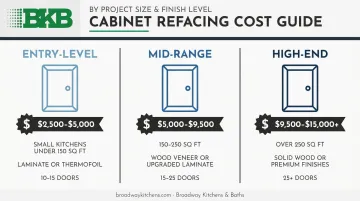
The Three Cost Tiers
Modernize's 2026 Cabinet Refacing Cost Guide puts the national range at $4,000–$9,500. Fixr extends that to $13,500 for larger or premium projects, and published averages from HomeAdvisor, Angi, and Forbes Home cluster around $7,200–$8,250.
| Tier | Cost Range | Best For |
|---|---|---|
| Entry-level | $2,500–$5,000 | Small kitchens under 150 sq ft, laminate or thermofoil, 10–15 doors, minimal hardware changes |
| Mid-range | $5,000–$9,500 | Medium kitchens 150–250 sq ft, wood veneer or upgraded laminate, 15–25 doors, new hardware |
| High-end | $9,500–$15,000+ | Large kitchens over 250 sq ft, solid wood or premium finishes, 25+ doors, custom add-ons |
What's Typically Included — and What's Not
Standard professional quotes generally cover:
- New cabinet doors and drawer fronts
- Veneer or laminate wrapping on visible box surfaces
- Removal of old doors and hardware
- Installation labor and finishing
Not typically included: hardware upgrades, specialty finishes, structural repairs, countertop work, new flooring, or layout changes. Always request an itemized quote.
Per-Linear-Foot Pricing
The most common contractor pricing method is per linear foot. National ranges vary by source:
- Modernize: $100–$250/LF
- Angi: $150–$450/LF
- Bob Vila: $210–$750/LF (upper bound reflects premium work)
If you're planning a project in the NYC metro or tri-state area, expect to land toward the higher end of these national ranges. Angi's New York City data reports an average of $8,034 and a typical range of $5,193–$10,938 — consistent with higher labor costs across the region.
Key Factors That Affect Cabinet Refacing Cost
No two projects are priced identically. Costs are shaped by a combination of physical, material, and location-based factors.
Kitchen Size and Number of Cabinets
The total number of doors and drawer fronts drives cost directly — more surfaces mean more material and more labor hours. Most contractors price either per linear foot or per door/drawer unit. A 10-door kitchen and a 30-door kitchen can differ by $4,000–$6,000 even with identical materials.
Material Choice
Material selection is one of the largest cost variables. Here's how the tiers compare:
| Material | Typical Total Project Range | Notes |
|---|---|---|
| Laminate / Thermofoil | $1,000–$3,000 (material cost) | Most affordable; lower durability in high-heat zones |
| Wood Veneer | $2,500–$6,500 (material cost) | Mid-range warmth and durability |
| Solid Wood | $6,000–$14,000 (material cost) | Premium appearance, longest lifespan |
Broadway Kitchens & Baths carries all three material tiers across its brands — UltraCraft covers laminate, thermofoil, Eurotek veneer, and solid wood; Plain & Fancy leans toward solid wood and premium veneer; Wolf Classic focuses on solid wood fronts with laminate interiors.
Design Complexity and Add-Ons
Flat-panel and Shaker-style doors cost less than ornate profiles with routed edges or raised panels. Add-ons can push the total up quickly:
- Glass inserts: $100–$300 per panel
- Crown molding: $7–$16 per linear foot
- Under-cabinet lighting: $200–$300 per fixture
- Hardware (hinges, pulls, knobs): $100–$1,000 depending on quantity and style
Geographic Location and Labor Rates
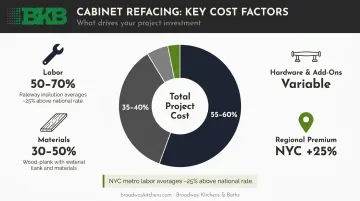
Labor accounts for 50–70% of the total project cost. According to BLS Occupational Employment and Wages data, construction and extraction wages in the New York-Newark-Jersey City metro average roughly 25% above the national rate — a premium that flows directly into refacing quotes.
Cabinet Condition and Structural Suitability
Beyond location and materials, the condition of existing cabinet boxes determines whether refacing is even viable. Warped frames, water damage, or soft spots in the substrate require repairs that add cost — or may disqualify the project entirely, making full replacement the better option.
Cabinet Refacing Cost Breakdown
A professional quote covers more than just doors and materials. Here's what's actually included:
Materials
New doors, drawer fronts, veneer or laminate for visible box faces, and decorative elements. Since labor is 50–70% of the total, materials typically represent 30–50% of the project cost.
Labor and Installation
Surface prep, removal of old doors and hardware, adhesion of new veneer or laminate, installation of new doors and drawer fronts, and finishing. Plan for $100–$450/LF nationally, with the upper end applying to premium materials or high-labor-cost regions.
Hardware and Upgrades
Hinges, pulls, knobs, and specialty features like soft-close mechanisms are easy to overlook in early budget planning. Hardware alone can add $100–$1,000 depending on quantity and quality — ask for a separate line item in any quote.
Long-Term Maintenance
Fixr reports refaced cabinets typically last 10–20 years or more with quality materials. Ongoing maintenance is straightforward:
- Gentle cleaning with non-abrasive products
- Avoiding prolonged moisture exposure near seams
- Periodic hardware checks and tightening
No significant recurring costs — which makes understanding the upfront breakdown all the more important when comparing bids.
Cabinet Refacing vs. Full Cabinet Replacement
Many homeowners face this decision. Cost is one factor, but timeline and disruption matter just as much.
| Factor | Cabinet Refacing | Full Replacement |
|---|---|---|
| Typical cost | $4,000–$10,500 | Varies widely; $8,200+ average per Forbes Home |
| Timeline | 2–5 days | Several weeks |
| Disruption | Minimal; kitchen stays functional | Significant; kitchen out of commission |
| Best when | Boxes are sound, layout stays the same | Boxes are damaged or layout must change |
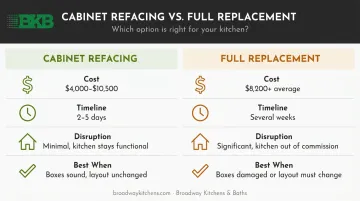
Bob Vila reports refacing averages 30–50% less than full replacement — not the commonly cited 50–70%, which isn't supported by major national sources.
Refacing makes sense when:
- Cabinet boxes are structurally solid
- The layout works and isn't changing
- The homeowner wants a style refresh without demolition
Full replacement makes more sense when:
- Boxes are warped, water-damaged, or structurally compromised
- The kitchen layout needs to change
- Cabinets need to be added, removed, or relocated around plumbing or electrical
That cost gap also plays out at resale. The JLC 2025 Cost vs. Value report tracks a minor kitchen remodel — defined as leaving boxes in place and replacing fronts — at a job cost of $28,458 against a resale value of $32,141. That's 113% cost recouped. The scope is broader than standalone cabinet refacing, but the data confirms that cabinet-level updates consistently rank among the better-performing kitchen investments when selling.
How to Budget Smartly — and Avoid Common Mistakes
Getting the budget right means understanding the total cost of ownership, not just the upfront quote. Four predictable budgeting errors show up repeatedly:
- Focusing only on the base price and ignoring add-ons
- Overlooking hardware costs, which can add $500–$1,000 quietly
- Over-specifying premium materials for a space that doesn't warrant them
- Underestimating labor costs in high-cost regions like the NYC metro
A Practical Budgeting Framework
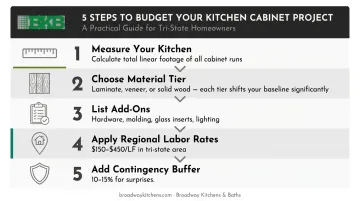
Follow this sequence before committing to a contractor:
- Measure your kitchen — calculate total linear footage of cabinetry
- Identify your material tier: laminate, veneer, or solid wood
- List your add-ons: hardware, molding, glass inserts, and lighting
- Apply regional labor rates — use $150–$450/LF in the tri-state area as your planning range
- Build in a 10–15% contingency buffer — refacing projects regularly surface surprises like substrate damage or discontinued hardware that shift costs mid-project
For tri-state area homeowners and project managers, Broadway Kitchens & Baths offers consultations and cabinetry options from Wolf Classic for value-focused projects to Plain & Fancy for fully custom work. Their in-house carpentry crews handle both product supply and installation under one roof, giving you a single point of contact from material selection through final punch-list. You can visit their showrooms in Englewood, NJ, or Manhattan, NY, to see materials in person before committing to a tier.
Conclusion
Cabinet refacing in 2026 remains one of the more cost-effective ways to update a kitchen or bathroom without the timeline and disruption of a full replacement. A well-built budget accounts for materials, labor, regional rates, add-ons, and long-term durability — not just the lowest quote you receive.
For residential clients, contractors, and management companies in the tri-state area, Broadway Kitchens & Baths handles the full process — from field measurements through project completion — across both single-unit and multi-unit projects.
Call (201) 567-9585 (NJ) or (212) 260-7768 (Manhattan) to schedule a consultation and get an estimate tailored to your space.
Frequently Asked Questions
What is the average cost to reface kitchen cabinets?
Most professional refacing projects in 2026 run $4,000–$10,500, with published national averages from HomeAdvisor, Angi, and Forbes Home landing around $7,200–$8,250. Per-linear-foot rates typically range from $100–$450 nationally, with higher figures in premium markets. Final cost depends on kitchen size, material choice, and local labor rates.
Is it cheaper to reface cabinets or buy new?
Refacing is cheaper — Bob Vila reports it averages 30–50% less than full replacement. It's the right choice when existing cabinet boxes are structurally sound and the kitchen layout isn't changing. Full replacement becomes the better option when boxes are damaged or a layout redesign is needed.
Can I redo my kitchen for $10,000?
Yes, $10,000 is a realistic budget for a mid-to-large kitchen refacing project, or a smaller kitchen with selected upgrades. A full cabinet replacement at that budget would be limited to stock cabinets in a small space.
How long does cabinet refacing take?
Most professional refacing projects are completed in 2–5 days for average-sized kitchens, compared to several weeks for a full replacement. The kitchen stays largely functional throughout — a practical benefit for households that can't be without a working kitchen for long.
Does cabinet refacing add value to a home?
Kitchen updates consistently rank among the strongest resale investments. The JLC 2025 Cost vs. Value report shows a related minor kitchen remodel — which replaces fronts while keeping boxes — recouped 113% of its cost at resale.
When is cabinet refacing NOT a good idea?
Refacing is not recommended when cabinet boxes are warped, water-damaged, or structurally compromised — the new surfaces won't hold properly and the underlying problems will worsen. It's also the wrong call when the goal is to change the kitchen layout, add or remove cabinet runs, or relocate plumbing and electrical.