Introduction
Renovating a kitchen in New Jersey or New York City isn't the same as doing it anywhere else. NYC housing stock averages 63 years old — third oldest in the nation — and labor costs routinely consume 30–50% of the total project budget, well above national norms.
On top of that, most NJ and NYC projects come with constraints that don't appear on national renovation guides:
- Co-op and condo board approvals that add weeks to timelines
- Union labor requirements on many Manhattan buildings
- Floor plans designed decades before open-concept living or modern appliances
Despite those hurdles, the return is hard to argue with. Minor kitchen remodels recover over 107% of costs at resale, and the NAR's 2024 Remodeling Impact Report gives complete kitchen renovations a perfect satisfaction score of 10 out of 10. Every design decision has direct cost implications — which makes choosing the right ideas essential.
This guide covers 20 renovation ideas specifically chosen for NJ and NYC homes — spanning layout, cabinetry, countertops, lighting, and smart technology — with real cost benchmarks for the tri-state market.
Key Takeaways
- NJ/NYC kitchens average $40,000–$100,000+ depending on scope — budget for regional labor and permitting from the start
- Cabinetry and countertops drive the most visual and functional impact per dollar spent
- 2026 trends favor warm palettes, natural textures, bold range hoods, and zellige tile over generic all-white subway
- Layout decisions — work triangle, island clearances, floor plan flow — must come before any finish selections
- Work with a tri-state specialist who understands local codes, co-op rules, and union job sites
What Makes Kitchen Renovation Different in NJ & NYC
Most national renovation guides quote a kitchen remodel average of around $26,944. That number is useless for tri-state homeowners.
Here's what the actual numbers look like:
| Renovation Tier | NJ Range | NYC Range |
|---|---|---|
| Cosmetic refresh | $12,000–$25,000 | $15,000–$25,000 |
| Mid-range (no layout change) | $28,000–$81,300 | $30,000–$60,000 |
| Full gut with layout changes | $170,000+ | $100,000+ |
Beyond cost, NJ and NYC homeowners face a cluster of constraints that most markets don't:
- Older infrastructure — knob-and-tube wiring, galvanized pipes, and non-standard framing are common in pre-1960s homes, and bringing them up to code adds cost before a single cabinet is installed
- Co-op and condo board rules — most NYC buildings require formal alteration agreements, architectural drawings, contractor vetting, and board approval before any plumbing or electrical work begins
- Limited square footage — galley kitchens in brownstones, narrow layouts in co-ops, and compact footprints in suburban colonials all demand smarter design decisions
- Union labor requirements — some buildings and municipalities require union crews, which affects scheduling, crew composition, and budget
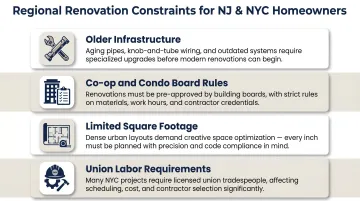
The 20 ideas below are chosen with exactly these constraints in mind.
Design, Layout & Space-Optimization Ideas
Layout is the one decision that affects everything downstream. Get it wrong and no amount of beautiful tile fixes it.
#1: Open Up the Floor Plan
Removing a non-load-bearing wall between the kitchen and an adjacent dining or living space remains one of the most popular upgrades in NJ row houses and older colonials. According to Houzz's 2024 Kitchen Trends Study, 43% of renovating homeowners now open kitchens to adjacent spaces — up from 38% in 2021. Homeowners cite three main drivers:
- Better functionality (64%)
- Improved entertaining flow (54%)
- Aesthetic preference (47%)
Wall removal costs range from $300 for a simple non-load-bearing partition to $10,000+ when structural reinforcement is required. Always verify load-bearing status, plumbing runs, and electrical paths with a licensed professional before demolition.
#2: Optimize Your Layout Configuration
In tight NJ/NYC kitchens, the right cabinet configuration does more for usability than any finish upgrade:
- Galley layout — best for very narrow rooms; creates an efficient two-wall workflow
- U-shape — maximizes counter run and storage in medium-sized spaces
- L-shape with island — ideal for open-plan footprints where an island defines the kitchen zone
None of these require structural changes — which means faster timelines and lower disruption costs for NJ/NYC renovations where contractor access and scheduling are constant constraints.
#3: Build a Multi-Functional Island
A properly sized island transforms how a kitchen works. Per NKBA planning guidelines, work aisles must be at least 42 inches wide for a single cook — a spec that many NJ/NYC kitchens can't actually meet without careful planning.
When space allows, build in:
- Seating on one side (standard 12–15" overhang for stools)
- Integrated outlets for countertop appliances
- Deep drawer storage below
- Task lighting directly overhead
#4: Create a Breakfast Nook or Casual Dining Corner
For NYC apartments that have absorbed the dining room into the living space, a built-in corner banquette with a small table adds seated dining capacity without taking square footage from the main kitchen. The key is built-in bench seating with under-seat storage — it reads as intentional design, not a space compromise.
#5: Reclaim Space from Adjacent Rooms
In NJ suburban homes, borrowing 30–50 square feet from a formal dining room or oversized pantry closet to expand the kitchen footprint is one of the most practical moves available. Most formal dining rooms see weekly use at best; that same square footage added to the kitchen delivers impact every single day.
#6: Add a Walk-In or Butler's Pantry
Even a small pass-through pantry — 4 to 6 feet deep — solves the visual clutter problem in open-concept homes where the kitchen is constantly visible from the living area. Appliances, dry goods, and small electrics disappear behind closed doors, keeping the main kitchen uncluttered and camera-ready.
#7: Apply the Work Triangle Principle
Storage and layout configuration set the stage — but workflow efficiency comes down to one foundational principle. The work triangle connects the sink, range, and refrigerator, and NKBA guidelines specify each leg should measure 4 to 9 feet, with a total perimeter under 26 feet.
Many older NJ/NYC kitchens violate this completely, with refrigerators stuck in corners and sinks positioned awkwardly relative to the range. Repositioning these three elements — often without touching the overall layout — can reduce daily cooking steps by a measurable amount and is one of the most cost-effective functional upgrades in a kitchen renovation.
Cabinetry, Countertops & Storage Ideas
Cabinetry and countertops account for the largest share of any NJ/NYC kitchen renovation budget. These choices define both the aesthetic and the long-term durability of the space.
#8: Install Custom Floor-to-Ceiling Cabinetry
Taking cabinetry to ceiling height eliminates the dust-collecting gap above upper cabinets, maximizes storage in tight spaces, and creates a built-in look that reads as high-end — even in modest-sized kitchens.
NJ cabinetry costs by tier (per linear foot):
| Cabinet Type | Cost/Linear Foot | Total for ~25 LF |
|---|---|---|
| Stock | $500–$800 | $12,500–$20,000 |
| Semi-custom | $800–$1,400 | $20,000–$35,000 |
| Custom | $1,400–$2,000+ | $35,000–$50,000+ |
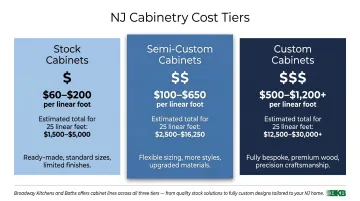
Broadway Kitchens & Baths carries five cabinetry lines — UltraCraft, Plain & Fancy, Wolf Classic Cabinets, Hanssem/Massachusetts Design, and Great Northern — covering stock through full custom for projects at any budget level.
#9: Try Two-Tone Cabinet Color Combinations
The all-white kitchen is fading fast. The 2026 move is pairing dark lower cabinets — navy, forest green, charcoal — with lighter upper cabinets or a contrasting island color. This adds depth without overwhelming a smaller kitchen. It also plays well with the natural wood tones that 67% of designers now specify, per NKBA's 2026 trends data.
#10: Upgrade to Quartz or Natural Stone Countertops
89% of kitchen designers now specify quartz, according to the NKBA/KBIS 2026 Kitchen Trends Report. In the NJ/Northeast market, installed quartz runs $80–$110 per square foot — durable, low-maintenance, and available in a wide aesthetic range.
For luxury renovations, marble and quartzite bring natural variation and premium appeal, though both require more maintenance awareness. One of the strongest design moves available: extend the countertop material up the wall as a full-height backsplash slab behind the range. It eliminates grout lines and creates a seamless, high-end finish.
Broadway Kitchens & Baths works with Caesarstone, Silestone, Corian Quartz, and MSI Stone — all well-represented in their countertop offerings for both kitchen and bathroom applications.
#11: Reface or Repaint Existing Cabinets
If the cabinet boxes are structurally sound, replacement isn't necessary. Cabinet refacing costs 30–50% less than new cabinets, and professional repainting in NYC runs approximately $30–$60 per linear foot.
A refinished cabinet with new hardware and a fresh countertop can transform the kitchen's appearance for a fraction of the full renovation cost. For context, a full cabinet replacement on a 25-linear-foot kitchen can run $35,000+; refacing the same layout typically lands under $15,000.
#12: Add Pull-Out Pantries and Smart Interior Storage
In NJ/NYC kitchens where every inch counts:
- Pull-out pantry shelves convert dead corner space into accessible storage
- Deep drawer organizers replace inefficient base cabinet shelving
- Lazy Susans make corner cabinets usable
- Custom drawer inserts for utensils and spices reduce countertop clutter
Most can be retrofitted into existing cabinet boxes — no full replacement required.
#13: Create an Appliance Garage
Dedicated appliance garages — upper cabinet sections with roll-up or lift-up doors — keep air fryers, espresso machines, and blenders accessible without consuming counter space. For NJ/NYC homeowners with extensive small appliance collections and minimal counter room, this is one of the most practical upgrades available.
#14: Choose Panel-Ready or Integrated Appliances
Panel-ready refrigerators and dishwashers accept cabinet-matching fronts, making them visually disappear into the design. Once limited to luxury renovations, this approach now appears regularly in mid-range NJ/NYC projects. The practical benefits for resale-minded homeowners:
- Fewer visual interruptions create a cleaner, more cohesive look
- Integrated appliances are a documented draw for buyers in the NJ/NYC market
- The seamless finish holds up better in listing photos than exposed appliance facades
Lighting, Backsplash, Flooring & Style Ideas
These finishing choices are where NJ/NYC kitchens diverge most visibly from the all-white, stainless-steel defaults that defined the past decade — and where design decisions have the biggest impact on how a space feels day-to-day.
#15: Design a Layered Lighting Plan
Three layers, working together:
- Ambient — recessed or flush ceiling lights for general illumination
- Task — under-cabinet LED strips positioned directly above countertops; Broadway Kitchens & Baths incorporates these in their kitchen designs as a standard element
- Accent — pendant lights over the island, statement range hood lighting
All dimmable. NJ/NYC entertaining-focused homeowners want the ability to shift from bright prep lighting to softer dinner ambiance without installing separate systems.
#16: Make the Range Hood a Statement Piece
The generic stainless steel box range hood is done as a default choice. Custom hoods in plaster, wood cladding, shiplap, or bold metal now anchor kitchen designs in a way that cabinets and countertops alone can't achieve. In compact NJ/NYC kitchens especially, a well-specified hood commands the room and pulls the whole design together.
#17: Install a Bold or Full-Height Backsplash
Extending tile from counter to ceiling behind the range is one of the easiest ways to create dramatic visual impact in a compact kitchen. Popular 2026 choices in NJ and NYC design circles:
- Zellige — handmade Moroccan tile with irregular surfaces and natural variation
- Large-format stone slab — seamless and minimal, pairs well with quartz countertops
- Handmade ceramic — artisan texture, warmer than standard ceramic
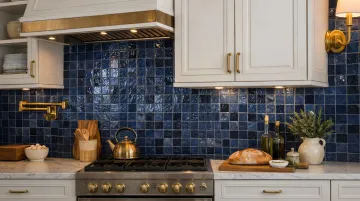
Ceramic and porcelain remain the dominant specification at 87% of designer projects per NKBA — but the patterns, sizes, and finishes within that category have shifted considerably toward texture and warmth.
#18: Upgrade to Wide-Plank or Wood-Look Flooring
Wide-plank hardwood and porcelain wood-look tile are the dominant 2026 flooring choices in NJ/NYC kitchens. Per NKBA trends data, wood-look tile is specified by 60% of designers; hardwood by 56%.
For active urban kitchens, wood-look porcelain solves the durability problem: it delivers the warmth of wood without susceptibility to moisture, heavy foot traffic, or the wear that wood floors in kitchens inevitably show over time.
#19: Integrate Smart Kitchen Technology
The global smart kitchen appliance market is on track to reach $60.20 billion by 2030, growing at a 17.9% annual rate. In NJ/NYC kitchens, the preference is for technology that blends into the design:
- Wi-Fi-enabled appliances — ovens with remote preheating, refrigerators with inventory tracking
- Touchless faucets — popular upgrade with a minimal footprint
- Hidden induction cooktops — flush-mount designs that disappear when not in use
- Pop-up outlets — countertop outlets that retract flush when not needed
In practice, NJ/NYC homeowners are specifying these features for function, not novelty — choosing one or two high-use upgrades rather than stacking every available option.
#20: Choose Sustainable and Natural Materials
Demand for sustainable materials is growing for two reasons in this market: homeowner preference and regulatory pressure. NYC's Local Law 97 imposes carbon emissions caps on larger residential buildings, with fines of $268 per metric ton of CO2 over the annual limit — creating board-level pressure toward energy-efficient appliances and materials in covered buildings.
Practical sustainable choices that work aesthetically:
- Reclaimed wood accents for open shelving or island fronts
- Bamboo cabinetry as a renewable alternative to hardwood
- Low-VOC paints and finishes throughout
- ENERGY STAR-certified appliances (also relevant to NJ's clean energy incentive programs)
Planning Your Renovation: Order, Budget & Choosing the Right Partner
The Correct Renovation Sequence
Skipping this order is the most common and costly mistake NJ/NYC homeowners make:
- Structural and layout changes — wall removal, footprint expansion
- Rough plumbing and electrical — repositioning fixtures, upgrading panels
- Cabinetry installation
- Countertops and backsplash
- Flooring
- Appliances and plumbing fixtures
- Lighting, hardware, and final finishes
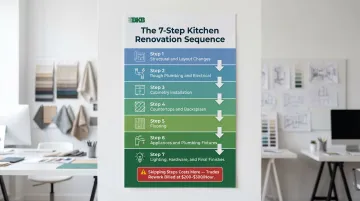
Doing flooring before cabinetry, or backsplash before countertops, creates rework. In a market where labor runs $200–$300/hour for trades, rework is expensive.
Realistic Budget Framing for the Tri-State Market
| Tier | NJ | NYC |
|---|---|---|
| Cosmetic refresh | $12,000–$25,000 | $15,000–$25,000 |
| Mid-range renovation | $28,000–$81,300 | $30,000–$60,000 |
| Full gut with layout changes | $170,000+ | $100,000+ |
Add architect and design fees (typically 10–20% of the construction budget) and NJ permit costs ($500–$1,500) on top of these figures. In NYC, co-op alteration agreement fees and board-required deposits add further to upfront costs.
The Right Partner for This Market
Broadway Kitchens & Baths operates showrooms in Englewood, NJ and Manhattan, serving residential homeowners, builders, and management companies across the tri-state area. Their team coordinates every phase — from initial field measurements to final punch-list — in both union and non-union environments.
Cabinetry options span five brands across every budget tier, and countertop selections include Caesarstone, Silestone, Corian Quartz, and MSI Stone.
For builders, developers, and management companies, their builders division handles multi-unit projects across Bergen County, Manhattan, Brooklyn, and the broader metro area with a single point of accountability for the entire kitchen and bath scope.
Free design consultations are available at their Englewood showroom, Monday–Friday 9AM–5PM and Saturday 10AM–4PM. Reach them directly at +1 201-567-9585.
Conclusion
The best kitchen renovations in NJ and NYC in 2026 prioritize what actually works — layouts suited to the region's housing stock, finishes backed by solid infrastructure, and design decisions grounded in project economics. Aesthetic ambition matters. So does execution.
If you're ready to move forward, reach out to Broadway Kitchens & Baths at +1 201-567-9585. With showrooms in Englewood, NJ and Manhattan, their team understands the local renovation landscape — building codes, co-op requirements, tight floor plans — and manages projects from design through installation across a wide range of budgets.
Frequently Asked Questions
What is a realistic budget for a kitchen renovation in NJ or NYC?
Expect to spend $28,000–$81,000 for a mid-range NJ renovation and $30,000–$60,000 in NYC — both significantly above the national average of $26,944. Layout changes and high-end materials push budgets toward $100,000–$170,000+. Labor alone accounts for 30–50% of the total.
In what order should a kitchen be remodeled?
Start with structural and layout changes, then rough plumbing and electrical, then cabinetry, countertops, flooring, appliances, and finally lighting and hardware. This sequence prevents costly rework at every stage.
How can I update a kitchen without replacing cabinets?
Professional cabinet refacing or repainting — combined with new hardware, countertops, and backsplash — delivers a near-complete transformation at 30–50% of full replacement cost. Interior organizers (pull-outs, drawer inserts) also add significant functional value without touching the cabinet boxes.
Is $30,000 enough for a kitchen remodel in NJ or NYC?
At $30,000, you're in cosmetic-to-moderate territory: cabinet refacing, new countertops, updated backsplash, budget appliance package, and new flooring are all achievable. Layout changes or semi-custom cabinetry will push the budget higher.
What does a $50,000 renovation get you?
In NJ/NYC, $50,000 covers a solid mid-range kitchen: semi-custom cabinetry, quartz countertops, a mid-range appliance package ($5,000–$10,000), new flooring, backsplash, and lighting. Minor layout adjustments may be possible within this budget if structural work is minimal.
What does it cost to redo kitchen cabinets and countertops in NJ?
For a 25-linear-foot kitchen with quartz countertops (~30 sq ft), installed costs in the NJ market break down as follows:
- Stock cabinets + quartz: $14,900–$23,300
- Semi-custom + quartz: $22,400–$38,300
- Full custom + quartz: $37,400–$53,300+