Introduction
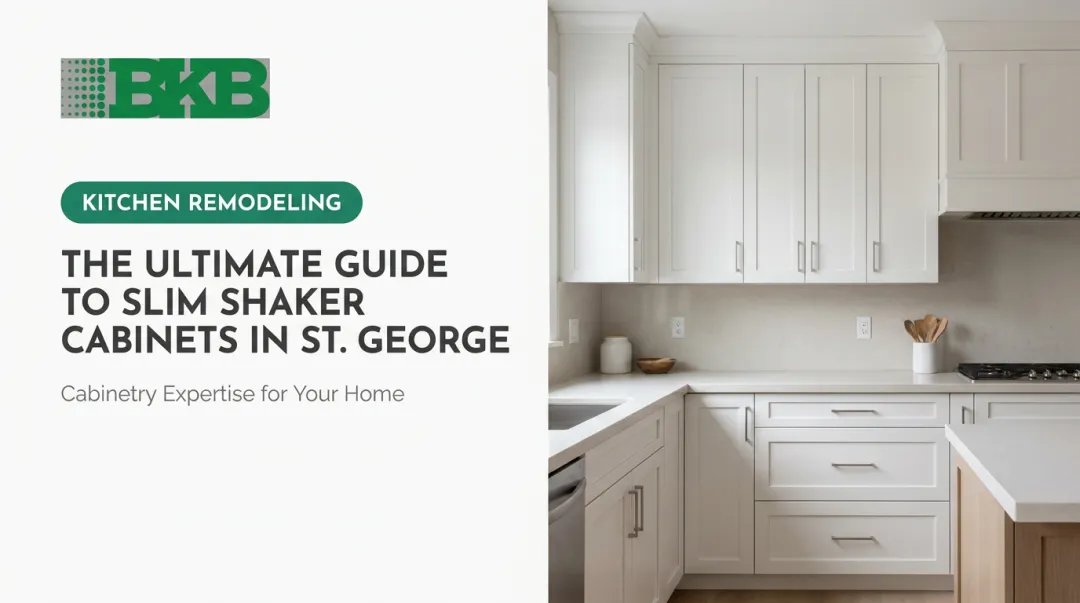
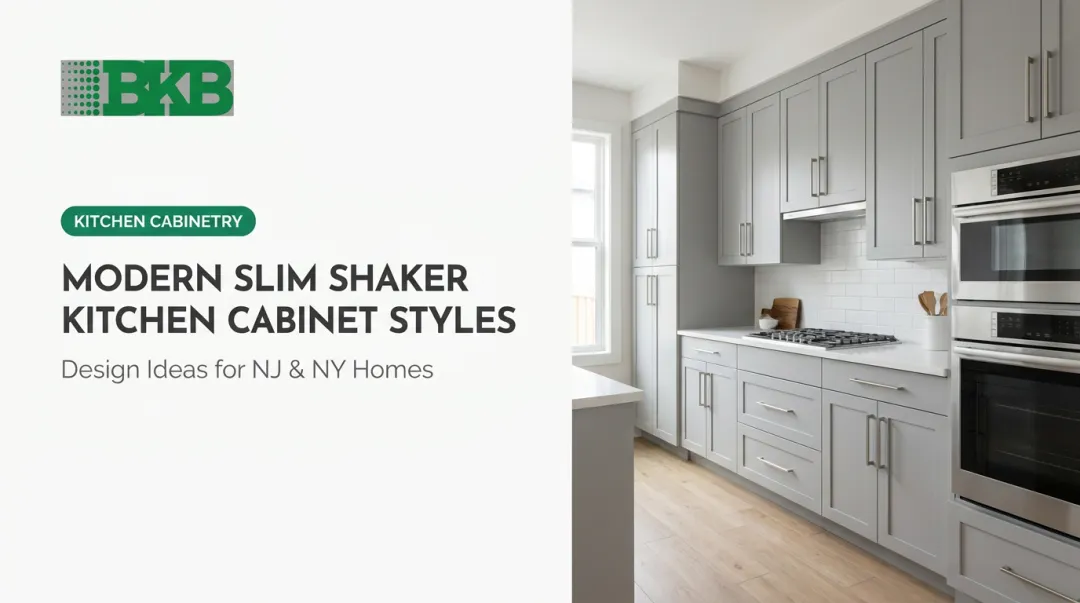
Slim shaker cabinets have become the cabinet profile design professionals reach for most — and debate least. Where classic shaker reads as traditional and slab doors can feel cold, slim shaker lands in a place most clients actually want: familiar enough to feel grounded, minimal enough to feel current.
That balance has real staying power. According to Houzz's 2025 U.S. Kitchen Trends Study, shaker-style cabinets now appear in 61% of renovated U.S. kitchens — up from 60% the year before. Slim shaker sits at the leading edge of that number.
For architects specifying multi-unit residential projects, builders working with management companies across the tri-state area, and homeowners planning a renovation, knowing where slim shaker is heading changes how you specify it. This article breaks down the defining style trends, color and material directions, and what's driving continued adoption.
Key Takeaways
- Shaker cabinets lead all door styles at 61% of U.S. kitchen renovations, with slim shaker driving the contemporary segment
- Minimalism, two-tone finishes, organic materials, and integrated hardware are the four dominant style directions right now
- Warm whites, off-whites, wood tones, and muted greens are replacing cool stark whites across residential and commercial projects
- Open-plan living has made cabinet selection more architecturally visible, favoring slim profiles that read cleanly from across a room
- Material innovation in thermofoil and TFL woodgrain is expanding slim shaker's accessibility across project budgets
What Makes Slim Shaker Cabinets a Design Staple — Not Just a Trend
The Profile That Changed the Conversation
A slim shaker cabinet follows the same five-panel door construction as classic shaker — a flat center panel framed by horizontal rails and vertical stiles. The difference is dimensional. Classic shaker frames typically run 2.5 to 3.5 inches wide. Slim shaker brings those frames down to roughly ¾ to 2 inches, sometimes less.
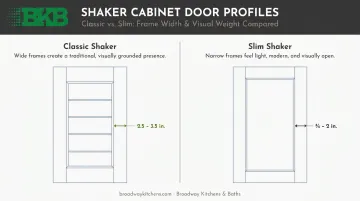
In practice, that shift changes the entire visual weight of a cabinet run — and, by extension, a room.
The "Middle Lane" Problem It Solves
Most kitchen and bath design decisions live in tension: clients want something contemporary but not stark, updated but not trendy, clean but not cold. Full slab doors resolve the visual clutter problem by removing the frame entirely — but many buyers find them too industrial. Classic shaker reads warm and grounded but can feel dated in open-plan, high-ceilinged spaces.
Slim shaker occupies the gap between those extremes. It retains the structural warmth of a framed door while reading clean enough for modern interiors — which is why it's specified across such a wide range of project types, from compact Manhattan apartments to suburban multi-unit residential builds.
A Timeline That Proves Longevity
The slim shaker category has a documented manufacturer history. Superior Cabinets launched its MDF Darby slim shaker door in 2018, followed by the solid wood Eryn door in 2020. In April 2025, the company introduced the Verra — a new profile with 1⅛-inch stiles and rails that lands between ultra-slim and classic shaker dimensions. That seven-year progression is the trajectory of a maturing category.
The naming fragmentation across the market confirms the same pattern. The style goes by thin shaker, skinny shaker, narrow shaker, micro shaker, nexus slim shaker — Superior Cabinets alone lists eight trade variations. When terminology splinters this widely across manufacturers, it signals saturation, not novelty.
ROI Context
Minor kitchen remodels consistently outperform larger renovations on return. The 2025 Cost vs. Value Report from JLC/Zonda puts minor midrange kitchen remodels at 113% cost recouped — meaning the right refresh more than pays for itself at resale. Cabinet door style is a direct lever in that outcome: profiles with broad buyer appeal — neither polarizing nor dated — support faster sales and stronger offers.
Top Style Trends Shaping Slim Shaker Cabinets Today
Trend 1: The Minimalist Clean-Line Aesthetic
The narrower the frame, the more the eye travels to the center panel — and through it, to the countertop, backsplash, and room beyond. That's the design mechanic driving slim shaker's dominance in minimalist and contemporary interiors. Less frame means less visual interruption across a run of cabinets.
This shows up most consistently in:
- Open-concept urban kitchens where cabinet banks are visible from living areas
- Compact apartments where visual clutter costs perceived square footage
- New-build multi-unit residential projects, where a clean, broadly appealing profile simplifies specification across units
For builders and architects working with management companies in New York and New Jersey, that last point matters practically. A door profile that photographs well, appeals to a wide tenant demographic, and holds up stylistically across lease cycles is a specification decision with long-term value.
Trend 2: Two-Tone and Mixed-Finish Designs
Houzz's 2025 data shows 24% of renovating homeowners chose contrasting colors for upper and lower cabinets — up from 23% in 2024. That consistent year-over-year growth puts two-tone firmly in the mainstream, not the experimental category.
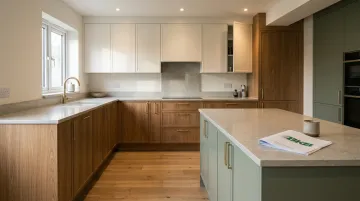
The most common configuration: warm wood-tone or deeper-colored lowers grounding the space, with lighter painted uppers keeping the upper half open and airy. Kitchen islands offer a natural third zone for a contrasting finish.
Slim shaker excels in this application because its simple profile transitions cleanly between finishes. Ornate door styles create visual tension when mixed — slim shaker doesn't. It also layers well with frameless slab panels in island or accent applications, giving designers more flexibility without the risk of a mismatched kitchen.
Trend 3: Natural, Organic, and Warm Material Pairings
Mid-Century Modern, Organic Modern, and similar aesthetics have pushed natural materials back to the center of kitchen and bath design. White oak, live-edge countertops, handmade tile, and textured stone are showing up consistently — and slim shaker pairs naturally with this direction.
The reason is proportional. With a narrower frame, more of the door face belongs to the center panel. In a natural wood or stained finish, the grain takes center stage. The frame recedes; the material speaks.
This is why white oak at 59% ranks as a preferred cabinet material in NKBA's 2025 coverage. A slim shaker oak door paired with a stone or handmade tile backsplash works because the proportions align — neither element competes for visual priority.
For those exploring natural finish options, Broadway Kitchens & Baths carries Plain & Fancy cabinetry, which spans over 100 door styles across traditional, contemporary, and shaker categories.
Trend 4: Integrated Hardware and Handleless Profiles
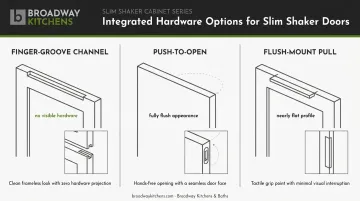
Integrated hardware has moved from an architectural detail to a mainstream specification. Options include:
- Finger-groove channels routed into the door bottom, eliminating visible hardware entirely
- Push-to-open mechanisms for a fully flush appearance
- Flush-mount pulls that sit nearly flat against the door face
When visible hardware is used, the slim frame proportionally showcases the choice better than a wider-frame door. Matte black, brushed gold, and brushed nickel all read as intentional choices against a narrow frame — the hardware becomes the accent rather than competing with the frame for visual weight.
Color and Finish Trends to Watch
Where Color Is Moving
Stark cool whites are giving way to warmer, more layered palettes. Houzz's 2025 data shows:
| Color Direction | 2025 Share |
|---|---|
| White | 33% |
| Wood tones | 23% |
| Off-white | 14% |
NKBA's 2025 Kitchen Trends coverage adds further texture: green leads at 76% of designer interest, blue at 63%, and brown at 56%. White oak registers at 59% as a preferred cabinet material or finish.
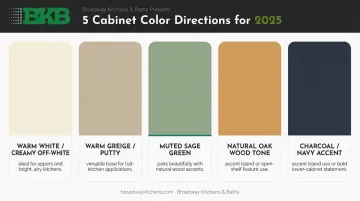
For slim shaker specifically, the leading color directions are:
- Warm whites and creamy off-whites (replacing cool stark white)
- Warm greiges and putty tones
- Muted sage and earth greens
- Natural wood stains (oak, maple)
- Charcoal, navy, and black for island or lower-cabinet accent applications
One caveat on darker tones: designers are using them intentionally, not universally. A charcoal slim shaker island against warm white uppers is a design statement. A full kitchen in the same charcoal reads heavier and narrows buyer or tenant appeal. That distinction matters for multi-unit residential specifications.
Material Finish Innovation
Color choice and finish material are increasingly linked decisions. The painted MDF slim shaker remains a workhorse, but the material menu has expanded considerably:
- Wood veneer (oak, maple, walnut): natural grain with dimensional stability
- Thermofoil: Superior Cabinets' 2025 thermofoil collection positions it as durable, easy to clean, and antibacterial — useful for high-traffic commercial kitchens and rental units
- TFL/HPL laminate: Wilsonart's LUJO collection added woodgrain designs including oak, cherry, elm, and eucalyptus finishes with matte textures, making realistic wood-look surfaces accessible at lower price points
That last development matters for commercial and multi-unit residential clients. The look of natural wood without the maintenance profile — and at a price point that scales across 20 or 200 units — reshapes how specifiers approach the finish decision.
Matte finishes are clearly outpacing high-gloss across the slim shaker category. No single market-share figure captures that shift precisely, but the evidence is consistent: product launches from manufacturers like Wilsonart have emphasized matte and low-sheen textures in every recent release. That's where demand is pulling.
What's Driving the Slim Shaker Movement
Two structural shifts have accelerated slim shaker adoption beyond taste preferences.
Two forces are doing most of the work:
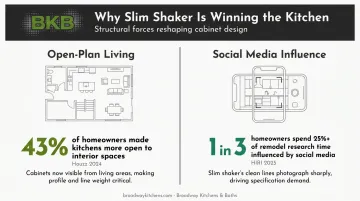
- Open-plan living has made cabinets architectural. Houzz's 2024 data shows 43% of homeowners made kitchens more open to interior spaces, up from 38% among those renovating in 2021 or 2022. When a cabinet run is visible from the living room sofa, door profiles that read cleanly at 20 feet — slim, unfussy, proportionally light — get specified more.
- Social media has compressed the trend cycle. HIRI's 2025 research found 1 in 3 homeowners spend 25% or more on home improvement purchases influenced by social media content. Slim shaker photographs particularly well — its clean lines and shadow detail translate clearly on screen — so homeowners increasingly arrive at showrooms already knowing what they want.
Beyond the kitchen, the category has expanded into bathrooms, home offices, laundry rooms, and entertainment centers — driven by homeowners who want visual continuity across rooms. Slim shaker's versatility across styles makes it well-suited to that whole-home specification approach.
That whole-home demand puts pressure on the specification process — coordinating cabinet profiles, finishes, and room-to-room consistency across a single project is a different challenge than a single kitchen swap. Broadway Kitchens & Baths works with architects, builders, and management companies in the tri-state area on exactly this kind of work, managing field measurements through final installation across projects of varying scale and complexity.
Future Signals: Where Slim Shaker Design Is Headed
Profile Diversification
The category isn't just getting thinner — it's getting more nuanced. Superior Cabinets' Verra door, introduced in April 2025, sits between ultra-slim and classic shaker at 1⅛-inch stiles and rails. WalzCraft's S1026 Cole Nexus Slim Shaker uses a 1¼-inch outside edge molding. These "in-between" profiles suggest manufacturers are responding to demand for options that aren't locked into one extreme.
Expect the profile conversation to shift from "slim vs. standard" to "which slim" — as specifiers get more precise about frame dimensions and their visual effect.
Material and Sustainability Trends
Near-term developments worth watching:
- Realistic woodgrain TFL and thermofoil will continue improving, making natural-wood aesthetics more accessible across project budgets
- Low-VOC coatings are becoming a specification differentiator — NKBA's 2024 sustainability coverage notes nearly 50% of designers use VOC-free or non-toxic paints and stains
- FSC-certified wood and KCMA Environmental Stewardship Program certifications will increasingly appear in project specifications, particularly for commercial and institutional clients
These sustainability trends feed directly into the broader 1–3 year outlook: slim shaker consolidates as the default transitional cabinet choice across residential and commercial segments, with color innovation and multi-room applications driving continued growth.
The firms that win specifications will be those who understand the full picture — door profile, finish evolution, sustainability documentation, and multi-unit coordination. That depth is what converts a well-designed kitchen into a repeatable project pipeline.
Conclusion
Slim shaker has earned its position as a design staple because it works. The profile bridges traditional shaker heritage and contemporary minimalism, photographs well, scales across budgets, and accommodates the color and material directions that are defining residential and commercial interiors right now.
The style will keep evolving: more profile options, better material technology, deeper color stories, and broader room applications. For architects, designers, builders, and developers, that means navigating an expanding set of specifications — and getting those decisions right early matters more than most clients expect.
Broadway Kitchens & Baths brings that expertise to renovation and multi-unit projects across the tri-state area, with cabinet brands including UltraCraft, Plain & Fancy, and Wolf Classic Cabinets, and showrooms in Englewood, NJ, and Manhattan. If you're specifying cabinets for your next project, the team there is a practical starting point for narrowing the options and moving projects forward.
Frequently Asked Questions
Are slim shaker cabinets in style?
Yes — and trending upward. Shaker-style cabinets appear in 61% of renovated U.S. kitchens according to Houzz's 2025 data, with slim shaker leading the contemporary and transitional segments. They're widely specified across residential, commercial, and multi-unit projects.
Is slim shaker more expensive than regular shaker?
The difference is typically small. Slim shaker may carry a slight premium over standard shaker due to lower production volume, but the gap rarely affects overall project budgets in any meaningful way.
What is the most popular cabinet style right now?
Shaker is the dominant cabinet door style overall — see the 61% figure above. Within that category, slim shaker is increasingly specified for contemporary and transitional projects, where cleaner lines are the priority.
What is the difference between slim shaker and regular shaker cabinets?
The key difference is frame width. Slim shaker typically features ¾ to 2-inch stiles and rails versus 2.5–3.5 inches for classic shaker. Both use the traditional five-panel door structure, but slim shaker's narrower frame creates a noticeably more streamlined appearance.
Do slim shaker cabinets work in small kitchens?
They're particularly well-suited for smaller spaces. Narrower frames reduce visual weight and reflect more light across a cabinet run, creating a sense of openness. Light finishes — warm white, off-white, or natural oak — amplify that effect.
What colors are trending for slim shaker cabinets?
Warm whites, creamy off-whites, muted sage greens, natural wood tones (especially white oak and maple), and warm greiges are leading residential specifications. Charcoal, navy, and matte black are increasingly used for island or lower-cabinet accent applications.