
Introduction
Two cabinet styles keep coming up in kitchen and bath specifications right now, and they're closer in construction than most people expect. Both slim shaker and classic shaker use the same five-panel recessed door design. Both take finishes well and hold up across project types — from single-family renovations to multi-unit builds.
So why does the choice matter so much? Because that narrow frame difference, often less than an inch, changes everything about how a kitchen or bathroom feels. It affects perceived room size, hardware selection, how the space reads from across the room, and whether the cabinets feel at home in the architecture around them.
Whether you're specifying cabinetry across multiple units or planning a single renovation, understanding what separates these two styles leads to a more deliberate decision — and far less regret after installation.
Key Takeaways
- Slim shaker frames run ¾–1¾ inches wide; classic shaker frames are wider at roughly 2³⁄₁₆–3 inches
- Classic shaker suits traditional, farmhouse, and transitional spaces; slim shaker fits modern, contemporary, and compact layouts
- Both styles support a broad range of colors, finishes, and hardware options
- Expect pricing to vary by manufacturer, material, and finish — not simply by style category
- Shaker-style doors overall account for 58% of cabinet preferences in the 2026 Houzz Kitchen Trends Study
Slim Shaker vs. Classic Shaker: Quick Comparison
Both styles share the same foundational five-panel door construction. The differences come down to proportion, visual weight, and the spaces they serve best. Use the table below to evaluate which profile fits your project's aesthetic, scale, and budget requirements.
| Attribute | Slim Shaker | Classic Shaker |
|---|---|---|
| Frame Width | ~¾ in to 1¾ in (varies by manufacturer) | ~2 3/16 in to 3 in (varies by manufacturer) |
| Visual Style | Streamlined, contemporary, minimalist | Substantial, warm, traditional |
| Best-Fit Space | Compact kitchens, modern open-concept, bathrooms | Larger kitchens, heritage homes, transitional spaces |
| Typical Colors | White, light gray, navy, charcoal, natural oak | White, cream, warm wood tones, painted finishes |
| Hardware Pairing | Bar pulls, hidden hinges, matte black or brushed nickel | Cup pulls, bin pulls, round knobs in bronze or brushed gold |
| Price Point | Comparable to classic; specialty profiles may carry a small premium | Widely produced; generally strong availability across price tiers |
| Design Longevity | Growing adoption in contemporary markets | Decades of proven buyer appeal |
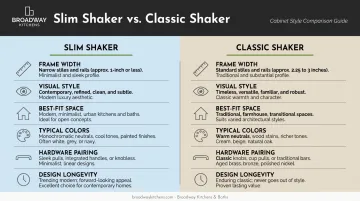
Individual manufacturer specs vary. These represent general tendencies across the category.
What Are Slim Shaker Cabinets?
Slim shaker — sometimes called skinny shaker or micro shaker — is a modern evolution of the classic door. It keeps the five-panel recessed construction but reduces the frame significantly. Product examples across manufacturers show visible stile and rail profiles as narrow as ¾ inch up to 1¾ inches, though structural backing behind that profile can be wider.
A narrower bezel shifts attention to the center panel, making each door appear larger. In a galley kitchen or compact bathroom, that shift can make the entire room feel less crowded without moving a single wall.
That restraint is intentional. Manufacturers position slim shaker as a bridge style: more detailed than a flat slab door, cleaner than traditional shaker. As Superior Cabinets puts it, slim shaker "fits between slab and five-piece door styles" — which is precisely why it adapts so well across kitchens, bathrooms, and multi-unit residential projects.
Construction and Materials
Slim shaker doors are built several different ways depending on the manufacturer:
- Single-piece MDF: Some doors are milled from one panel of high-density MDF for a seamless painted finish
- Solid wood frame with HDF panel: Barker Door, for example, uses a solid wood frame with an HDF inset panel and cope-and-stick tenon joinery
- Plywood cabinet boxes: Some prefabricated lines use ½-inch 7-ply hardwood plywood for cabinet sides
Wood species options include maple, cherry, walnut, alder, and quarter-sawn white oak, depending on the product line. MDF construction is common for painted finishes. Neither material nor joinery method is universal across the category — specifications vary by manufacturer.
Color and Finish Versatility
Slim shaker handles color exceptionally well across the full spectrum:
- Whites and light neutrals: Frost White, Arctic Mist, Dove — clean and broadly appealing
- Bold statements: Navy, charcoal, pitch black — slim frames let strong colors read without feeling heavy
- Natural wood tones: Quarter-sawn white oak and maple in natural finishes ground the style in warmth
- Soft mid-tones: Light gray, fawn, alabaster — ideal for transitional spaces
The NKBA's 2026 trends report notes that neutrals remain dominant at 96%, with greens at 86% and blues at 78% gaining traction — all palettes that pair naturally with slim shaker's clean proportions.
Ideal Applications for Slim Shaker
Slim shaker performs best in:
- Small to mid-size kitchens where visual lightness matters
- Modern urban apartments and open-concept layouts
- Bathroom vanities where a refined, uncluttered profile reads as intentional
- Multi-unit residential projects where a neutral-modern aesthetic appeals across diverse buyer preferences
- Any space where the design goal is contemporary with just enough detail
For hardware, bar pulls in brushed nickel or matte black are the natural pairing. Hidden hinges and soft-close mechanisms keep the look consistent without visual interruption.
What Are Classic Shaker Cabinets?
Classic shaker traces back to the Shaker religious communities that arrived in America in 1774. The first official community was established at New Lebanon, New York in 1787. Their furniture philosophy — built around utility, simplicity, and honest use of materials — produced a door profile that has outlasted virtually every other style in American kitchen design.
The defining feature is the wider frame. Classic shaker stiles and rails typically measure between 2 3/16 inches and 3 inches, depending on the manufacturer. That extra width creates visual mass and presence: a substantial border around each door panel that reads as warm, grounded, and confident in rooms large enough to carry it.
According to Architectural Digest, shaker cabinets suit both historic homes and new builds, working across traditional and contemporary contexts with equal ease. That cross-context flexibility has made shaker-style doors the dominant choice in residential cabinetry for well over a decade.
Construction and Materials
Classic shaker construction commonly includes:
- Solid wood species: Maple, oak, cherry, pine — the same woods Shaker craftsmen used historically
- Surface finishes: Full-color lacquer, hand-wiped stains, glazed treatments, and antique distressing
- Multiple door constructions: Cope-and-tenon joinery, miter construction, and laminate or thermofoil options for entry-level lines
The wider frame also provides more surface for decorative finish treatments. Glazes and patinas read particularly well on broader stiles — an effect that narrows dramatically on slim shaker profiles.
Ideal Applications for Classic Shaker
Classic shaker works best in:
- Larger kitchens with higher ceilings, where the substantial frame adds presence rather than clutter
- Heritage, farmhouse, and traditional homes where the architectural character calls for warmth and depth
- Transitional spaces that blend old and new elements — classic shaker is flexible enough to work with both traditional hardware and cleaner contemporary pulls
- Projects where proven resale appeal is a priority
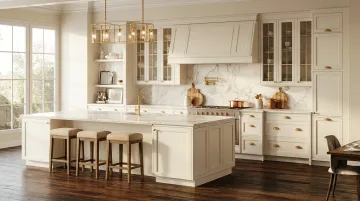
The wider frame also opens up hardware choices that slimmer profiles can't support as well. Cup pulls, bin pulls, and round knobs in bronze, brushed gold, or matte black all complement the proportions. Classic shaker carries more decorative hardware without looking overdone.
Slim Shaker vs. Classic Shaker: Which Is Right for You?
Neither style is objectively better. The right choice follows from four practical factors: room size, home architecture, design direction, and budget.
Space and Visual Perception
Room size is the clearest deciding factor:
- Small kitchens and bathrooms: Slim shaker's narrower frame makes doors appear larger and keeps the space from feeling tight. In a galley kitchen or compact vanity alcove, that matters.
- Larger, open kitchens: Classic shaker's wider frame fills space proportionally. In a large kitchen with 9-foot ceilings, slim shaker can read as underdressed — the room may feel unanchored.
Home Architecture and Design Direction
- Modern or transitional interiors: Slim shaker bridges the gap between slab doors and classic shaker — more character than flat panel, cleaner than traditional. It works in contemporary new construction and thoughtfully updated older homes.
- Traditional, farmhouse, or craftsman architecture: Classic shaker fits naturally within the existing visual language of the space. Wider frames echo the proportions found elsewhere in the home's trim and millwork.
Longevity and Resale Value
Both styles hold long-term appeal. The 2025 Cost vs. Value report from JLC shows that a midrange minor kitchen remodel recoups 113% of its cost at resale — though this reflects kitchen renovation broadly, not cabinet style specifically.
Classic shaker's longer market track record gives it a measurable advantage in broad buyer appeal. Slim shaker is gaining ground, particularly in urban markets and new construction, but doesn't yet have the decades of documented resale performance that classic shaker does.
Quick Decision Guide
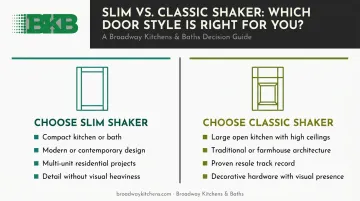
Choose slim shaker if:
- The kitchen or bathroom is compact
- The design direction is modern, contemporary, or minimalist-transitional
- The project involves multi-unit residential where broad aesthetic appeal matters
- You want cabinet detail without visual heaviness
Choose classic shaker if:
- The kitchen is large and open with high ceilings
- The home has traditional, farmhouse, or craftsman architecture
- You want a style with the longest proven track record in buyer preference
- The design calls for decorative hardware with more visual presence
For Design and Construction Professionals
For architects, decorators, and contractors specifying cabinetry across multi-unit or commercial projects, slim shaker offers a neutral-modern look that works across diverse buyer preferences without dating quickly.
Broadway Kitchens & Baths works directly with construction professionals and management companies to source and specify cabinetry across projects of any scale in the tri-state area. The team handles both slim and classic shaker options and is proficient in union and non-union environments, managing the full process from field measurements through final punch-list.
Conclusion
Slim shaker and classic shaker are not competing styles — they're different tools for different jobs. Slim shaker brings a contemporary, space-efficient profile suited to modern homes, compact layouts, and urban projects where visual lightness is a design goal. Classic shaker offers the depth, warmth, and architectural weight that traditional and transitional spaces need.
The best choice depends on the specific project context: room size, home architecture, design direction, and who will live or work there. Getting that match right — between style, space, and end user — is where the real value of a well-specified cabinet lies.
If you're planning a kitchen or bath renovation — whether a single residence or a multi-unit project — Broadway Kitchens & Baths can help you match the right cabinet profile to your project specs. Visit our showrooms in Englewood, NJ, or Manhattan, NY, or call (201) 567-9585 to speak with a design consultant directly.
Frequently Asked Questions
What's the difference between shaker and slim shaker cabinets?
Both styles use five-panel recessed door construction. The key distinction is frame width: slim shaker stiles and rails typically measure ¾ to 1¾ inches wide, while classic shaker frames run closer to 2 3/16 to 3 inches. That difference shifts the overall aesthetic from traditional and substantial to clean and contemporary.
Is slim shaker more expensive?
Pricing depends on manufacturer, material, finish, and construction method — not style category alone. Where slim shaker costs more, it typically reflects the precision required to produce narrower frames cleanly, not a universal price difference.
Are slim shaker cabinets a fad?
Slim shaker is an evolution of classic shaker, carrying the same five-panel construction with a refined frame. Its growing adoption in new construction and multi-family residential projects points to lasting design relevance, not a passing trend.
Which cabinet style works better for small kitchens?
Slim shaker is generally the stronger fit. Narrower frames make cabinet doors appear larger and reduce visual clutter in compact spaces — a meaningful advantage in galley kitchens, small apartments, and tight bathroom layouts.
What hardware works best with slim shaker cabinets?
Bar pulls in brushed nickel or matte black pair most naturally with slim shaker's clean profile. Hidden hinges and soft-close mechanisms keep the look consistent. Avoid heavy or ornate hardware that competes with the door's refined character.
Can slim shaker cabinets be used in bathrooms?
Yes — slim shaker is particularly well-suited for bathroom vanities, especially in modern or smaller bathrooms. The refined frame profile contributes to an uncluttered, spa-like aesthetic that flat slab doors lack and classic shaker can sometimes overpower in tight spaces.