The constraints are real: no counter space, cabinets that stop a foot short of the ceiling, appliances that eat into what little aisle you have, and building rules that can complicate even a straightforward cabinet swap.
But a small footprint doesn't mean a bad kitchen. The right renovation choices can dramatically change how a compact NYC kitchen looks, functions, and feels — without knocking down walls or fighting your co-op board over structural changes. The 12 ideas below are curated specifically for NYC apartment kitchens, balancing design impact, practicality, and the realities of working within NYC building requirements.
Key Takeaways
- NYC apartment kitchens often run under 90 sq ft — smart design choices beat square footage every time
- Vertical storage, layout efficiency, and light-amplifying surfaces deliver the biggest impact in tight spaces
- Board approvals, gas restrictions, and asbestos surveys must be addressed before any NYC renovation begins
- Cosmetic upgrades cost far less than layout changes involving plumbing or gas
- Partnering with a local renovator familiar with NYC building rules prevents costly mid-project surprises
Why Small NYC Kitchens Need a Different Approach
More than 64% of NYC housing units were built before 1960, according to Furman Center analysis. That translates directly into kitchens designed around pre-modern cooking habits — narrow galley runs, minimal counter real estate, and legacy plumbing and gas systems that complicate upgrades.
The national average kitchen runs 161–169 sq ft. Many NYC galley kitchens operate in half that space.
That gap matters for renovation planning — what works in a suburban kitchen often backfires in a Manhattan apartment. Before covering the 12 ideas below, understanding the two broad categories of renovation work shapes every decision downstream:
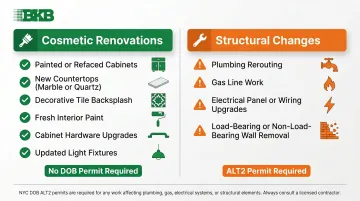
- Cosmetic renovations — cabinet replacement, new countertops, backsplash, paint, hardware, lighting — generally don't require DOB permits and may only need a basic decoration agreement from your building
- Structural changes — moving plumbing, rerouting gas, adding electrical circuits, or removing walls — require an ALT2 permit filed by a licensed PE or architect, plus full board approval in most co-ops and condos
12 Best NYC Apartment Kitchen Renovation Ideas
1. Maximize Vertical Space with Floor-to-Ceiling Cabinets
In an NYC apartment with standard 8–9 ft ceilings, the gap between the top of your upper cabinets and the ceiling is wasted space — and a dust trap. Extending cabinets all the way to the ceiling adds real storage without touching the floor plan.
Use the upper portion for seasonal cookware, bulk pantry items, and anything you access less than weekly. Keep everyday-use items in the lower, easily reachable sections.
Broadway Kitchens & Baths carries several cabinetry lines suited for custom-height configurations, including Plain & Fancy (fully handcrafted, built to exact dimensions) and UltraCraft (American-made semi-custom with hundreds of door styles). Every order includes professional field measurement and design rendering — important in NYC apartments where ceiling heights and soffit situations vary unit to unit.
2. Choose a Galley or L-Shaped Layout
Layout is the single most consequential decision in a small kitchen renovation. NKBA planning guidelines establish clear benchmarks:
- Work triangle total: no more than 26 ft, with each leg between 4 and 9 ft
- Work aisle minimum: 42 inches for one cook, 48 inches for two
Galley and L-shaped layouts are the most space-efficient configurations for kitchens under 90 sq ft. Both keep the sink, stove, and refrigerator within a compact triangle that minimizes unnecessary movement.
What to avoid: U-shaped layouts in very tight spaces can feel boxed-in and are hard to work in when more than one person is in the kitchen. If you want a peninsula, only add one when you can maintain a clear 42-inch walkway on all open sides.
3. Install Open Shelving or Glass-Front Doors
Solid upper cabinet doors create a wall-of-wood effect that makes small kitchens feel even more enclosed. Replacing some or all of them with open shelving or glass-front panels visually opens the room.
A few practical rules for this to work:
- Keep open shelves curated — dishware, glassware, or attractive cookware only
- Avoid storing visual clutter (mismatched containers, random pantry items) on open shelves
- Consider glass fronts as a middle ground: closed for dust protection, open-feeling visually
Cluttered open shelves have the opposite effect of what you're going for. Edit ruthlessly.
4. Use Compact and Panel-Ready Appliances
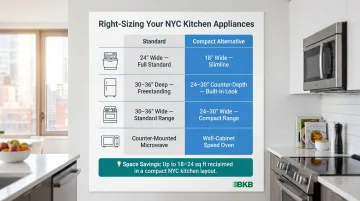
Standard appliances are sized for homes, not NYC apartments. Compact alternatives reclaim meaningful space:
| Appliance | Standard Size | Compact Alternative |
|---|---|---|
| Dishwasher | 24 inches wide | 18-inch compact model |
| Refrigerator | 30–36 inches deep | 24–30-inch counter-depth |
| Range | 30–36 inches wide | 24–30-inch range |
| Microwave | Counter-mounted | Speed oven at wall-cabinet height |
Panel-ready appliances — dishwashers and refrigerators designed to accept a custom cabinet door panel — are an especially effective NYC renovation move. They allow appliances to blend seamlessly with cabinetry, making a small kitchen feel cohesive rather than visually fragmented.
5. Add Toe-Kick Drawers and Pull-Out Interior Storage
The recessed space at the base of your cabinets (the toe-kick) is almost universally ignored. It shouldn't be — that space can house shallow drawers for baking sheets, cutting boards, and flat kitchen linens.
Beyond toe-kicks, interior cabinet storage accessories deliver outsized returns in small kitchens. Broadway Kitchens & Baths offers a full range of organizational solutions, including:
- Roll-out shelves that bring base-cabinet items to the front without digging
- Spice pull-outs — 6-inch-wide one-door cabinets that slide out beside a range
- Corner solutions including lazy Susans, chrome pull-out systems, and spinning organizers
- Trash pull-outs that move waste bins inside cabinetry and off the floor
The company sources accessories from Rev-A-Shelf, Richelieu, and Hafele — and most are integrated directly into their cabinetry manufacturing process.
6. Incorporate a Slim Rolling Island or Fold-Down Table
When you have no room to expand, you need prep surface that moves. A rolling island 18–24 inches wide provides additional counter space and under-counter storage — and can be rolled against the wall or into an adjacent room when not in use.
For even tighter kitchenettes, wall-mounted fold-down tables serve the same purpose. When folded, they take up zero floor space. When extended, they provide a prep or dining surface on demand.
7. Layer Your Lighting: Under-Cabinet, Recessed, and Pendant
Lighting does more for a small kitchen than most homeowners realize. A peer-reviewed study published in the journal Sustainability found that illuminated walls increase perceived spaciousness, and that horizontal light distribution makes rooms feel wider while vertical emphasis makes them feel taller.
A layered approach covers the full range:
- Recessed ceiling lights for general ambient illumination
- Under-cabinet LED strips to eliminate counter shadows (the primary work surface in any kitchen)
- Pendant or track lighting over a peninsula or island for task lighting and visual warmth
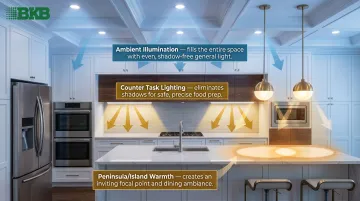
In NYC apartments where natural light is often limited, this layering — combined with reflective surfaces — can dramatically change how large the kitchen feels.
8. Use a Slab Backsplash for Visual Continuity
Standard tile backsplashes have one visual drawback: grout lines. In a small kitchen, all those horizontal and vertical divisions create visual noise that makes the space feel busier and more enclosed.
A slab backsplash — a single continuous piece of stone, quartz, or porcelain running from counter to upper cabinets — eliminates that. The uninterrupted surface creates a seamless, expansive look that tile doesn't replicate. It's also easier to clean: no grout to scrub in a kitchen where every surface gets regular use.
Broadway Kitchens & Baths carries countertop and slab materials from Caesarstone, Silestone, Corian Quartz, and MSI Stone — all of which can be specified in large-format configurations suitable for slab backsplash installations.
9. Go Induction: Swap Gas for an Induction Cooktop
Induction is particularly well-suited to small NYC kitchens for several reasons:
- Sits flush with the counter surface, usable as prep space when not cooking
- No open flame, so ventilation demands are lower
- Produces significantly less ambient heat — a real advantage in a compact space
- Compatible with buildings that have restricted or paused gas line work
On efficiency: induction transfers energy at roughly 84–90% efficiency compared to about 40% for gas, according to ACEEE research. Less wasted heat means a cooler, more comfortable kitchen.
There's also a policy dimension. NYC's Local Law 154 of 2021 phases out on-site combustion in new buildings — effective January 1, 2024 for buildings under 7 stories. If your building is moving toward electrification, planning around induction now is the smarter long-term call.
10. Choose a Counter-Depth Refrigerator
A standard-depth refrigerator protrudes 6–8 inches beyond the counter edge. In a galley kitchen where aisle width is already at the minimum, that intrusion noticeably narrows circulation. Counter-depth models align flush with cabinetry and reclaim that walkway.
The trade-off is interior capacity — counter-depth fridges hold less. Assess your actual storage needs honestly before committing. If you cook most meals at home and store a week's worth of groceries, you may feel the reduced capacity. If you're a two-person household that shops frequently, it probably won't matter.
Integrated or panel-ready counter-depth models deliver the additional benefit of visual cohesion with surrounding cabinetry.
11. Keep a Cohesive, Light Color Palette
When cabinets, countertops, and walls share the same color family, the eye moves smoothly across the space without interruption. That continuous flow makes the room read larger than its actual square footage.
The NKBA 2025 Kitchen Trends Report points to calming earth tones as the leading direction, with green cited by 76% of design professionals, blue by 63%, and brown by 56%. Light, tonal palettes in any of these ranges support visual expansion while staying current.
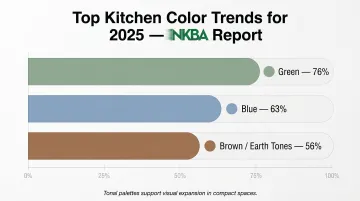
What to avoid: high contrast between adjacent surfaces in a small kitchen. A dark cabinet next to a white countertop next to a colored wall visually chops the room into smaller sections. Tonal consistency — not necessarily all-white — is the goal.
12. Use High-Gloss or Reflective Surfaces to Amplify Light
High-gloss cabinet finishes, polished stone countertops, and glossy ceramic tile bounce both natural and artificial light around the kitchen. In NYC apartments where windows are small or blocked by adjacent buildings, this matters more than it would in a suburban home.
The design balance: pair reflective surfaces with matte elements to keep the space from feeling sterile.
- Glossy upper cabinets + matte lower cabinets or countertop
- Polished stone backsplash + flat-painted walls
- High-gloss tile + natural wood accents
One surface doing the reflecting is enough. Everything glossy tips into clinical.
What to Consider Before Starting Your NYC Kitchen Renovation
Building Approvals and Permits
Most structural kitchen work in NYC requires an ALT2 permit filed by a licensed PE or registered architect. Cosmetic work (new cabinets in the same layout, countertop replacement, paint) generally doesn't require a DOB permit, though your building may still require a decoration agreement along with contractor insurance and license documentation.
Work that typically triggers an ALT2 permit includes:
- Moving or rerouting plumbing lines
- Rerouting gas lines
- Adding or modifying electrical circuits
- Removing or altering walls
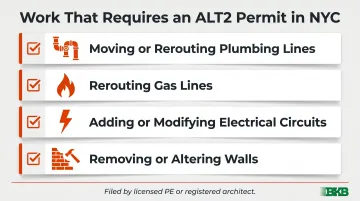
Co-op and condo boards typically require a formal alteration agreement for anything that modifies building systems. Board review timelines stretch weeks to months, so factor this into your project schedule from the start.
Asbestos Surveys in Pre-1987 Buildings
Buildings constructed before April 1, 1987 require an asbestos assessment by a Certified Asbestos Investigator before DOB permit issuance. The ACP-5 form documents that no asbestos project is required; if abatement is needed, ACP-7 and subsequent forms follow. Budget both time and cost for this step — skipping it can halt a renovation mid-project.
Gas Restrictions
Many NYC buildings are moving toward electrification or have paused new gas work entirely. If you're planning to keep a gas range, verify your building's current policy before designing around it. Induction is the practical alternative: Local Law 154 is pushing new and substantially renovated spaces in that direction regardless, so designing around it now avoids a costly mid-project pivot.
With these compliance checkpoints confirmed, the renovation ideas below become much easier to execute on budget and on schedule.
Conclusion
Transforming a small NYC apartment kitchen doesn't require more square footage. It requires smarter choices: extending storage to the ceiling, choosing the right layout, selecting appliances sized for the space, and using light and surface finishes to make every square foot feel more generous.
Customer Annette P.S. put it well after her Broadway Kitchens & Baths galley renovation: "The quality of materials and the careful design using every square inch of my small NYC galley kitchen turned the room into this home cook's dream space. What I now have is a drop-dead gorgeous kitchen which looks and feels larger than it is."
In NYC kitchen renovations, design decisions and building approval processes are tightly linked — getting one wrong affects the other. Broadway Kitchens & Baths has been working in Manhattan and Brooklyn apartments since 1995, with in-house carpentry crews experienced in both union and non-union buildings and a full range of cabinetry, countertops, and interior storage solutions sized for compact urban spaces.
Book a free design consultation at their Manhattan or Englewood, NJ showroom — call (212) 260-7768 for NYC or (201) 567-9585 for New Jersey.
Frequently Asked Questions
How much does it cost to redo a kitchen in NYC?
NYC kitchen renovations typically run above national averages due to labor rates, permitting, and building logistics. Nationally, Angi reports the average kitchen remodel at $26,944, with full gut renovations exceeding $130,000. In NYC, expect to add 15–25% for system moves and dense-building logistics, plus separate costs for permits and board approval.
How much should it cost to renovate a small kitchen?
A cosmetic refresh (paint, hardware, countertops) may start around $15,000–$20,000 in NYC. A mid-range remodel with new cabinets and appliances typically falls in the $30,000+ range. Full gut renovations with layout changes cost much more. Budget separately for permits, asbestos surveys, and board approval time on top of materials and labor.
Can you remodel a small kitchen for $10,000?
At $10,000 in NYC, expect paint, new hardware, and selective surface swaps — not full cabinet refacing plus appliance upgrades. NYC labor rates make $10,000 a tight budget for cosmetic-only work. Cabinet replacement, countertop installation, or any plumbing work will push costs higher.
What is the best layout for a small NYC apartment kitchen?
Galley and L-shaped layouts are the most efficient for small NYC kitchens. Both keep the sink, stove, and refrigerator within a compact work triangle and maintain the 42-inch aisle minimum required for comfortable one-person cooking. Galley kitchens work particularly well in narrow, rectangular spaces common in pre-war apartments.
Do I need board approval to renovate my NYC apartment kitchen?
Cosmetic changes (paint, hardware, countertop swaps, cabinet replacement in the same footprint) typically require only a decoration agreement or basic building notification. Structural work — plumbing, electrical, gas, or wall removal — requires a full alteration agreement and board approval. NYC DOB permits must be filed by a licensed PE or architect.
What kitchen cabinets work best in small NYC apartments?
Floor-to-ceiling cabinets in light, cohesive finishes with interior pull-out organizers deliver the most storage in the least footprint. Semi-custom and fully custom cabinetry, sized precisely to your ceiling height and dimensions, consistently outperforms stock sizing in NYC apartments where non-standard measurements are the norm.