For St. George homeowners navigating a remodel, that balance matters. The area's newer construction and open-plan layouts call for cabinetry that reads clean and contemporary without abandoning timeless craftsmanship. Slim shaker cabinets answer that call directly.
This guide covers everything you need to make a confident decision: what slim shaker cabinets actually are, how they compare to standard shaker, design applications across kitchens and bathrooms, color and material guidance, and how to get started on your project locally.
Key Takeaways
- Slim shaker cabinets use narrower stiles and rails than standard shaker, creating a lighter, more contemporary look
- Suit open-plan kitchens, smaller bathrooms, and minimalist interiors without sacrificing durability
- Shaker is the most popular cabinet door style, chosen by 60% of homeowners renovating in 2024 per Houzz
- White, off-white, and warm wood tones (especially white oak) offer the best long-term color value
- Bar pulls remain the dominant hardware choice, appearing in 75% of updated kitchens
What Are Slim Shaker Cabinets?
Slim shaker cabinets are five-piece recessed-panel doors — the same fundamental construction as a classic shaker door — but with narrower stiles and rails (the vertical and horizontal frame members surrounding the center panel).
Standard shaker doors typically run around 2¼" to 2⅝" wide on stiles and rails. Slim shaker cuts that down noticeably: Dura Supreme's Paris door, for example, uses 1¾" rails and stiles, while Barker Door's slim shaker uses just a 1" visible stile and rail. The result is a door that keeps the shaker silhouette but reduces the visual frame weight.
What They're Called
You'll encounter several names for the same profile:
- Slim shaker — the most common term
- Narrow shaker — used interchangeably
- Skinny shaker — popular in design media
- Thin shaker — appears in some manufacturer catalogs
- Proprietary names — Fabuwood calls theirs Luna, Diamond uses Bryant Narrow Rail, Dura Supreme offers the Paris, Wellborn has Muriel and Florence
There's no industry-wide standard defining where "slim" begins and "standard" ends, so it's worth asking your cabinet supplier for the exact rail and stile dimensions before committing.
Why the Narrower Frame Changes Everything
The slimmer border shifts the entire character of the door. A standard shaker reads as traditional — suited to farmhouse kitchens, cottage interiors, or classic craftsman homes. Shave down the frame, and the same door becomes transitional or modern. The center panel gets more visual space, the overall door looks airier, and the cabinetry stops competing with the rest of the room.
Slim shaker cabinets work in kitchens, bathrooms, laundry rooms, mudrooms, and home offices — anywhere you want clean-lined storage that doesn't feel cold or sterile.
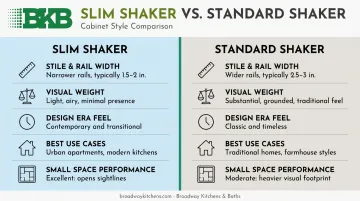
Slim Shaker vs. Standard Shaker Cabinets
Here's a direct comparison to help clarify when each style makes sense:
| Feature | Slim Shaker | Standard Shaker |
|---|---|---|
| Stile/rail width | ~¾" to 1¾" (varies by brand) | ~2¼" to 2⅝" |
| Visual weight | Light, airy | Heavier, more traditional |
| Design era feel | Transitional to modern | Traditional to farmhouse |
| Best for | Open plans, minimalist, contemporary | Cottage, craftsman, classic |
| Works in small spaces | Yes (less visual clutter) | Can feel heavy |
What Does It Cost?
The slim shaker profile itself doesn't automatically cost more. Cabinet pricing is driven primarily by:
- Cabinet tier — stock, semi-custom, or custom
- Material — MDF, solid wood, or veneer
- Finish — painted vs. stained vs. natural
- Box construction — plywood vs. particleboard carcass
HomeAdvisor puts shaker cabinet costs at $100–$1,200 per linear foot, while Angi reports custom cabinets ranging $500–$1,200 per linear foot. Both ranges apply equally to slim and standard shaker — the door profile is one of the smaller cost variables.
Which Style Is Right for Your Home?
Choose slim shaker if your space is:
- An open-plan kitchen visible from living areas
- A smaller kitchen or bathroom where visual lightness matters
- A newer build or renovated condo with contemporary finishes
- A project prioritizing transitional or modern aesthetics
Choose standard shaker if your space is:
- A farmhouse, cottage, or craftsman-style home
- A traditional interior with ornate millwork or decorative tile
- A larger kitchen where the heavier frame adds desirable substance
Long-Term Investment Value
Shaker cabinets have held a 60% market share consistently year over year — not a trend spike, but a sustained preference across residential and commercial projects alike. Slim shaker carries that same proven foundation while adapting it to contemporary taste. For architects and designers specifying cabinets for longevity, that's a meaningful distinction from purely cycle-driven styles like ultra-flat slab doors or ornate raised panels, which tend to date faster.
Design Styles and Applications for St. George Homes
St. George's housing stock leans newer, with open-plan layouts and mixed transitional interiors that play directly to slim shaker's strengths. The narrower frame keeps cabinetry from visually dominating large open spaces — an important consideration when your kitchen is visible from the living room and dining area simultaneously.
Kitchens
In open-plan kitchens, slim shaker creates a clean, recessive backdrop. Pair the doors with quartz or stone countertops and integrated appliances and the cabinetry recedes into the design rather than competing with it.
Two-tone applications work particularly well here. White or off-white slim shaker uppers with navy, sage, or warm wood-tone lowers add personality without overwhelming the minimalist structure. Houzz data supports this direction — medium and dark wood tones for contrasting island colors have grown steadily, with some homeowners using two-tone cabinet combinations as a way to refresh the kitchen without a full gut renovation.
Common two-tone pairings that work in St. George interiors:
- White uppers with warm walnut or oak-tone lowers
- Off-white uppers with navy or deep sage bases
- Light gray uppers with a contrasting island in charcoal or black
Bathrooms
Slim shaker vanity cabinets work well in St. George bathrooms because the reduced frame profile keeps smaller footprints from feeling crowded. The clean lines also pair naturally with:
- Freestanding soaking tubs
- Wall-mounted faucets and fixtures
- Large-format tile with minimal grout lines
- Frameless glass shower enclosures
Houzz's 2024 bathroom study found wood was the top vanity color choice at 26%, followed by white at 22% — both suit slim shaker proportions well, since the narrower stile doesn't compete with the finish for visual weight.
Home Offices and Beyond
Slim shaker cabinetry translates well to home offices, built-in storage walls, laundry rooms, and mudrooms. Using the same door profile throughout the home creates a unified design language. To keep finishes consistent across rooms, specify the same manufacturer and door line from the start — mixing cabinet brands mid-project often produces subtle color and sheen differences that become obvious at transitions.
Best Colors and Finishes for Slim Shaker Cabinets
Color choice matters more with slim shaker than with busier door styles, because the reduced frame puts the finish front and center.
Colors That Won't Date
According to Houzz's 2024 Kitchen Trends Study, white remained the most popular cabinet color at 46%, with wood tones at 25%. These aren't just trends — they're proven long-cycle choices. The most reliable options:
- White and off-white — bright, versatile, and compatible with virtually any countertop or tile
- Soft gray and greige — warmer than white, cooler than wood, very adaptable
- Navy blue — adds depth and richness without reading trendy
- Warm wood tones — natural maple and white oak have surged in popularity; white oak in particular has become a dominant choice among renovators seeking warmth without heavy grain
Saturated trend colors — terracotta, deep emerald, high-contrast black — can work in accent positions (a kitchen island, for example) but carry more risk as a whole-kitchen commitment.
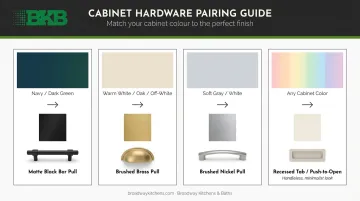
Hardware Pairing Guide
Color sets the tone, but hardware closes the look. On slim shaker doors, the narrower stile gives pulls and knobs more visual weight — so the pairing matters. Reliable combinations include:
- Matte black bar pulls with navy or dark green cabinets
- Brushed brass with warm white oak or off-white painted doors
- Brushed nickel with soft gray or white for a quieter, Scandinavian-adjacent look
- Recessed tab pulls or push-to-open for an ultra-clean, hardware-free look
Houzz 2024 reported bar pulls chosen in 75% of renovated kitchens — proportional and clean-lined, they're a natural fit for the slim shaker profile.
Customization Options: Materials, Hardware, and Features
Slim shaker cabinets offer more material and feature flexibility than most homeowners expect. The choices you make here affect both long-term performance and daily usability — especially in a climate as dry as St. George's.
Door Material Trade-offs
| Material | Best For | Watch Out For |
|---|---|---|
| Solid wood | Stained finishes, traditional quality feel | Moves with humidity; more visible joint lines in paint |
| HDF/MDF | Painted finishes, clean seamless look | Not as water-resistant; requires quality substrate |
| Wood veneer | Natural grain look with more stability | Edge quality varies; not immune to warping |
Houzz 2024 found solid wood used in 76% of new cabinets — it remains the default among buyers prioritizing traditional craftsmanship. For painted slim shaker specifically, HDF/MDF is worth considering: Dura Supreme notes that painted HDF has less than 0.5% moisture content versus 6.5% for maple, which helps minimize the expansion and contraction that can cause visible joint cracking in painted doors over time. In St. George's low-humidity environment, that stability advantage is less about seasonal swings and more about protecting against rapid temperature shifts between air-conditioned interiors and dry desert heat.
Interior Features Worth Requesting
When planning your slim shaker project, discuss these functional upgrades with your designer:
- Soft-close hinges — standard on most quality lines now; reduces wear and door noise over time
- Pull-out waste and recycling drawers — 66% of renovating homeowners requested these in Houzz 2024
- Deep drawers for lower cabinets — more accessible than door-and-shelf bases for pots, pans, and pantry storage
- Cookie-sheet and spice pull-outs — specified by 55% and 44% of kitchen remodelers respectively
- Bi-fold door systems — removes swing clearance problems in tight bathroom or laundry layouts
Planning Your Slim Shaker Cabinet Project in St. George
A cabinet remodel has more moving parts than most homeowners expect. Here's a realistic sequence:
- Design consultation — Establish your layout, door style, finish direction, and overall scope
- Field measurements — Accurate dimensions prevent costly errors at installation
- Material and finish selection — Door style, wood species or MDF, paint or stain color
- Hardware and countertop coordination — Select these alongside cabinets, not after, to ensure a cohesive palette
- Order and lead time — Custom and semi-custom cabinets typically require several weeks; plan accordingly
- Installation and punch-list — Final walkthrough to address any fit or finish issues before project close

Working with a partner who manages this process end-to-end keeps the project on schedule and on budget. Broadway Kitchens & Baths works with design professionals, architects, and construction teams seeking a wide selection of cabinetry options — including brands like Wolf Classic Cabinets, Plain & Fancy, and UltraCraft — with a process that runs from initial field measurements through final installation.
Their team can walk you through slim shaker door options, confirm exact rail and stile dimensions for the lines they carry, and help coordinate hardware, countertops, and finishes into a cohesive plan. Reach their Englewood, NJ showroom at (201) 567-9585 to schedule a consultation.
Frequently Asked Questions
What is a thin (slim) shaker cabinet called?
Slim shaker cabinets are also marketed as thin shaker, narrow shaker, or skinny shaker — all referring to the same narrow-frame recessed-panel door style. Individual manufacturers often use proprietary names: Fabuwood calls theirs Luna, Diamond uses Bryant Narrow Rail, and Dura Supreme offers the Paris.
Are slim shaker cabinets more expensive than standard shaker cabinets?
Cabinet pricing is driven by tier (stock vs. custom), material, and finish — not door profile. Custom sizing or premium wood species can increase costs for either style, but the narrower frame itself isn't a significant price driver.
Are slim shaker cabinets still in style?
Yes. Slim shaker builds on the shaker style's proven longevity — 60% of renovating homeowners chose shaker doors in 2024 — while adding a contemporary edge that resists short-cycle trend pressure.
What kitchen colors won't date for slim shaker cabinets?
White, off-white, soft gray, navy, and warm wood tones (particularly white oak and natural maple) are the most reliable choices. These neutrals and natural finishes stay relevant across decades and resist short-cycle trend pressure.
What's the difference between slim shaker and skinny shaker cabinets?
The terms are used interchangeably in most contexts. Some manufacturers use "skinny shaker" to describe an even more minimal frame, but there's no universal industry standard drawing a firm line between the two. Always ask for the exact stile and rail dimensions from your supplier.
Can slim shaker cabinets work in a bathroom remodel?
Yes — slim shaker vanity cabinets suit both small and large bathrooms. Their reduced frame keeps the look light and contemporary, and the clean lines complement modern fixtures, freestanding tubs, and large-format tile without visual competition.