The good news is that this layout is actually one of the most efficient cooking configurations ever designed. The problem isn't the galley format itself — it's that most haven't been thoughtfully renovated to match how people actually live in them.
This guide covers 15 renovation ideas organized across three categories: layout and space-opening moves, smart storage and cabinetry upgrades, and lighting, color, and design refreshes. Each idea is tailored to the specific realities of NJ and NYC renovations — building codes, co-op approval requirements, older construction, and tight square footage. Practical planning guidance (and current cost ranges) follows at the end.
Key Takeaways
- A galley kitchen has two parallel counter runs with a central walkway — the standard layout in NJ/NYC apartments, co-ops, and condos
- The highest-impact renovations tackle layout flow first, then storage, then aesthetics
- NYC mid-range kitchen renovations typically run $30,000–$55,000; NJ mid-range starts around $35,000+, both well above the national average
- Below, 15 ideas are organized into three categories: Layout & Space-Opening, Smart Storage & Cabinetry, and Light, Color & Design
Layout & Space-Opening Ideas (Ideas 1–5)
In NJ and NYC, reconfiguring square footage is rarely an option. Smart layout decisions are where the most dramatic improvements happen — better flow, fewer visual barriers, and smarter use of the footprint you already have.
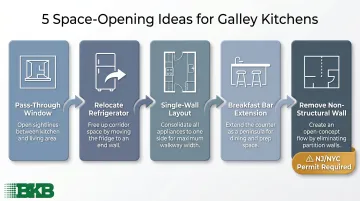
Idea 1: Open a Pass-Through Window to the Living Space
Knocking a countertop-height opening through to the living room or dining area, even without removing the full wall, changes how a galley kitchen feels. Light enters from another direction. The corridor effect breaks. The kitchen stops feeling like a sealed-off room.
This works particularly well in prewar apartments and NJ row houses where the kitchen wall is adjacent to the living room but not load-bearing. Keep in mind:
- NYC co-ops and condos typically require board approval for any structural modification — check your alteration agreement before planning this change
- A pass-through is far less invasive (and less expensive) than a full wall removal, making board approval more likely
- Counter-height openings can double as a breakfast bar, adding function to the aesthetic benefit
Idea 2: Relocate the Refrigerator
A refrigerator placed at the kitchen entrance creates an immediate bottleneck. In a narrow galley, that protrusion forces a squeeze every time someone enters, blocking prep space on the adjacent counter as well.
Moving the refrigerator to the far end of the galley opens the entry, improves traffic flow, and often reveals usable prep space that was previously blocked.
Pro tip: If full relocation isn't feasible due to plumbing or electrical constraints, a counter-depth refrigerator is a lower-cost alternative. Standard models protrude 30–36 inches beyond cabinetry; counter-depth units run 24–30 inches, freeing up roughly 6 inches of aisle width. In a galley where clearance is already tight, that difference is felt immediately.
Idea 3: Switch to a Single-Wall Layout for Very Narrow Spaces
For galley kitchens under 7 feet wide, concentrating everything on one wall and leaving the opposite wall clear creates a walkway that actually functions. The kitchen feels less like a corridor and more like a purposeful room.
This works especially well in:
- Studio apartments across NJ's urban centers (Hoboken, Jersey City, Newark)
- Secondary kitchens in multi-unit residential buildings
- Spaces where the priority is a usable walkway over maximum cabinet storage
Idea 4: Add a Breakfast Bar or Counter Extension
Dropping one counter section to bar height — or extending it slightly beyond the standard run — creates an eat-in zone without consuming extra floor space. In NYC apartments with no separate dining room, this is often the only practical way to add seating.
A few details that make this work:
- Choose slim-profile counter stools that tuck fully under the overhang when not in use
- Limit overhang depth to 12–15 inches to avoid blocking aisle traffic
- Waterfall or rounded edges reduce the visual bulk of the extended counter
Idea 5: Remove a Non-Structural Wall to Create Open-Concept Flow
Where budget and building structure allow, opening one end of a galley to the living or dining space transforms the entire layout. The shift from enclosed corridor to open kitchen is one of the more impactful changes possible in a constrained footprint.
The critical first step is identifying whether the wall is structural. In NJ and NYC's older building stock — prewar and 1930s–1960s construction — walls frequently conceal plumbing, gas lines, or load-bearing elements. A licensed contractor assessment is essential before any work begins.
NJ/NYC-specific note: Multi-trade structural work requires permits in both states. In NYC, this typically means an Alteration Type 2 permit filed by a licensed Professional Engineer or Registered Architect. In NJ, the Uniform Construction Code requires building permits for any structural, plumbing, or gas modifications.
Smart Storage & Cabinetry Ideas (Ideas 6–10)
Storage is where most galley kitchen renovations succeed or fail. Without sufficient organization, even a well-designed layout becomes cluttered fast. These five ideas make every inch count — floor to ceiling.
Idea 6: Extend Cabinets to Ceiling Height
Standard upper cabinets stop 12–18 inches below the ceiling, leaving a gap that collects dust and wastes significant storage potential. Ceiling-height cabinetry eliminates both problems.
Prewar buildings in NYC commonly have ceiling heights of 10–12 feet versus the 8–9.5 feet found in postwar construction. That vertical real estate is storage waiting to be claimed — ideal for seasonal cookware, pantry overflow, and small appliances that don't need daily access.
Non-standard ceiling heights — common in older tri-state area buildings — typically require semi-custom or fully custom cabinetry. Broadway Kitchens & Baths carries several lines suited to this, including UltraCraft, Plain & Fancy, and Wolf Classic Cabinets, with professional measurement and design rendering included on every project.
Idea 7: Replace Upper Cabinets on One Side with Open Shelving
Heavy upper cabinets on both walls create the tunnel effect that makes galley kitchens feel oppressive. Swapping one side for open shelving reduces visual bulk, keeps frequently used items accessible, and lets the eye travel through the space rather than stopping at cabinet doors.
One honest caveat: open shelving requires discipline. Overcrowded shelves undermine the airy effect entirely. Curated shelving that works:
- One consistent plate style, not a mix of patterns
- Glassware grouped by type (not scattered)
- Two or three decorative objects max — not a collection
- Everyday items within reach; everything else in closed cabinets below
Idea 8: Use Shallow or Slim-Profile Base Cabinets
Standard base cabinets run 24 inches deep. In a galley with a 42-inch work aisle (the NKBA's recommended minimum for a single-cook kitchen), that leaves limited room for comfortable movement once two people are in the space.
Shallow base cabinets — 12–18 inches deep on one side — preserve walkway clearance while still offering useful storage. The loss in cabinet volume is real, but in a space where the walkway is already tight, it's often the right call.
Idea 9: Install Pull-Out Pantry Systems and Drawer Organizers
In NJ and NYC apartments, pantry closets are rare. That makes the interior of every cabinet count. Pull-out pantry columns, deep drawer dividers, and vertical tray storage for baking sheets and cutting boards convert dead cabinet space into organized, accessible storage.
Broadway Kitchens & Baths incorporates pull-out systems from Rev-A-Shelf, Richelieu, and Hafele into cabinetry projects. Many of these can be added without a full renovation, which makes them a practical upgrade for an existing galley kitchen on a limited budget.
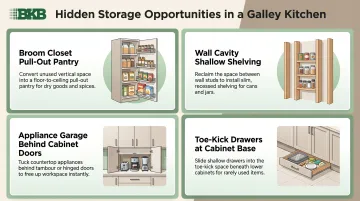
Idea 10: Repurpose Dead Space for Hidden Storage
Every galley kitchen in the tri-state area has dead space that isn't being used:
- A nearby broom closet converted to a pull-out pantry column
- Wall cavity between the kitchen and an adjacent room built out as shallow shelving
- Appliance garage units concealing small appliances behind cabinet doors
- Toe-kick drawers at the base of existing cabinetry
Identifying these opportunities requires a professional eye. A kitchen designer or experienced remodeler will spot storage possibilities that aren't visible on first walkthrough.
Light, Color & Design Refresh Ideas (Ideas 11–15)
Aesthetics and functionality aren't separate in a narrow galley — the right lighting, color, and surface choices make a small kitchen feel significantly larger without moving a single wall.
Idea 11: Choose a Light, Reflective Color Palette
Soft whites, warm neutrals, and light grays reflect both natural and artificial light back into the room. In a kitchen where walls are close together, that reflected light does real work.
Dark finishes can work in galley kitchens, but they require careful handling — primarily strong lighting and high-contrast countertops to prevent the space from feeling like a closed hallway.
Two-tone cabinetry offers a practical middle ground: slightly deeper lowers anchored by lighter upper cabinets keep the upper half of the room feeling open while adding visual interest at counter level.
Idea 12: Layer Lighting Strategically
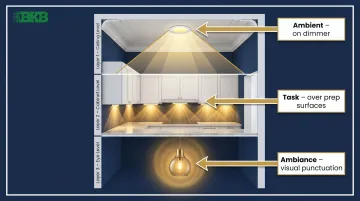
A single overhead fixture isn't enough for a galley kitchen. The three-layer approach:
- Recessed ceiling fixtures — general ambient brightness, ideally on a dimmer
- Under-cabinet LED strips — task lighting directly over prep surfaces, where it's actually needed
- A statement sconce or pendant — ambiance and visual punctuation
According to the U.S. Department of Energy, LED bulbs use at least 75% less energy and last up to 25 times longer than incandescent bulbs — a practical reason to use them throughout.
In very narrow galleys, hanging pendants can interrupt sightlines and make the ceiling feel lower. Recessed fixtures are the safer choice for the ambient layer.
Idea 13: Install Large-Format Tile or Continuous Flooring
Large-format floor tiles — 12×24 inches or larger — reduce the number of grout lines and visual breaks across the floor. Fewer lines mean fewer interruptions for the eye, which reads as a longer, wider space.
Orientation amplifies the effect. Rectangular tiles laid lengthwise — along the direction of the galley — elongate the visual space further with no additional cost.
The same logic applies to hardwood and LVP: continuous planks running the length of the kitchen create a sense of flow that tiles arranged across the narrow axis simply don't achieve. Key flooring choices to consider:
- Large-format tile (12×24"+): fewer grout lines, cleaner visual field
- Plank flooring (hardwood or LVP): strong directional flow when run lengthwise
- Consistent finish throughout: no transition strips between kitchen and adjacent rooms where possible
Idea 14: Add a Statement Backsplash
A bold backsplash draws the eye through the kitchen rather than toward the narrow walls. Subway tile in a herringbone pattern, zellige, or a full-height stone slab all create focal points that shift how the space reads.
The 2025 Houzz Kitchen Trends Study found that nearly 2 in 5 renovating homeowners chose horizontal brick as their backsplash pattern. In a galley, that horizontal emphasis does double duty — it reinforces the sense of length.
Glossy, glass, or mirrored mosaic tiles add another benefit: they bounce light throughout the kitchen, reducing the shadow buildup common in narrow spaces without direct natural light.
Idea 15: Modernize Hardware, Fixtures, and Finishes
Swapping cabinet pulls, faucets, and switch plates is one of the highest-ROI moves in a kitchen refresh — minimal cost, visible everywhere, no structural work required.
Popular finishes for 2026 lean warm: matte black, brushed brass, warm bronze, and unlacquered brass are all replacing the cool chrome and nickel that dominated the previous decade. They pair well with the neutral cabinetry palettes trending alongside them.
For NJ/NYC renters: hardware swaps are sometimes feasible without building approval, but confirm with your landlord or building management before ordering anything. Keep the original hardware to reinstall at move-out.
What to Consider Before Starting Your NJ/NYC Galley Kitchen Renovation
Budget Realistically for the Market
Kitchen renovation costs in NJ and NYC run well above national averages. The national average sits around $26,944 (Angi, 2026), but that figure doesn't reflect local labor rates, permit costs, or building-specific requirements.
| Market | Scope | Estimated Range |
|---|---|---|
| NYC | Minor/cosmetic | $12,000–$25,000 |
| NYC | Mid-range | $30,000–$55,000 |
| NYC | Full gut renovation | $60,000–$100,000+ |
| NJ | Minor/cosmetic | $15,000–$25,000 |
| NJ | Mid-range | $35,000–$65,000 |
| NJ | Full renovation | $45,000–$80,000 |
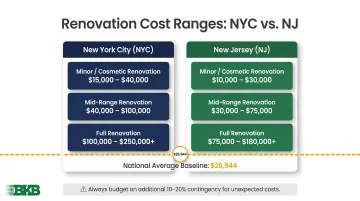
Set aside a 10–20% contingency on top of your budget. Older buildings in both states regularly produce structural surprises once walls open up.
Plan for Longer Timelines Than You Expect
A galley kitchen renovation that takes 6–8 weeks in a standalone NJ home can stretch to 5–9 months total in an NYC co-op. The co-op board review alone typically takes 4–8 weeks, with the full pre-construction phase (design, permits, procurement) running 3–5 months. Custom cabinet fabrication adds another 8–12 weeks from order to delivery.
The practical implication: material orders often need to begin before board approval is finalized to avoid exceeding the building's construction window — typically 90–120 days — and the daily fines that come with it.
Common Mistakes to Avoid
- Underestimating permit and approval timelines — both NYC DOB and NJ UCC requirements add time that homeowners frequently don't account for
- Choosing materials before confirming lead times — supply chain delays in the cabinet industry persist; order early
- Prioritizing aesthetics over workflow — in a galley, both walls need to serve functional purposes; don't sacrifice prep space for a beautiful but shallow storage solution
Work with a Local Specialist
Avoiding these pitfalls is easier with a contractor who already knows the territory. Broadway Kitchens & Baths works with residential and commercial clients across NJ and NYC, handling multi-family projects including condos, co-ops, apartment complexes, and mixed-use developments in Bergen County, Manhattan, Brooklyn, and the surrounding metro area. The team is proficient in both union and non-union environments and manages everything from field measurements through final punch-list, coordinating with other trades on-site.
Their showrooms in Englewood, NJ and Manhattan carry cabinetry, countertop, tile, and hardware options suited to galley kitchens. Designers on staff can work within the dimensional constraints of prewar buildings and urban apartments — something that matters when every inch of a narrow kitchen has to earn its keep.
Conclusion
A galley kitchen in NJ or NYC doesn't have to be a compromise. Whether the goal is better workflow, more storage, or a modernized aesthetic, the renovation approaches covered here address a wide range of budgets, building types, and project scopes.
Start with whatever causes the most daily frustration — usually layout bottlenecks or inadequate storage — before moving to cosmetic upgrades. That sequencing ensures every dollar spent solves a real problem.
For homeowners, builders, and architects ready to plan their galley kitchen renovation, Broadway Kitchens & Baths provides end-to-end support from first design consultation through final installation. Contact their Englewood, NJ showroom at (201) 567-9585 to get started.
Frequently Asked Questions
What is the average cost to remodel a galley kitchen?
In NYC, mid-range galley kitchen renovations typically run $30,000–$55,000, with cosmetic refreshes starting around $12,000; NJ projects range from $35,000 to $65,000+. Both markets sit well above the national average of roughly $27,000, driven by local labor rates, permit costs, and building-specific requirements.
How do you modernize a galley kitchen?
The highest-impact moves are updating cabinet hardware and faucet finishes (matte black, brushed brass, or warm bronze), improving lighting with under-cabinet LEDs and recessed fixtures, adding a statement backsplash, and replacing dated appliances with slimmer counter-depth models. These changes deliver strong visual results without requiring structural work.
What is the best layout for a galley kitchen?
A double-wall galley — appliances and cabinetry on both sides — is generally the most efficient for cooking workflow. A single-wall layout works better in very narrow spaces (under 7 feet wide) where preserving walkway clearance matters more than maximizing storage. The right choice depends on your available width and how you actually use the kitchen.
What is the 3x4 kitchen rule?
The 3x4 rule calls for three work zones — cooking, cleaning, and food prep — each at least 4 feet long, totaling a minimum of 12 linear feet of usable counter space. Note that this is separate from aisle width: the NKBA recommends 42 inches for one cook and 48 inches for two.
What are the 2026 kitchen trends?
The NKBA's 2026 Kitchen Trends Report highlights storage maximization, visual space expansion, and organic, earthy aesthetics as dominant themes. Hardware-wise, brushed brass, satin black, and warm bronze are replacing cool chrome. Full-height statement backsplashes, integrated appliances, and layered lighting round out the list.