Introduction
According to U.S. Bureau of Labor Statistics 2024 data, 27.1% of New Jersey workers and 21.2% of New York workers telework regularly — both above the national average of 22.8%. In the NJ and NYC tri-state area, that's a substantial share of households trying to be productive in spaces never designed for full-time work.
The challenge in this region is specific: co-op board restrictions, cramped square footage, thin walls, high contractor rates, and aging housing stock all complicate what should be a straightforward upgrade. A Manhattan one-bedroom doesn't offer the same options as a three-bedroom colonial in Montclair. Most generic home office advice ignores that gap entirely.
This guide covers 12 remodel ideas built specifically for tri-state area constraints and budgets — from quick cosmetic refreshes under $1,000 to full dedicated-room build-outs that can run $50,000 or more. Each idea is matched to the space types and renovation realities most common in this market.
Key Takeaways
- Cost range: Basic refresh starts around $1,000; full dedicated room build-outs run $15,000–$50,000+ in NJ/NYC
- Best small-footprint wins: Cloffice conversions, kitchen desk nooks, and Murphy bed combos
- Highest ROI upgrade: Custom floor-to-ceiling cabinetry with an integrated desk surface
- Top 2026 design trends: Biophilic elements, soundproofing, smart tech integration, and textured accent walls
- Solve function before aesthetics — nail lighting, storage, and acoustics before finalizing your look
Why NJ & NYC Homeowners Are Investing in Home Office Remodels in 2026
Hybrid work has become the baseline. 21% of NYC metro job postings were listed as hybrid in Q1 2026, per Robert Half's remote work research, and that share of the workforce is splitting time between office and home indefinitely. A corner of the dining table doesn't cut it when you're on video calls five days a week.
The property market adds another layer of pressure. With NJ and NYC home prices remaining elevated and mortgage rates keeping many homeowners locked in place, renovation — not relocation — is the primary path to a better living situation.
A dedicated home office addresses both concerns at once:
- Daily productivity — a proper workspace reduces distractions and supports focused work
- Resale value — listings with a home office have averaged a 3.4% price premium and sold 9 days faster, per a realtor.com survey cited by The Federal Savings Bank
With that context, here are 12 of the best home office remodel ideas for tri-state area homes in 2026.
12 Best Home Office Remodel Ideas for NJ & NYC Homeowners
These ideas are selected for their adaptability to common tri-state home types — urban apartments, NJ townhomes, and suburban single-family homes — and span a wide range of budgets and complexity levels.
Idea 1: Convert a Closet into a "Cloffice"
A cloffice — closet office — is one of the most space-efficient moves available to NYC apartment dwellers and NJ townhome owners. Remove the rod, install a desk surface at the right height, add open shelving above, and hang a quality task light. When the workday ends, close the doors and the office disappears entirely.
Practical checklist before starting:
- Confirm there's an accessible outlet inside, or budget for an electrician to add one
- Choose bifold or barn-style doors to keep the conversion reversible — important for co-op resale
- Shallow floating shelves (8–10 inches) maximize storage without encroaching on knee clearance
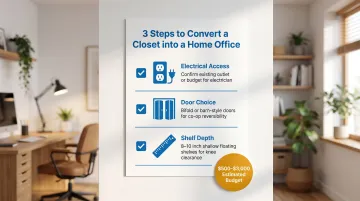
Budget range: $500–$3,000 depending on whether you're buying stock components or going custom.
Idea 2: Install Custom Built-In Cabinetry and a Desk System
No other home office upgrade delivers the same combination of function, aesthetics, and resale appeal as floor-to-ceiling custom cabinetry with an integrated desk surface. Every inch of wall space works, the room looks finished rather than improvised, and the off-the-shelf problem disappears entirely.
Because it's built to exact room dimensions, custom cabinetry handles the irregular angles and awkward corners common in NJ and NYC homes far better than stock furniture ever could.
Broadway Kitchens & Baths designs and installs exactly this type of system throughout the tri-state area. Their home office cabinetry includes custom desks, file storage, built-in bookshelves, and cable management — built using brands like UltraCraft, Plain & Fancy, and Wolf Classic Cabinets, with desk surfaces available in Silestone, Caesarstone, or Corian Quartz.
Their in-house carpentry crews are experienced working in NYC co-op and condo buildings where union-compliant labor and building board approvals are required. Every project starts with a free design consultation at their Englewood, NJ showroom.
Idea 3: Soundproof the Home Office
Dense NJ suburbs and NYC neighborhoods generate constant background noise: street traffic, neighboring units, HVAC systems, and thin walls in multi-family buildings. For professionals on calls all day, this isn't a minor inconvenience — it's a real productivity problem.
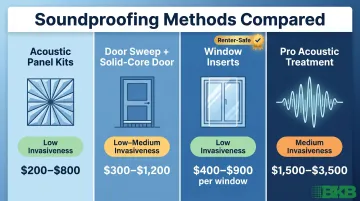
Effective soundproofing options, ranked by invasiveness:
| Method | Invasiveness | Estimated Cost |
|---|---|---|
| Acoustic panel kits (DIY) | Low | $200–$800 |
| Door sweep + solid-core door | Low-medium | $300–$1,200 |
| Window inserts (renter-safe) | Low | $400–$900 per window |
| Pro acoustic treatment (small office) | Medium | $1,500–$3,500 |
According to New York Soundproofing, a professionally treated small home office in NYC typically runs $1,500–$3,500. Window inserts are particularly useful for co-op owners who can't modify walls.
Idea 4: Maximize Natural Light
Many NJ and NYC rooms face other buildings, sit below grade, or have limited south-facing exposure — which makes intentional daylighting strategy worth the effort. Cornell University research found an 84% reduction in eyestrain, headaches, and blurred vision after optimizing daylight access for office workers. A peer-reviewed study published in the Journal of Clinical Sleep Medicine also linked window exposure to better sleep quality and overall well-being.
No-structural-change upgrades that actually work:
- Solar sheer shades — reduce glare while preserving daylight and outward views
- Light-reflecting paint — warm whites and soft off-whites bounce natural light deeper into the room
- Strategically placed mirrors — a large mirror perpendicular to a window can nearly double perceived daylight
- Skylight addition — for NJ homeowners with top-floor or basement offices, a tubular skylight is a 2026 trend worth the investment
Idea 5: Install a Murphy Bed + Desk Combo
When a home office must double as a guest room, a Murphy bed with an integrated fold-down desk is the most space-efficient solution available. Folded up, the bed disappears into a wall panel. The desk surface pivots into position. Modern units include hidden cable management and flanking storage columns.
Cost reality for the tri-state area:
- Standard desk-integrated Murphy bed: $2,500–$6,000 installed nationally (Angi 2026 data)
- Premium NYC-market brands (e.g., Resource Furniture's Circe Desk): from $8,335 product-only, before installation
- Custom millwork versions: $12,000–$20,000+
It's one of the pricier small-footprint solutions, but it eliminates the need for a dedicated guest bedroom entirely — a trade-off that makes sense when spare rooms are scarce.
Idea 6: Convert a Basement into a Dedicated Home Office
NJ homeowners have a structural advantage that most NYC residents don't: unfinished basements. A converted basement creates a completely separate, acoustically isolated floor with room for built-ins, a sitting area, and a proper closing door. It's the closest thing to a real dedicated office you can build without leaving the house.
Key upgrades required for a functional basement office:
- Install egress lighting (code-required in NJ — not discretionary)
- Address moisture with a vapor barrier, dehumidifier, or drainage membrane before finishing walls
- Route HVAC by extending the existing system or adding a mini-split unit
- Add dedicated electrical circuits for monitors, equipment, and lighting
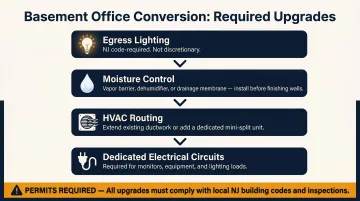
Permit note: In New Jersey, any basement finishing work involving electrical, HVAC, or plumbing changes requires permits under the NJ Uniform Construction Code. Applications go through the NJ DCA. A knowledgeable local contractor will handle the filing — but budget for the lead time.
Idea 7: Carve Out a Kitchen or Living Room Desk Nook
Not every NJ townhome or NYC apartment has a spare room to convert. For these homes, a built-in desk nook integrated into the kitchen or living room cabinetry run is often the most realistic path. A recessed alcove — even 24–30 inches wide — can house a functional workspace with upper cabinets above and matching finishes throughout.
Design tip: use a bold wallpaper or contrasting paint color inside the nook to visually separate the "work zone" from the surrounding space. This technique is common in NYC renovation projects and prevents the desk from feeling like an afterthought. The nook becomes a feature, not a workaround.
Broadway Kitchens & Baths' custom cabinetry lines — particularly Plain & Fancy for higher-end finishes or Wolf Classic for more budget-conscious projects — offer the flexibility needed to integrate a desk nook seamlessly into an existing kitchen design.
Idea 8: Convert a Spare Bedroom into a Full Home Office
For NJ suburban homeowners or NYC residents with a genuine second bedroom they don't need for sleeping, a full bedroom-to-office conversion is the most thorough approach. Done well, it creates a professional-grade workspace with layered lighting, built-in storage, and proper acoustic treatment.
Typical scope for a bedroom-to-office conversion:
- Built-in storage — floor-to-ceiling cabinetry along one or two walls
- Layered lighting — overhead (ambient), task (desk lamp positioned to eliminate screen glare), and accent (wall sconces)
- Window treatments — solar shades or blackout panels for glare control during video calls
- Optional seating area — a small sofa or two chairs for client meetings or focused reading
ROI caveat: In the NYC metro real estate market, removing a bedroom from the listing count can affect buyer pool and pricing. Consider reversible design choices — freestanding furniture, removable shelving — where possible, so the room can read as a bedroom again if needed at resale.
Idea 9: Incorporate Biophilic Design Elements
Biophilic design — natural materials, live plants, organic textures, views of greenery — has moved from boutique interiors into mainstream home office design. The shift is especially meaningful in dense urban environments where daily contact with nature is limited.
The evidence supports the investment: a 2015 Human Spaces global report surveying 7,600 employees across 16 countries found that workspaces with natural elements produced workers who were 6% more productive and reported 15% higher well-being than those in spaces without.
Practical entry points for NJ and NYC homes:
- Low-maintenance plants: Snake plants, pothos, and ZZ plants thrive with minimal light and irregular watering
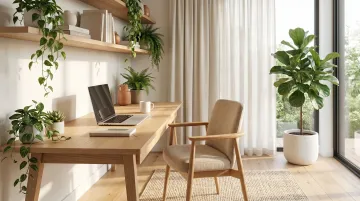
- Natural material accents: A solid wood desk surface, rattan accessories, linen curtains — these don't require structural work
- Moss panel accent wall: A preserved moss installation adds texture and biophilic benefit without irrigation
- Stone or quartz desk surface: Pairs naturally with cabinetry and adds tactile warmth
Idea 10: Upgrade to a Layered Lighting Scheme
Builder-grade overhead lighting — a single ceiling fixture, often with harsh color temperature — is the most common complaint in home offices and one of the easiest problems to fix. A three-layer approach transforms the space:
- Ambient layer: Recessed lights or a statement pendant at the appropriate color temperature (2700–3000K for warmth, 4000K for focus)
- Task layer: An adjustable desk lamp positioned to the side, not behind the monitor, to eliminate screen glare
- Accent layer: Wall sconces or picture lights that add depth and reduce the flat, institutional feeling of overhead-only lighting
NYC-specific note: If ceiling work requires co-op board approval, plug-in sconces and high-quality LED desk lamps deliver a significant lighting upgrade with zero permits required. This is a no-barrier path to a meaningfully better workspace.
Idea 11: Integrate Smart Home Technology and Ergonomic Upgrades
The 2026 home office technology layer is now accessible and practical for most budgets:
- Motorized window shades — especially useful for east- or west-facing rooms with direct sun during working hours; some integrate with voice assistants for scene control
- Voice-controlled lighting scenes — set a "focus mode" and a "call mode" from a single command
- Built-in cable management — integrated during cabinetry installation or retrofitted with surface channels
- Sit-stand desk mechanisms — electric height-adjustable desks reduce physical strain during long work sessions
Before any of these, address the ergonomic fundamentals: monitor arm (raises screen to eye level), ergonomic task chair (proper lumbar support, armrest height), and correct desk height (elbows at 90° when seated). No smart shade corrects for a poorly positioned screen.
Idea 12: Create a Statement Accent Wall or Gallery Wall
An accent wall is one of the most cost-effective ways to give a home office a finished design identity without touching the structure. In 2026, the most popular choices in NJ and NYC design circles include:
- Limewash plaster effect — soft, textured, and highly photogenic on video calls
- Grasscloth or linen-look wallpaper — adds warmth and acoustic softness simultaneously
- Shiplap or board-and-batten — works well in NJ suburban homes with traditional or transitional aesthetics
- Curated gallery wall — personal, low-cost, and easily updated
Position the accent wall directly behind the desk. It serves double duty as a professional video call backdrop — which has become a legitimate design driver since 2020 and shows no sign of losing relevance.
Home Office Remodel Costs in NJ & NYC: What to Budget in 2026
Renovation costs in this region consistently run above national averages. NYC full-home remodel projects typically fall in the $100–$200 per square foot range per Sweeten's contractor guide, with upper mid-tier apartment renovations reaching $400–$550 per square foot according to Gallery KBNY's 2026 data.
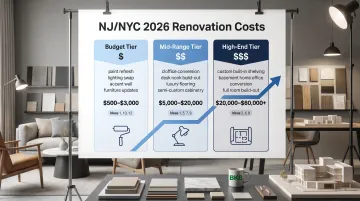
Here's how home office remodel budgets break down by tier:
| Tier | Scope | Estimated Cost (NJ/NYC) | Relevant Ideas |
|---|---|---|---|
| Budget | Paint, lighting swap, accent wall, furniture | $500–$3,000 | Ideas 1, 10, 12 |
| Mid-Range | Cloffice, desk nook, flooring, semi-custom cabinetry | $5,000–$20,000 | Ideas 1, 5, 7, 9 |
| High-End | Custom built-ins, basement conversion, full room build-out | $20,000–$60,000+ | Ideas 2, 6, 8 |
Permit costs and timelines:
- NYC electrical work requires a separate permit pulled by a licensed electrical contractor (NYC Admin Code 28-112.2)
- NJ basement finishing involving electrical, HVAC, or plumbing requires permits under the NJ Uniform Construction Code via NJ DCA
- NYC co-op boards add an extra approval layer — Alteration Agreements, COIs, and architect plans can extend timelines by one week to a month or more
What this means for resale value: Nationally, listings with dedicated home offices have sold for a 3.4% premium and 9 days faster. NYC-specific public data is limited, but the direction is consistent: a functional home office strengthens buyer appeal in a market where hybrid workers are the dominant demographic.
What Makes a Great Home Office Remodel in the Tri-State Area
Before committing to any of the 12 ideas above, evaluate your project against these four criteria:
- Space efficiency — every square foot should serve a function; dead zones are expensive in NJ/NYC real estate
- Acoustic quality — neighborhood density makes this non-negotiable for professionals on calls
- Flexibility — reversibility matters for co-op and condo owners who may sell; avoid permanent changes that eliminate bedroom count
- Aesthetic integration — the office should feel like part of the home, not a separate improvisation
The most common mistake: spending on wallpaper and furniture before solving lighting, storage, and acoustics. A beautiful but frustrating office is worse than a plain one that works. Function first.
Contractor selection matters here specifically. Not every general contractor knows NYC DOB permit categories, co-op Alteration Agreement requirements, or how to operate in union-compliant building environments.
Broadway Kitchens & Baths covers all three. They work in both union and non-union environments, carry proper insurance documentation for co-op and condo buildings, and have in-house crews with over 20 years of custom cabinetry installation across the tri-state area.
Conclusion
A well-executed home office remodel is one of the more practical investments an NJ or NYC homeowner can make in 2026. Whether that means an $800 cloffice conversion or a $45,000 custom built-in system with integrated stone desk surfaces, the right idea matched to the right space improves day-to-day productivity and adds real value when it's time to sell.
Broadway Kitchens & Baths serves homeowners throughout the tri-state area, specializing in custom cabinetry, countertop surfaces, and full-service renovation across the tri-state area. Their process starts with a free, no-obligation design consultation — call +1 201-567-9585 or visit the showroom at 257 South Dean St., Englewood, NJ to discuss your space and vision.
Frequently Asked Questions
How much does a home office remodel cost?
Basic cosmetic updates — paint, lighting, an accent wall — can come in under $1,000. Full dedicated room conversions with custom built-ins typically run $15,000–$50,000+ in NJ and NYC. Expect costs at the higher end of national averages due to regional labor rates, material costs, and permit fees.
How much home office remodeling can you do with $50,000 or $100,000?
In the tri-state area, $50,000 covers a high-end custom built-in system with premium cabinetry, new flooring, and upgraded lighting. $100,000 stretches to a full basement conversion or spare bedroom transformation with smart home integration, custom millwork, and quality stone surfaces.
What is a high-end renovation?
A high-end renovation uses premium materials (custom cabinetry, natural stone desk surfaces, solid wood), involves skilled trades (custom millwork, professional lighting design), and results in a fully cohesive finished space. In the NJ/NYC market, that typically starts at $400–$550 per square foot for complex scope.
What are the latest home office design trends for 2026?
The leading trends in the tri-state area right now are biophilic design elements (plants, wood, natural textures), limewash and grasscloth accent walls, motorized window shades with smart home integration, sit-stand desk systems, and multi-functional furniture that allows the office to convert to a guest room when needed.
What are common interior design rules for a home office?
The 60-30-10 rule (60% dominant color, 30% secondary, 10% accent) keeps palettes balanced. The rule of odds — grouping décor in sets of 3, 5, or 7 — adds visual interest to shelves. The 70/30 principle for mixing old and new elements prevents the space from feeling either sterile or cluttered.
What is the $2,500 expense rule?
The IRS de minimis safe harbor lets taxpayers without an Applicable Financial Statement deduct business property purchases up to $2,500 per item in the year of purchase rather than depreciating them (up to $5,000 with an AFS). Consult a tax professional about which remodel expenses qualify for your situation.