

Introduction
Shower wall tile installation looks straightforward until it isn't. A slightly off-level baseline creates drifting grout lines three feet up the wall. Miss a corner with the waterproofing membrane and you won't know until mold is already growing inside the wall cavity.
According to a Custom Building Products technical white paper, a standard shower receives over 2,500 inches of water annually — more than 80 times the average U.S. rainfall. Those numbers matter because ceramic tile and cement-based grout aren't inherently waterproof.
Moisture penetrates through micro-capillaries, which means the system behind the tile carries all the actual waterproofing responsibility.
What follows are 10 best practices professional installers rely on to produce shower tile work that holds up for decades — not just until the first leak.
Key Takeaways
- Never use drywall in a shower — cement backer board or foam tile backer is the only substrate that holds up to moisture
- Plan your full layout and snap reference lines before mixing any mortar
- Apply thin-set in small sections; check level every few tiles
- Use 100% silicone caulk (not grout) at all corners and plane changes
- Respect cure times at every stage: waterproofing, thin-set, and grout each need adequate drying before the next step
Before You Begin: Prerequisites and Tools
Site Conditions
Before a single tile goes up, the walls must be structurally sound, dry, and free of old adhesive, soap scum, or grease. Loose or damaged framing needs repair first. The plumbing rough-in must be finalized and inspected — rerouting pipes through fresh tile is a costly mistake.
Hard rules before you start:
- No tiling directly over drywall in a shower
- No skipping the waterproofing membrane
- No starting until plumbing rough-in is signed off
Tools and Materials Checklist
Essential:
- Cement backer board (Durock, HardieBacker) or foam tile backer (Schluter KERDI-BOARD)
- Waterproofing membrane and seam tape
- Polymer-modified thin-set mortar
- Notched trowel (size matched to tile format)
- Tile spacers
- Rubber grout float
- Wet saw or tile cutter
- Level and straightedge
- Chalk line and tape measure
- Grout and penetrating grout sealer
- 100% silicone caulk
Optional but useful:
- Mixing paddle drill attachment
- Laser level
- Knee pads
10 Best Practices for Installing Shower Wall Tile
Shower tile installation follows a defined sequence. The 10 practices below represent the decisions that most directly determine whether the finished installation holds up for decades or requires expensive tearout within a few years.
Best Practice 1: Install the Right Substrate
Standard drywall — including moisture-resistant "greenboard" — cannot support a shower tile installation. Many local building codes explicitly prohibit it in wet areas, and for good reason: drywall swells, softens, and delaminates when exposed to sustained moisture.
Approved substrate options:
| Option | Key Properties |
|---|---|
| USG Durock (cement board) | Rated 10/10 for mold resistance; 30-year limited warranty; won't rot or delaminate |
| HardieBacker (cement board) | 1/4 in. or 1/2 in. thickness; requires corrosion-resistant fasteners |
| Schluter KERDI-BOARD (foam) | Waterproof, dimensionally stable, no cement or fiberglass dust |
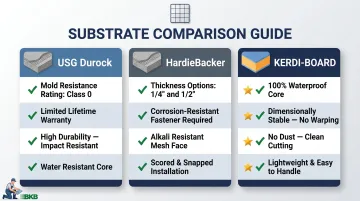
When fastening cement board, maintain 8-inch fastener spacing on walls and leave a 1/4-inch gap above the tub or shower pan to prevent moisture wicking. Stagger seams so they don't align between adjacent boards, and tape all joints with alkali-resistant fiberglass mesh tape embedded in thin-set.
Best Practice 2: Apply a Full Waterproofing Membrane
Tile and grout are not your waterproofing layer — the membrane behind them is. TCNA Handbook methods B421 and B422 require a waterproofing membrane meeting ANSI A118.10 for shower installations.
Apply membrane across the entire tiled surface, not just corners. Then pay specific attention to:
- Inside corners and seams — embed waterproofing tape with proper overlap
- Plumbing penetrations — seal every pipe and valve opening individually with preformed pipe collars or compatible sealant
- Cure time — liquid-applied membranes like RedGard typically need 1–12 hours per coat depending on conditions; sheet membranes like Schluter KERDI allow immediate tile setting
Do not rush this step. According to tile installation consultants at CTASC, most shower failures trace back to a breach in the waterproof membrane or a sealant failure at a transition — not the tile itself. A properly installed membrane normally lasts 15+ years without failure.
Best Practice 3: Plan Your Layout Before Mixing Anything
Dry-lay your tiles on the floor first to visualize the full pattern. This reveals problems before they're set in mortar: slivers of tile at visible edges, awkward cuts around fixtures, or a pattern that doesn't center the way you expected.
Sketch the layout on paper. Identify where every cut will fall. Adjust the starting point if necessary to avoid tile pieces narrower than half a tile at prominent edges. Time spent here saves far more time later.
Best Practice 4: Find True Center and Establish Level Reference Lines
Locate the center point of the back wall and use a level to draw a true vertical plumb line. Then establish a horizontal baseline — not by following the tub ledge or shower pan, which is almost never perfectly level, but by finding the lowest point and measuring up from there.
These two intersecting lines govern every tile placed in the shower. Any drift here multiplies with every course up the wall.
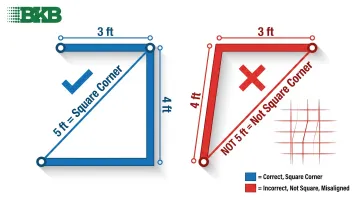
Best Practice 5: Use the 3/4/5 Rule to Check for Square
Before setting tile into corners, verify they're actually square. The method: measure 3 feet along one wall from a corner, mark it. Measure 4 feet along the adjacent wall from the same corner, mark it. If the diagonal between those two marks equals exactly 5 feet, the corner is at a true 90-degree angle.
Most bathroom corners aren't perfectly square. If yours aren't, adjust your layout reference lines to compensate rather than assuming the corner will self-correct as you tile toward it. Out-of-square corners cause grout lines to visibly drift, and there's no fix short of removing tile.
Best Practice 6: Follow the 1/3 Rule for Rectangular Tiles
Many installers default to a 50% offset (standard running bond) for rectangular tiles. For tiles with any side 15 inches or longer, ANSI A108.02 section 4.3.8.2 prohibits this — the maximum allowable offset is 33%.
Here's why: at a 50% offset, the center of one tile (its highest point due to inherent warpage) aligns directly with the edge of the adjacent tile (its lowest point), creating maximum visible lippage. The 1/3 offset minimizes this effect. For large-format calibrated tiles, also use a minimum 3/16-inch grout joint and a large-unit porcelain mortar rated for that format.
If a client requests a 50% offset anyway, ANSI requires an owner-approved physical mock-up first — and written acceptance of the resulting lippage.
Best Practice 7: Mix and Apply Thin-Set Correctly
Thin-set should reach a smooth, peanut butter-like consistency. After initial mixing, let it slake for 10 minutes, then remix briefly before use. Adding water after slaking compromises the mortar's bond strength.
Application technique:
- Spread mortar in sections no larger than 3×3 feet — only as much as you can tile in the product's open time
- Hold the notched trowel at a 45-degree angle to create uniform ridges
- Check coverage periodically: ANSI A108.5 requires 95% mortar contact in wet areas — back-butter large-format tiles to achieve this
- If mortar doesn't transfer to your finger when pressed, it has skinned over — scrape it off and apply fresh
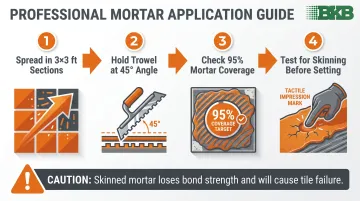
Skinned-over mortar is one of the primary reasons tiles pop off walls weeks after installation.
Best Practice 8: Set Tiles Starting from Center and Check Alignment Continuously
Begin at the intersection of your plumb and horizontal reference lines. Press each tile with a slight back-and-forth motion perpendicular to the trowel ridges — this collapses the ridges and eliminates air pockets. Don't slide tiles into position.
Use spacers consistently. Check horizontal and vertical alignment with a level and straightedge every 3–4 tiles, not every dozen. By the time a drift is visible to the eye, it's already a significant problem. Pull a tile occasionally and inspect mortar coverage on the back — you should see full contact, not isolated ridge marks.
Best Practice 9: Cut Accurately for Edges and Plumbing Fixtures
Measure twice before cutting. For straight edge cuts, a wet saw produces clean results. For pipe and valve penetrations, use a diamond hole saw with water cooling to minimize chipping.
A few reminders for fixture cuts:
- Mark the tile face with the exact center and diameter of the penetration before cutting
- Seal all plumbing penetrations with the waterproofing membrane before tile goes up — not after
- Poorly cut tiles around fixtures are a common water ingress point; the trim plate hides the cut but doesn't seal it
Trim plates and escutcheons cover rough cuts visually, but the waterproofing at those penetrations is what actually keeps water out of the wall.
Best Practice 10: Grout, Caulk Corners, and Seal Properly
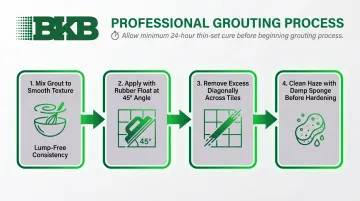
Wait the full thin-set cure time — minimum 24 hours, sometimes 48 depending on mortar type and conditions — before grouting. Grouting too early traps moisture and can disturb tile alignment.
Grouting process:
- Mix grout to a smooth, consistent texture
- Apply with a rubber float held at a 45-degree angle, pressing grout firmly into joints
- Remove excess by working the float diagonally across tiles
- Clean haze with a damp sponge before it hardens — dried grout haze is far more difficult to remove
At all corners and changes of plane (wall-to-wall, wall-to-floor, wall-to-tub), use 100% silicone caulk — not grout. TCNA section EJ171 mandates this. Grout cracks at movement joints because it can't flex; silicone accommodates the micro-movement that occurs with temperature and humidity changes. Siliconized acrylic caulk is not an acceptable substitute.
After full cure (typically 48–72 hours post-grouting), apply a penetrating grout sealer. In shower environments, plan to reseal every 6–12 months.
Common Installation Problems and How to Fix Them
Tiles Popping Off the Wall
Cause: Thin-set skinned over before tiles were set, or substrate had residue preventing proper bond.
Fix: Remove affected tiles, clean the substrate thoroughly, apply fresh thin-set in smaller sections, and re-set tiles with proper back-buttering on larger formats.
Uneven or Drifting Grout Lines
Cause: Reference lines weren't established or checked consistently; spacers were removed before mortar cured.
Fix: This is primarily a planning failure. For future projects, snap lines before setting a single tile and leave spacers in until thin-set has fully cured.
Water Seeping Behind Tiles
Cause: Waterproofing membrane wasn't applied, had gaps at corners or fixtures, or grout was used at movement joints instead of silicone caulk.
Fix: Re-caulk all corner joints and fixture surrounds with 100% silicone immediately. If moisture has already penetrated, tiles may need full removal to reapply the membrane correctly — full remediation is the only reliable path forward.
Most of these problems trace back to steps covered earlier in this guide — proper substrate prep, consistent reference lines, and waterproofing done before the first tile goes up. Getting those fundamentals right is far less costly than pulling tile after the fact.
Pro Tips for a Flawless Shower Tile Installation
Blend boxes throughout the installation. Mix tiles from multiple boxes as you work to distribute any shade variation between production batches. This prevents visible color banding — a detail that's easy to miss during installation and impossible to fix without retiling.
Protect the tub or shower base before starting. Cover it with cardboard or a protective mat. A dropped tool or tile fragment can crack or permanently scratch the surface, turning a tile project into a tub replacement.
Photograph every stage. Document the substrate, membrane application, layout lines, and first course set. If a problem surfaces a year later, those photos can identify the root cause without demolition.
Coordinate trades early when tile is part of a larger renovation. When shower tile work is one piece of a broader bathroom remodel — involving cabinetry, countertops, vanities, or plumbing fixtures — sequencing conflicts between trades are common and expensive. A full-service remodeler like Broadway Kitchens & Baths can manage the sequencing from the start, keeping tile, plumbing, and cabinetry installs in the right order.
Conclusion
The quality of a shower tile installation is determined almost entirely before the first tile is ever set. Substrate choice, waterproofing, and layout planning account for the majority of long-term success or failure. The actual tile-setting is the visible part — but it rests entirely on what happened before it.
Follow each of these 10 practices without shortcuts. Be honest about the scope of what you're taking on. A shower tile project done correctly is manageable. Done incorrectly, it can mean mold remediation, structural repair, and a complete tear-out — costs that routinely exceed what a professional installation would have run in the first place.
Frequently Asked Questions
Frequently Asked Questions
How much does it cost to install a tile shower?
According to HomeAdvisor's 2025 data, professional shower tile installation ranges from $1,800 to $5,000, with a national average of $2,700. Tile material, shower size, design complexity, and local labor rates all affect where a specific project lands in that range.
When tiling shower walls, where do you start?
Start at the center of the back wall. Draw a vertical plumb line and a level horizontal baseline — these become your reference lines. Setting the first tile at that intersection ensures the layout is symmetrical, with cuts falling at the least visible edges.
How do you tile around shower fittings?
Mark the exact fixture location on the tile face, then use a diamond hole saw (with water cooling) or tile nipper to make the cut. Before tiles go up, the waterproofing membrane must also seal around every penetration — the trim plate conceals the cut, but doesn't waterproof it.
What do you put behind shower wall tile?
Use cement backer board (such as Durock or HardieBacker) or a foam tile backer like Schluter KERDI-BOARD, topped with a waterproofing membrane that meets ANSI A118.10. Standard drywall — including moisture-resistant greenboard — is not acceptable in a wet shower environment.
What is the 3/4/5 rule for tiling?
Measure 3 feet along one wall and 4 feet along the adjacent wall from the same corner point. If the diagonal between those two marks equals exactly 5 feet, the corner is at a true 90-degree angle.
What is the 1/3 rule for tile?
The 1/3 rule states that rectangular tiles in a running bond pattern should be offset no more than one-third of the tile's length — not the commonly assumed 50%. For tiles with any side 15 inches or longer, ANSI A108.02 mandates this limit to prevent lippage and structural stress at tile edges.