Only 34% of NYC rental listings include in-unit washer-dryers, and most of those setups occupy retrofitted spaces never designed for laundry. Meanwhile, NJ townhomes and split-levels frequently relegate the washer and dryer to a basement corner or mudroom nook that doubles as a catch-all utility area.
The right cabinet configuration changes everything. It turns a chaotic, cramped utility space into something functional — and in many cases, genuinely attractive. This guide covers nine cabinet ideas curated specifically for tri-state home layouts, from compact NYC apartments to larger NJ suburban laundry rooms.
Key Takeaways
- Vertical storage (floor-to-ceiling built-ins) maximizes capacity in NJ and NYC homes where floor space is limited
- Ideas covered: slim pull-out towers, closet conversions, two-tone Shaker designs, and mud-laundry combos
- Use moisture-resistant materials (thermofoil, painted MDF, moisture-resistant plywood) to prevent warping and mold
- Custom and semi-custom cabinets fit non-standard wall widths far better than stock options in older urban homes
- Working with a tri-state cabinetry partner familiar with local building layouts prevents costly rework
Why NJ & NYC Laundry Rooms Demand Smarter Storage
Space is the central challenge. NYC borough apartments average between 692 and 737 square feet — well below the national average of 916 square feet — and a standard side-by-side washer/dryer pair requires a minimum 4-by-5-foot nook just for the appliances alone. That leaves very little margin for practical storage.
NJ homes have more square footage on average, but the laundry room itself is rarely prioritized during construction. Basement corners, hallway nooks, and cramped utility closets are common placement choices — each with their own set of constraints: sloped ceilings, exposed plumbing, limited wall runs, and awkward door swings.
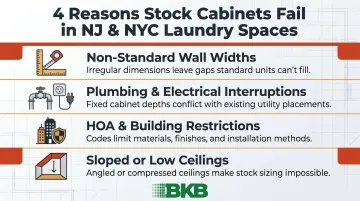
Stock cabinets fail in these environments for several reasons:
- Non-standard wall widths in older NJ homes and NYC co-ops don't align with standard cabinet module sizes
- Plumbing and electrical fixtures often interrupt otherwise usable wall runs
- HOA and building management restrictions in NYC co-ops and condos can dictate what renovations are permitted and how they're executed
- Sloped or low ceilings in basement laundry areas make standard-height upper cabinets impractical
These constraints apply across the region — but NJ homes carry an additional complication. The laundry room frequently serves double duty as a mudroom or utility room, particularly in homes with side-door or back-door entries.
That dual function demands a cabinet layout that handles both laundry supplies and everyday items like shoes, bags, and sports gear. Standard laundry cabinet configurations don't account for that.
9 Best Laundry Room Storage Cabinet Ideas for NJ & NYC Homes
These ideas are ordered from most space-efficient to most design-forward. Every option has been selected with tri-state home realities in mind — tight clearances, non-standard dimensions, and the need to make every square foot work harder. Start with whichever matches your current constraints.
1. Floor-to-Ceiling Built-In Cabinets
When floor space is limited, the only direction left is up. Floor-to-ceiling built-ins use the full height of the wall — typically 8 to 10 feet in NJ suburban homes — to create substantial storage without consuming additional floor area.
The practical split: upper cabinets store seasonal or rarely used items (extra detergent, cleaning supplies, spare linens), while lower cabinets handle daily-use products within easy reach. Adjustable shelving inside both zones lets you reconfigure storage as needs change.
For laundry environments, spec accordingly:
- Cabinet boxes: moisture-resistant MDF or plywood to prevent warping in humid conditions
- Doors: painted MDF, thermofoil, or sealed hardwood — all easier to wipe clean than raw wood
- Hardware: soft-close hinges and full-extension drawer slides for smooth operation under heavy detergent loads
UltraCraft, one of the brands carried by Broadway Kitchens & Baths, offers custom sizing in 1/16-inch increments at no additional charge — a significant advantage when fitting floor-to-ceiling cabinets in rooms with non-standard ceiling heights.
2. Over-Washer and Dryer Wall Cabinets
Wall-mounted cabinets above the washer and dryer are the most common laundry storage solution — and for good reason. They use dead overhead space without touching the floor plan at all.
Cabinet depth is typically 12 inches, keeping doors clear of appliances below. The bottom shelf should sit around 48 inches from the floor, with at least 36 inches of clearance in front for full door and appliance access.
For NYC apartment laundry closets where overhead space is tight, flip-up or push-to-open door styles prevent the awkward overhead reach-and-duck that standard hinged doors require. Leave at least 1 inch of clearance on each side of appliances to prevent vibration damage during spin cycles.
3. Slim Pull-Out Tower Cabinets
The gap between the washer and the wall — or between two appliances — is usually wasted. Pull-out tower cabinets, as narrow as 6 inches wide, turn that dead zone into accessible storage.
These work especially well for items that need to stay arm's reach from the machines: dryer sheets, stain removers, lint rollers, small spray bottles. Rev-A-Shelf's 432 Series offers pull-out filler organizers starting at 6 inches wide with soft-close mechanisms — available as standalone inserts or built into a larger cabinet run.
Pull-out towers can be:
- Purchased as pre-finished standalone units for faster installation
- Custom-built to match surrounding cabinetry for a seamless, integrated look
- Configured with multiple tiers for different product heights
In hallway laundry setups common in older NJ homes, a 9-inch pull-out tower beside a stacked unit often provides more usable storage than a full cabinet would in the same linear space.
4. Closet-Conversion Built-In Cabinets
A standard hall closet — roughly 24 to 30 inches deep and 30 to 36 inches wide — can be converted into a functional laundry space with a stacked washer/dryer unit, overhead built-in cabinets, and a small countertop.
Appliance manufacturers specify a minimum of 29 inches wide, 80 inches tall, and 32 to 34 inches deep for a stacked unit, plus at least 6 inches behind for venting and hoses.
The design moves that make this work:
- Remove closet doors and install wall-to-wall cabinetry with a countertop to create the appearance of a purpose-built laundry room
- Add bi-fold or pocket doors to conceal the entire setup when not in use — useful in NYC apartments where the hallway is visible to guests
- Use upper built-in cabinets above the appliances for detergent, softener, and cleaning supplies
Broadway Kitchens & Baths has experience creating closet laundry rooms across the NJ and NYC metro area, and their design team can assess whether your existing closet dimensions support a stacked conversion before any demolition begins.
5. Mud-Laundry Combo Cabinets
Popular in NJ homes with side or back-door entries, the mud-laundry combo treats the laundry area as part of the home's daily entry flow. The cabinet layout needs to handle two distinct functions simultaneously.
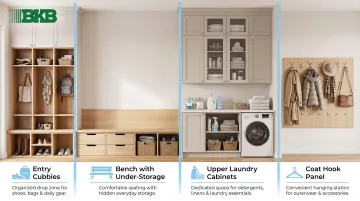
A well-planned mud-laundry cabinet layout includes:
- Base cabinets with cubbies near the entry for shoes and bags
- A bench seat with storage underneath (drawers or open cubbies)
- Upper cabinets for laundry detergents, cleaning supplies, and linens
- Hooks integrated into a tall cabinet or wall panel for coats and bags
Houzz identified the combined laundry-mudroom as a top home trend starting in 2024, and it continues to appear in their most-featured laundry room designs through 2025.
For finish selection near dryer vents, thermofoil is a risk — heat above 240°F causes delamination. Painted hardwood holds up better near heat sources and is easier to touch up over time.
Broadway Kitchens & Baths specifically designs mud-laundry combinations, incorporating bench seating, cubbies, and integrated laundry storage into a single cohesive cabinet run.
6. Under-Counter Cabinets with Integrated Folding Countertop
Most laundry rooms have nowhere to fold. A countertop spanning the width of the wall above the washer and dryer — supported by base cabinets — solves that immediately.
Countertop material guide for laundry rooms:
| Material | Moisture Resistance | Best For |
|---|---|---|
| Quartz | Excellent | High-use folding stations |
| Solid surface (Corian) | Excellent | Seamless integration with sink |
| Laminate | Good | Budget-conscious renovations |
| Butcher block | Moderate | Aesthetic warmth (requires sealing) |
Broadway carries Caesarstone, Silestone, Corian Quartz, and MSI Stone — all viable options for laundry room folding stations with varying price points. Standard countertop height is 36 inches, consistent with base cabinet height, though front-loading machine configurations may benefit from a slightly higher surface.
Drawers built into the base cabinets beneath the countertop are ideal for ironing accessories, lint rollers, sewing kits, and small tools that accumulate in laundry spaces.
7. Two-Tone Shaker-Style Cabinets
Shaker-style doors account for 64% of cabinet choices in US renovations according to Houzz's 2022 study, and the NKBA named them the #1 cabinet choice in 2025. The recessed center panel profile reads as traditional, transitional, or modern depending on the finish — which is exactly why they hold their appeal across buyer preferences and market cycles.
The two-tone approach pairs a lighter upper cabinet (white, soft gray) with a darker or wood-toned lower cabinet, giving the laundry room a kitchen-quality aesthetic without a kitchen renovation budget. It works particularly well in NJ home renovations where the laundry room is visible from adjacent living areas.
Why Shaker makes sense for NJ/NYC resale:
- Broadly appealing across buyer preferences — no risk of dating the space
- 87% of homebuyers rank a laundry room as essential or high-priority, so an attractive laundry room actively supports resale
- Mid-range laundry remodels return 60–70% ROI on average
Wolf Classic Cabinets, carried by Broadway, offers Shaker-style doors in multiple painted finishes with quick lead times — a practical option for NJ homeowners working with defined project timelines.
8. Open Shelving and Closed Cabinet Hybrid
Closed cabinets handle storage. Open shelves handle accessibility — and in smaller NYC laundry spaces, they reduce visual weight that a wall of closed cabinet doors would impose.
A practical hybrid layout:
- Open shelves 12–18 inches above the washer/dryer for detergent, dryer sheets, and frequently grabbed items
- Closed cabinets below or beside the appliances for cleaning products, keeping them out of reach of children
- Uniform containers or labeled baskets on open shelves to maintain an organized appearance without constant tidying
The key trade-off is dust accumulation on open shelves versus the visual heaviness of all-closed cabinetry. In rooms under 50 square feet — common in NYC laundry setups — open shelving above and closed storage below tends to strike the right balance.
9. Pedestal and Under-Appliance Storage Cabinets
Front-loading washers and dryers sit low to the ground by design, which means constant bending to load and unload. Pedestal cabinets raise the appliances 13 to 15 inches — bringing them to a more ergonomic height — while adding a pull-out storage drawer underneath.
Pedestal height by major brand:
| Brand | Model | Height |
|---|---|---|
| LG | WDP6W | 13.6 inches |
| Samsung | WE402NW | ~14.2 inches |
| Whirlpool | WFP2715HW | 15.5 inches |
Brand-supplied pedestals cost approximately $250–$500 per unit and come pre-finished, requiring no custom work. Custom pedestal cabinets built to match surrounding cabinetry create a more seamless, built-in appearance — worth considering if the laundry room has additional cabinetry runs along the same wall.
How to Choose the Right Cabinet Style for Your Space
Once you've narrowed down a layout concept, three factors determine which option actually works in your specific space.
1. Measure before you decide anything
Account for door swings, appliance clearances, plumbing stub-outs, and electrical panel locations. What looks like a 72-inch wall run often shrinks to 54 usable inches once obstacles are mapped.
2. Match the material to the environment
| Finish | Moisture Resistance | Heat Resistance | Best Use |
|---|---|---|---|
| Thermofoil | Excellent | Poor above 240°F | Away from dryer vents |
| Painted MDF | Good | Good | General laundry storage |
| Sealed hardwood | Moderate | Good | Near heat sources |
| Plywood box | Good | Good | Cabinet carcass (any layout) |
3. Choose the right cabinet tier
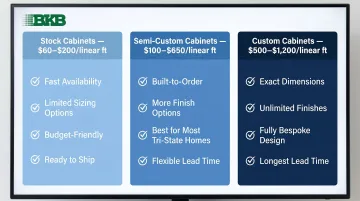
- Stock cabinets ($60–$200/linear foot): Fast, affordable, but rarely fit non-standard NJ/NYC wall widths
- Semi-custom ($100–$650/linear foot): Built to order in more sizes with more finish options — the most practical option for most tri-state homes
- Custom ($500–$1,200/linear foot): Exact dimensions, unlimited finishes, longest lead time — necessary for complex closet conversions or fully integrated built-ins
Budget for hardware from the start — these additions pay off every time you use the room:
- Soft-close hinges eliminate slamming in tight spaces
- Pull-out shelves make deep cabinets fully accessible
- Integrated hamper baskets keep sorted laundry off the floor
- Tilt-out trays use dead space below the cabinet toe kick
How Broadway Kitchens & Baths Can Help
Broadway Kitchens & Baths is a cabinetry and renovation specialist with showrooms in Englewood, NJ and Manhattan, NY — serving homeowners, builders, architects, and contractors across Bergen County, Hudson County, Essex County, Brooklyn, and the wider NYC metro area.
Their process starts with a no-obligation design consultation and field measurements, ensuring cabinet configurations fit your actual space rather than a standard template. For laundry room projects, their team guides selections across door styles, finishes, and interior accessories from brands including UltraCraft, Plain & Fancy, Wolf Classic Cabinets, and Great Northern:
- Pull-out ironing boards
- Pull-out rolling tables
- Tilt-out hamper trays
- Adjustable shelving and drawer inserts
Broadway works directly with homeowners or alongside external contractors and architects. Depending on project scope, they handle design and product supply only — or manage the full renovation from demolition through final inspection.
To explore cabinet options for your laundry room, contact Broadway Kitchens & Baths to schedule a consultation: (201) 567-9585 (Englewood, NJ) or (212) 260-7768 (NYC).
Frequently Asked Questions
How much do laundry room cabinets cost?
Cabinet installation typically runs $100–$300 per linear foot, with stock materials starting around $60–$200 and custom built-ins reaching $500–$1,200. In NJ and NYC, higher labor rates, permit costs ($400–$1,300), and plumbing requirements push totals above national averages.
What is the best layout and cabinet size for a laundry room?
For side-by-side units, 12-inch-deep wall cabinets above the appliances paired with 24-inch-deep base cabinets alongside them is the standard go-to configuration. Stacked units free up the adjacent wall for a full run of floor-to-ceiling storage.
How do I maximize storage in a small laundry room?
Go vertical first — floor-to-ceiling cabinets on any available wall. Then use the space above and beside appliances with wall cabinets and slim pull-out towers. Pull-out inserts and drawer organizers inside cabinets recover storage that otherwise sits inaccessible at the back.
Are laundry room cabinets the same as kitchen cabinets?
Structurally, yes — kitchen cabinets transfer directly to laundry rooms. The key difference is finish selection: laundry rooms benefit from moisture-resistant options like thermofoil or painted MDF. Non-standard room dimensions also make semi-custom or custom sizing more practical than stock kitchen cabinet modules.
What color should laundry room cabinets be?
White and light neutrals remain the most popular choices for making compact laundry spaces feel brighter and larger. Two-tone combinations — light uppers paired with darker or wood-toned lowers — are growing in NJ and NYC renovations where homeowners want a kitchen-quality aesthetic in the laundry room.
What are the latest laundry cabinet trends?
The dominant trends for 2025 include two-tone finishes, Shaker-style profiles, integrated hamper pull-outs, handleless push-to-open doors, and floor-to-ceiling built-ins. Rich cabinet colors, brass hardware, and appliances raised on custom pedestals are bringing kitchen-level finish quality into the laundry room.