That's a gamble worth avoiding. The right solid surface brand depends on your budget, your fabricator's access to materials locally, and whether you need food-safe certifications or just a clean, seamless aesthetic for a residential kitchen.
This guide compares the 9 most recognized solid surface brands on the market — their pros, costs, certifications, and ideal use cases — so you can make a decision based on facts rather than brand recognition alone.
Key Takeaways
- Solid surface countertops run $50–$150 per square foot installed, with a national average project cost around $3,000
- Corian is the original brand with the deepest fabricator network; Staron leads in food-safe certifications; Meganite and Livingstone offer the best value
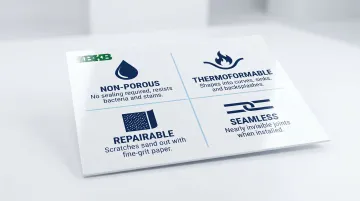
- All solid surface materials share the same core traits: non-porous, seamless, repairable, and thermoformable
- Brand differences show up in aesthetics, pricing, and warranty depth
- Best applications: residential kitchens, bathrooms, commercial interiors, and weight-restricted spaces
What Are Solid Surface Countertops?
Solid surface is an engineered composite — roughly 33% acrylic resin (PMMA) and 67% aluminum trihydrate mineral filler, plus pigments. DuPont biochemist Don Slocum developed the first version in 1967, trademarked as Corian, and the material category has grown considerably in the decades since.
Why It Works in Kitchens
- Non-porous by nature — resists bacteria and stains without ever needing sealing
- Thermoformable — can be heated and shaped into curves, integrated sinks, and seamless backsplashes
- Repairable — surface scratches sand out with fine-grit sandpaper, which no stone countertop can claim
- Seamless fabrication — joints are nearly invisible when installed by a skilled fabricator
Those advantages come with real trade-offs worth understanding before specifying this material.
Where It Falls Short
Heat resistance is the primary limitation. Most solid surface materials are rated to 212°F — well below the thresholds quartz or granite withstand. Hot pans placed directly on the surface can cause white marks or cracks, and most manufacturer warranties exclude heat damage explicitly.
The surface is also softer than stone. It scratches more easily day-to-day, though those scratches are fixable. For projects where resale value drives material decisions, solid surface doesn't hold the same premium perception as quartz or natural stone.
9 Best Solid Surface Countertop Brands Compared
All nine brands below use the same core acrylic-and-mineral formula. What separates them: resin quality, color range, certifications, warranty terms, and where they're positioned in the market. Material costs below are sourced from Angi (2026) and Fixr.com (August 2025).
Each entry below includes cost data, key certifications, and a best-fit use case to help narrow the field — whether you're specifying for a single kitchen remodel or a multi-unit commercial build.
Corian (by Corian Design)
The original solid surface brand, now operated independently under Corian Design (affiliates of DuPont). After more than 55 years, it remains the industry benchmark — largely because no other brand matches its fabricator network depth or color library breadth.
| Spec | Details |
|---|---|
| Material cost | $26–$65/sq ft |
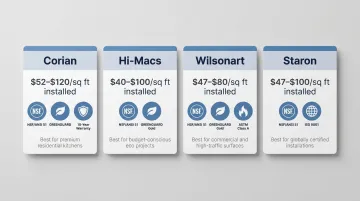
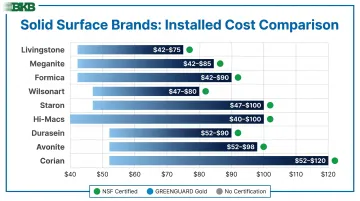
| Installed cost | $52–$120/sq ft |
| Colors | 100+ |
| Key certifications | NSF/ANSI 51, GREENGUARD |
| Warranty | 10-year limited residential |
| Best for | Residential kitchens, bathrooms, commercial interiors requiring certified installer support |
Standout: The 10-year DuPont-backed warranty covers material defects and associated labor — a stronger commitment than most competitors offer.
LG Hausys Hi-Macs (now LX Hausys)
LG Hausys rebranded as LX Hausys in July 2021, but Hi-Macs continues as one of North America's most widely distributed solid surface lines. It's a strong choice when clean, modern aesthetics and competitive pricing matter equally.
| Spec | Details |
|---|---|
| Material cost | Not publicly listed |
| Installed cost | $40–$100/sq ft |
| Colors | 100+ |
| Key certifications | NSF/ANSI 51, GREENGUARD Gold |
| Warranty | Not publicly stated |
| Best for | Budget-conscious residential projects, commercial applications, designers prioritizing broad color selection |
Worth noting: Wide-format sheet availability reduces seaming on large countertop runs — a meaningful advantage on open-plan kitchen islands.
Wilsonart Solid Surface
A Temple, Texas-based manufacturer with one of the most comprehensive certification portfolios in the category. Wilsonart's solid surface line targets high-traffic commercial environments while also serving residential projects through wide dealer distribution.
| Spec | Details |
|---|---|
| Material cost | $25–$30/sq ft |
| Installed cost | $47–$80/sq ft |
| Colors | 50+ |
| Key certifications | NSF/ANSI 51, GREENGUARD Gold, FDA approved, ASTM E84 Class A fire rating |
| Warranty | 10-year commercial limited |
| Best for | Commercial renovations, multi-unit residential, kitchen-bath dealers needing reliable supply |
Standout: The ASTM E84 Class A fire rating and NEMA LD-3 impact resistance make Wilsonart particularly well-suited for high-specification commercial builds. It also coordinates with Wilsonart's laminate line for mixed-material kitchen designs.
Staron (by LOTTE Chemical)
Originally developed by Samsung via Cheil Industries, Staron was acquired by LOTTE Advanced Materials in May 2016 and now operates under LOTTE Chemical. It's one of the most globally distributed solid surface brands, with particularly strong credentials for food-contact environments.
| Spec | Details |
|---|---|
| Material cost | $25–$50/sq ft |
| Installed cost | $47–$100/sq ft |
| Colors | 100+ |
| Key certifications | NSF/ANSI 51, GREENGUARD Gold, ISO 9001, ISO 45001 |
| Best for | Healthcare facilities, restaurant counters, commercial food prep surfaces |
Standout: The combination of NSF/ANSI 51 food contact certification and ISO 45001 health and safety management certification gives Staron a credibility edge in regulated environments.
Avonite Surfaces (by Aristech Surfaces / Trinseo)
A U.S.-manufactured solid surface brand under Aristech Surfaces (now part of Trinseo), Avonite differentiates through transparency certifications and stone-mimicking collections like the Riverine Series, which replicate cut marble and granite aesthetics.
| Spec | Details |
|---|---|
| Material cost | $30–$48/sq ft |
| Installed cost | $52–$98/sq ft |
| Colors | Extensive, including bold and stone-look options |
| Key certifications | Indoor Advantage Gold, DECLARE Label, Health Product Declaration (HPD) |
| Best for | Hospitality interiors, LEED-specified projects, designer kitchens where countertop color is a focal point |
Standout: The DECLARE Label and HPD certifications appeal specifically to architects specifying for Living Building Challenge and other transparency-focused green building programs.
Formica Solid Surfacing (Everform)
Formica's solid surface product is branded as Everform Solid Surface — an acrylic-based line distinct from the company's laminate products. The Formica name is familiar to most clients, which tends to simplify approval conversations during specification.
| Spec | Details |
|---|---|
| Material cost | $20–$40/sq ft |
| Installed cost | $42–$90/sq ft |
| Colors | Multiple collections |
| Key certifications | GREENGUARD |
| Best for | Full-kitchen remodels coordinating surfaces across materials, budget-conscious homeowners |
Why it matters: Formica's Design a Room Tool lets designers visualize Everform countertops alongside Formica laminate in a single workflow — practical for full-room finish coordination.
Durasein
Founded in 1999 in Zhuhai, China, with U.S. headquarters in Columbia, Maryland, Durasein has built a growing presence in commercial and hospitality projects through five named design collections and a custom color matching program.
| Spec | Details |
|---|---|
| Material cost | $30–$40/sq ft |
| Installed cost | $52–$90/sq ft |
| Colors | Extensive, including veined, wood-look, and custom |
| Key certifications | NSF/ANSI 51, GREENGUARD Gold |
| Best for | Architects and designers seeking distinctive finishes, hospitality and commercial interiors |
Standout: Five named design collections (The Essentials, The Elements, The Dreamy, The Duo, Movement Collection) and a custom color program push Durasein beyond standard solid surface aesthetics.
Meganite
A privately held, family-owned company founded in Taiwan in 1976 — not affiliated with Cheil Industries or Samsung. Meganite entered the U.S. solid surface market via a joint venture in 1994 and has built a value-positioned line with strong sustainability credentials.
| Spec | Details |
|---|---|
| Material cost | $20–$35/sq ft |
| Installed cost | $42–$85/sq ft |
| Colors | 100+ |
| Key certifications | NSF/ANSI 51, GREENGUARD Gold, Red List Free, SCS recycled content certified |
| Best for | Multi-unit residential renovations, property managers, cost-sensitive commercial projects |
Best differentiator: Marketed as crystalline-silica-free, with a minimum 6% recycled content in popular colors — a differentiator for health-conscious and sustainability-focused projects.
Livingstone (by US Surfaces)
Livingstone is manufactured by US Surfaces (not Aristech Surfaces, which produces Avonite). It's positioned as a value-tier brand with a focused palette of 74 colors through its SmartPalette collection and a CertainSpec program that guarantees color availability for registered projects.
| Spec | Details |
|---|---|
| Material cost | $20–$25/sq ft |
| Installed cost | $42–$75/sq ft |
| Colors | 74 (SmartPalette) |
| Key certifications | Not publicly listed |
| Warranty | Not publicly stated |
| Best for | High-specification projects where budget is tight, fabricators prioritizing material predictability |
Standout: At $20–$25/sq ft for materials, Livingstone is the most budget-friendly option in this comparison — and the CertainSpec program reduces procurement risk on larger builds.
How to Choose the Right Solid Surface Brand
Brand selection often comes down to four factors that most comparison guides overlook.
1. Fabricator Access in Your Area
A brand with strong global distribution doesn't help if no certified fabricator within 50 miles stocks it. Before committing to a brand, confirm that a qualified installer can source and work with that material locally. Corian and Wilsonart have among the deepest fabricator networks nationally; newer or more design-forward brands like Durasein may require more lead time to source depending on your region.
2. Certification Requirements
If the project involves food service or healthcare, NSF/ANSI 51 certification is non-negotiable. Staron, Wilsonart, Corian, Hi-Macs, Durasein, and Meganite all carry it. Avonite and Livingstone do not have confirmed NSF/ANSI 51 certifications — worth verifying with the manufacturer before specifying for regulated environments.
3. Warranty Terms vs. Price
Corian's 10-year residential warranty covers labor costs, not just material replacement. That distinction matters: brands that cover material only leave you absorbing installation costs on a claim. For multi-unit projects where warranty claims are a realistic concern, warranty depth can matter as much as upfront material cost.
4. Aesthetic vs. Performance Priority
Use this quick-reference table to match your project's priorities to the right brands:
| Priority | Recommended Brands |
|---|---|
| Largest color selection | Corian, Hi-Macs, Staron, Meganite |
| Design-forward / distinctive | Avonite, Durasein |
| Budget-first | Livingstone, Meganite, Formica |
| Commercial / food-safe | Staron, Wilsonart, Corian |
| Sustainability credentials | Meganite, Wilsonart, Avonite |
Once you've narrowed down priorities, local availability and project specifications typically make the final call. Broadway Kitchens & Baths works with clients across the tri-state area to evaluate countertop options against specific kitchen layouts, cabinet finishes, and renovation budgets. For solid surface projects, the team can help identify which brands are readily accessible through local fabricators and which specifications — NSF certifications, warranty coverage, or color libraries — matter most for a given application.
Conclusion
Solid surface countertops offer a practical middle ground: more affordable than quartz at the entry level, easier to repair than any stone, and suitable for everything from residential kitchens to commercial food prep surfaces. The material category is consistent — brands differ on warranty depth, aesthetic range, certification coverage, and fabricator availability in your area.
The most common mistake buyers make is selecting a brand based on name recognition alone, only to find their local fabricator doesn't carry it — or that the warranty terms fall short of what the project requires. Check fabricator access first. Confirm certifications match the project's requirements. Then look at color libraries.
Renovation professionals, architects, and homeowners in the tri-state area can work with Broadway Kitchens & Baths to explore solid surface countertop options, request samples, and get project-specific guidance. Reach the team at (201) 567-9585 or visit the Englewood, NJ showroom.
Frequently Asked Questions
What is the average cost of solid surface countertops?
Solid surface countertops typically run $50–$150 per square foot installed, with a national average project cost of around $3,000. Final cost varies by brand, color complexity, edge profile, and labor rates in your area.
Is solid surface good for kitchen countertops?
Yes, solid surface is non-porous, bacteria-resistant, and seamless, making it a strong kitchen choice. The main limitation is heat sensitivity: the surface is rated to 212°F, so trivets and hot pads are necessary near cooktops.
Are solid surface countertops cheaper than quartz?
Generally, yes. Entry-level solid surface starts around $50/sq ft installed, while quartz ranges from $50–$200/sq ft installed. Premium solid surface brands can overlap with mid-range quartz pricing, so get quotes on specific brands before deciding.
Is Corian the same as solid surface?
Corian is a brand of solid surface — the original, introduced by DuPont in 1967. "Solid surface" describes the material category, while Corian is one of many manufacturers, alongside Hi-Macs, Wilsonart, Staron, and others.
How does Corian compare to granite and quartz?
Corian is more repairable and typically less expensive than both granite and quartz. The trade-off: lower heat resistance and less perceived premium value for resale. Natural stone and quartz tend to hold stronger appeal for buyers prioritizing resale or high-end finishes.
What is the best solid surface for countertops?
There's no single best brand — it depends on your project. Corian leads in fabricator access; Staron excels in food-safe certifications; Hi-Macs and Meganite offer strong value at lower price points. Match the brand to your use case and local fabricator availability.